Category: Cybersecurity

Practical cybersecurity guidance for Australian SMEs on identity, phishing, cloud security, zero trust, incident response, recovery and risk prioritisation.

  • DDoS Defence by Bottleneck: A Practical Guide for Websites and Game Servers

    DDoS Defence by Bottleneck: A Practical Guide for Websites and Game Servers

    Reviewed: 31 August 2026 · Next review: 28 February 2027
    Author: Ozlin Info Editorial Team · Human review: Lin

    A DDoS plan is only useful when it names the resource that is expected to fail first. “We have a firewall” does not answer whether an incident will fill the upstream link, exhaust packet forwarding, consume connection state, overload a query parser or make the application perform too much work.

    This guide offers a defensive planning model for public websites, Java multiplayer services and Valve-family dedicated-server queries. It avoids universal thresholds and packet recipes. The goal is to help owners ask better questions, place controls in the right part of the path and define a degraded mode before an incident.

    No single control guarantees availability. Capacity, provider routing, protocol support, application design and incident response all matter. Validate any design against your provider, software versions, traffic patterns and risk appetite.

    Start with the bottleneck, not the attack name

    Use more than one traffic measure. Each describes a different kind of pressure:

    MeasureWhat it representsTypical failure point
    bps / GbpsBits carried per secondInternet circuit, transit or scrubbing capacity
    pps / MppsPackets processed per second; Mpps means millions of packets per secondRouter, NIC, virtual switch, ACL or kernel packet path
    CPSNew connections per secondSYN handling, state tables, TLS handshakes or accept queues
    Concurrent connectionsConnections held open at onceMemory, descriptors, proxy workers or load-balancer state
    RPSHTTP requests per secondReverse proxy, application, cache or database
    QPSProtocol queries per secondDNS or game-query parsing and response work

    “Bpps” can mean billions of packets per second in some network discussions, but the notation is easy to confuse with bits per second. Write out the unit in procurement and incident records.

    Average packet size can be estimated for context as bits per second ÷ (8 × packets per second). For example, 100 Gbps divided by 100 million packets per second is about 125 bytes per packet. That is illustrative arithmetic, not an attack fingerprint or a sizing promise.

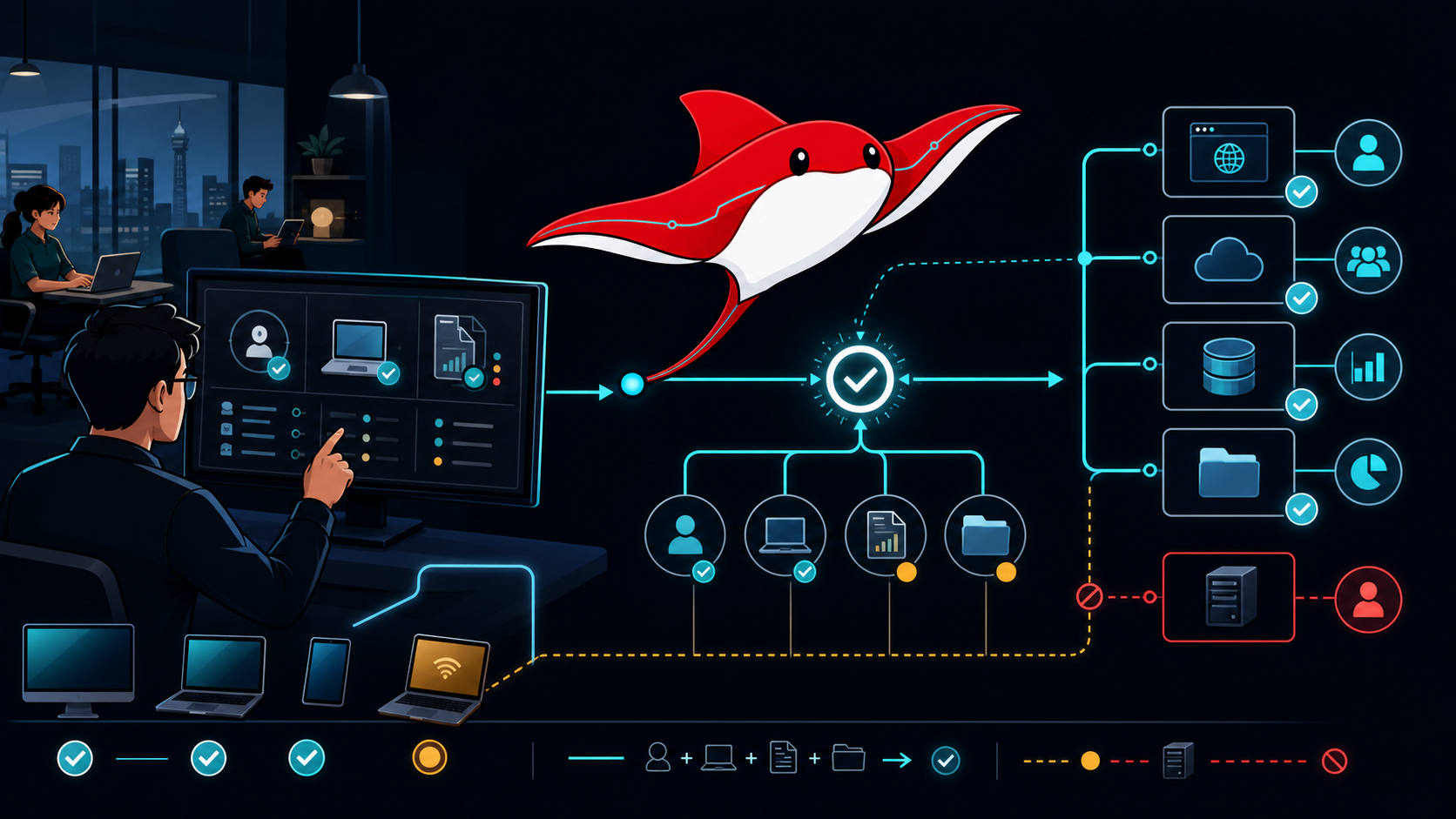
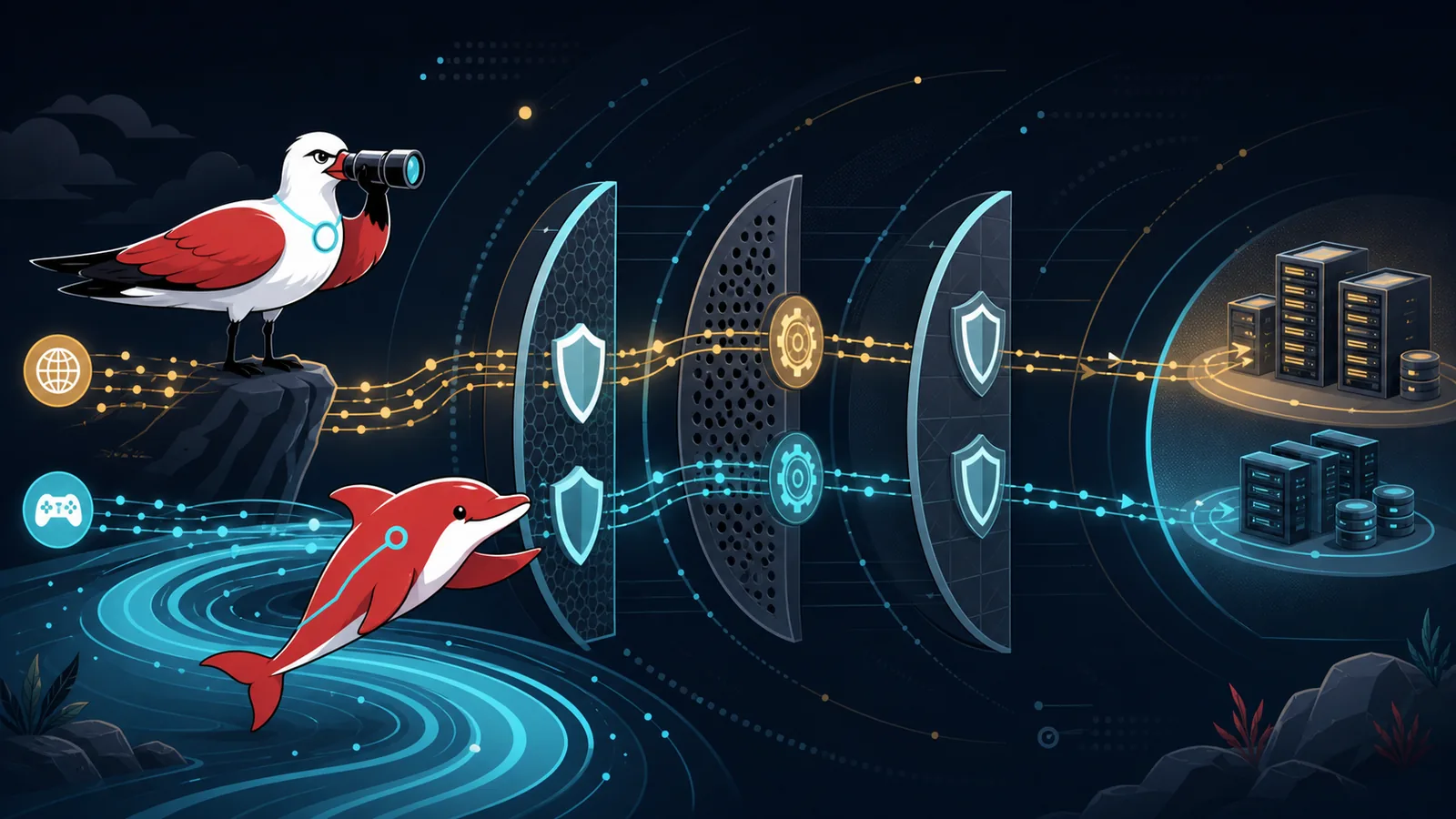
    Current Ray moves between four visual channels representing bandwidth, packet rate, connection pressure and request or query load.
    Different traffic measures reveal different bottlenecks; use shape, density and path behaviour as well as volume.

    Five useful pressure classes

    1. Volumetric pressure consumes link capacity. If the link is full before traffic reaches your server, a host firewall behind that link cannot restore the lost bandwidth. Mitigation must happen upstream, such as at the provider edge, an anycast network or a scrubbing service.
    2. Packet-rate pressure uses many small packets to exhaust packet handling before bandwidth looks full. Ask providers about packet rate as well as Gbps.
    3. Connection or state pressure targets new-connection handling or retained state. SYN defences, connection proxies and careful timeout policies help, but must be placed where they can still receive traffic.
    4. Protocol-query pressure repeatedly invokes a public protocol function, such as a status or server-browser query. It needs protocol-aware validation and budgets, not only generic port filtering.
    5. Application-resource pressure makes apparently valid requests consume CPU, database, cache, search, authentication or external-service capacity. This is commonly called application-layer or Layer 7 DDoS. “CC attack” is an informal term often used for HTTP request floods; it is not a standards-defined category.

    RFC 4732 explains why Internet denial-of-service defence is a system problem rather than a single appliance feature. BCP 38 / RFC 2827 and its update, RFC 3704, describe source-address filtering that can reduce spoofed traffic near its source. They do not stop attacks sent from valid source addresses.

    Websites: defend the whole request path

    A useful website pattern is:

    upstream or anycast edge → HTTP DDoS controls → validation and WAF → cache → reverse proxy → bounded application and queue → origin data stores

    • Upstream or edge capacity absorbs traffic before the origin link becomes the bottleneck.
    • Request validation and WAF rules reject traffic that violates known application behaviour.
    • Caching prevents repeated public reads from becoming repeated origin work.
    • Path-specific budgets recognise that a cached article, a login, a search and a large export have very different costs.
    • Queues and back-pressure keep a burst from turning into uncontrolled work.
    • Graceful degradation preserves essential pages while temporarily disabling expensive search, exports, previews or third-party calls.
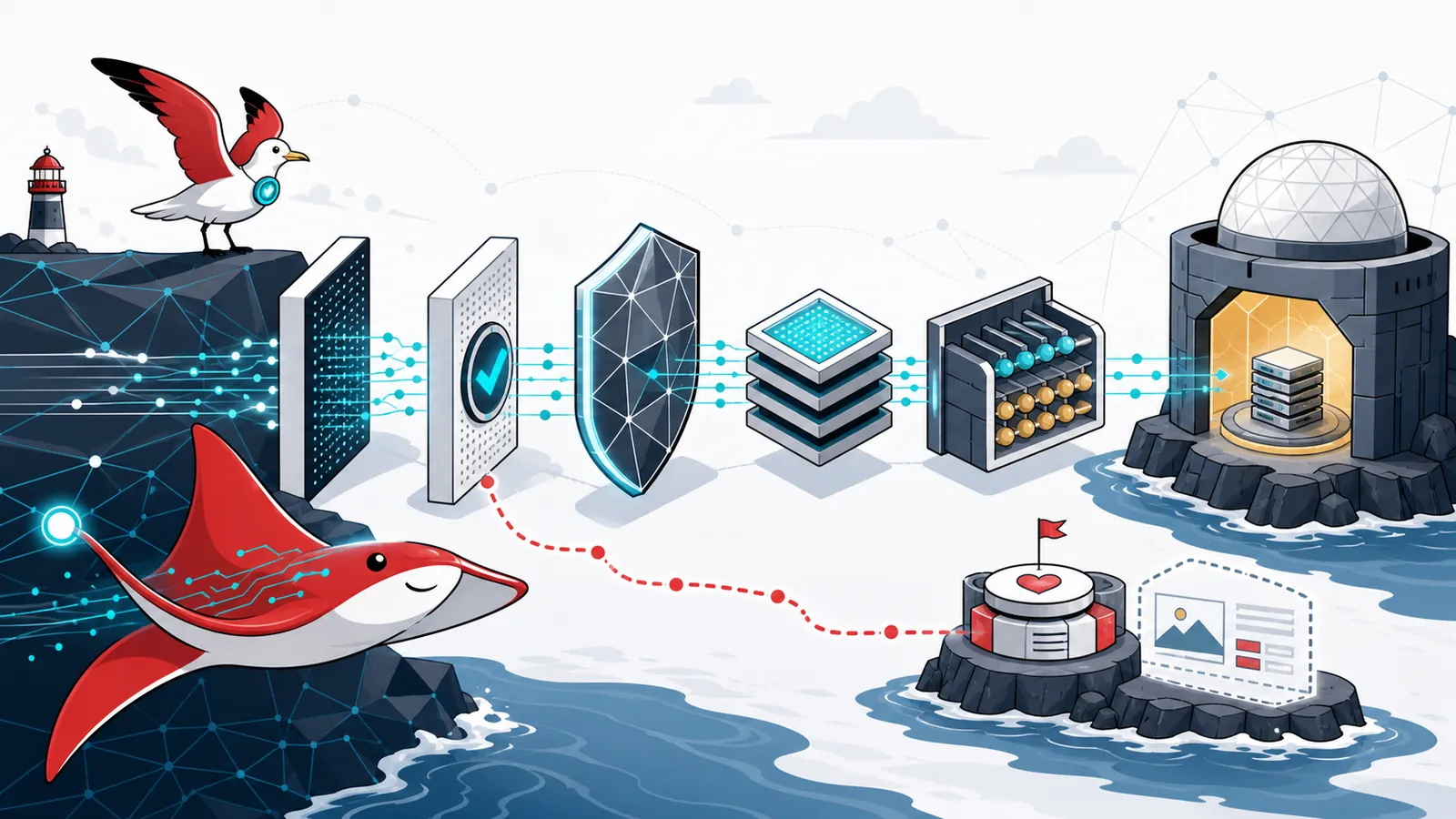
    Current Ray and Signal Gull guide website traffic through validation, a shield, cache, queue, protected origin and a separate degraded-service path.
    Website resilience depends on layers that reduce work before traffic reaches the origin.

    Conceal and constrain the origin

    An HTTP reverse proxy is bypassable if the origin address remains reachable. Cloudflare’s own guidance recommends proxying appropriate DNS records, auditing DNS-only records for origin exposure, restricting origin access and rotating an address that has previously been exposed. Those are Cloudflare-specific operational recommendations; equivalent controls differ by provider.

    Do not assume that an ordinary HTTP CDN or proxied DNS record protects arbitrary raw game protocols. Cloudflare documents that proxied DNS covers specific HTTP/HTTPS ports, while other TCP/UDP services need a protocol-specific product or upstream service. Confirm the clean traffic path before changing DNS.

    Rate limits need context

    Per-address limits are simple, but mobile carriers, offices, universities and households may share public addresses through NAT or CGNAT. A rigid source-IP threshold can punish legitimate users. Combine signals where the platform permits it: path, method, session, authenticated identity, token, device evidence, request cost and behaviour over time. Maintain a documented false-positive appeal or bypass process.

    Cloudflare recommends combining managed DDoS controls, custom WAF rules, rate limits, origin protection and caching. Treat that as vendor guidance, then test it against your actual application and plan level. Rate limits are especially useful when they describe the expensive route they protect rather than applying one blanket number to every request.

    Java multiplayer services: separate status, login and play

    • Status discovery supports server-list visibility and should be lightweight and observable.
    • Login and authentication create new connection, cryptographic and identity work.
    • Join and initialisation load player data, plugins, worlds or resource checks.
    • Ongoing play produces long-lived, stateful traffic with game-specific packet handling.

    A protocol-aware edge can distinguish these stages and protect a proxy tier. A common architecture is a protected public edge, a Velocity proxy and isolated backend servers that accept connections only from the trusted proxy path.
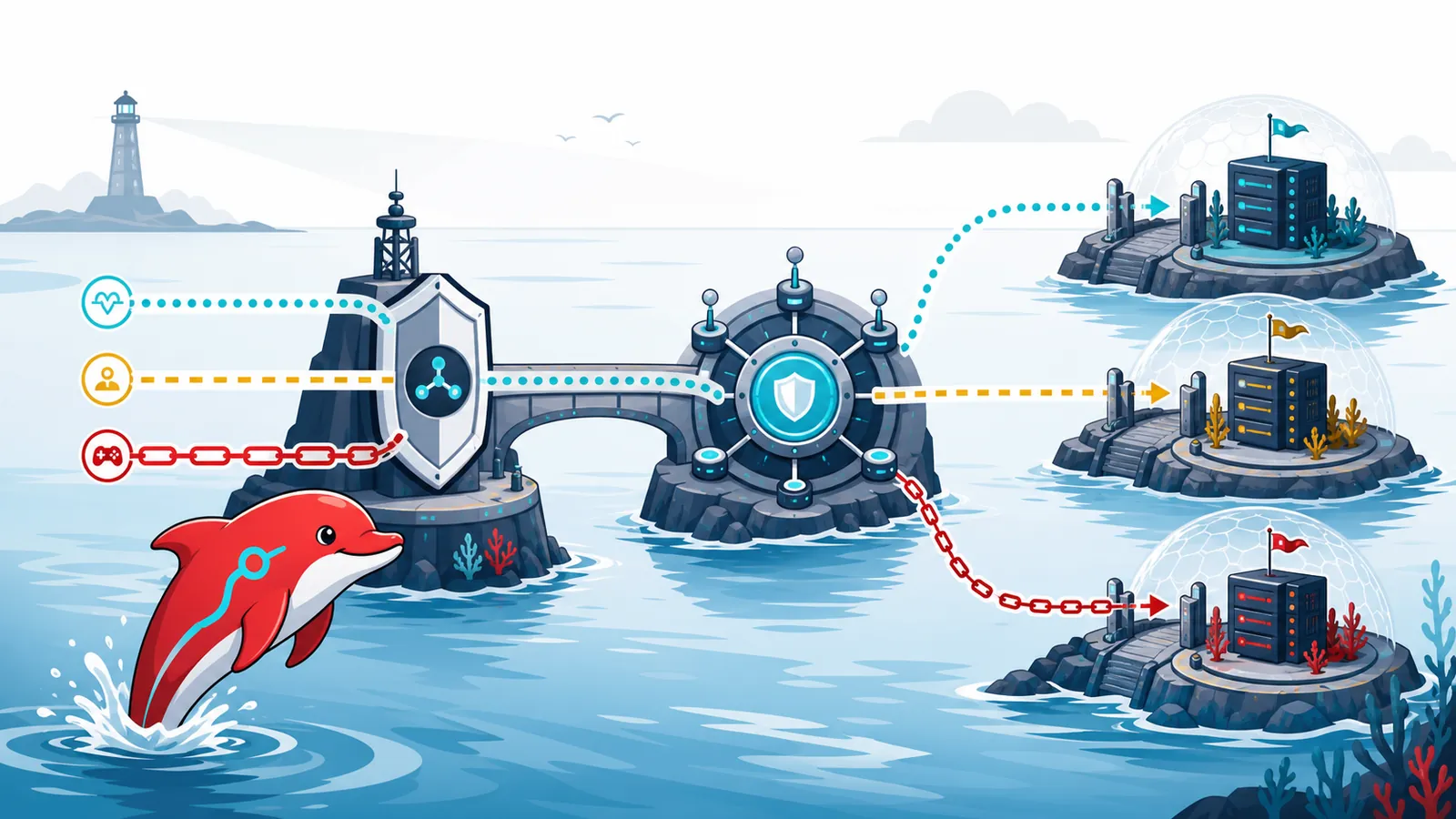
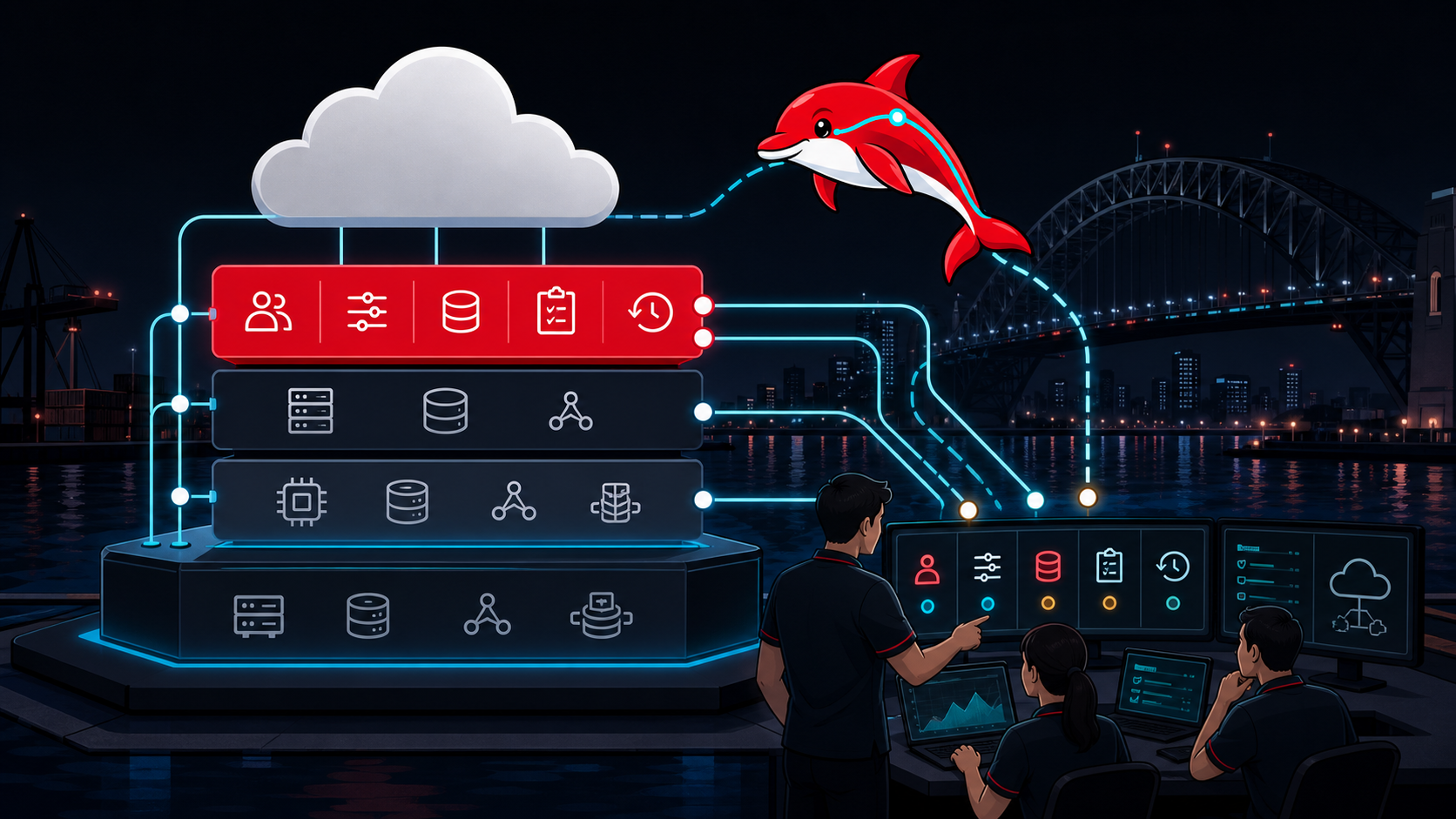
    Harbour Dolphin maps three distinct Java multiplayer traffic paths through a protected proxy hub to isolated backend server nodes.
    Separate status, login and play paths so controls reflect their different costs and user impact.

    PaperMC’s current Velocity security documentation strongly recommends a firewall for backend isolation. It also warns that Velocity modern forwarding is a second layer of protection, not a replacement for a firewall. Keep the proxy and backend software updated, restrict backend reachability and review plugins because application-level abuse can still consume server work after network traffic is accepted.

    Do not copy a universal join-rate or packet threshold from a blog. Establish a legitimate baseline, test player experience, change one control at a time and keep an emergency rollback. A protection provider should be able to explain whether it understands the game protocol or merely forwards a protected generic TCP stream.

    Valve-family server queries: challenge spoofing, then budget real sources

    Valve-family dedicated servers expose discovery information through A2S query types commonly known as A2S_INFO, A2S_PLAYER and A2S_RULES. These queries are useful to players and server browsers, but unauthenticated UDP responses can contribute to reflection risk when source addresses are spoofed. High query rates from real sources can also consume packet and protocol-processing capacity.

    Valve developer communication describes an A2S challenge exchange that lets a server ask a client to return a challenge before an information response, helping demonstrate that the requester can receive traffic at the claimed source. That can reduce spoofed reflection. It cannot prove that a real-source bot is benign, and it does not create infinite query capacity.
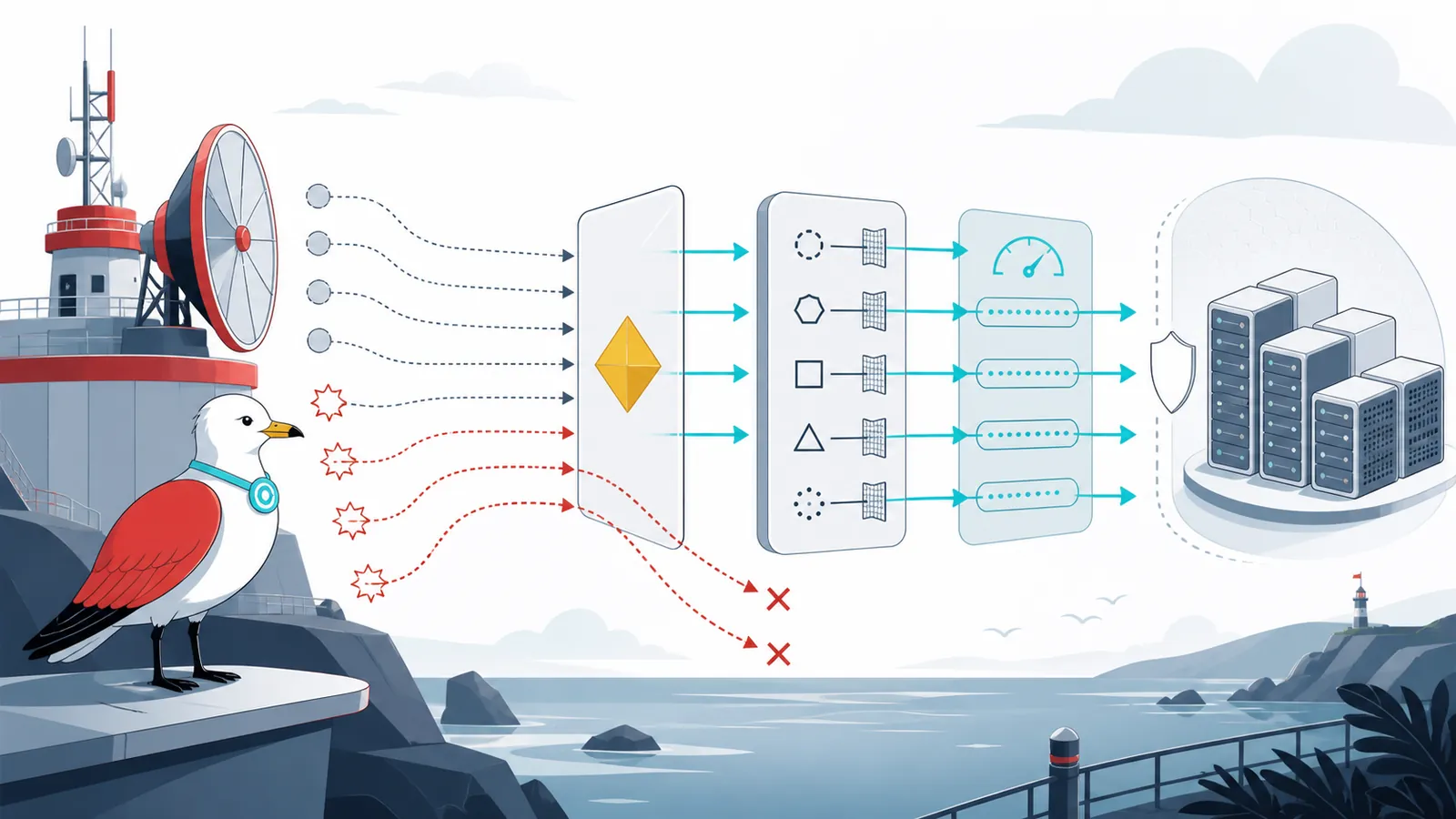
    Signal Gull observes geometric query challenges, protocol-aware filters and rate-controlled paths protecting a generic dedicated-server cluster.
    Challenge validation addresses spoofing; protocol-aware budgets and monitoring still matter for real-source query floods.
    • current server software and protocol support;
    • challenge validation where compatible;
    • protocol-aware filtering before expensive parsing;
    • separate budgets and observability for information, player and rules queries;
    • aggregate and source-aware controls that do not rely on one address threshold alone;
    • an incident mode that preserves the minimum discovery response needed for legitimate clients, if the game and provider support it.

    The Steamworks game-server overview explains the role of game-server discovery and connection. The challenge details above are based on a Valve developer-authored Steam Community announcement, not an RFC; compatibility and defaults can change, so verify them against the current game build and hosting provider.

    What to ask a DDoS provider

    • What clean and attack capacity is stated in Gbps and packets per second?
    • How are new connections, simultaneous state and protocol queries handled?
    • Which of our actual protocols are parsed, proxied or merely forwarded?
    • Is mitigation always on or triggered on demand, and what is the expected time to mitigate?
    • Where does clean traffic re-enter our network, and what latency or MTU changes should we expect?
    • What traffic and mitigation telemetry can we access during and after an event?
    • What is the escalation path, including after-hours response?
    • How are legitimate-traffic drops investigated and corrected?
    • Which features, traffic volumes, logs, support levels or data transfers add cost?
    • What happens if the origin address is exposed or attacked directly?

    OVHcloud’s Network Security Dashboard documentation is a useful example of provider-side visibility: it describes per-address events, attack-vector labels, bps/pps charts, clean and dropped traffic, and escalation data. Those fields describe one provider’s service, not a universal capability. Record what your selected provider actually offers.

    A compact incident and degradation runbook

    1. Declare and timestamp. Nominate an incident lead, start a record and preserve provider alerts and dashboards.
    2. Classify the bottleneck. Compare link utilisation, pps, new connections, concurrent state, request/query rates, latency, errors, queue depth and host saturation.
    3. Protect the management path. Keep administrative access separate where practical; avoid making emergency changes through the affected public service.
    4. Escalate upstream early. If the link or provider edge is the bottleneck, contact the network or mitigation provider with destination, protocol, time window, customer impact and evidence.
    5. Apply the smallest prepared control. Use reviewed edge rules, path budgets or protocol policies. Record the owner, timestamp and rollback.
    6. Degrade intentionally. Serve cached or static content, pause expensive routes, reduce optional query detail or limit new joins while preserving existing sessions where feasible.
    7. Watch legitimate traffic. Sample successful user journeys, geographic reachability, authentication and game-session health. Roll back a control that causes disproportionate harm.
    8. Recover and review. Remove temporary controls carefully, retain evidence according to policy, document false positives and update the capacity model.

    Monitoring signals worth keeping together

    • provider and interface bps/pps;
    • packet drops and NIC, virtual-switch or kernel saturation;
    • SYN rate, accepted connections, resets, timeouts and connection occupancy;
    • edge, cache and origin request rates plus cache-hit ratio;
    • application latency, error rate, worker saturation, queue depth and database pressure;
    • status, login, join, play and query-path health for game services;
    • clean-traffic delivery, mitigation start/stop times and false positives;
    • customer-impact signals such as successful page journeys or completed joins.

    Alerts should identify the suspected bottleneck and a human owner, not merely announce “high traffic”.

    Limits of this guide

    This is general educational information, not a guarantee, penetration-test instruction or substitute for provider engineering. It does not prescribe universal capacity, thresholds or packet filters. Service architecture, versions, jurisdiction, budget and acceptable user impact can change the correct design. Test controls in an authorised environment, maintain rollback and confirm contractual limits directly with suppliers.

    Plan the failure path before buying capacity

    DDoS resilience improves when owners can answer three questions: what resource fails first, who can act before that point, and what essential service remains during degradation? That model turns product names into testable requirements and makes incident decisions faster.

    If you need a bounded review of public exposure, dependencies, monitoring and recovery priorities, see Ozlin Info’s Cybersecurity Risk Advisory or contact us. Related reading: Incident Response and Disaster Recovery Planning and Home Broadband Server Hosting Risks in Australia.


    Sources and review note

    Material technical claims were checked on 31 August 2026 against the RFC Editor, Cloudflare documentation, PaperMC Velocity documentation, Steamworks documentation, a labelled Valve developer communication and OVHcloud documentation. Product behaviour and documentation can change; next scheduled review is 28 February 2027.

    AI disclosure: AI assisted with source discovery, drafting, copyediting and the original editorial illustrations; Ozlin Info reviewed the final article and remains responsible for publication.

  • Post-Quantum Cryptography for Australian Organisations: A 2026 Transition Guide

    Post-Quantum Cryptography for Australian Organisations: A 2026 Transition Guide

    Post-quantum cryptography is now a migration programme, not a prediction contest. An organisation does not need to guess the date of a cryptographically relevant quantum computer before it can locate vulnerable dependencies, assess the lifetime of protected information and ask suppliers for an upgrade path.

    The Australian Signals Directorate (ASD) recommends a refined transition plan by the end of 2026, commencement of migration for critical systems and data by the end of 2028, and completion by the end of 2030. That is a demanding timetable for environments containing legacy systems, hardware security modules, certificates, embedded devices, external APIs and long-lived vendor contracts (ASD — Planning for post-quantum cryptography).

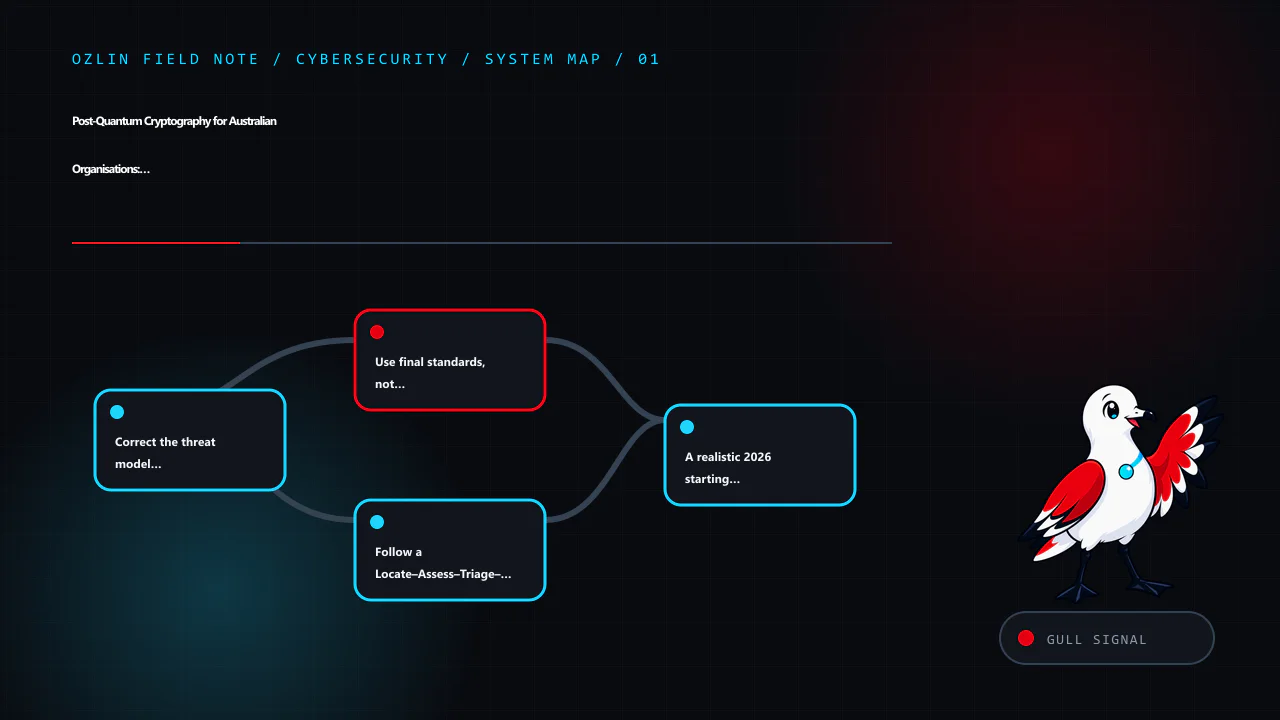
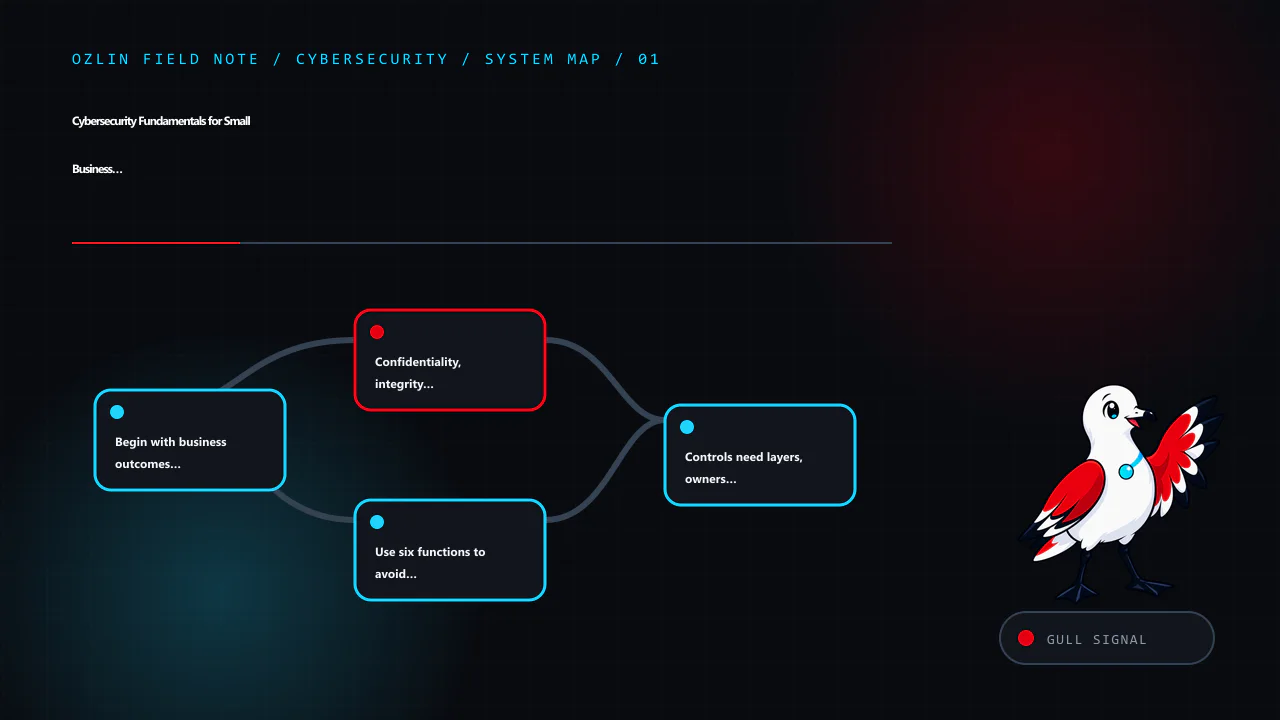
    Article map for Post-Quantum Cryptography for Australian Organisations: A 2026 Transi…, covering Correct the threat model first, Use final standards, not old candidate names, Follow a Locate–Assess–Triage–Implement–Comm…
    Article map: Correct the threat model first; Use final standards, not old candidate names; Follow a Locate–Assess–Triage–Implement–Communicate path; A realistic 2026 starting point.

    Correct the threat model first

    The original version of this article said quantum computers perform calculations “exponentially faster” and treated RSA and elliptic-curve cryptography as if both depended on integer factoring. That is inaccurate.

    Shor's algorithm threatens the mathematical problems used by widely deployed public-key systems. RSA relies on integer factorisation; Diffie–Hellman and elliptic-curve systems rely on discrete-logarithm problems in different groups. A sufficiently capable, fault-tolerant quantum computer would undermine both families, but not because they use the same problem.

    Symmetric encryption and hash functions have a different risk profile. Quantum search can reduce the effective work factor of brute-force search, which influences key-size and design choices, but it does not mean every cryptographic primitive instantly fails or that quantum speed-up is universal.

    The practical risk is broader than encrypted archives. Vulnerable asymmetric cryptography is used for:

    • TLS authentication and key establishment;
    • VPNs and remote administration;
    • software and firmware signing;
    • document and email signatures;
    • device identity and update chains;
    • public-key infrastructure and certificates; and
    • machine, workload and API authentication.

    Information with long-lived confidentiality requirements may also be exposed to “harvest now, decrypt later”: encrypted traffic or data captured today could be retained for an attempt to decrypt it in the future. ASD advises organisations to begin planning even though the arrival date of a cryptographically relevant quantum computer remains uncertain (ASD — Planning for post-quantum cryptography).

    Use final standards, not old candidate names

    In August 2024, the US National Institute of Standards and Technology (NIST) approved three post-quantum standards:

    Standard Function Important distinction
    FIPS 203 — ML-KEM Establishing shared secrets A key-encapsulation mechanism, not general-purpose “encryption” by itself
    FIPS 204 — ML-DSA Digital signatures Derived from the CRYSTALS-Dilithium submission
    FIPS 205 — SLH-DSA Digital signatures A stateless hash-based signature scheme derived from SPHINCS+

    These are final standards, not merely candidates under evaluation (NIST — Post-Quantum Cryptography FIPS Approved). NIST says the standards are ready to implement, while work continues on additional algorithms and migration guidance (NIST — Post-quantum cryptography).

    For Australian organisations that apply the Information Security Manual, current ASD-approved choices, parameters and transition rules should be checked directly in ASD guidance. Do not assume that a library exposing an algorithm name is approved, interoperable or safely configured for the intended use.

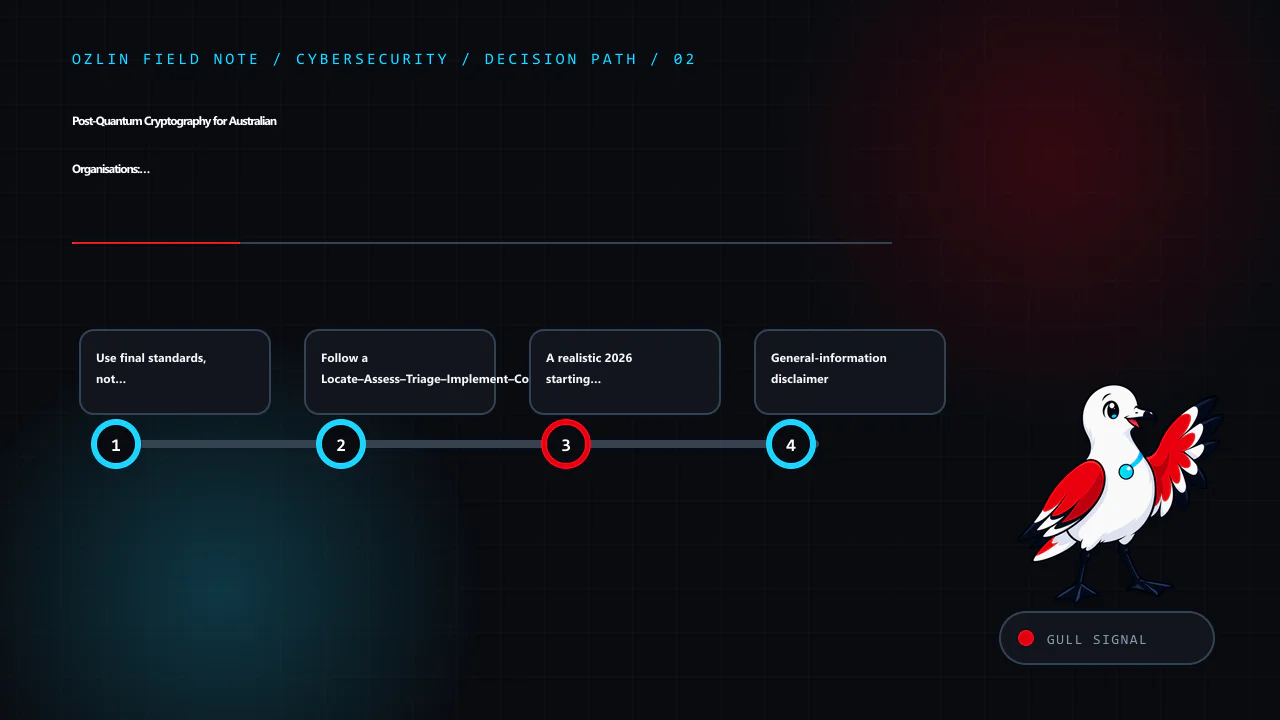
    Decision path for Post-Quantum Cryptography for Australian Organisations: A 2026 Transi…, covering Use final standards, not old candidate names, Follow a Locate–Assess–Triage–Implement–Communicate path, A realistic 2026…
    Decision path: Use final standards, not old candidate names; Follow a Locate–Assess–Triage–Implement–Communicate path; A realistic 2026 starting point; General-information disclaimer.

    Follow a Locate–Assess–Triage–Implement–Communicate path

    ASD's LATICE framework provides a useful migration sequence.

    1. Locate cryptography and its owners

    Build a cryptographic inventory. Begin with high-impact services and record:

    • the business function and information protected;
    • algorithm, key size, protocol, certificate type and library;
    • product, version, hardware or managed service involved;
    • whether the organisation controls the configuration or depends on a supplier;
    • key and certificate lifetimes;
    • data-confidentiality lifetime;
    • interoperability and external-party dependencies; and
    • accountable business and technical owners.

    A cryptographic bill of materials can mature from a simple list into a machine-readable record, but perfect tooling is not a prerequisite for beginning. Certificates alone are not a complete inventory: cryptography may be compiled into applications, embedded in devices or hidden behind a SaaS interface.

    2. Assess value, lifetime and business impact

    Prioritise more than secrecy. A future loss of signature trust could affect software updates, device identity, records, contracts or evidence. Ask how long the protected information or authenticity decision must remain trustworthy and what happens if a dependency cannot be updated.

    Document regulatory, contractual and customer requirements without assuming that adopting a NIST algorithm automatically proves compliance.

    3. Triage difficult and externally connected systems

    Critical, sensitive, long-lived and slow-to-change systems usually need earlier attention. Include operational technology, appliances, mobile applications, identity platforms and services whose vendors control the implementation. Record legacy interoperability that may delay a clean cutover.

    4. Implement through supported products and controlled tests

    Do not design proprietary cryptography or rush an unreviewed library into production. Prefer standardised implementations, supported products and vendor guidance. Test in a representative non-production environment for:

    • protocol and certificate interoperability;
    • larger keys, signatures, certificates and messages;
    • latency, memory, CPU and storage effects;
    • monitoring, logging and failure behaviour;
    • downgrade and fallback handling;
    • key lifecycle, backup and recovery; and
    • rollback without silently returning to an insecure state.

    ASD does not recommend, but does not prohibit, post-quantum/traditional hybrid schemes. A hybrid can support interoperability and resilience during transition, but its traditional component remains vulnerable to a future cryptographically relevant quantum computer. Treat it as a transition design requiring review, not a permanent endpoint.

    5. Communicate with vendors and stakeholders

    Ask each critical supplier:

    • Which cryptographic dependencies are in the product, including third-party libraries and hardware?
    • Which final standards and profiles will be supported?
    • Is the implementation production-ready, independently tested and enabled by default or by configuration?
    • What versions, contracts, hardware replacements or downtime are required?
    • How will keys, certificates, backups, logs and rollback be handled?
    • Does the roadmap align with ASD's 2030 objective?
    • How will vulnerabilities or standards changes be communicated?

    ASD published a current vendor-question set in 2026 that can be adapted to procurement and renewal reviews (ASD — Post-quantum questions to ask your vendors).

    A realistic 2026 starting point

    For a smaller organisation, the first deliverable is not a fleet-wide cryptographic replacement. It is an owned transition plan:

    1. name the accountable owner and affected teams;
    2. identify the ten most critical services and their suppliers;
    3. document certificates, libraries, protocols and long-lived data for those services;
    4. ask vendors for current evidence and dates;
    5. rank dependencies by impact and difficulty;
    6. select one supported non-production pilot; and
    7. fund the next inventory and migration milestones.

    Measure progress by inventory coverage, supplier evidence, tested compatibility and closed migration risks—not by the number of products that display a “quantum-safe” badge.

    For help turning an infrastructure and software inventory into a scoped security roadmap, see Ozlin Info's cybersecurity services or contact Ozlin Info.

    Related reading: Cybersecurity fundamentals for business risk.


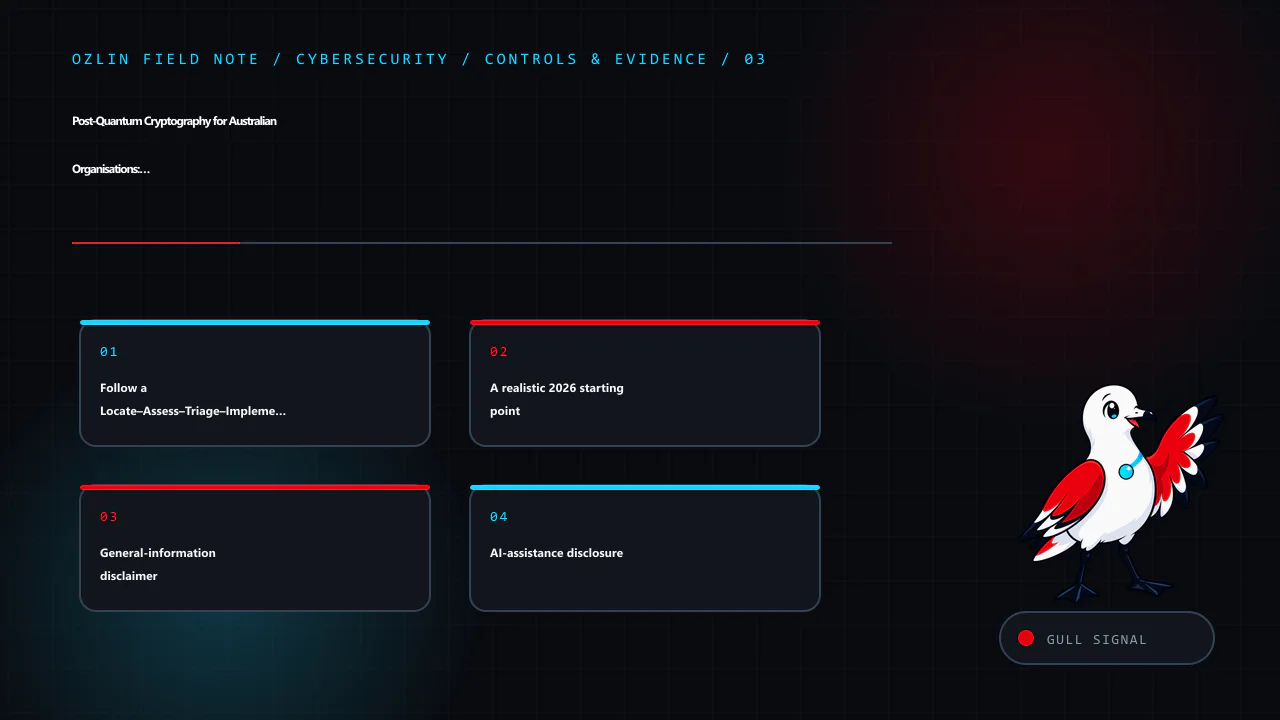
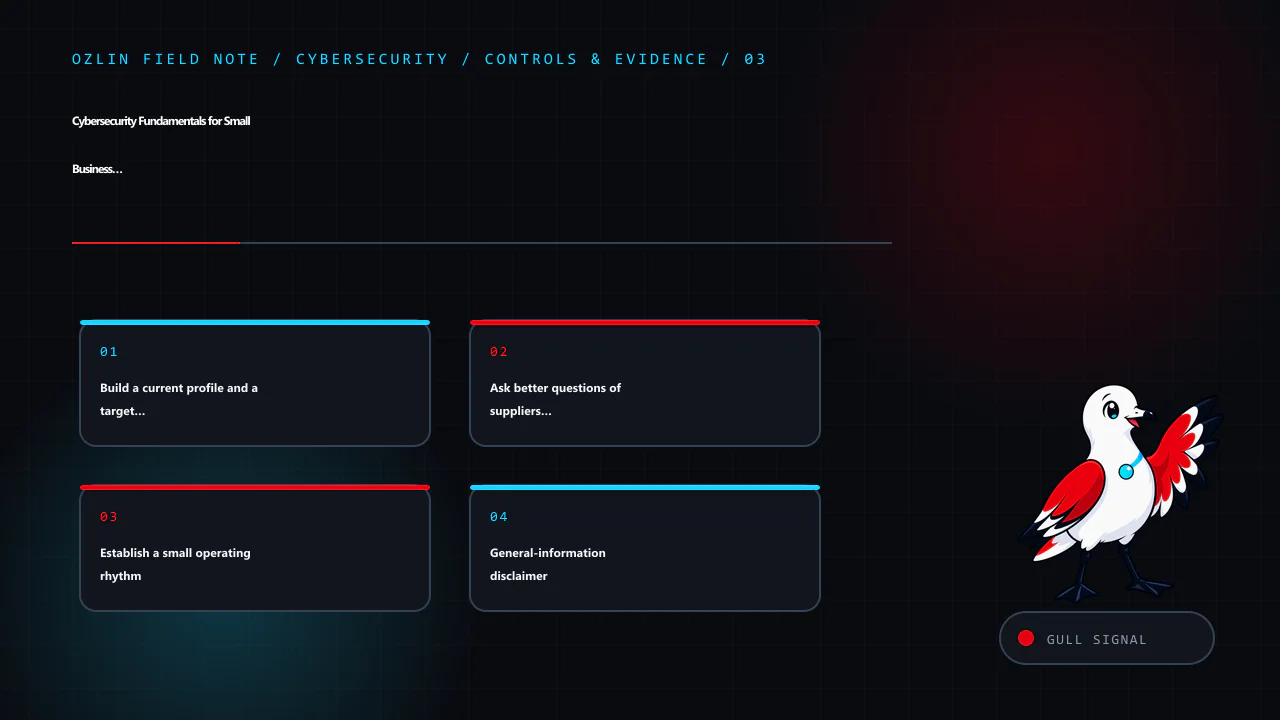
    Control and evidence map for Post-Quantum Cryptography for Australian Organisations: A 2026 Transi…, covering Follow a Locate–Assess–Triage–Implement–Communicate path, A realistic 2026 starting point, General-informatio…
    Control and evidence map: Follow a Locate–Assess–Triage–Implement–Communicate path; A realistic 2026 starting point; General-information disclaimer; AI-assistance disclosure.

    General-information disclaimer

    This article provides general technical information only. It is not cryptographic, legal, regulatory, procurement or compliance advice. Approved algorithms, profiles and transition obligations depend on the organisation, information, jurisdiction, system and applicable ASD or sector requirements. Obtain qualified cryptographic and legal advice for high-consequence systems.

    AI-assistance disclosure

    AI tools assisted with source discovery, outlining and copyediting. A human reviewer must verify every source, technical statement, organisational claim and publication decision before release. No claim is made that any Ozlin or client system is quantum-ready.

    Practical checklist for Post-Quantum Cryptography for Australian Organisations: A 2026 Transi…, covering A realistic 2026 starting point, General-information disclaimer, AI-assistance disclosure and related review point…
    Practical checklist: A realistic 2026 starting point; General-information disclaimer; AI-assistance disclosure; Primary sources checked.

    Primary sources checked

    Source access date: 29 August 2026.

  • Incident Response and Disaster Recovery: A Practical Australian Playbook

    Incident Response and Disaster Recovery: A Practical Australian Playbook

    Incident response and disaster recovery are related, but they are not interchangeable. An organisation can contain an attacker and still be unable to operate. It can also restore a server quickly while restoring the same compromise, losing evidence or making an unapproved public statement.

    A useful plan connects four disciplines:

    • cyber incident response — detecting, analysing, containing, remediating and learning from a security incident;
    • business continuity — maintaining the organisation's critical activities during disruption;
    • disaster recovery — restoring technology and data to an acceptable state; and
    • crisis communication and decision-making — coordinating leaders, workers, suppliers, customers, regulators and other stakeholders.

    The previous version of this article asserted that breaches are inevitable, quoted an unverified average Australian breach cost and prescribed quarterly testing for every organisation. Those claims are removed. Risk, impact and exercise frequency depend on the organisation and its obligations; readiness should be demonstrated by evidence, not fear-based statistics.

    Article map for Incident Response and Disaster Recovery: A Practical Australian Playb…, covering Prepare before the alert arrives, Detect and triage with business context, Contain without making the situation worse and…
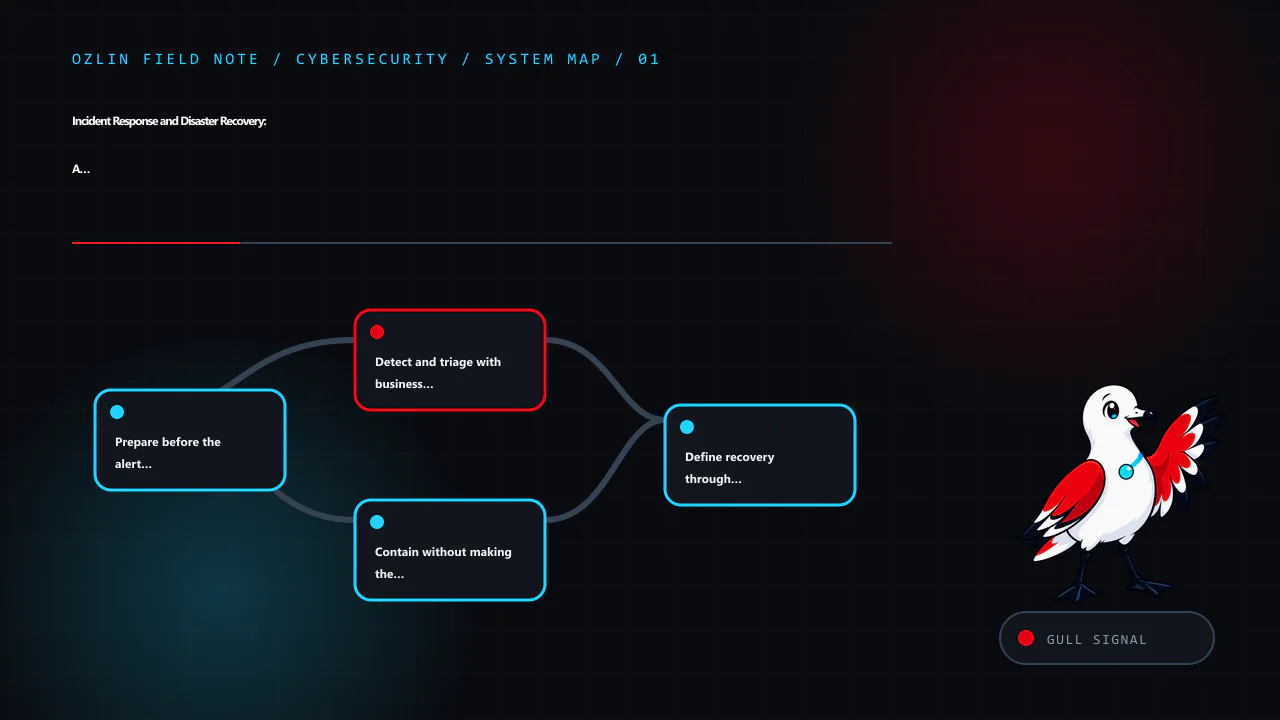
    Article map: Prepare before the alert arrives; Detect and triage with business context; Contain without making the situation worse; Define recovery through business impact.

    Prepare before the alert arrives

    ASD's current practitioner guidance says a cyber incident response plan should align with emergency, crisis, business continuity and disaster-recovery arrangements, be tailored to the environment, and be regularly tested and reviewed (ASD — Cyber security incident response planning).

    Begin with decision rights and reliable contact paths. Record:

    • the incident lead and deputy;
    • technical, business, legal/privacy and communications decision-makers;
    • critical service owners and recovery priorities;
    • cyber insurer or broker contacts and relevant policy conditions;
    • hosting, cloud, identity, banking and managed-service escalation paths;
    • law-enforcement and government reporting routes where relevant;
    • who can isolate systems, disable accounts, restore data and approve public statements; and
    • an offline, protected copy of the plan and key contacts.

    Create short playbooks for likely scenarios such as phishing/business email compromise, compromised administrator access, ransomware, lost devices, website compromise, cloud-key exposure and data breach. A playbook should support judgement; it should not force responders to follow a damaging action merely because it appears as step three.

    Detect and triage with business context

    Define how workers and suppliers report a concern at any time. Record the first observation, source, time, affected accounts or services and actions already taken. Establish an incident log early and preserve the original alert, relevant timestamps and decision rationale.

    Triage should ask:

    1. What is known and what is only suspected?
    2. Which identities, data, systems and business processes may be affected?
    3. Is the activity ongoing?
    4. Could a containment action disrupt a critical service or destroy evidence?
    5. Who has authority to make the next decision?
    6. Is specialist incident-response, legal, privacy, insurer or law-enforcement help required now?

    NIST SP 800-61 Rev.3, finalised in April 2025, integrates incident response across the Govern, Identify, Protect, Detect, Respond and Recover functions of the Cybersecurity Framework 2.0 rather than treating response as an isolated technical phase (NIST SP 800-61 Rev.3).

    Contain without making the situation worse

    “Isolate everything immediately” is not a universal rule. Isolation may be appropriate, but responders should consider operational impact, evidence preservation, attacker visibility and the time required for a safer alternative. ASD's guidance explicitly asks organisations to consider the additional effects, duration and effectiveness of containment options.

    Possible authorised actions include disabling a compromised session, account, API key or forwarding rule; restricting network access; blocking a malicious indicator; preserving a system image or relevant logs; and moving a critical service to a known-clean path. The exact action depends on the incident and must stay within legal authority and the agreed response role.

    Do not delete logs, wipe a system or “hack back”. Protect collected evidence from unnecessary access and record who collected it, when, from where and how its integrity was maintained. Engage a qualified forensic specialist where evidence may support litigation, insurance, employment or regulatory decisions.

    Decision path for Incident Response and Disaster Recovery: A Practical Australian Playb…, covering Detect and triage with business context, Contain without making the situation worse, Define recovery through business im…
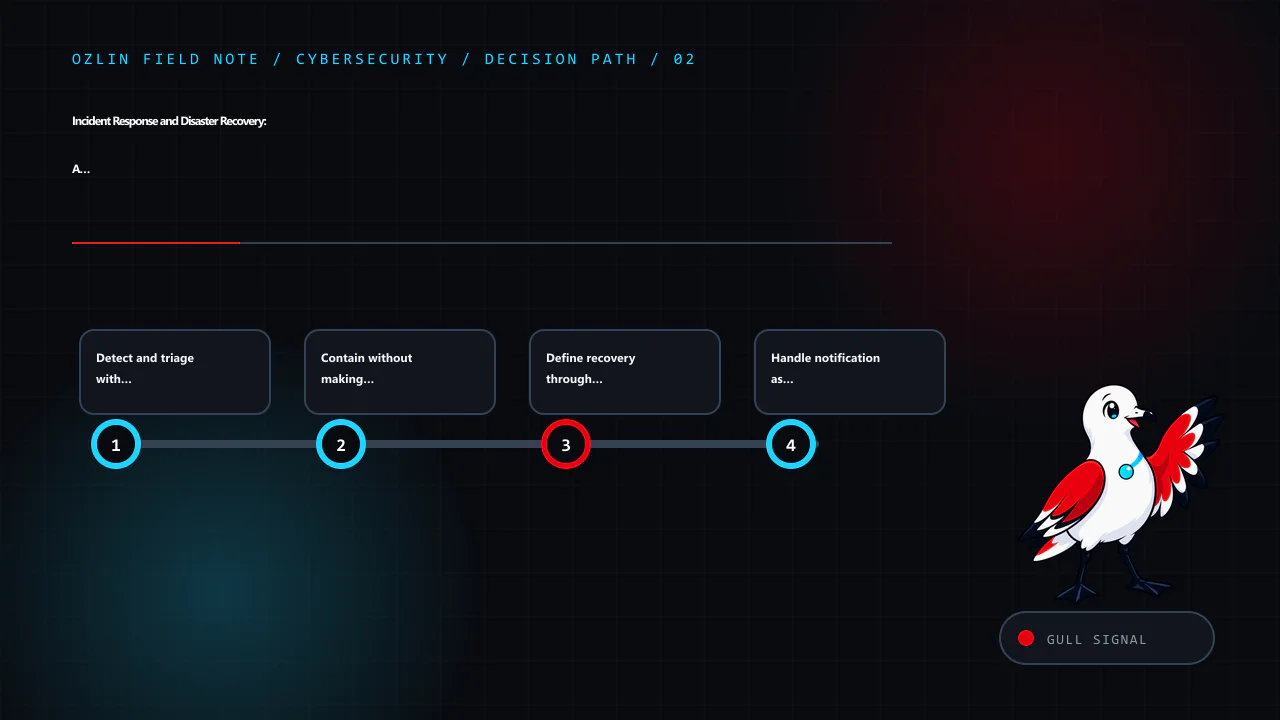
    Decision path: Detect and triage with business context; Contain without making the situation worse; Define recovery through business impact; Handle notification as a scoped decision.

    Define recovery through business impact

    Recovery objectives should be based on the business processes a system supports. NIST's contingency-planning guide distinguishes:

    • maximum tolerable downtime (MTD): the total outage or disruption the process can tolerate;
    • recovery time objective (RTO): the maximum time a system resource can remain unavailable before unacceptable impact; and
    • recovery point objective (RPO): the point in time to which data must be recoverable, which expresses tolerable data loss (NIST SP 800-34 Rev.1).

    Do not copy a supplier's advertised recovery figure into the plan without validating dependencies. A website may depend on DNS, identity, secrets, database, storage, mail, payment, third-party APIs and staff access. Recovery should specify the order, prerequisites, owners and acceptance tests.
    A safe recovery sequence normally includes:

    1. approve a remediation and recovery plan;
    2. establish a known-clean identity and administration path;
    3. remediate the entry point and affected trust relationships;
    4. restore systems and data from an appropriate source;
    5. rotate exposed credentials and keys according to impact;
    6. validate integrity, security configuration and business function;
    7. monitor for recurrence or missed persistence; and
    8. obtain accountable approval before returning to normal operation.

    A backup is not recovery evidence. Run restoration exercises, record duration and missing dependencies, and protect recovery administration from the identities used for everyday work.

    Handle notification as a scoped decision

    Not every security event is a notifiable data breach, and not every Australian organisation has the same obligations. The OAIC's current quick-reference guide applies to entities covered by the Notifiable Data Breaches scheme and uses a contain–assess–notify if required–review sequence (OAIC — Responding to data breaches).

    Assess coverage, the information involved, likely serious harm, remedial action and statutory timeframes with appropriate advice. Preserve the basis for the decision. Sector-specific obligations can also apply. For example, APRA's CPS 230 and CPS 234 apply to APRA-regulated entities, not to every Australian business (APRA — CPS 230). Contractual, insurer, customer and platform notification requirements may be separate again.

    Report active cybercrime or incidents through the appropriate official channel when relevant. Do not delay urgent containment solely to perfect a report, but do not make unsupported public attribution or promise an outcome before facts are established.

    Exercise the decisions, not just the document

    Choose exercise frequency from risk, change, obligations and prior findings rather than a universal quarterly rule. Useful exercise types include:

    • a contact-tree and escalation test;
    • a tabletop decision exercise;
    • a technical restore test;
    • a failover or alternate-workflow exercise; and
    • a combined incident, recovery and communications simulation.

    Define observable acceptance criteria: contacts reached within the expected window, correct authority identified, evidence preserved, backup restored, critical transaction completed, notification question escalated and unresolved actions assigned.

    After an incident or exercise, run a blameless review that still assigns ownership. Update the plan, architecture, controls, supplier agreements and funded work backlog. An incident is not “closed” merely because production is available again.

    For a scoped review of response roles, backups, restoration evidence and website/cloud dependencies, see Ozlin Info's cybersecurity services or contact Ozlin Info.

    Related reading: Phishing response playbook for Australian businesses.


    Control and evidence map for Incident Response and Disaster Recovery: A Practical Australian Playb…, covering Define recovery through business impact, Handle notification as a scoped decision, Exercise the decisions, no…
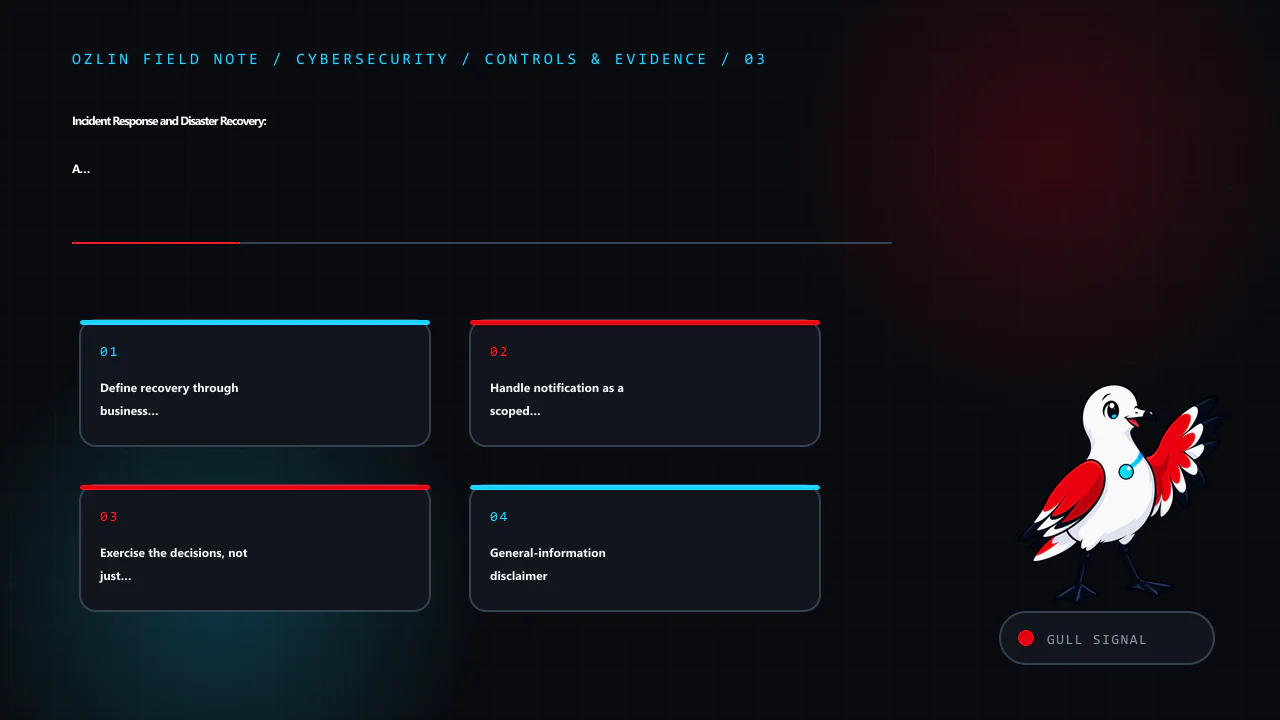
    Control and evidence map: Define recovery through business impact; Handle notification as a scoped decision; Exercise the decisions, not just the document; General-information disclaimer.

    General-information disclaimer

    This article provides general information only. It is not incident-response, forensic, legal, privacy, regulatory, insurance or business-continuity advice. Actions and notification obligations depend on the facts, authority, systems, information, contracts, sector and jurisdiction. Seek urgent qualified help when an incident may be active.

    AI-assistance disclosure

    AI tools assisted with source discovery, outlining and copyediting. A human reviewer must verify every factual statement, link, scope decision and publication choice before release. No recovery time or incident outcome is promised.

    Practical checklist for Incident Response and Disaster Recovery: A Practical Australian Playb…, covering Exercise the decisions, not just the document, General-information disclaimer, AI-assistance disclosure and relate…
    Practical checklist: Exercise the decisions, not just the document; General-information disclaimer; AI-assistance disclosure; Primary sources checked.

    Primary sources checked

    Source access date: 29 August 2026.

  • Zero Trust for Australian Organisations: A Practical Migration Guide

    Zero Trust for Australian Organisations: A Practical Migration Guide

    Zero trust is not a product, a VPN replacement or a requirement to interrupt people with a new login prompt every few minutes. It is an architecture and operating approach that removes implicit trust based only on network location, device ownership or organisational affiliation.

    NIST SP 800-207 defines zero trust around users, assets and resources. Authentication and authorisation occur before a session to a protected resource is established, and policy decisions use available evidence rather than treating “inside the network” as sufficient proof (NIST SP 800-207).

    ASD now places zero trust within its modern defensible architecture guidance alongside layered architecture and secure-by-design practices. Its foundations describe three principles: never trust, always verify; assume breach; and verify explicitly (ASD — Foundations for modern defensible architecture).

    Article map for Zero Trust for Australian Organisations: A Practical Migration Guide, covering Start with the resource and business decision, Build prerequisites before dynamic policy, Verify explicitly without creating…
    Article map: Start with the resource and business decision; Build prerequisites before dynamic policy; Verify explicitly without creating permanent friction; Enforce least privilege at several layers.

    Start with the resource and business decision

    A weak zero trust programme begins by buying tools. A stronger one begins by identifying a business resource and writing the access decision that must be enforced.

    For example:

    Finance records may be accessed by a current finance worker using an approved account and compliant managed device for an authorised task. High-risk sessions require stronger evidence or are denied. Privileged changes use a separate role and are logged.

    That statement exposes the required capabilities: reliable identity, device information, resource ownership, policy, enforcement, logging, exception handling and recovery. It also gives the organisation something testable.

    Do not try to transform every system at once. Select a workflow where the resource, users, risks and dependencies are understood. Common pilots include privileged administration, contractor access, a cloud application containing sensitive data or an internal application currently reachable by a broad network group.

    Build prerequisites before dynamic policy

    Zero trust decisions are only as reliable as their inputs. Establish:
    • an inventory of important resources, data and services;
    • named business and technical owners;
    • unique human, workload and device identities;
    • controlled account lifecycle and prompt removal of stale access;
    • device registration and meaningful posture signals where appropriate;
    • data classification that can influence access decisions;
    • central policy and change control; and
    • logs that allow a decision to be reconstructed.

    If a directory contains shared accounts, devices cannot be identified and no one owns the application, a highly dynamic policy may add complexity without adding assurance.

    Verify explicitly without creating permanent friction

    Explicit verification means using evidence appropriate to the requested action. Evidence can include:

    • identity and authentication strength;
    • device identity, management and security posture;
    • requested resource and action;
    • user, service or workload role;
    • location, network and time as contextual signals—not sole proof;
    • recent risk events or impossible behaviour;
    • data sensitivity; and
    • session and transaction risk.

    Phishing-resistant MFA is valuable for high-impact access, but zero trust is larger than MFA. Likewise, conditional access is not useful if emergency accounts, service identities, API keys and legacy protocols bypass it.

    Good design reduces unnecessary prompts by reusing strong, current evidence and raising requirements when risk or consequence changes. It should remain possible to explain why access was allowed, denied or escalated.
    Decision path for Zero Trust for Australian Organisations: A Practical Migration Guide, covering Verify explicitly without creating permanent friction, Enforce least privilege at several layers, Design monitoring, resil…
    Decision path: Verify explicitly without creating permanent friction; Enforce least privilege at several layers; Design monitoring, resilience and exceptions together; Migrate in measurable increments.

    Enforce least privilege at several layers

    Least privilege should cover people, administrators, applications, machines and automated agents. Review both standing access and what can be requested temporarily.

    Useful controls include:

    • role or attribute-based access tied to a defined job;
    • just-in-time elevation for high-impact administration;
    • separate routine and privileged identities;
    • workload identities instead of embedded shared secrets;
    • resource-specific application and API permissions;
    • approval and logging for exceptional access; and
    • automatic expiry where the business need is temporary.

    Micro-segmentation can reduce lateral movement, but it is one possible capability—not the definition of zero trust and not mandatory in the same form for every environment. NIST SP 800-207A shows how cloud-native access can focus on application and service identity in addition to network controls (NIST SP 800-207A).

    Design monitoring, resilience and exceptions together

    Policy engines, identity providers, device services and enforcement points become critical dependencies. Plan what happens when one is unavailable or supplies stale information. A zero trust programme that locks out every responder during an incident is not resilient.

    Document:

    • high-availability and recovery requirements;
    • protected emergency access with independent monitoring;
    • safe behaviour when a dependency is unavailable;
    • alert ownership and expected response;
    • policy versioning and rollback;
    • how false denials and false allowances are investigated; and
    • how compromised identities or devices are revoked quickly.

    “Assume breach” means designing so one compromised account or device does not automatically reach every resource. It does not mean assuming every employee is malicious or blocking work without evidence.

    Migrate in measurable increments

    A practical sequence is:

    1. Discover: map the selected workflow, resources, identities, data and current trust assumptions.
    2. Define: write the intended access rules, evidence, exceptions and owners.
    3. Observe: collect data without blocking to identify unexpected dependencies and policy errors.
    4. Pilot: enforce for a limited population with support and rollback available.
    5. Validate: test expected access, denial, elevation, revocation, outage and recovery cases.
    6. Expand: add resources only after the operating model works.

    Useful measures include:

    Measure Evidence
    Resource coverage Important resources with named owners and explicit policy
    Identity hygiene Shared, dormant and excessive accounts removed
    Privilege exposure Standing high-impact access converted or justified
    Revocation Time to remove access across connected systems
    Decision quality Sampled allow/deny decisions supported by expected evidence
    User impact Failed legitimate access, support effort and workaround attempts
    Resilience Successful identity/policy outage and emergency-access exercise

    Do not claim that a drop in breaches proves the zero trust programme caused it. Security incidents are sparse, affected by exposure and detection, and not a clean single-control metric.

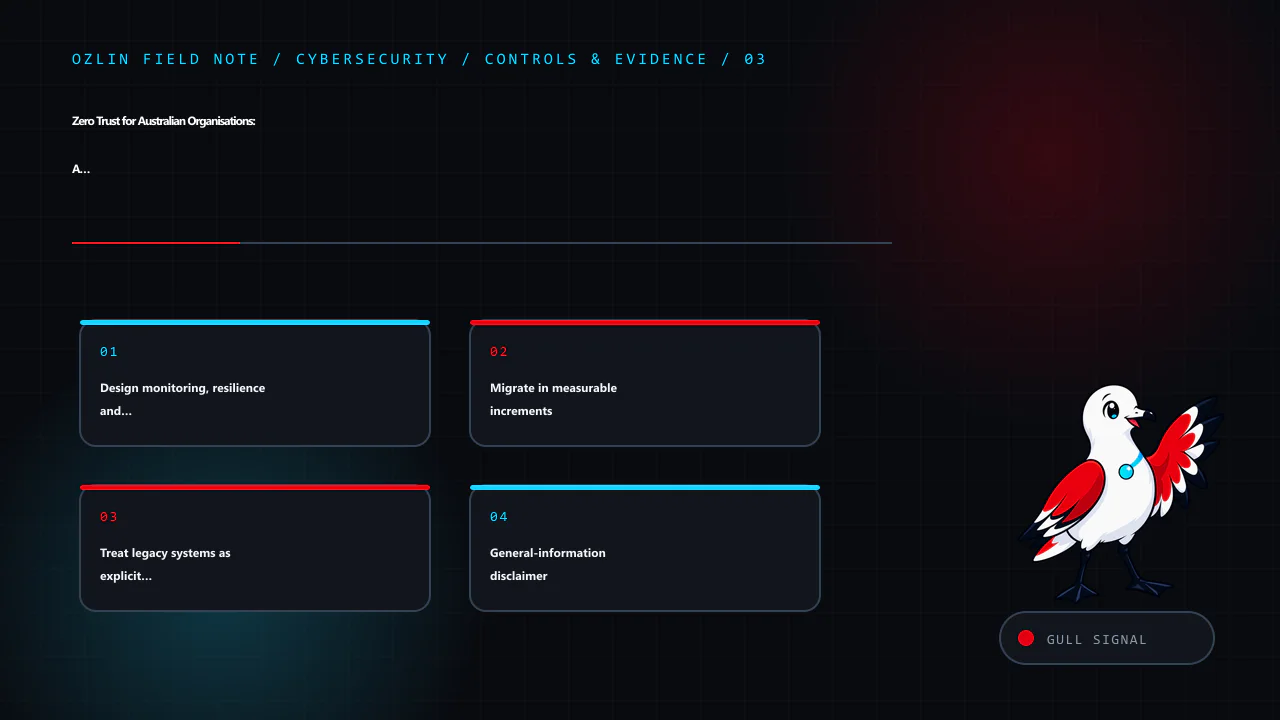
    Control and evidence map for Zero Trust for Australian Organisations: A Practical Migration Guide, covering Design monitoring, resilience and exceptions together, Migrate in measurable increments, Treat legacy systems a…
    Control and evidence map: Design monitoring, resilience and exceptions together; Migrate in measurable increments; Treat legacy systems as explicit risk; General-information disclaimer.

    Treat legacy systems as explicit risk

    Some systems cannot consume modern identity, device or workload signals. Record the limitation, business need, compensating controls, monitoring, owner and retirement or upgrade date. A network gateway may provide a temporary policy boundary, but it does not magically give the legacy application resource-level authorisation.

    Use current ASD modern defensible architecture guidance rather than the obsolete “DSD” wording in the original article. Also avoid saying that zero trust itself proves Privacy Act, APRA, ISO or other compliance. It may support control objectives; applicability and compliance require separate assessment and evidence.

    For help mapping an identity, website, cloud or administration workflow into a scoped access-control roadmap, see Ozlin Info's cybersecurity services or contact Ozlin Info.

    Related reading: Cybersecurity fundamentals for business risk.


    General-information disclaimer

    This article provides general technical information only. It is not architecture, legal, privacy, regulatory or compliance advice and does not define a complete zero trust implementation. Appropriate policy and controls depend on the organisation, data, systems, users, risks and obligations.

    AI-assistance disclosure

    AI tools assisted with source discovery, outlining and copyediting. A human reviewer must verify each source, architectural statement, service claim and publication decision before release. No security or compliance outcome is guaranteed.

    Practical checklist for Zero Trust for Australian Organisations: A Practical Migration Guide, covering Treat legacy systems as explicit risk, General-information disclaimer, AI-assistance disclosure and related review p…
    Practical checklist: Treat legacy systems as explicit risk; General-information disclaimer; AI-assistance disclosure; Primary sources checked.

    Primary sources checked

    Source access date: 29 August 2026.

  • AI in Cyber Defence: How to Evaluate Threat Detection Without the Hype

    AI in Cyber Defence: How to Evaluate Threat Detection Without the Hype

    Artificial intelligence can help a security team sort events, enrich investigations and identify patterns that are difficult to express as static rules. It can also amplify bad data, produce persuasive but incorrect explanations, expose sensitive telemetry or automate the wrong response at machine speed.

    The useful question is therefore not “Does this product use AI?” It is: for a defined security task, under our conditions, does the system improve a measured operational outcome without creating unacceptable new risk?

    The Australian Signals Directorate (ASD) says AI may help cyber defenders analyse large volumes of data and support tasks such as detection and response, while emphasising cyber fundamentals, human oversight, secure integrations and controls for AI-specific risks (ASD — Opportunities for AI in cyber defence).

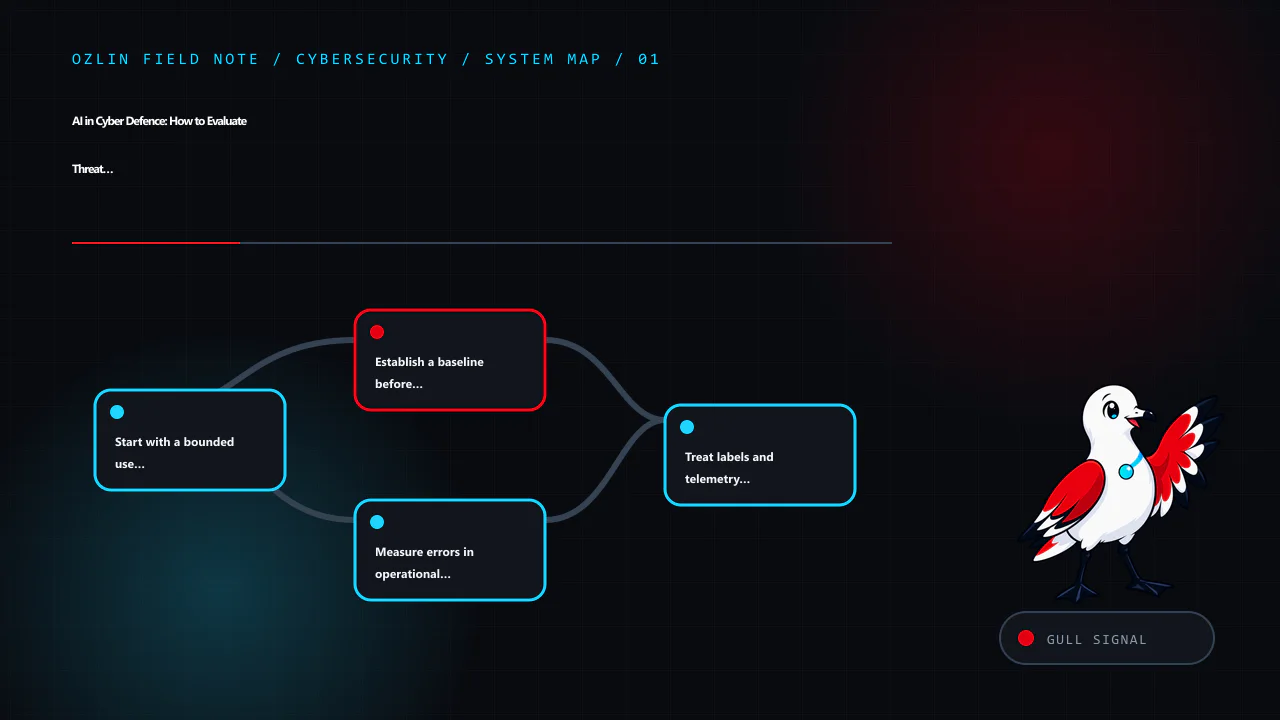
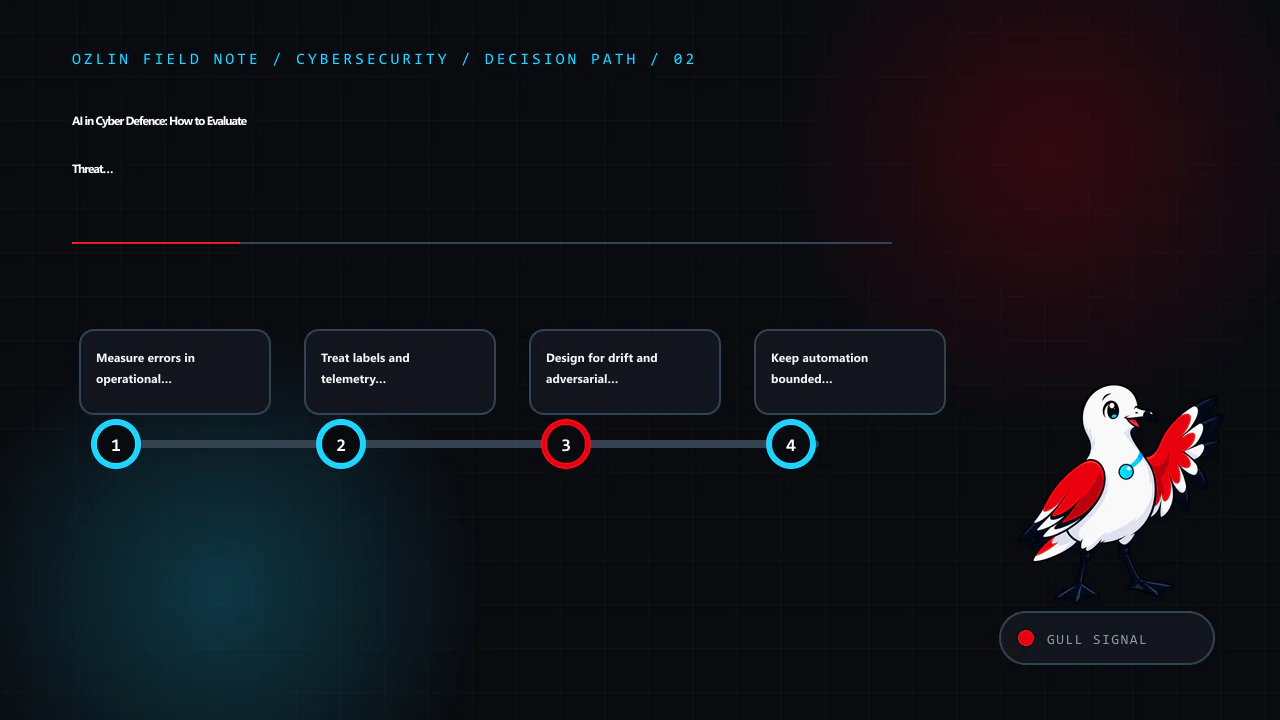
    Article map for AI in Cyber Defence: How to Evaluate Threat Detection Without the Hype, covering Start with a bounded use case, Establish a baseline before adding a model, Measure errors in operational terms and related…
    Article map: Start with a bounded use case; Establish a baseline before adding a model; Measure errors in operational terms; Treat labels and telemetry as security-critical inputs.

    Start with a bounded use case

    “AI security” is not one capability. Define the decision being assisted and the person who remains accountable. Examples include:

    • clustering related endpoint alerts into a candidate incident;
    • prioritising suspicious authentication events for an analyst;
    • summarising a known set of investigation records;
    • recommending a query or playbook step;
    • identifying anomalous cloud activity for review; or
    • extracting indicators from a report in a controlled workspace.

    For each use case, document the input, expected output, permitted data, latency requirement, failure cost and action that follows. A system that produces a useful morning summary may be unsuitable for automatically disabling accounts. A detector evaluated on endpoint data may say little about its performance on identity, email or operational-technology telemetry.

    Establish a baseline before adding a model

    Measure the existing workflow first. Useful baselines may include:

    • number of events reviewed and alerts escalated;
    • median and upper-percentile triage time;
    • confirmed incidents missed or detected late;
    • false escalations and unnecessary response actions;
    • analyst time spent on repetitive enrichment; and
    • evidence quality at handoff.

    The comparison should be against the current rule, query or human process—not against a marketing demo. A model that finds more suspicious events can still make operations worse if the extra volume overwhelms the team.

    Measure errors in operational terms

    Accuracy alone can conceal poor performance when genuine incidents are rare. At minimum, inspect:

    • precision: of the alerts the system raised, how many were relevant under the agreed label definition;
    • recall: of the relevant cases in the evaluation set, how many the system identified;
    • false-positive volume: how much avoidable work reaches analysts;
    • false-negative impact: which meaningful cases were missed and how they would otherwise be detected;
    • time to useful disposition: whether the system speeds a correct decision, not merely produces text sooner; and
    • calibration: whether confidence scores correspond to observed reliability.

    Thresholds involve trade-offs. A suitable threshold for a low-impact investigation queue may be unsafe for account suspension or network isolation. Record performance by environment, event source and risk class rather than relying only on a single aggregate figure.

    Use representative, time-separated data where possible. Randomly mixing near-duplicate events across training and evaluation sets can exaggerate performance. A later-period holdout is useful because attacker behaviour, infrastructure and normal business activity change over time.

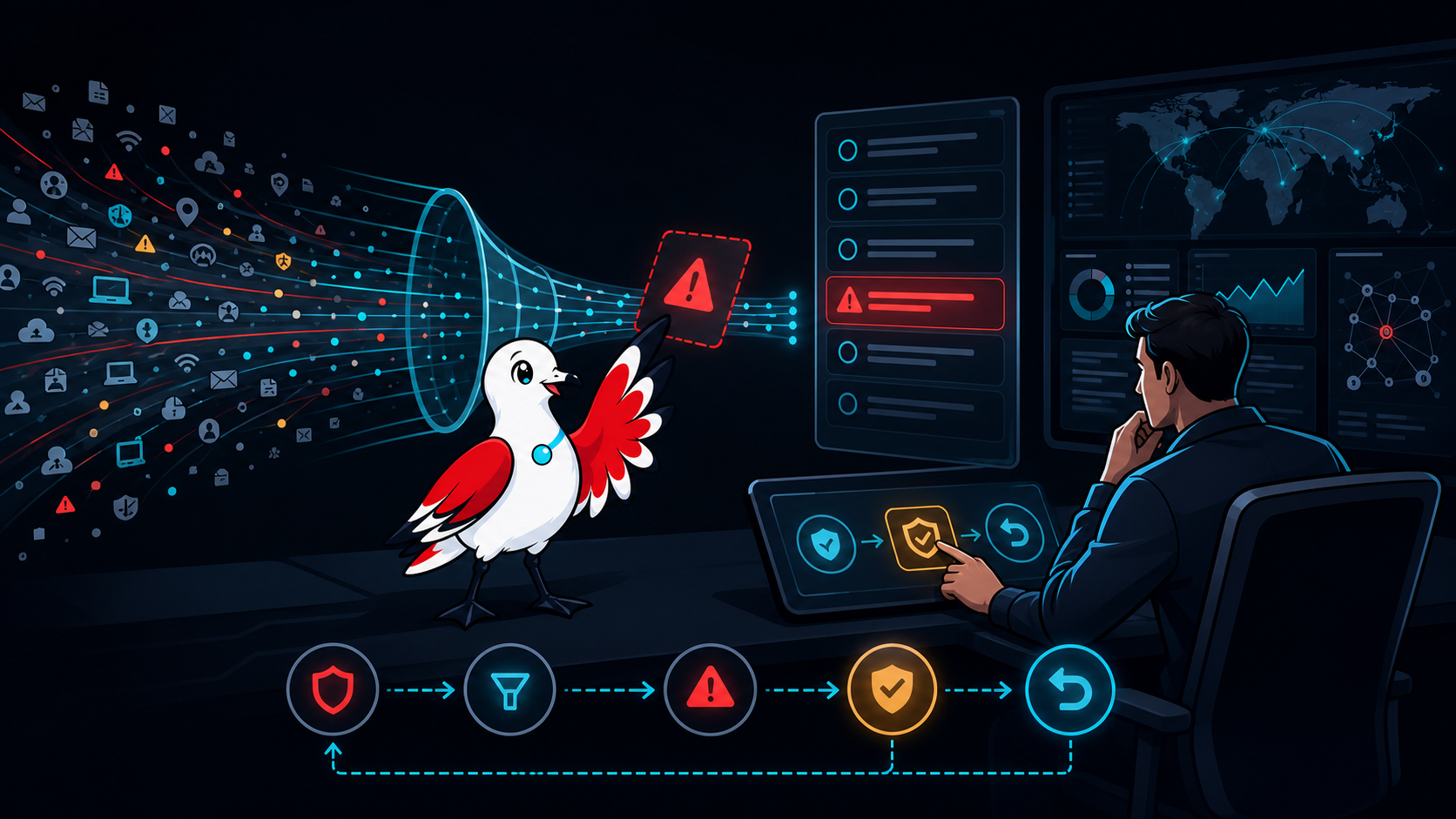
    Decision path for AI in Cyber Defence: How to Evaluate Threat Detection Without the Hype, covering Measure errors in operational terms, Treat labels and telemetry as security-critical inputs, Design for drift and advers…
    Decision path: Measure errors in operational terms; Treat labels and telemetry as security-critical inputs; Design for drift and adversarial behaviour; Keep automation bounded and reversible.

    Treat labels and telemetry as security-critical inputs

    A detector inherits the limitations of its data. Ask:

    • Who defined the ground truth, and how were disagreements resolved?
    • Are incident labels based on completed investigations or only earlier alerts?
    • Does the data include relevant seasons, offices, cloud services and user populations?
    • Which identities, hosts or event sources are missing?
    • Can an attacker influence logs, text, URLs or other model inputs?
    • Does the integration expose secrets, personal information or privileged investigation data?

    Generative systems can be influenced by untrusted content embedded in logs, tickets, webpages or documents. An apparent instruction inside an artefact is data to investigate, not authority to run a command. ASD recommends constrained integrations, appropriate isolation and human oversight for higher-impact actions (ASD — Opportunities for AI in cyber defence).

    Design for drift and adversarial behaviour

    Production performance will change. Software updates alter event formats; a new office changes normal login patterns; attackers adapt to visible controls; and a vendor may update a hosted model without reproducing the original evaluation.

    Monitor:

    • input schema and missing-field rates;
    • alert volume and score distribution;
    • precision and recall on reviewed samples;
    • performance by data source and business unit;
    • overrides, rejected recommendations and response reversals;
    • changes to model, prompt, rules, dependencies and provider terms; and
    • security incidents involving the AI system itself.

    NIST describes evasion, poisoning, privacy and misuse risks across AI system lifecycles in its adversarial-machine-learning taxonomy (NIST AI 100-2e2025). MITRE ATLAS catalogues observed techniques against AI-enabled systems and can help structure threat modelling; it is not a certification checklist (MITRE ATLAS).

    Keep automation bounded and reversible

    Begin in observe-only mode. Let the system recommend or enrich while humans compare results with the established process. Progressively automate only when evidence supports it.

    Safer early actions often have all of these properties:

    • limited effect and short duration;
    • a clear owner and audit trail;
    • an independent check before high-impact execution;
    • a tested rollback path;
    • rate and blast-radius limits; and
    • continued operation if the model or provider is unavailable.

    For example, adding a temporary investigation tag is easier to reverse than deleting data or disabling a workforce account. Isolation, credential revocation, firewall changes and external notifications normally require stronger evidence, explicit authority and a human decision.

    Questions to put to a vendor

    Request evidence that matches the intended environment:

    1. What exact task is the model performing, and what remains rule-based or human-operated?
    2. Which data is collected, retained, transferred or used to improve a provider service?
    3. Can customer data, prompts and outputs be excluded from model training?
    4. How are tenants separated, administrators controlled and access logged?
    5. How was performance measured, on what prevalence and against which baseline?
    6. Can results be broken down by source, environment and error type?
    7. How are model, rule and prompt changes communicated and rolled back?
    8. What happens during service degradation, a provider breach or contract termination?
    9. Can the customer export alerts, evidence, configuration and audit history?
    10. What independent security assessment applies to the actual service being purchased?

    A benchmark percentage without the dataset, label definition, threshold, base rate and operating context is not enough to support a deployment decision.

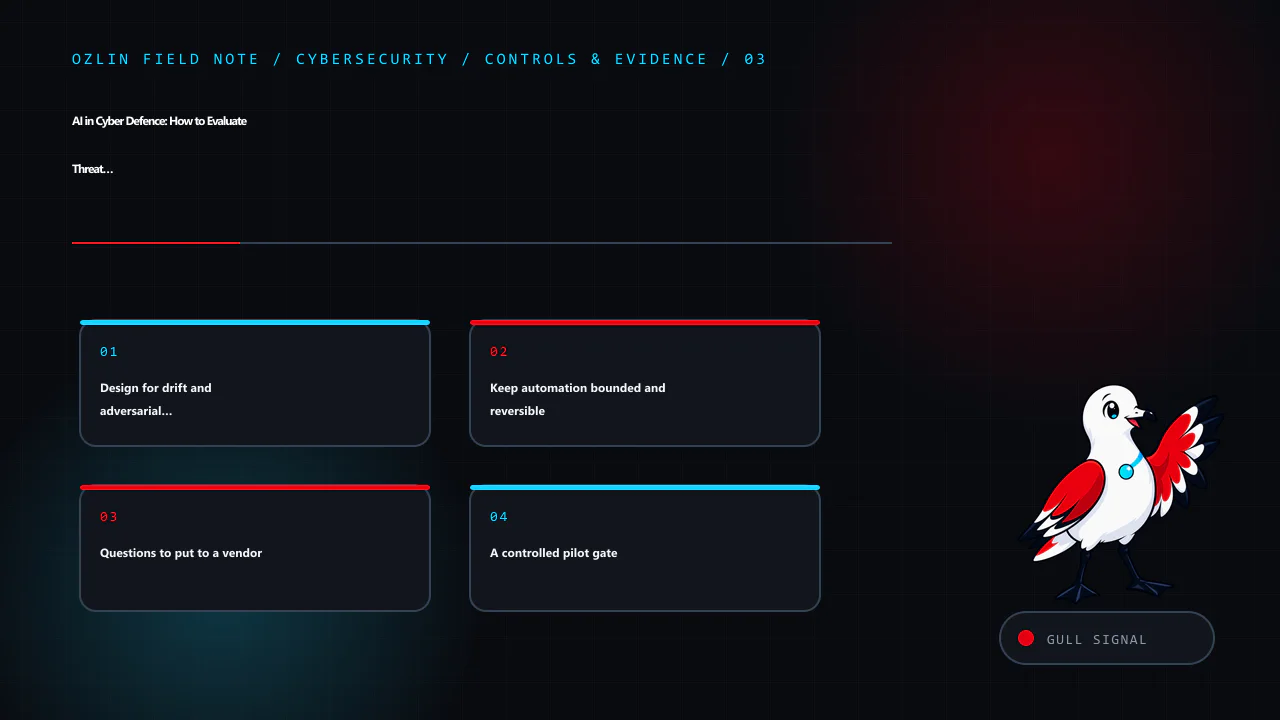
    Control and evidence map for AI in Cyber Defence: How to Evaluate Threat Detection Without the Hype, covering Design for drift and adversarial behaviour, Keep automation bounded and reversible, Questions to put to a ven…
    Control and evidence map: Design for drift and adversarial behaviour; Keep automation bounded and reversible; Questions to put to a vendor; A controlled pilot gate.

    A controlled pilot gate

    Before production use, agree on:

    • a named owner and decision authority;
    • the bounded task and prohibited actions;
    • privacy, retention and cross-border-data review;
    • a representative evaluation set and baseline;
    • error and workload thresholds;
    • human review and escalation paths;
    • logging, monitoring and model-change controls;
    • rollback and provider-outage procedures; and
    • a date for reassessment.

    The NIST AI Risk Management Framework organises AI risk work around Govern, Map, Measure and Manage. It is voluntary guidance rather than a guarantee or one-size-fits-all compliance regime (NIST AI RMF Core).

    Where Ozlin can help

    Ozlin can help a small organisation define a bounded AI-assisted security workflow, map data and integrations, establish a baseline, design a pilot and document human review and rollback. Any engagement must define scope, data handling and decision ownership before testing begins. Ozlin does not promise zero-day detection, automatic accuracy improvement, breach prevention or autonomous incident resolution.

    See Cybersecurity services or contact Ozlin to discuss a scoped assessment.

    Related reading: AI chatbots for Australian SMEs.

    This article provides general technical information, not legal, compliance or security assurance. Results depend on data, configuration, people, threat conditions and the specific service evaluated.

    AI-assistance disclosure

    AI tools assisted with source discovery, outlining and copyediting. A human reviewer must verify every factual statement, source, service claim and publication decision before release. No model, product or control is endorsed by inclusion.

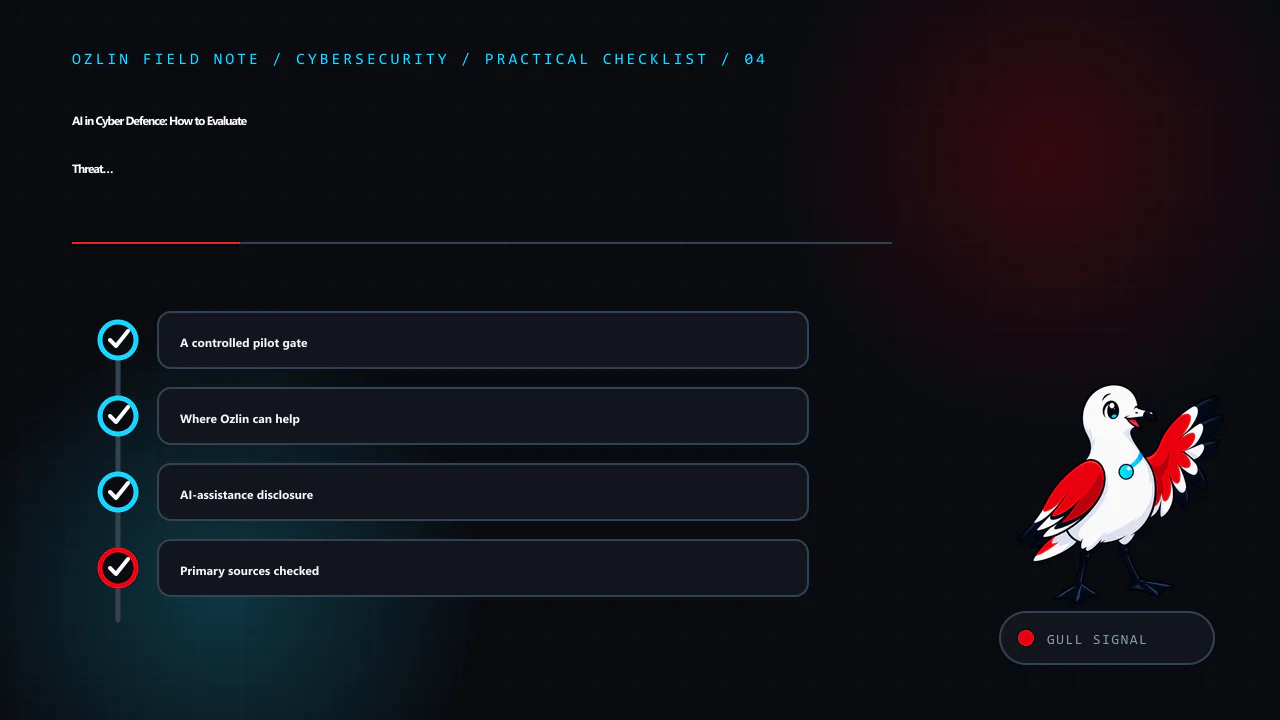
    Practical checklist for AI in Cyber Defence: How to Evaluate Threat Detection Without the Hype, covering A controlled pilot gate, Where Ozlin can help, AI-assistance disclosure and related review points.
    Practical checklist: A controlled pilot gate; Where Ozlin can help; AI-assistance disclosure; Primary sources checked.

    Primary sources checked

    Source access date: 29 August 2026.

  • AWS and Azure Cloud Security: A Shared-Responsibility Checklist

    AWS and Azure Cloud Security: A Shared-Responsibility Checklist

    Moving a workload to AWS or Microsoft Azure changes who operates parts of the technology stack; it does not transfer every security decision to the cloud provider. Identity configuration, data access, workload code, logging, recovery and many network choices normally remain customer responsibilities.

    Both AWS and Microsoft describe security as a shared-responsibility model. The exact boundary changes with the service. A virtual machine leaves the customer responsible for more operating-system and application work than a managed database or software-as-a-service product. The contract, architecture and configuration—not the word “cloud”—determine the real boundary (AWS — Shared responsibility model; Microsoft — Shared responsibility in the cloud).

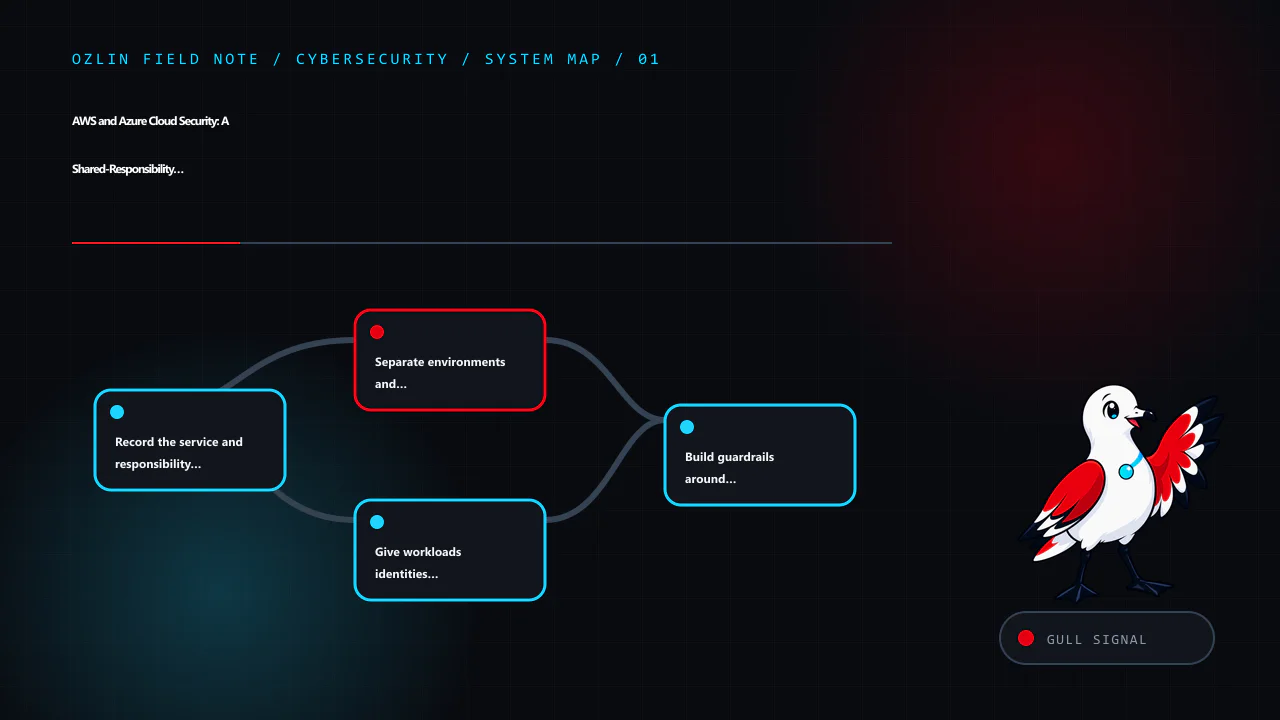
    Article map for AWS and Azure Cloud Security: A Shared-Responsibility Checklist, covering Record the service and responsibility boundary, Separate environments and reduce root-level access, Give workloads identities ins…
    Article map: Record the service and responsibility boundary; Separate environments and reduce root-level access; Give workloads identities instead of embedded secrets; Build guardrails around change.

    1. Record the service and responsibility boundary

    For each production service, maintain a short record of:

    • business owner and technical owner;
    • cloud account, subscription, project or tenant;
    • data classification and relevant people or jurisdictions;
    • service model and provider/customer responsibilities;
    • internet exposure and trust dependencies;
    • identity and privileged-access path;
    • logging destination and retention decision;
    • backup, restore and continuity design; and
    • critical supplier and exit dependencies.

    Do not copy a generic responsibility diagram into a policy and assume the job is done. Confirm responsibilities for the precise service and support plan in use.

    2. Separate environments and reduce root-level access

    Use organisational structures, accounts, management groups, subscriptions or projects to separate production, development, security logging and shared services. Apply centrally governed controls where they are testable and appropriate, while maintaining an exception process for legitimate workloads.

    Protect the highest-privilege identities:

    • avoid everyday use of AWS root or Microsoft tenant-wide administrative accounts;
    • require phishing-resistant MFA where supported, with controlled recovery methods;
    • use workforce federation and short-lived sessions rather than distributing long-lived access keys;
    • separate administrative and normal-user identities where risk justifies it;
    • maintain emergency-access procedures, monitoring and periodic tests; and
    • review effective permissions, not only group names.

    AWS recommends federation and temporary credentials for human users and workloads where possible (AWS — IAM security best practices). In Azure, managed identities and other workload-identity patterns can reduce stored secrets; the correct design still depends on the workload and trust boundary (Microsoft — Secure service accounts).

    3. Give workloads identities instead of embedded secrets

    Static credentials copied into source repositories, container images, scripts or virtual-machine configuration are difficult to rotate and easy to leak. Prefer workload identities, instance or task roles, managed identities and short-lived tokens when supported.

    Where a secret remains necessary:

    • store it in an approved secrets service;
    • restrict who and what may retrieve it;
    • rotate it according to risk and provider capability;
    • audit access and failed retrievals; and
    • define a revocation procedure that does not require rebuilding the entire environment.

    Least privilege is an ongoing measurement problem. Start with a documented purpose, monitor use, remove unused permissions and review privilege escalation paths across identity, resource and key-management policies.

    4. Build guardrails around change

    Infrastructure as code can make cloud configuration reviewable and repeatable, but it can also reproduce a dangerous mistake quickly. Use version control, peer review, automated checks, separate deployment identities and tested rollback.

    Useful guardrails may detect or prevent:

    • public storage or database exposure;
    • unrestricted administrative ports;
    • resources without accountable ownership or environment tags;
    • disabled or diverted audit logging;
    • overly broad identity or key policies;
    • unapproved regions or services; and
    • backups that do not meet the workload's recovery design.

    Not every preventive policy is safe to deploy globally without testing. Roll out in stages, measure legitimate exceptions and ensure responders can diagnose policy-caused outages.

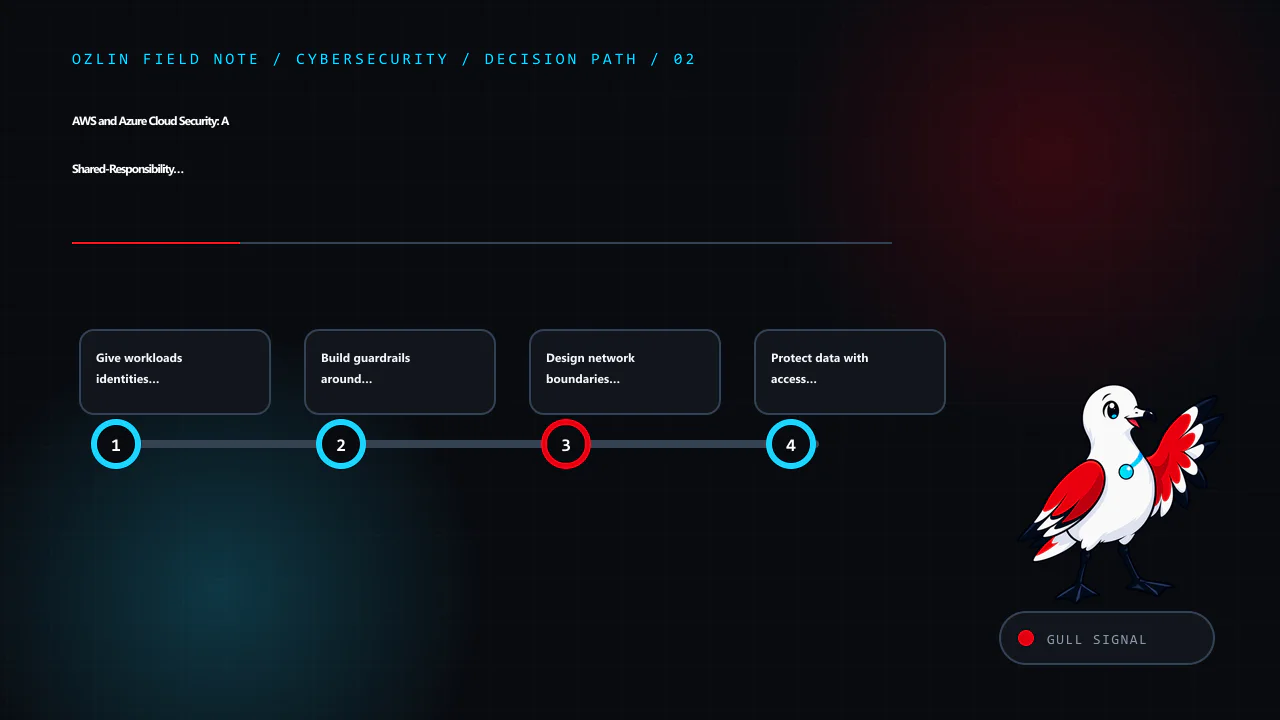
    Decision path for AWS and Azure Cloud Security: A Shared-Responsibility Checklist, covering Give workloads identities instead of embedded secrets, Build guardrails around change, Design network boundaries around flows,…
    Decision path: Give workloads identities instead of embedded secrets; Build guardrails around change; Design network boundaries around flows, not appearances; Protect data with access control, encryption and lifecycle….

    5. Design network boundaries around flows, not appearances

    A virtual network is not automatically private merely because resources have private addresses. Map inbound, outbound and east–west flows, including provider control planes, managed-service endpoints, DNS, update sources and third-party APIs.

    Where appropriate:

    • remove public endpoints that have no business requirement;
    • use private endpoints and explicit routing for sensitive services;
    • constrain administrative access through managed paths rather than open source ranges;
    • control outbound traffic where the operational benefit justifies the complexity;
    • protect internet applications with layered application, rate and abuse controls; and
    • verify that security groups, network-security groups, firewalls and load balancers express the intended path.

    Network controls supplement identity and resource policy. They do not repair an over-privileged application identity or a public data policy.

    6. Protect data with access control, encryption and lifecycle decisions

    Cloud-provider encryption defaults are useful, but “encrypted” is not a complete security decision. Since January 2023, Amazon S3 automatically encrypts new object uploads with server-side encryption using Amazon S3 managed keys by default (AWS — Setting default server-side encryption behavior for Amazon S3 buckets). That does not decide who can read the bucket, whether a customer-managed key is required, how exports are controlled, or whether the design meets a legal or contractual obligation.

    Record:

    • data classification and minimisation decisions;
    • resource and identity access paths;
    • key ownership, rotation, separation and recovery;
    • replication, backup and deletion behaviour;
    • snapshots, logs and non-production copies; and
    • what can be exported by users, services and administrators.

    Microsoft Purview Information Protection can support classification and protection workflows in relevant Microsoft environments, but product deployment does not by itself establish a compliant information-governance programme (Microsoft — Learn about information protection).

    7. Centralise evidence and protect the logging path

    Enable the logs required to answer who changed what, from where, through which identity and with what result. Send security-relevant evidence to a location that a compromised workload administrator cannot silently rewrite.

    Cover at least:

    • control-plane and identity activity;
    • workload, application and authentication events;
    • network and name-resolution evidence where justified;
    • key, secret and data-access events for sensitive resources;
    • changes to logging, monitoring and security controls; and
    • time synchronisation and asset context needed for investigation.

    Test alerts with benign simulations. An enabled service that no one receives, can query or knows how to interpret is not an operational control.

    8. Engineer and test recovery

    High availability inside one service or region is not the same as recoverability. Define recovery time and recovery point objectives from business impact, then choose architecture and backups to meet them.

    Test:

    • restoration into an isolated or clean environment;
    • dependencies, identities, secrets, DNS and certificates—not only data files;
    • recovery from malicious deletion or encryption;
    • provider-account lockout and emergency access;
    • cross-region or alternate-service assumptions where used; and
    • evidence that the restored application is complete and trustworthy.

    Keep restoration authority and backup deletion paths appropriately separated. Record measured results rather than saying that a service is “fully redundant.”

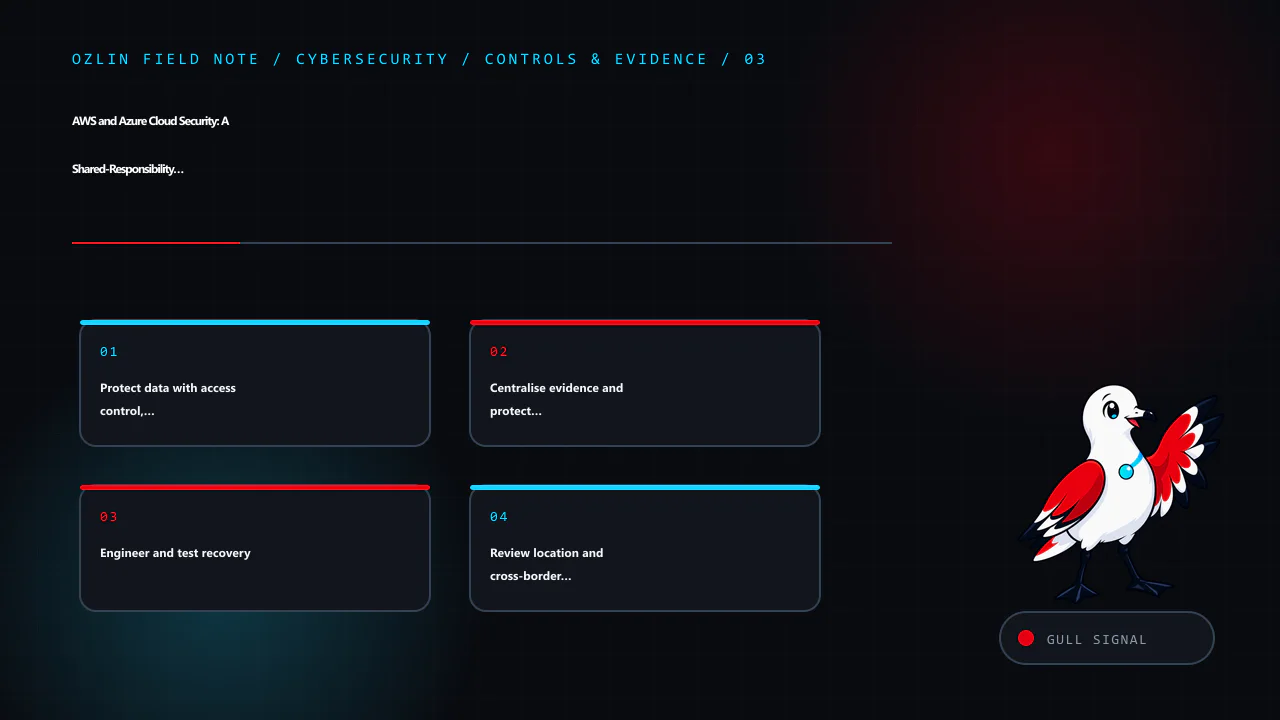
    Control and evidence map for AWS and Azure Cloud Security: A Shared-Responsibility Checklist, covering Protect data with access control, encryption and lifecycle…, Centralise evidence and protect the logging path, Engin…
    Control and evidence map: Protect data with access control, encryption and lifecycle…; Centralise evidence and protect the logging path; Engineer and test recovery; Review location and cross-border disclosure separately.

    9. Review location and cross-border disclosure separately

    Choosing an Australian region can be relevant to latency, contractual commitments, resilience and information handling. It does not prove that all support, logs, backups, administrators or subprocessors remain in Australia.

    For organisations covered by the Australian Privacy Act, APP 8 addresses cross-border disclosure of personal information and includes requirements and exceptions that depend on the circumstances (OAIC — APP 8). A region selection is not a substitute for mapping recipients, provider terms, access, subprocessors and applicable exceptions. Obtain qualified advice for legal conclusions.

    A practical review sequence

    1. Inventory production accounts, subscriptions, owners and critical data.
    2. Protect root and tenant-wide identities and establish emergency access.
    3. Remove unused credentials, public endpoints and broad permissions.
    4. Centralise control-plane and identity logs, then test alerts.
    5. Review infrastructure code and high-impact guardrails.
    6. Map sensitive data, keys, copies, transfers and deletion paths.
    7. Restore a critical workload and record the measured outcome.
    8. Track exceptions and repeat the review after material changes.

    Where Ozlin can help

    Ozlin can help a small organisation inventory AWS or Azure resources, review identity and configuration, map exposed services, check logging and document a backup/restore exercise within a written scope. Ozlin does not certify an environment, guarantee breach prevention or provide legal compliance determinations.

    See Cybersecurity services or contact Ozlin for a scoped review.

    Related reading: Eight cybersecurity priorities for Australian SMEs.

    This article is general technical information, not legal advice, certification or a warranty that a particular cloud design is secure or compliant.

    AI-assistance disclosure

    AI tools assisted with source discovery, outlining and copyediting. A human reviewer must verify every source, platform statement, service claim and publication decision before release.

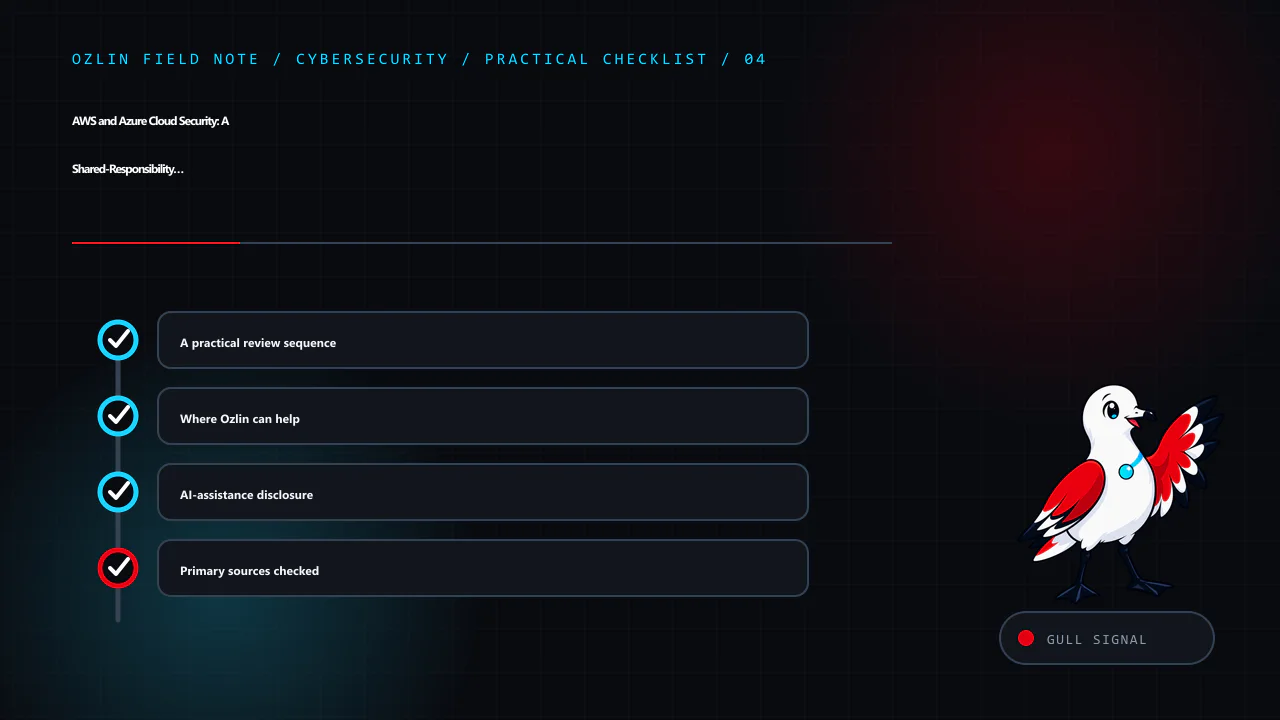
    Practical checklist for AWS and Azure Cloud Security: A Shared-Responsibility Checklist, covering A practical review sequence, Where Ozlin can help, AI-assistance disclosure and related review points.
    Practical checklist: A practical review sequence; Where Ozlin can help; AI-assistance disclosure; Primary sources checked.

    Primary sources checked

    Source access date: 29 August 2026.

  • Authorised Security Testing: Scope, Rules of Engagement and Safe Evidence

    Authorised Security Testing: Scope, Rules of Engagement and Safe Evidence

    A penetration test is not made lawful or safe by good intentions. The people who own or validly control the systems must provide written authorisation for the exact activity, assets, time and conditions. A domain appearing to belong to a client does not prove the client can authorise testing of every hosting provider, SaaS tenant, payment service, network or user behind it.

    The first deliverable in a security test is therefore a defensible scope and rules of engagement—not a scanner report.

    This article provides general technical information. It is not legal advice or permission to test any system.

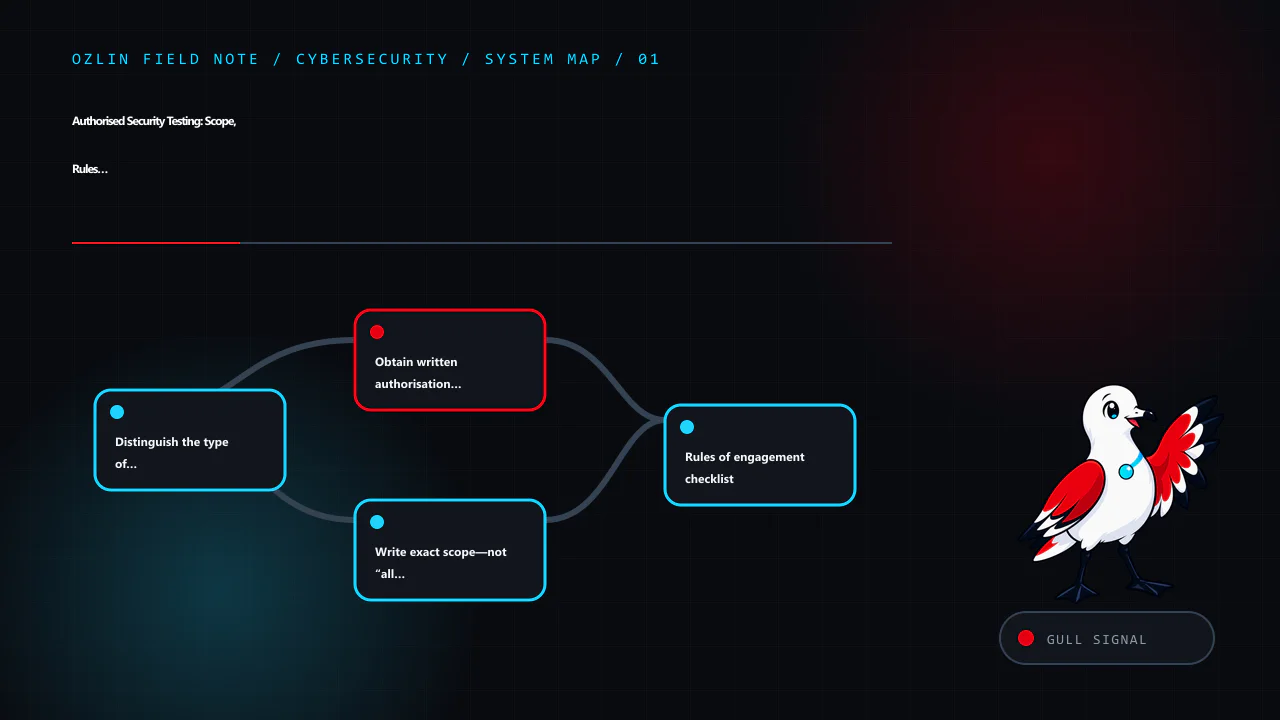
    Article map for Authorised Security Testing: Scope, Rules of Engagement and Safe Evid…, covering Distinguish the type of work, Obtain written authorisation from the right parties, Write exact scope—not “all company syst…
    Article map: Distinguish the type of work; Obtain written authorisation from the right parties; Write exact scope—not “all company systems”; Rules of engagement checklist.

    Distinguish the type of work

    Terms are often used loosely, so state what will actually occur.

    • Configuration review: compares selected settings and evidence against an agreed baseline or product guidance.
    • Vulnerability scan: uses automated checks to identify potential weaknesses; results require validation and may include false positives and false negatives.
    • Security assessment: evaluates selected controls, architecture, processes and evidence against defined objectives.
    • Penetration test: attempts controlled exploitation within written rules to demonstrate whether particular attack paths are feasible and what impact could follow.
    • Red-team exercise: tests broader detection and response against agreed objectives, usually with more realistic adversary behaviour and specialised safety governance.

    A scan is not automatically a penetration test. A penetration test is not proof that no vulnerability remains. An exercise covers only its agreed time, assets, methods and visibility.

    ASD's security-assurance guidance similarly distinguishes vulnerability assessments, penetration tests and other assurance activities, and emphasises suitable scope and assessor capability (ASD — Guidelines for security assurance).

    Obtain written authorisation from the right parties

    Before active testing, identify:

    • the legal client entity and authorised representative;
    • asset owners and operators;
    • hosting, cloud, SaaS, ISP and managed-service providers;
    • shared infrastructure and other tenants;
    • third-party code, APIs, networks and data;
    • internal system owners and change authorities; and
    • any employee, customer or member population that could be affected.

    Provider terms may prohibit or condition security testing even when a client controls a tenant. Obtain required provider approval and keep the evidence with the engagement record. If ownership or authority cannot be resolved, exclude the asset until it can.

    In Australia, the Criminal Code defines when access, modification or impairment is unauthorised and contains computer offences with specific elements and circumstances. A contract and rules of engagement help document permission, but legal effect depends on the facts and law. Seek qualified advice for uncertainty (Federal Register of Legislation — Criminal Code Act 1995, current compilation).

    Write exact scope—not “all company systems”

    Identify assets using stable, testable descriptions:

    • domain and subdomain names;
    • IP addresses and ranges;
    • cloud account, subscription, project or tenant identifiers;
    • application environments and API versions;
    • wireless locations and network names;
    • source repositories, container registries or mobile builds;
    • test accounts, roles and authentication states; and
    • explicit exclusions.

    Record how dynamic cloud addresses, content-delivery networks, redirects and newly discovered assets will be handled. Discovery of a related hostname does not expand permission. Stop and request a written scope change.

    Production and non-production environments require separate treatment. A staging system can contain production data or connect to live services; a production system can be too critical for particular techniques. Confirm the actual dependencies.

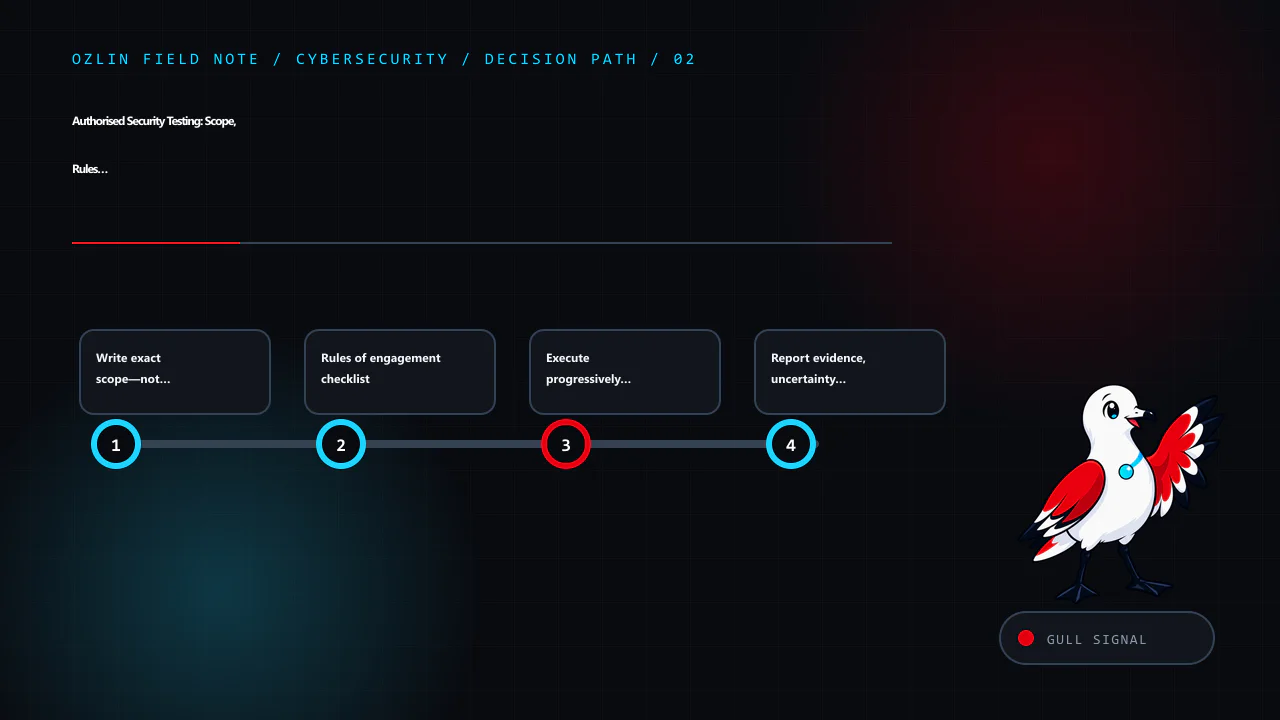
    Decision path for Authorised Security Testing: Scope, Rules of Engagement and Safe Evid…, covering Write exact scope—not “all company systems”, Rules of engagement checklist, Execute progressively and preserve safety an…
    Decision path: Write exact scope—not “all company systems”; Rules of engagement checklist; Execute progressively and preserve safety; Report evidence, uncertainty and business context.

    Rules of engagement checklist

    NIST defines rules of engagement as detailed guidelines and constraints established before a security test, giving the team authority to conduct defined activities without additional permission (NIST — Rules of Engagement definition). A practical document should cover:

    Purpose and success criteria

    • business objective and threat scenarios;
    • type and depth of test;
    • deliverables and retest conditions; and
    • what would constitute sufficient evidence without increasing harm.

    Allowed activity

    • approved assets, paths, techniques and tools;
    • authenticated and unauthenticated roles;
    • source IP addresses and tester identities;
    • test windows, time zone, rate and concurrency limits; and
    • approved test data and accounts.

    Prohibited or separately approved activity

    Unless the engagement specifically authorises and controls them, exclude:

    • denial-of-service, stress or resource-exhaustion testing;
    • destructive payloads, data modification or deletion;
    • malware deployment, persistence or actions that survive the test;
    • credential stuffing or use of credentials from unrelated breaches;
    • phishing, pretexting, physical entry or other social engineering;
    • access to real personal, health, financial or secret data beyond minimal proof;
    • testing suppliers, staff devices or neighbouring tenants; and
    • public disclosure or contact with customers, media or law enforcement.

    These activities are not prohibited because they are never useful. They require separate authority, specialist controls and a risk decision appropriate to their potential impact.

    Safety and communication

    • primary and backup contacts on both sides;
    • authenticated communication channels;
    • health checks and change freezes;
    • critical-system owners and provider escalation paths;
    • stop conditions and who can invoke them;
    • incident-versus-test differentiation; and
    • emergency restoration or credential-revocation procedures.

    Examples of stop conditions include unexpected access to highly sensitive data, service instability, possible impact to another tenant, evidence of an unrelated active compromise, loss of reliable communication or uncertainty about scope.

    Evidence and data handling

    • minimum evidence needed to substantiate a finding;
    • approved capture methods and prohibited data;
    • encrypted storage and transfer;
    • role-based access and access logging;
    • retention and verified deletion dates;
    • treatment of credentials, tokens, keys and screenshots; and
    • procedure for reporting accidental access or a high-impact finding.

    Do not copy entire databases to prove that one record was accessible. Prefer metadata, a controlled test record, a redacted screenshot, a hash or another minimal artefact when it provides adequate evidence.

    Execute progressively and preserve safety

    Begin with passive review and low-impact discovery, then move to increasingly active techniques only where the rules allow and previous evidence justifies it.

    A typical controlled sequence is:

    1. Validate written scope, contacts and target ownership.
    2. Record the starting configuration and service health.
    3. Map approved attack surfaces and authentication states.
    4. Run limited checks at agreed rates.
    5. Validate likely findings to reduce false positives.
    6. Demonstrate impact using the least harmful sufficient proof.
    7. Notify the client immediately when the agreed severity or safety trigger is reached.
    8. Remove test accounts, artefacts and changes; confirm restoration.
    9. Reconcile and protect evidence.

    The OWASP Web Security Testing Guide provides structured test areas for web applications, but it is a methodology reference—not permission, a universal checklist or a substitute for system-specific threat modelling (OWASP Web Security Testing Guide).

    Report evidence, uncertainty and business context

    Each finding should state:

    • affected asset and tested condition;
    • evidence collected and time observed;
    • prerequisite access or assumptions;
    • plausible impact without exaggeration;
    • confidence and limitations;
    • prioritised remediation options;
    • owner and target decision date; and
    • retest result when completed.

    Separate confirmed findings from unvalidated scanner output. A severity score can support prioritisation, but business exposure, exploit preconditions, existing controls, data sensitivity and operational consequences still require analysis.

    Also document what was not tested. A clear limitations section prevents the report from being read as a certification that the environment is free of vulnerabilities.

    Control and evidence map for Authorised Security Testing: Scope, Rules of Engagement and Safe Evid…, covering Execute progressively and preserve safety, Report evidence, uncertainty and business context, Retesting close…
    Control and evidence map: Execute progressively and preserve safety; Report evidence, uncertainty and business context; Retesting closes findings, not risk forever; Ozlin's current public service boundary.

    Retesting closes findings, not risk forever

    A retest should reproduce the original condition where safe, verify the intended control and check for obvious regression or workaround paths within scope. Record whether the issue is resolved, partially resolved, accepted, transferred or still open.

    The result applies to the tested version and time. New code, configuration, dependencies, identities and threat conditions can change exposure immediately afterward.

    Ozlin's current public service boundary

    Subject to a signed scope and capability assessment, Ozlin may offer small-business work such as:

    • WordPress, server and cloud configuration review;
    • scoped vulnerability scanning and validation;
    • authenticated web-security checks using agreed test accounts;
    • internet-exposure and identity-permission review;
    • backup and restore evidence exercises; and
    • hardening recommendations with a documented retest.

    Ozlin does not offer destructive payloads, denial-of-service, covert persistence, unauthorised testing, surprise social engineering or real-data extraction as routine services. Specialist or higher-risk work requires separate assessment and may be declined or referred.

    See Cybersecurity services or contact Ozlin to define a written scope.

    Related reading: Cybersecurity fundamentals for business risk.

    This article is general information, not legal advice, authorisation, certification or a promise that a test will identify every vulnerability.

    AI-assistance disclosure

    AI tools assisted with source discovery, outlining and copyediting. A qualified human reviewer must verify every legal statement, scope rule, source, service capability and publication decision before release.

    Practical checklist for Authorised Security Testing: Scope, Rules of Engagement and Safe Evid…, covering Retesting closes findings, not risk forever, Ozlin's current public service boundary, AI-assistance disclosure and…
    Practical checklist: Retesting closes findings, not risk forever; Ozlin's current public service boundary; AI-assistance disclosure; Primary sources checked.

    Primary sources checked

    Source access date: 29 August 2026.

  • Cybersecurity Fundamentals for Small Business Owners

    Cybersecurity Fundamentals for Small Business Owners

    Cybersecurity becomes easier to manage when it is translated from technical products into business questions:

    • What services and information matter?
    • What could go wrong, and what would the impact be?
    • Who owns the decision?
    • Which safeguards are proportionate?
    • How will we know they are operating?
    • How will the business respond and recover when prevention is not enough?

    These are fundamentals because they remain useful when products, threats and business models change. They also prevent a common mistake: buying a tool before defining the problem it is supposed to reduce.

    Article map for Cybersecurity Fundamentals for Small Business Owners, covering Begin with business outcomes and risk, Confidentiality, integrity and availability, Use six functions to avoid prevention-only security and…
    Article map: Begin with business outcomes and risk; Confidentiality, integrity and availability; Use six functions to avoid prevention-only security; Controls need layers, owners and evidence.

    Begin with business outcomes and risk

    A risk discussion needs context. A public brochure website, an accounting platform, a developer's source-code repository and a health-services booking system do not have the same data, dependencies or consequences.

    List the activities the business must continue and the technology, people, data and suppliers that support them. For each important scenario, describe the plausible business impact: interrupted delivery, fraudulent payment, lost records, exposed personal information, unsafe decisions, contractual breach or reputational harm. Estimate likelihood only as carefully as the available evidence allows; false precision does not improve the decision.

    Record a responsible owner and a chosen treatment. The business might reduce the risk, avoid the activity, transfer some financial consequences through contract or insurance, or consciously accept residual risk. Acceptance should be an informed business decision with a review date—not what happens silently when nobody acts.

    NIST describes its Cybersecurity Framework 2.0 as a taxonomy of high-level outcomes for organisations of any size to understand, assess, prioritise and communicate cybersecurity work. The framework is deliberately non-prescriptive: it describes desired outcomes rather than requiring one product or implementation (NIST CSF 2.0).

    Confidentiality, integrity and availability

    Three enduring security objectives are confidentiality, integrity and availability, often shortened to CIA (NIST glossary). In practical terms:

    • Confidentiality: information is not disclosed to people or systems that should not receive it. Examples include protecting credentials and limiting access to client records.
    • Integrity: information and systems are accurate and changed only in authorised ways. Examples include detecting altered bank details, unauthorised website changes or tampered backups.
    • Availability: authorised users can access the service or information when the business needs it. Examples include recovering invoices after device failure or continuing customer communication during an email outage.

    The priorities vary by service. Encryption can protect confidentiality in storage or transit, but it does not ensure that a compromised authorised account uses the data correctly. A backup can support availability, but an untested or attacker-accessible backup may not recover the business. A control should be connected to a specific objective and failure scenario.

    Other concepts fit around the same model. Identification claims who a user or system is. Authentication checks that claim. Authorisation decides what the authenticated identity may do. Accountability depends on records that are reliable enough to connect important actions with identities and time. None of these should be described as absolute “non-repudiation” unless the specific technical and legal context supports that conclusion.

    Use six functions to avoid prevention-only security

    NIST CSF 2.0 groups outcomes into six concurrent functions: Govern, Identify, Protect, Detect, Respond and Recover. Govern was made explicit in version 2.0 because cybersecurity risk belongs in organisational decision-making, alongside operational, financial and reputational risk (NIST CSF 2.0 overview).

    For a small business, the functions can be translated as follows:

    1. Govern: set risk ownership, priorities, policy, supplier expectations and relevant legal or contractual obligations.
    2. Identify: know critical assets, data flows, dependencies, vulnerabilities and plausible threats.
    3. Protect: apply safeguards such as MFA, least privilege, secure configuration, patching, backups and staff procedures.
    4. Detect: collect and review useful signals, including privileged sign-ins, backup failures and unexpected account or data changes.
    5. Respond: assess, contain, communicate, preserve evidence and coordinate the people needed during an incident.
    6. Recover: restore services and information, communicate appropriately and improve the plan from lessons learned.

    The functions happen together. Recovery cannot wait until after an incident to be designed, and detection cannot be improvised from logs that were never enabled.

    Decision path for Cybersecurity Fundamentals for Small Business Owners, covering Use six functions to avoid prevention-only security, Controls need layers, owners and evidence, Build a current profile and a target profi…
    Decision path: Use six functions to avoid prevention-only security; Controls need layers, owners and evidence; Build a current profile and a target profile; Ask better questions of suppliers and security tools.

    Controls need layers, owners and evidence

    Controls can be administrative, technical or physical. A payment-fraud risk might be reduced by a written approval process, independent callback, role-based access, email protections and staff reporting. If one layer fails, another can still limit harm.

    Avoid treating familiar tools as complete solutions:

    • A firewall filters defined traffic; it does not make an allowed application secure.
    • Endpoint security can detect some malicious activity; it does not prove an endpoint is uncompromised.
    • A VPN protects a connection in particular circumstances; it does not make an untrusted device or fraudulent website safe.
    • Encryption protects data under defined conditions; it does not correct excessive access or a stolen authorised session.
    • Training supports decisions; it should not be the only control protecting a high-value payment.

    Every important control needs an owner, an expected operating state and evidence. Evidence might be a current access review, a successful restore test, patch-status records, a verified alert, an incident-exercise result or a supplier report. ASD's Essential Eight assessment guidance emphasises credible evidence when assessing both implementation and control effectiveness (ASD's ACSC Essential Eight assessment process guide).

    Build a current profile and a target profile

    A practical first assessment can fit in a short table:

    Business outcome Current state Target state Evidence Owner Due date
    Important accounts resist password theft MFA varies by service MFA on all high-impact accounts; recovery methods reviewed Provider export and access review Operations owner Set locally
    Critical records can be restored Backups report success A clean restore is demonstrated within the required time Dated restore-test record System owner Set locally
    Payment changes are independently verified Informal checking Known-number callback and second approval Sampled approval record Finance owner Set locally
    Incidents can be escalated Contacts are scattered Offline contact list and exercised response plan Exercise notes and actions Business owner Set locally

    NIST calls these Current and Target Profiles. Comparing them helps expose gaps and build an action plan aligned with business needs, risk tolerance and resources (NIST CSF frequently asked questions). Do not copy somebody else's target blindly; sector obligations, client contracts, technical complexity and threat exposure can justify a different outcome.

    Ask better questions of suppliers and security tools

    Before buying a product or managed service, ask:

    • Which documented risk and target outcome does this address?
    • What data and administrator access will the supplier receive?
    • How are privileged actions authenticated and logged?
    • What happens when the supplier or integration is unavailable?
    • How are vulnerabilities, incidents and material changes communicated?
    • Can the business export its data and logs in a usable form?
    • What evidence will show that the control works after deployment?
    • Who remains responsible for configuration, monitoring and recovery?

    A contract can allocate tasks, but outsourcing does not remove the need to understand critical dependencies. NIST's small-business material similarly recommends considering business objectives, high-value assets, obligations and dependencies before deciding whether to build capability internally or outsource it (NIST small-business team guidance).

    Control and evidence map for Cybersecurity Fundamentals for Small Business Owners, covering Build a current profile and a target profile, Ask better questions of suppliers and security tools, Establish a small operating…
    Control and evidence map: Build a current profile and a target profile; Ask better questions of suppliers and security tools; Establish a small operating rhythm; General-information disclaimer.

    Establish a small operating rhythm

    Security improves through repeated, owned work:

    • Monthly: review critical alerts, failed backups, privileged accounts, new integrations and overdue high-priority actions.
    • Quarterly or risk-based: test a restore, review access, sample payment verification and rehearse one incident scenario.
    • On material change: review risks when adopting a new SaaS platform, collecting new data, exposing a service to the internet or changing a critical supplier.
    • After an incident or exercise: record what happened, which assumptions failed and which change has an owner and date.

    The related Australian SME cybersecurity baseline turns these principles into an implementation sequence. The phishing response playbook covers one common scenario in more depth.

    For help defining a proportionate target state and evidence plan, see Ozlin Info's cybersecurity uplift service or contact Ozlin Info.


    General-information disclaimer

    This article provides general information only. It is not legal, privacy, insurance, compliance, financial or incident-response advice, and it does not establish that any control set is sufficient for a particular organisation. Appropriate safeguards depend on your data, systems, contracts, sector, threat exposure and risk decisions.

    AI-assistance disclosure

    AI tools assisted with outlining and copyediting this draft. A human reviewer must verify every factual claim, link, scope statement and publication decision before release. The draft avoids product endorsements and does not promise prevention or compliance.

    Practical checklist for Cybersecurity Fundamentals for Small Business Owners, covering Establish a small operating rhythm, General-information disclaimer, AI-assistance disclosure and related review points.
    Practical checklist: Establish a small operating rhythm; General-information disclaimer; AI-assistance disclosure; Primary sources checked.

    Primary sources checked

    Source access date: 28 August 2026.

  • Cyber Insurance for Australian Small Businesses: A Reading Checklist

    Cyber Insurance for Australian Small Businesses: A Reading Checklist

    Cyber insurance transfers defined financial risks under a contract. It does not make an insecure system safe, guarantee that every incident is covered or replace legal, privacy, continuity and incident-response work. Two products carrying the same label can differ materially in definitions, triggers, exclusions, sublimits, excesses and response providers.

    For an Australian small business, the practical task is to map its own loss scenarios, read the complete policy pack and rehearse how a claim would begin. Premium anecdotes and headline coverage figures cannot do that work.

    Article map for Cyber Insurance for Australian Small Businesses: A Reading Checklist, covering Map the exposure before asking for a quote, Read the complete contract stack, Turn coverage headings into questions and rela…
    Article map: Map the exposure before asking for a quote; Read the complete contract stack; Turn coverage headings into questions; Inspect exclusions, timing and aggregation.

    Map the exposure before asking for a quote

    Describe the systems and dependencies that could stop revenue, expose data or create liability:

    • customer, employee, payment and credential data held by the business or a provider;
    • websites, cloud tenants, email, endpoints, backups and remote access;
    • outsourced hosting, managed services, software and payment platforms;
    • maximum tolerable downtime and critical manual workarounds;
    • contractual security, notification and indemnity commitments; and
    • plausible events such as business email compromise, ransomware, accidental disclosure, provider outage or stolen credentials.

    Estimate losses by scenario rather than choosing a round limit. Separate restoration and specialist-response cost, lost gross profit, extra expense, customer or regulator communication, third-party claims and fraud. Record the assumptions and run a range. Insurance may address some categories and exclude or sublimit others.

    The Australian Government’s business insurance overview says cyber cover can include costs associated with extortion, interruption, network or data breaches, recovery and accidental loss or release of personal information. “Can include” is the important phrase; the actual contract controls.

    Read the complete contract stack

    Do not assess a product from the quote summary alone. Obtain and read the Product Disclosure Statement or policy wording, quotation, schedule, endorsements and any proposal or application incorporated into the contract. Confirm which document prevails if terms conflict.

    The schedule normally personalises items such as the insured entity, period, limits, sublimits and excess. Endorsements can add, remove or rewrite cover. Definitions can change the ordinary meaning of terms such as computer system, insured data, security failure, dependent business, claim or loss.

    Business.gov.au’s insurance-management guidance recommends understanding covered events, exclusions, definitions, settlement, excess, cancellation, disclosure duties and the complaints process. Ask a licensed broker or authorised insurer to explain anything unclear and retain the answer in writing.

    Turn coverage headings into questions

    For each relevant loss scenario, ask where and how it is addressed:

    Incident response and recovery

    • Are forensic investigation, legal triage, data restoration, crisis communications and customer support covered?
    • Must the insured use a panel provider or obtain consent before spending?
    • Are emergency costs before consent treated differently?
    • Does restoration include only data, or also software, configuration and improved replacement?

    Business interruption

    • What event triggers cover, when does the waiting period start, and how is loss calculated?
    • Are outages at named cloud, software or managed-service providers included?
    • Is there a maximum indemnity period or sublimit for dependent business interruption?

    Privacy, network and media liability

    • Which third-party allegations and defence costs are included?
    • Are defence costs inside or outside the limit?
    • How are investigations, notification expenses, contractual liability and payment-card assessments treated?
    • Are fines or penalties covered only where legally insurable, or excluded?

    Extortion, fraud and funds transfer

    • Does the policy cover response advice and negotiation, and what legal, sanctions and consent conditions apply?
    • Is fraudulent transfer or social-engineering loss included, separately sublimited or excluded?
    • Does a loss caused by impersonation without a network intrusion meet the definition of a cyber event?

    Never assume that ransomware payment is lawful, advisable or recoverable. Escalate to the insurer’s response service, legal adviser and relevant authorities rather than improvising.

    Decision path for Cyber Insurance for Australian Small Businesses: A Reading Checklist, covering Read the complete contract stack, Turn coverage headings into questions, Inspect exclusions, timing and aggregation and re…
    Decision path: Read the complete contract stack; Turn coverage headings into questions; Inspect exclusions, timing and aggregation; Make the application match reality.

    Inspect exclusions, timing and aggregation

    Compare exclusions against the risk map. Common areas requiring close reading include prior known circumstances, unsupported software, failure to maintain declared controls, infrastructure or utility failure, war or cyber-operation wording, bodily injury or property damage, professional services, intellectual property, contractually assumed liability and conduct exclusions. Their scope varies; the label alone is not enough.

    Ask which sections are claims-made and notified, what counts as a claim or circumstance, whether a retroactive date applies and how soon notice must be given. Check territorial and jurisdiction limits. Understand whether multiple events are aggregated into one claim, one excess or one limit.

    Compare the main aggregate limit with every sublimit. A policy advertised with a large headline limit may apply much smaller amounts to social engineering, dependent providers, restoration, notification, reputational harm or voluntary shutdown. Record waiting periods, excesses and coinsurance as well as dollars.

    Make the application match reality

    Insurance applications may ask about multi-factor authentication, backups, endpoint protection, patching, privileged access, remote access, email controls, training and incident history. Answer accurately, identify uncertainty and keep evidence. Do not check “yes” because a control exists somewhere; confirm its scope, enforcement and exceptions.

    Maintain those controls after inception and notify the broker or insurer of material changes when the contract requires it. Keep versioned network diagrams, asset records, backup and restore tests, security policies, training records and remediation tickets. These artefacts support operations first and may also help explain a claim.

    ASD’s Australian Cyber Security Centre recommends small businesses start with multi-factor authentication, updates and backups, then build further resilience through its Small Business Cyber Security Guide. Insurance is one treatment alongside those controls, not an alternative to them.

    Rehearse notification before an incident

    Store the policy number, broker, insurer hotline, panel contacts and notification method somewhere available when normal systems are down. Define who can call, who preserves evidence and who approves emergency work. The first technical instinct—rebuilding or deleting—can destroy evidence or conflict with response instructions.

    Privacy obligations depend on the organisation and activity. Most Australian small businesses with annual turnover of $3 million or less are not covered by the Privacy Act, but important exceptions apply. Use the OAIC’s small-business guidance and obtain advice rather than assuming an exemption.

    For entities covered by the Notifiable Data Breaches scheme, notification is required for eligible breaches likely to cause serious harm when remedial action has not removed that likely risk. The OAIC’s NDB guidance explains the threshold and assessment process. Contractual, sector and insurer notice requirements can be different and earlier.

    At renewal, compare changed systems, revenue, data, providers, incidents and contract obligations against the wording. Verify the insurer on APRA’s general-insurer register and a broker or other financial-services provider through ASIC’s professional registers where applicable.

    For help improving the technical controls and incident evidence behind an application, see Ozlin Info’s cybersecurity services or contact Ozlin Info.

    Related reading: cybersecurity priorities for Australian SMEs and a phishing response playbook.


    Control and evidence map for Cyber Insurance for Australian Small Businesses: A Reading Checklist, covering Inspect exclusions, timing and aggregation, Make the application match reality, Rehearse notification before an…
    Control and evidence map: Inspect exclusions, timing and aggregation; Make the application match reality; Rehearse notification before an incident; General-information disclaimer.

    General-information disclaimer

    This article provides general information only and is not financial product advice, legal advice, insurance advice or a statement about any Ozlin Info policy. Cover depends on the complete wording, schedule, endorsements, facts and applicable law. Consult a licensed broker, authorised insurer and qualified legal or privacy adviser for your circumstances.

    AI-assistance disclosure

    AI tools assisted with source discovery, outlining and copyediting. A human reviewer must verify every policy, legal, privacy and incident-response statement against current official guidance and the complete proposed contract before publication or use.

    Practical checklist for Cyber Insurance for Australian Small Businesses: A Reading Checklist, covering Rehearse notification before an incident, General-information disclaimer, AI-assistance disclosure and related revie…
    Practical checklist: Rehearse notification before an incident; General-information disclaimer; AI-assistance disclosure; Primary sources checked.

    Primary sources checked

    Source access date: 29 August 2026.

  • Phishing Response Playbook for Australian Small Businesses

    Phishing Response Playbook for Australian Small Businesses

    The most valuable phishing response is not a perfect employee who never makes a mistake. It is a business process that makes suspicious activity easy to report, limits what one mistake can expose and helps the response team act quickly without blame.

    Phishing is broader than a poorly written email. Socially engineered messages can arrive by email, SMS, chat, QR code or phone and may ask a person to open a file, visit a website, share credentials or verification codes, install software, approve an MFA prompt, transfer money or change bank details. ASD's Australian Cyber Security Centre (ASD's ACSC) updated its guidance in April 2026 to include unsolicited “support”, device-linking requests, QR codes and registration or verification codes (ASD's ACSC detecting socially engineered messages).

    Good spelling is not evidence that a message is legitimate. Treat context and requested action as more important than appearance.

    Article map for Phishing Response Playbook for Australian Small Businesses, covering Before an incident: make the safe action the easy action, Recognise the request, not just the design, Response path 1: the message arr…
    Article map: Before an incident: make the safe action the easy action; Recognise the request, not just the design; Response path 1: the message arrived, but nobody interacted; Response path 2: somebody clicked a link, but entered nothi….

    Before an incident: make the safe action the easy action

    Give every worker one obvious reporting route—a mail-client report button, a dedicated address or a help-desk option—and tell them what happens next. A report should be welcomed even when the message proves harmless. If people fear embarrassment or punishment, they may hide the event until damage becomes harder to contain.

    Put independent verification into business processes, especially payments, payroll, credential resets, customer-data exports and changes to supplier details. A callback must use a number obtained from an existing trusted record or official website, not the number in the suspicious message. ASD's business email compromise guidance recommends a clear and consistent process to verify payment and sensitive-information requests (ASD's ACSC BEC guidance).

    Technical layers still matter: MFA, unique credentials in a password manager, restricted administrator access, supported updates, endpoint protection, email filtering and domain authentication. None proves that every delivered message is safe. Pair controls with logging and an escalation path so the business can investigate account changes, new sessions and unusual mailbox rules.

    Recognise the request, not just the design

    Pause when a message introduces one or more of these conditions:

    • an unexpected change to bank or supplier details;
    • urgency, secrecy, authority or pressure to bypass a normal approval;
    • an unexpected attachment, shared document, QR code or login link;
    • a request for a password, recovery code, MFA approval or remote access;
    • “support” that contacts you first and asks you to install software or link a device;
    • a sender name that looks familiar but a domain, reply address or conversation context that does not; or
    • a request that is plausible but unusual for that person, customer or supplier.

    When uncertain, go independently to the organisation's official website or app, or call a known number. ASD advises users not to enter credentials into a website reached through a message link and to use an out-of-band contact method to confirm unexpected attachments or requests (ASD's ACSC detection guidance).

    Response path 1: the message arrived, but nobody interacted

    Do not reply, click, scan the QR code, call a supplied number or forward the message casually. Use the organisation's reporting method. Where an IT or security team may need headers or the original item, follow its preservation instructions rather than deleting the evidence immediately; ASD's guidance tells workers who suspect a socially engineered message not to delete or forward it, but to contact their IT help desk or security team.

    The person handling the report should check whether other staff received the same campaign, block known malicious indicators where appropriate and warn the specific people who may be targeted. Avoid sending a clickable malicious link in the warning.

    Response path 2: somebody clicked a link, but entered nothing

    Report the event immediately and record the time, device, account, message and observed page. A click does not by itself establish that the device or account is compromised, but it warrants triage. Do not keep browsing the page to “test” it.

    If a download ran, an attachment opened, software was installed, a browser extension appeared or the device behaves unexpectedly, stop using the device and contact the response owner. Isolate it from normal business connectivity if the response procedure calls for that. Do not use a potentially compromised device to reset important credentials.

    Decision path for Phishing Response Playbook for Australian Small Businesses, covering Response path 1: the message arrived, but nobody interacted, Response path 2: somebody clicked a link, but entered nothi…, Response…
    Decision path: Response path 1: the message arrived, but nobody interacted; Response path 2: somebody clicked a link, but entered nothi…; Response path 3: a password, code or MFA approval was provi…; Response path 4: an attachment or remote-support tool may h….

    Response path 3: a password, code or MFA approval was provided

    Treat the account as potentially compromised. From a known-clean device and trusted route to the service:

    1. contact the internal response owner or provider;
    2. change the affected credential and any reused credential;
    3. sign out or revoke other sessions and tokens where the service supports it;
    4. verify recovery email addresses, phone numbers, MFA methods and delegated access;
    5. check for new mailbox forwarding rules, filters, application permissions and administrators;
    6. review available sign-in and audit logs; and
    7. preserve a timeline of what was observed and changed.

    ASD's recovery guidance for business email compromise specifically includes changing the passphrase, checking recovery details, signing out other sessions and enabling MFA (ASD's ACSC BEC recovery guidance). If the account can reset other services, assess those services too.

    Response path 4: an attachment or remote-support tool may have executed

    Separate the affected device from business networks without wiping or “cleaning” it first, unless qualified responders direct otherwise. Record what ran and when. Preservation matters because logs and files may be needed to establish scope. The response team can then decide whether to collect evidence, scan, rebuild or restore the device.

    Change exposed credentials from a clean device, not from the suspected endpoint. Review access from the device to file shares, cloud storage, password stores and administrative systems. A factory reset or antivirus scan alone does not establish what data or credentials were accessed.

    Response path 5: money, bank details or identity information may be at risk

    Contact the financial institution immediately using an independently verified number. Ask about recalling or stopping the transaction and securing affected accounts. Notify the legitimate supplier or customer through a trusted channel. Preserve invoices, account details, message headers and the sequence of approvals; do not continue negotiating with the suspected sender.

    Report cybercrime through ReportCyber or seek help from the 24/7 Australian Cyber Security Hotline on 1300 CYBER1 (1300 292 371). ASD also directs people whose identity information is at risk towards relevant support services, including IDCARE (ASD's ACSC hacking recovery guidance). Call 000 if there is an immediate threat to life or safety.

    Assess privacy and notification obligations—do not guess

    Determine what information and people may be affected, who may have accessed it, whether access was prevented or remediated and what harm could result. Preserve the basis for the decision.

    Not every phishing event is an eligible data breach. For entities covered by the Notifiable Data Breaches scheme, however, reasonable grounds to suspect a serious breach trigger an assessment obligation. The OAIC says the entity must take all reasonable steps to complete that assessment within 30 calendar days and should treat that period as a maximum, not a waiting period (OAIC data-breach preparation and response guide). Obtain appropriate legal or privacy advice when the facts or obligations are unclear.

    Control and evidence map for Phishing Response Playbook for Australian Small Businesses, covering Response path 4: an attachment or remote-support tool may h…, Response path 5: money, bank details or identity informatio…
    Control and evidence map: Response path 4: an attachment or remote-support tool may h…; Response path 5: money, bank details or identity informatio…; Assess privacy and notification obligations—do not guess; Run a 20-minute rehearsal.

    Run a 20-minute rehearsal

    Use a fictional supplier email requesting an urgent bank-detail change. Ask the team:

    • How does the recipient report it?
    • Who independently verifies the request?
    • Who checks accounts, sessions and mail rules?
    • Who calls the bank and supplier if payment was made?
    • Where is evidence recorded?
    • Who assesses customers, contracts and privacy obligations?
    • What continues if email is temporarily unavailable?

    Record owners and gaps, then repeat the exercise after changes. This article supports the broader Australian SME cybersecurity baseline. For a scoped review of account, email and incident-response controls, see Ozlin Info's cybersecurity uplift service or contact Ozlin Info.


    General-information disclaimer

    This article provides general information only. It is not legal, privacy, insurance, financial, forensic or incident-response advice. Do not delay urgent assistance to follow a generic checklist. The appropriate actions depend on the message, device, accounts, data, contracts and active threat.

    AI-assistance disclosure

    AI tools assisted with outlining and copyediting this draft. A human reviewer must verify every factual claim, link, response step and publication decision before release. No claim is made that following this playbook will prevent or fully contain an incident.

    Practical checklist for Phishing Response Playbook for Australian Small Businesses, covering Run a 20-minute rehearsal, General-information disclaimer, AI-assistance disclosure and related review points.
    Practical checklist: Run a 20-minute rehearsal; General-information disclaimer; AI-assistance disclosure; Primary sources checked.

    Primary sources checked

    Source access date: 28 August 2026.