
Evidence notice: this is a hypothetical worked example, not an Ozlin Info client case study. The organisation, volumes, times, costs and results below are invented to demonstrate a calculation method. They must not be quoted as customer outcomes or service guarantees.
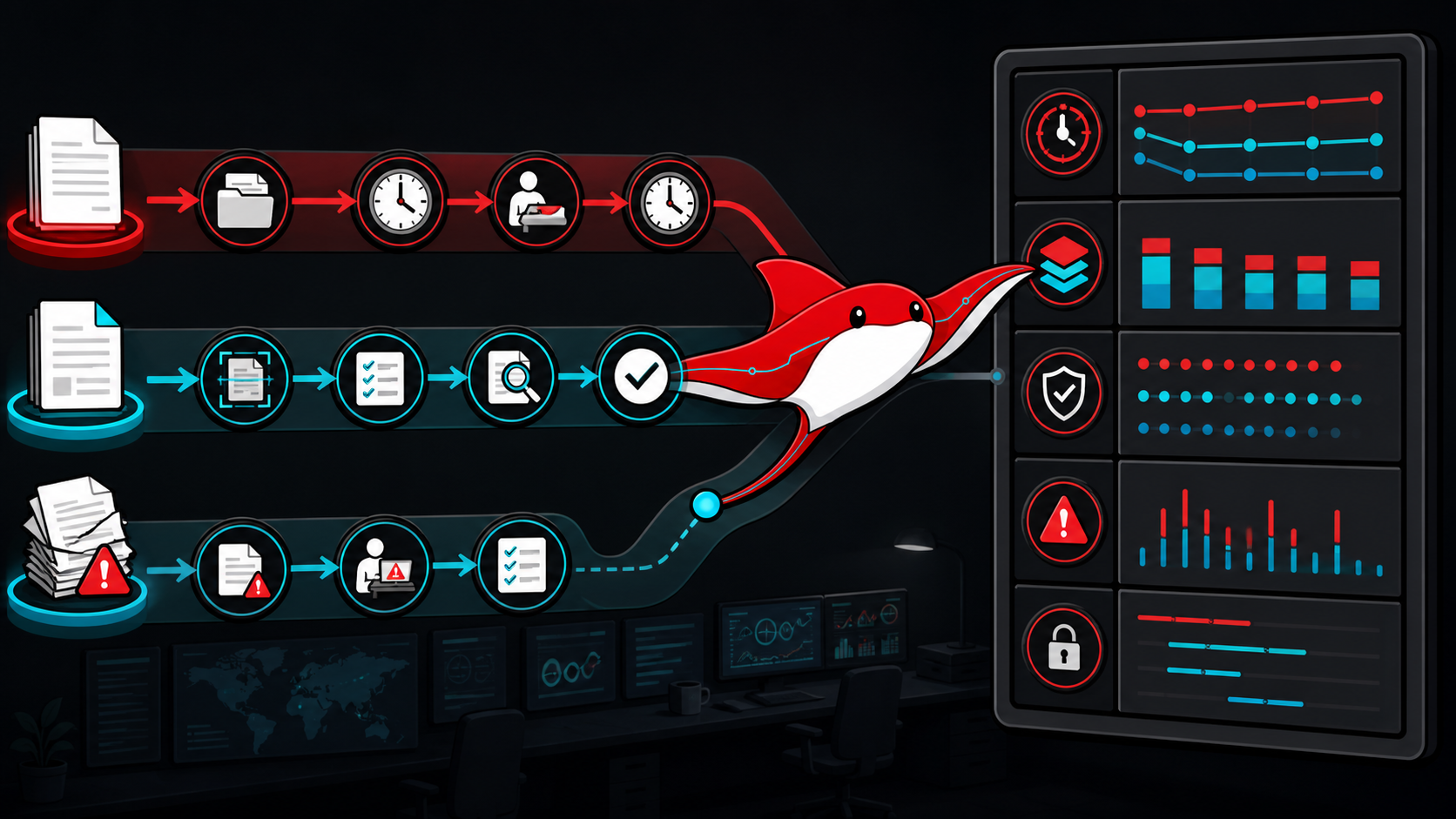
Document processing can be a useful automation target because the work is repeated and measurable: receive a file, classify it, extract fields, validate them, route an exception and post approved data into another system. The business case fails, however, when it counts only model accuracy or theoretical staff minutes and ignores review, integration, privacy, failures and ongoing operation.
Treat return on investment as an evidence workbook, not a marketing percentage.
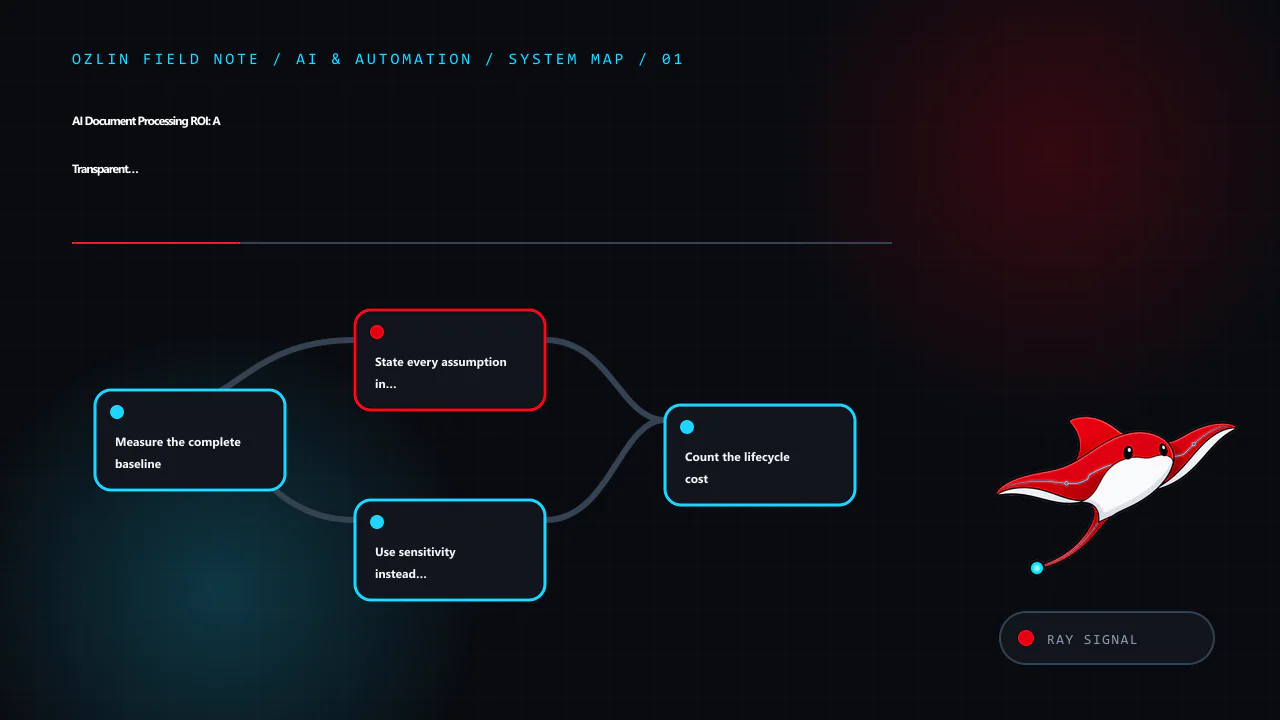
Measure the complete baseline
Define where the process starts and ends. For invoice handling, “start” might be receipt in an approved mailbox and “end” might be a validated record ready for authorisation, with the source attached and duplicate checks complete. Include:
- intake and file preparation;
- classification and field entry;
- supplier, tax and purchase-order checks;
- exception research and correction;
- approvals, export and reconciliation;
- rework caused by downstream rejection; and
- supervision, reporting and incident handling.
Sample several representative periods rather than timing a convenient clean batch. Stratify by source, document type, supplier, language, page count and difficulty. Record volume, end-to-end cycle time, hands-on minutes, error and rework definitions, exception reason and downstream consequence.
A loaded labour cost should reflect the employer’s actual planning method; it is not the employee’s wage and not necessarily a cash saving. If automation frees time but headcount and hours remain unchanged, the benefit is capacity that must be assigned to useful work before it becomes economic value.
State every assumption in the worked example
Assume a fictional Australian business processes 1,000 documents per month. The measured baseline averages 6 hands-on minutes per document and the planning value of that time is AUD 55 per hour. All figures are illustrative, before tax and rounded.
Baseline monthly labour cost:
1,000 documents × 6 minutes ÷ 60 × AUD 55 = AUD 5,500Assume the implementation—including workflow design, integration, test data preparation, security review, training and launch support—costs AUD 18,000. Do not hide this in a separate “digital transformation” budget.
After a controlled pilot, suppose the expected case measures 2.5 average hands-on minutes per document across both straight-through and exception work. The monthly operating cost for software, model or API use, storage, monitoring and support is AUD 1,400.
new labour = 1,000 × 2.5 ÷ 60 × AUD 55 = AUD 2,291.67
new monthly cost = AUD 2,291.67 + AUD 1,400 = AUD 3,691.67
monthly net benefit = AUD 5,500 - AUD 3,691.67 = AUD 1,808.33
simple payback = AUD 18,000 ÷ AUD 1,808.33 = 9.95 months
Simple payback ignores the timing of cash flows, financing, tax, risk, residual value and whether released capacity is realised. It is one planning lens, not a financial recommendation.
Use sensitivity instead of one attractive answer
The same fictional case changes sharply when handling time and operating cost move:
| Scenario | Assisted minutes per document | Monthly operating cost | Monthly net benefit | Simple payback |
|---|---|---|---|---|
| Conservative | 4.0 | AUD 1,600 | AUD 233.33 | 77.1 months |
| Expected | 2.5 | AUD 1,400 | AUD 1,808.33 | 10.0 months |
| Optimistic | 1.8 | AUD 1,200 | AUD 2,650.00 | 6.8 months |
The conservative result is close to break-even because exception work consumes most of the theoretical saving. That is precisely why a range is more useful than a claimed “92% accuracy” or an untraceable payback figure.
Add sensitivity for volume, staffing cost, supplier pricing, exchange rates, implementation overrun and adoption. Show the point at which the project no longer meets the organisation’s hurdle. A decision-maker should be able to change one input and reproduce every output.
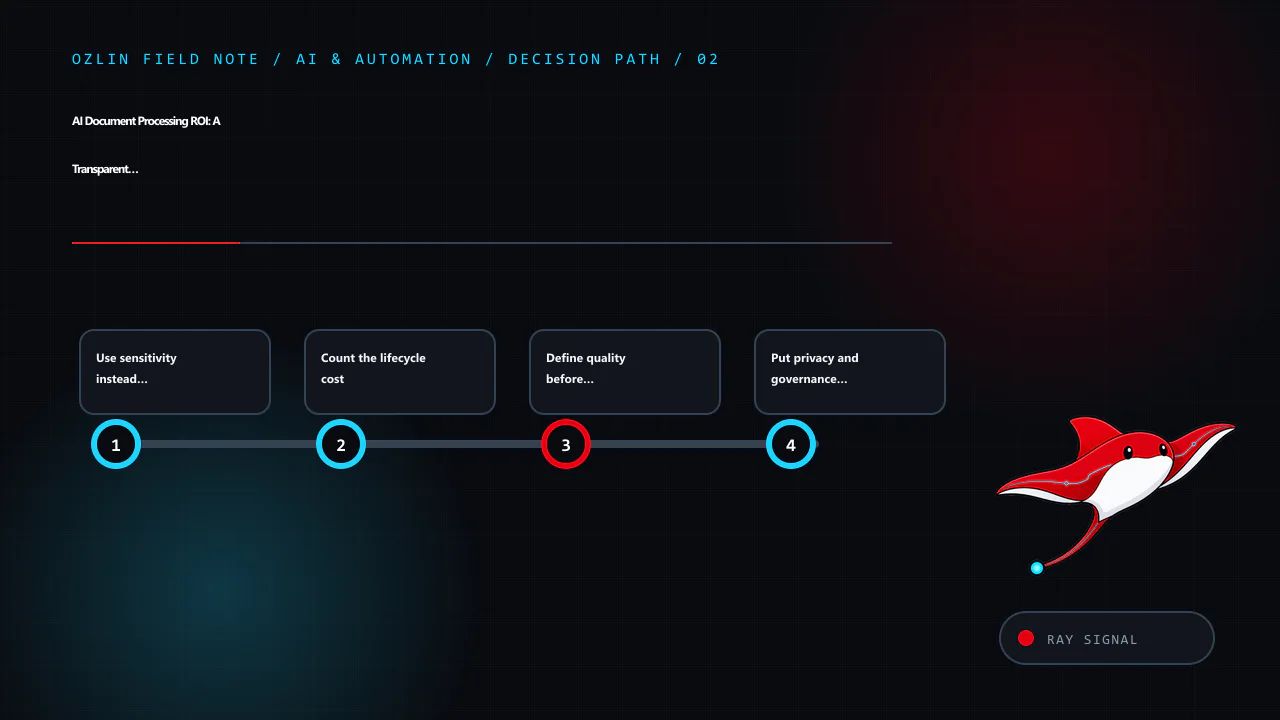
Count the lifecycle cost
A defensible model includes:
- discovery, process redesign and data cleanup;
- scanning, email or upload integration;
- workflow, accounting or records-system integration;
- licences, model/API usage, compute, storage and network transfer;
- human validation and exception queues;
- security, privacy and access-control work;
- evaluation data, regression testing and change approval;
- monitoring, support, retraining or prompt/configuration maintenance;
- vendor exit, export and rollback; and
- staff training and temporary productivity loss during transition.
Separate fixed implementation cost from variable and recurring cost. Measure per-document cost at current and stress volumes. A low unit price can be irrelevant if a provider outage blocks the whole process or if manual review grows faster than volume.
Define quality before the pilot
“Accuracy” is ambiguous. For extraction, measure each required field and the whole record. A document can have 19 correct fields and one wrong bank account, tax amount or supplier identity. Define exact match, accepted tolerance, missing-field handling and which fields require independent verification.
Track at least:
- straight-through processing rate under the approved rules;
- average and high-percentile human handling time;
- field-level error, precision or recall where appropriate;
- exception and rejection rate by reason;
- downstream reversal, duplicate and payment-block events;
- cycle time and queue age;
- cost per accepted document; and
- incidents affecting privacy, security or customers.
Create an untouched acceptance set representing normal, difficult and rare cases. Keep documents from the same source or template family together when splitting data so near-duplicates do not leak into the test. Re-run the set after model, prompt, template or provider changes.
Human review is a control only when the reviewer has enough context, time, authority and interface support to detect an error. Sample “accepted” output as well as exceptions, and provide a safe manual path when the system is unavailable.
Put privacy and governance into the gate
Inventory the personal, confidential and financial information in the documents. Establish collection authority, retention, access, processing location, subprocessors, training-data use, deletion, export and breach response before uploading real files.
The OAIC recommends due diligence, human oversight, ongoing monitoring and a privacy-by-design approach when organisations adopt commercially available AI products. It also recommends not entering personal or sensitive information into publicly available generative-AI tools as a matter of best practice because of the risks (OAIC commercial AI guidance).
Australian Government guidance says businesses remain accountable for their AI tools, should define permitted uses, assess privacy and cyber risks, test before use and continue monitoring (business.gov.au — Artificial intelligence). NIST’s voluntary AI RMF Core similarly links a clearly defined business context to documented measurement and ongoing management.
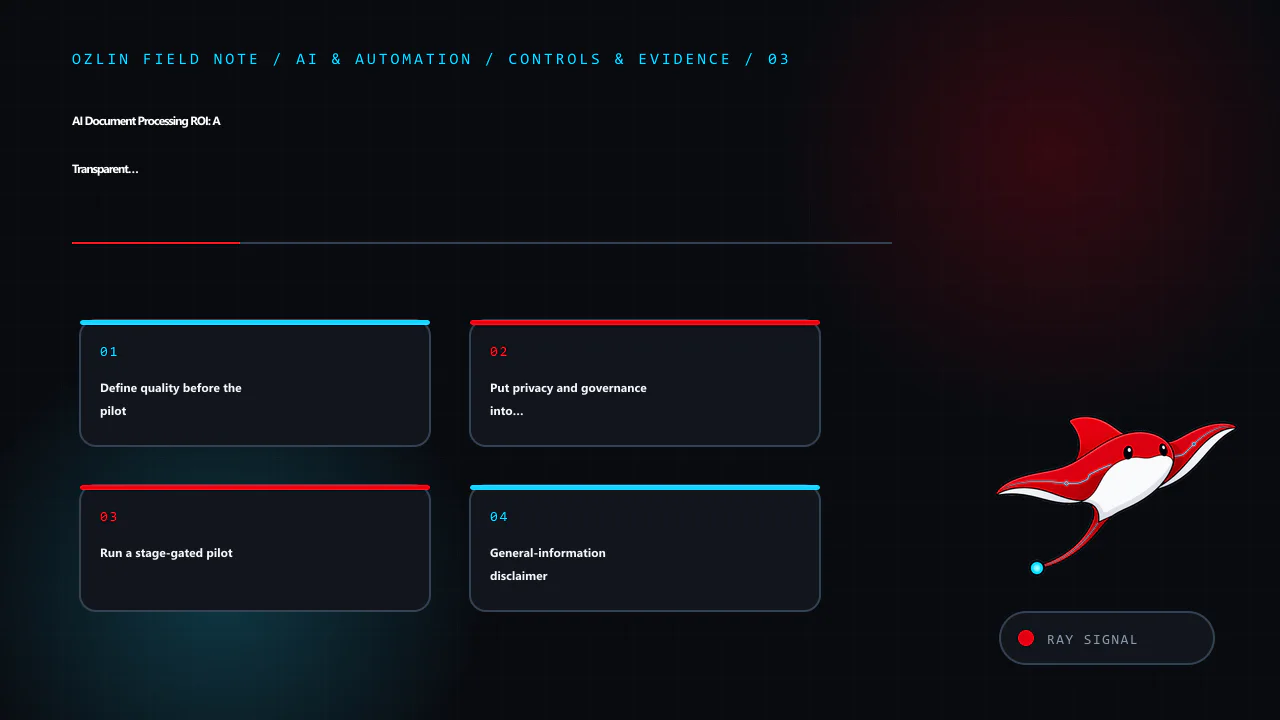
Run a stage-gated pilot
- Approve the problem, process boundary, owner and prohibited data.
- Baseline a representative sample and publish definitions.
- Prototype with synthetic or appropriately controlled data.
- Run the old and assisted processes in parallel without automatic high-consequence actions.
- Compare time, cost, quality, exceptions and incidents against the baseline.
- Review sensitivity, supplier exit and operational controls.
- Approve, revise or stop against pre-agreed gates.
A stopped pilot that disproves the business case is useful evidence. Do not scale because implementation money has already been spent.
For help designing a document-processing prototype and evidence workbook, see Ozlin Info’s AI and automation services or contact Ozlin Info.
Related reading: building a document-scanner prototype and AI chatbots for Australian SMEs.
General-information disclaimer
This hypothetical example provides general technical and business-planning information, not financial, accounting, tax, legal or privacy advice and not a quote or promised outcome. Replace every assumption with verified data and obtain qualified advice where required.
AI-assistance disclosure
AI tools assisted with source discovery, arithmetic cross-checking, outlining and copyediting. A human reviewer must independently verify the calculations, assumptions, legal context, source links and proposed controls before publication or use.
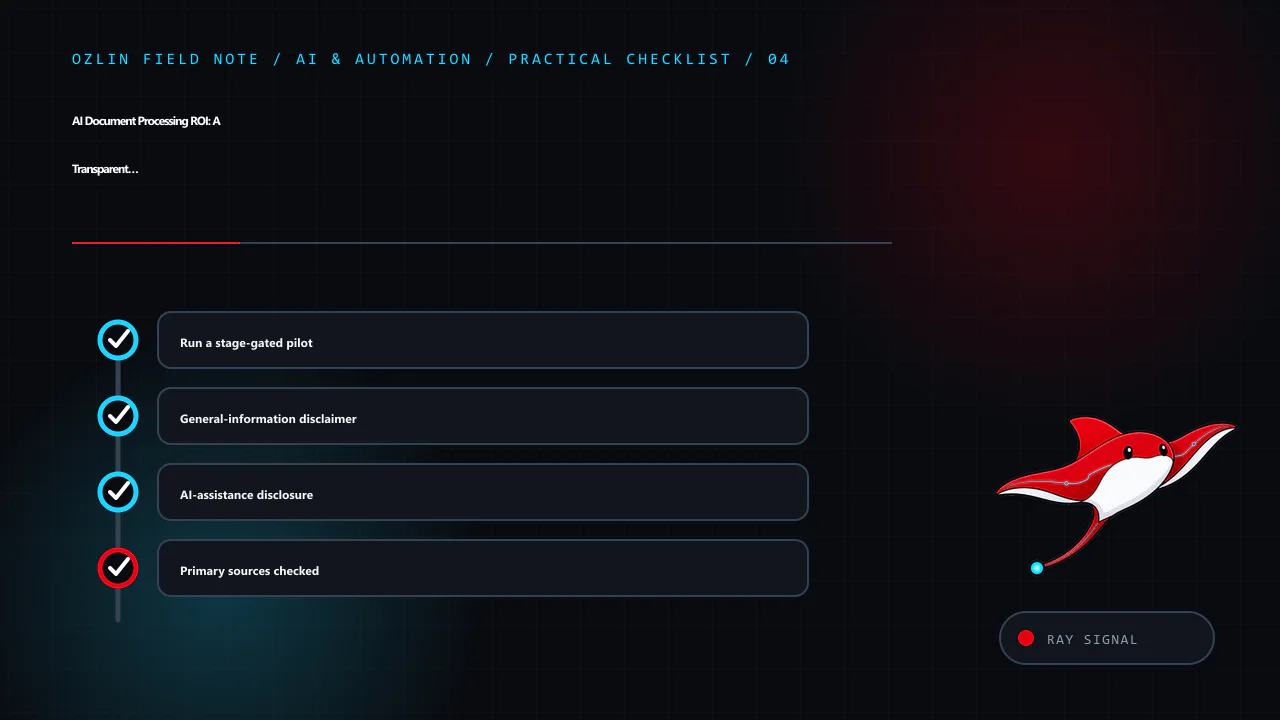
Primary sources checked
- business.gov.au — Artificial intelligence
- National AI Centre — Guidance for AI adoption: foundations
- OAIC — Privacy and commercially available AI products
- NIST AI Resource Center — AI RMF Core
Source access date: 29 August 2026.