
Reading an Older PyTorch HMER Repository Responsibly: Fork, Architecture and Limits
Handwritten mathematical expression recognition (HMER) is more than ordinary character recognition. A recogniser must identify symbols and recover their two-dimensional relationships: a mark may be a superscript, a denominator, the limit of an operator or part of a matrix. The desired output is often a structured token sequence such as LaTeX, where one misplaced brace changes the expression.
Oz-Lin has a public repository named Pytorch-Handwritten-Mathematical-Expression-Recognition. The most important fact comes before any architecture discussion: GitHub identifies it as a fork of whywhs/Pytorch-Handwritten-Mathematical-Expression-Recognition. The upstream README credits Hongyu Wang, referring to Dr Jianshu Zhang, and the included MIT licence carries “Copyright (c) 2019 Hongyu Wang.” This is upstream work preserved in Oz-Lin's account, not a model that Ozlin Info can accurately claim to have invented or independently built.
What the upstream code appears to implement
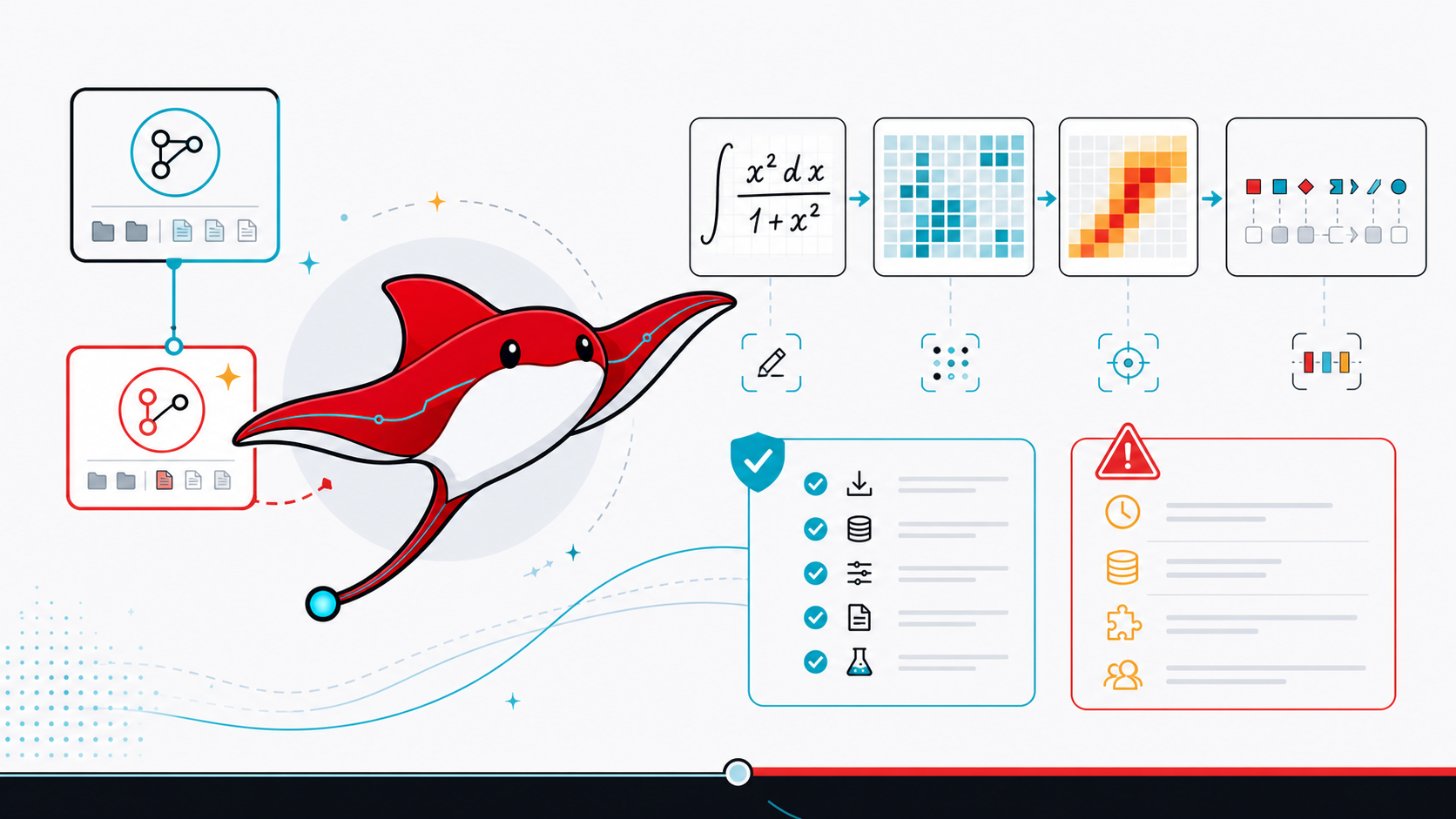
The upstream repository describes an Attention-and-Coverage HMER system. Its code contains a DenseNet-style convolutional encoder and an attention recurrent decoder. The DenseNet source file converts an image into a spatial feature map instead of immediately collapsing the page into one vector. The attention decoder embeds the preceding token, updates GRU cells, scores spatial encoder features and produces a log-probability distribution over output tokens.
In broad terms, the decoder performs three jobs at every output step:
- use the previous token and recurrent state to represent what has already been generated;
- assign attention weights across locations in the image feature map; and
- combine the attended visual context with the recurrent state to predict the next token.
The “coverage” idea is visible in the accumulated attention state passed through the decoder. It gives the next attention calculation information about regions that have already received attention. That can help an autoregressive recogniser avoid repeatedly focusing on the same strokes or overlooking a region. It does not guarantee correct structural parsing, and an attention visualisation is not proof that a prediction is trustworthy.
What the repository reports—and what it does not establish
The upstream README says the experiment used the CROHME 2016 dataset, a batch size of six, a maximum label length of 48 and two TITAN Xp GPUs. It reports “WER loss” of 17.160% and an expression rate of 38.595%.
Those figures should be attributed to the upstream repository exactly as reported. They are not Ozlin Info benchmark results. The public Oz-Lin fork does not, by itself, document an independent rerun, a controlled comparison, a current environment lockfile, confidence intervals or performance on client handwriting. “Expression rate” is also stricter than recognising many individual symbols: for an exact-expression metric, every required token must be correct. Any future article or project page should avoid turning those upstream numbers into a general accuracy promise.
Dataset results do not automatically transfer to phone photographs, classroom whiteboards, different notation conventions or a new writer population. A credible new evaluation would specify the dataset version and licence, train/validation/test separation, normalisation, decoding strategy, metric implementation, random seeds and hardware. PyTorch's current reproducibility guidance warns that completely reproducible results are not guaranteed across releases, commits, platforms or CPU and GPU execution, even when sources of randomness are controlled (PyTorch reproducibility notes).
Why this is a historical research artifact, not a current package
The README specifies Python 3.6 and PyTorch 1.0. The code contains older patterns such as torch.autograd.Variable, explicit .cuda() calls, fixed GPU-ID handling and assumptions tied to two GPUs. The training script uses hard-coded paths and parameters. Those choices are understandable in a 2019 research repository, but they are warning signs for a modern environment.
The repository also shows no packaged API, maintained release, automated test suite, model card, container definition, current dependency lock or documented security review. Some README images use old third-party HTTP hosts, which is another reason to treat the page as archival evidence rather than polished documentation. The MIT licence permits reuse subject to retaining its copyright and permission notice, and it provides the software without warranty (repository licence).
None of this makes the code worthless. It makes its status clear: useful for studying an older encoder–attention–decoder implementation, not a drop-in service and not evidence of production capability.
A responsible modernisation path
Before changing the model, preserve provenance. Keep the GitHub fork relationship and upstream copyright notice visible. Record Oz-Lin changes in a separate changelog or branch rather than presenting inherited files as original work.
Then make reproducibility the first milestone:
- create an isolated environment and document the exact Python, PyTorch, CUDA and driver versions used for the first successful run;
- replace device-specific
.cuda()calls with explicit device handling and remove fixed multi-GPU assumptions; - turn paths and hyperparameters into configuration rather than source edits;
- add smoke tests for data loading, one forward pass, token decoding and metric calculation;
- verify the dataset's permitted use and document how each split was obtained; and
- reproduce the upstream metric locally before claiming any improvement.
Only after that baseline should a new experiment consider a maintained PyTorch release, revised batching, modern decoding, updated encoders or alternative sequence/structure models. Compare on the same held-out data and publish both successes and failure cases. For a user-facing tool, add confidence or uncertainty signals, input validation, observability, privacy controls and human review for consequential uses.
What Ozlin can honestly say today
The repository demonstrates interest in HMER and provides a public, traceable starting point for research review. Ozlin can describe what the upstream architecture does, document modernisation experiments and publish independently reproduced results if that work is completed. Until then, the accurate wording is “we maintain or study a fork,” not “we built the model.”
That distinction is good open-source practice. Clear attribution makes technical work more credible and gives future Ozlin contributions a clean baseline from which their actual value can be measured.
AI-assistance disclosure
AI tools assisted with structure and copy editing. A human editor reviewed this draft on 28 August 2026 against the live GitHub fork relationship, upstream README, source files, MIT licence and current PyTorch reproducibility guidance. No model was retrained for this article, and no upstream result was independently reproduced; reported metrics remain attributed to the upstream author.