
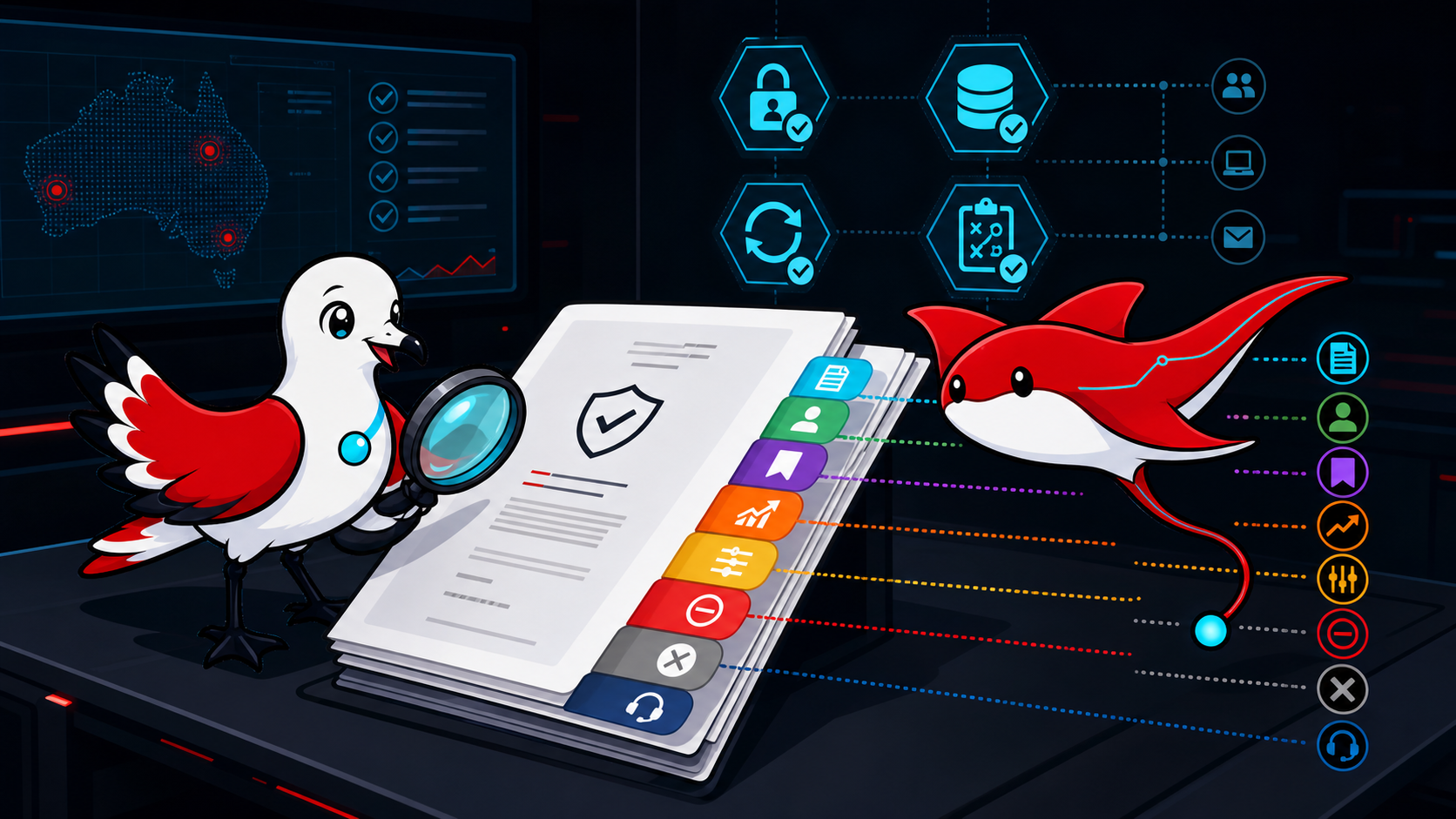
Cyber insurance transfers defined financial risks under a contract. It does not make an insecure system safe, guarantee that every incident is covered or replace legal, privacy, continuity and incident-response work. Two products carrying the same label can differ materially in definitions, triggers, exclusions, sublimits, excesses and response providers.
For an Australian small business, the practical task is to map its own loss scenarios, read the complete policy pack and rehearse how a claim would begin. Premium anecdotes and headline coverage figures cannot do that work.
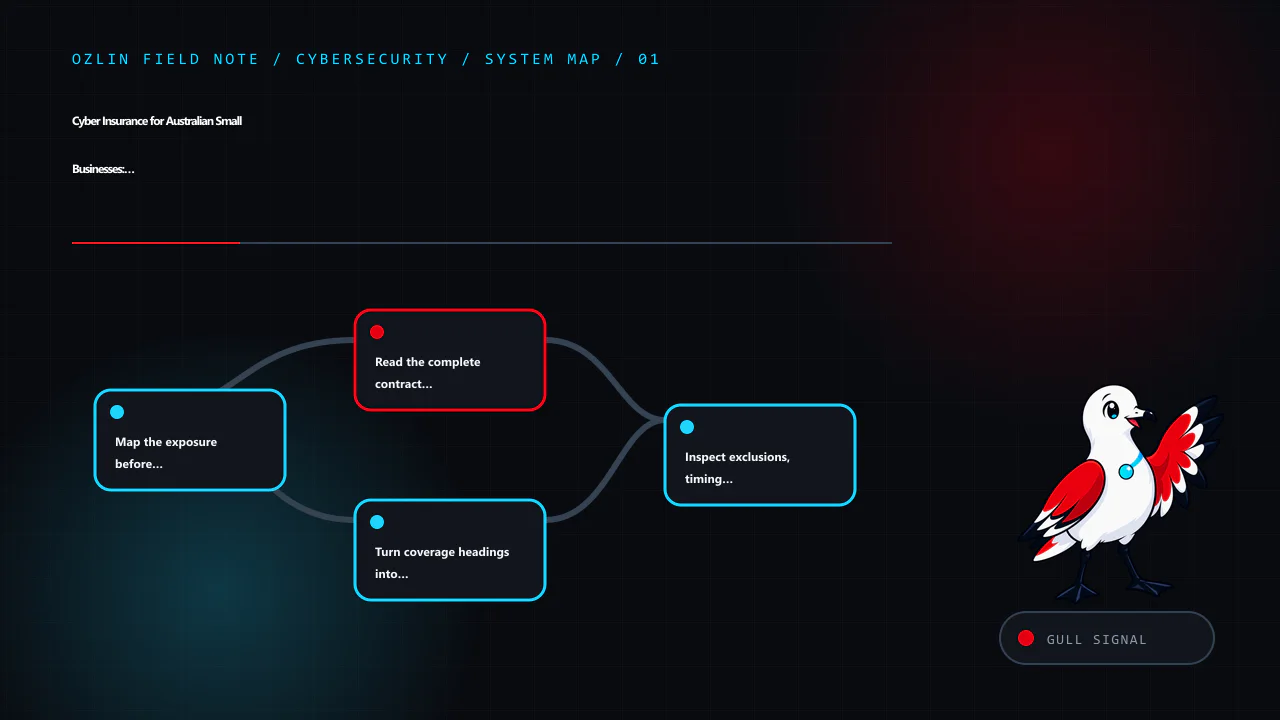
Map the exposure before asking for a quote
Describe the systems and dependencies that could stop revenue, expose data or create liability:
- customer, employee, payment and credential data held by the business or a provider;
- websites, cloud tenants, email, endpoints, backups and remote access;
- outsourced hosting, managed services, software and payment platforms;
- maximum tolerable downtime and critical manual workarounds;
- contractual security, notification and indemnity commitments; and
- plausible events such as business email compromise, ransomware, accidental disclosure, provider outage or stolen credentials.
Estimate losses by scenario rather than choosing a round limit. Separate restoration and specialist-response cost, lost gross profit, extra expense, customer or regulator communication, third-party claims and fraud. Record the assumptions and run a range. Insurance may address some categories and exclude or sublimit others.
The Australian Government’s business insurance overview says cyber cover can include costs associated with extortion, interruption, network or data breaches, recovery and accidental loss or release of personal information. “Can include” is the important phrase; the actual contract controls.
Read the complete contract stack
Do not assess a product from the quote summary alone. Obtain and read the Product Disclosure Statement or policy wording, quotation, schedule, endorsements and any proposal or application incorporated into the contract. Confirm which document prevails if terms conflict.
The schedule normally personalises items such as the insured entity, period, limits, sublimits and excess. Endorsements can add, remove or rewrite cover. Definitions can change the ordinary meaning of terms such as computer system, insured data, security failure, dependent business, claim or loss.
Business.gov.au’s insurance-management guidance recommends understanding covered events, exclusions, definitions, settlement, excess, cancellation, disclosure duties and the complaints process. Ask a licensed broker or authorised insurer to explain anything unclear and retain the answer in writing.
Turn coverage headings into questions
For each relevant loss scenario, ask where and how it is addressed:
Incident response and recovery
- Are forensic investigation, legal triage, data restoration, crisis communications and customer support covered?
- Must the insured use a panel provider or obtain consent before spending?
- Are emergency costs before consent treated differently?
- Does restoration include only data, or also software, configuration and improved replacement?
Business interruption
- What event triggers cover, when does the waiting period start, and how is loss calculated?
- Are outages at named cloud, software or managed-service providers included?
- Is there a maximum indemnity period or sublimit for dependent business interruption?
Privacy, network and media liability
- Which third-party allegations and defence costs are included?
- Are defence costs inside or outside the limit?
- How are investigations, notification expenses, contractual liability and payment-card assessments treated?
- Are fines or penalties covered only where legally insurable, or excluded?
Extortion, fraud and funds transfer
- Does the policy cover response advice and negotiation, and what legal, sanctions and consent conditions apply?
- Is fraudulent transfer or social-engineering loss included, separately sublimited or excluded?
- Does a loss caused by impersonation without a network intrusion meet the definition of a cyber event?
Never assume that ransomware payment is lawful, advisable or recoverable. Escalate to the insurer’s response service, legal adviser and relevant authorities rather than improvising.
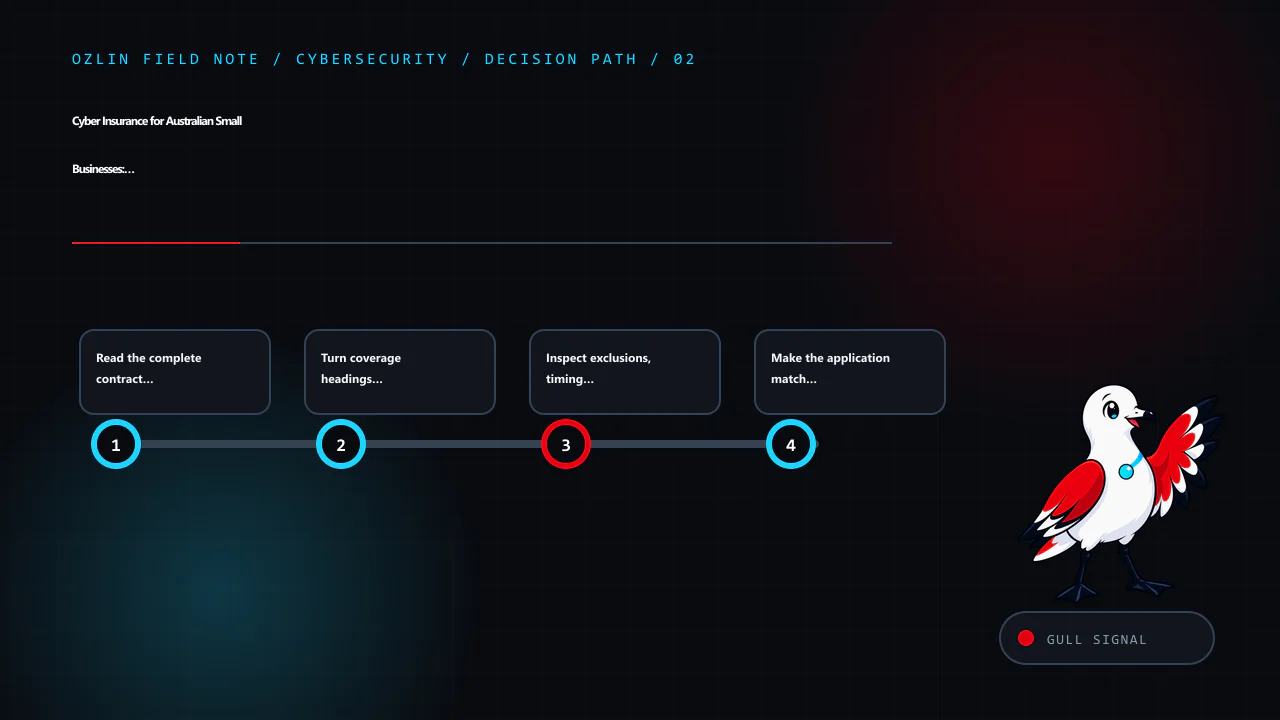
Inspect exclusions, timing and aggregation
Compare exclusions against the risk map. Common areas requiring close reading include prior known circumstances, unsupported software, failure to maintain declared controls, infrastructure or utility failure, war or cyber-operation wording, bodily injury or property damage, professional services, intellectual property, contractually assumed liability and conduct exclusions. Their scope varies; the label alone is not enough.
Ask which sections are claims-made and notified, what counts as a claim or circumstance, whether a retroactive date applies and how soon notice must be given. Check territorial and jurisdiction limits. Understand whether multiple events are aggregated into one claim, one excess or one limit.
Compare the main aggregate limit with every sublimit. A policy advertised with a large headline limit may apply much smaller amounts to social engineering, dependent providers, restoration, notification, reputational harm or voluntary shutdown. Record waiting periods, excesses and coinsurance as well as dollars.
Make the application match reality
Insurance applications may ask about multi-factor authentication, backups, endpoint protection, patching, privileged access, remote access, email controls, training and incident history. Answer accurately, identify uncertainty and keep evidence. Do not check “yes” because a control exists somewhere; confirm its scope, enforcement and exceptions.
Maintain those controls after inception and notify the broker or insurer of material changes when the contract requires it. Keep versioned network diagrams, asset records, backup and restore tests, security policies, training records and remediation tickets. These artefacts support operations first and may also help explain a claim.
ASD’s Australian Cyber Security Centre recommends small businesses start with multi-factor authentication, updates and backups, then build further resilience through its Small Business Cyber Security Guide. Insurance is one treatment alongside those controls, not an alternative to them.
Rehearse notification before an incident
Store the policy number, broker, insurer hotline, panel contacts and notification method somewhere available when normal systems are down. Define who can call, who preserves evidence and who approves emergency work. The first technical instinct—rebuilding or deleting—can destroy evidence or conflict with response instructions.
Privacy obligations depend on the organisation and activity. Most Australian small businesses with annual turnover of $3 million or less are not covered by the Privacy Act, but important exceptions apply. Use the OAIC’s small-business guidance and obtain advice rather than assuming an exemption.
For entities covered by the Notifiable Data Breaches scheme, notification is required for eligible breaches likely to cause serious harm when remedial action has not removed that likely risk. The OAIC’s NDB guidance explains the threshold and assessment process. Contractual, sector and insurer notice requirements can be different and earlier.
At renewal, compare changed systems, revenue, data, providers, incidents and contract obligations against the wording. Verify the insurer on APRA’s general-insurer register and a broker or other financial-services provider through ASIC’s professional registers where applicable.
For help improving the technical controls and incident evidence behind an application, see Ozlin Info’s cybersecurity services or contact Ozlin Info.
Related reading: cybersecurity priorities for Australian SMEs and a phishing response playbook.
General-information disclaimer
This article provides general information only and is not financial product advice, legal advice, insurance advice or a statement about any Ozlin Info policy. Cover depends on the complete wording, schedule, endorsements, facts and applicable law. Consult a licensed broker, authorised insurer and qualified legal or privacy adviser for your circumstances.
AI-assistance disclosure
AI tools assisted with source discovery, outlining and copyediting. A human reviewer must verify every policy, legal, privacy and incident-response statement against current official guidance and the complete proposed contract before publication or use.
Primary sources checked
- business.gov.au — Types of business insurance
- business.gov.au — Manage your business insurance
- ASD’s ACSC — Small Business Cyber Security Guide
- OAIC — Privacy and small business
- OAIC — When to report a data breach
- APRA — List of authorised general insurers
- ASIC — Professional registers search
Source access date: 29 August 2026.