
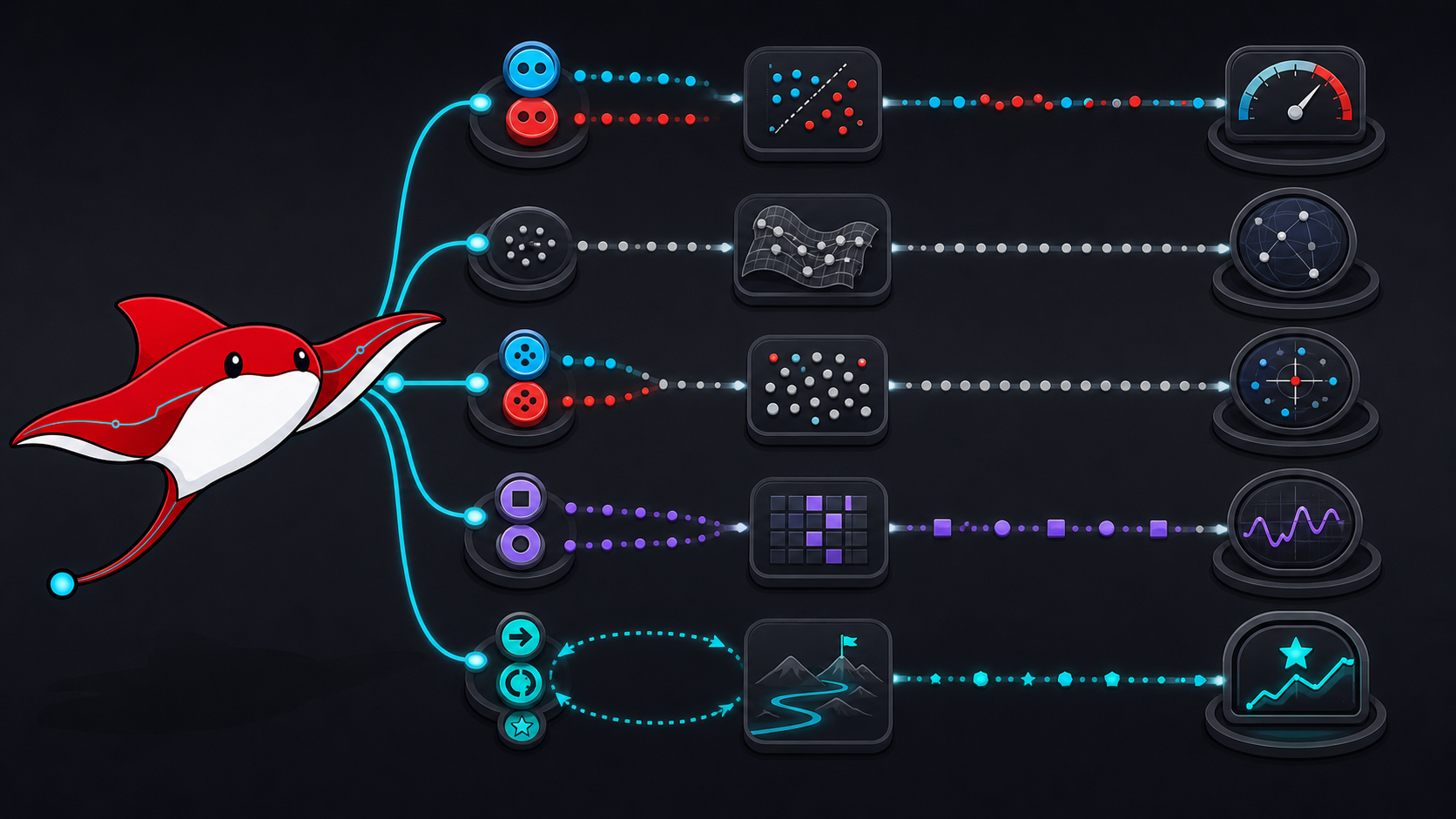
“Supervised or unsupervised?” is a useful opening question, but it is not a complete project brief. The right learning setup depends on the decision to support, what feedback exists, when it arrives, what mistakes cost and how success can be evaluated on data the system did not learn from.
Algorithms are also not permanently owned by one paradigm. The same neural architecture can be trained with labelled targets, a self-supervised objective or reinforcement feedback. Recommendation and anomaly-detection systems often combine several approaches. Start with the source of the learning signal rather than a list of fashionable model names.
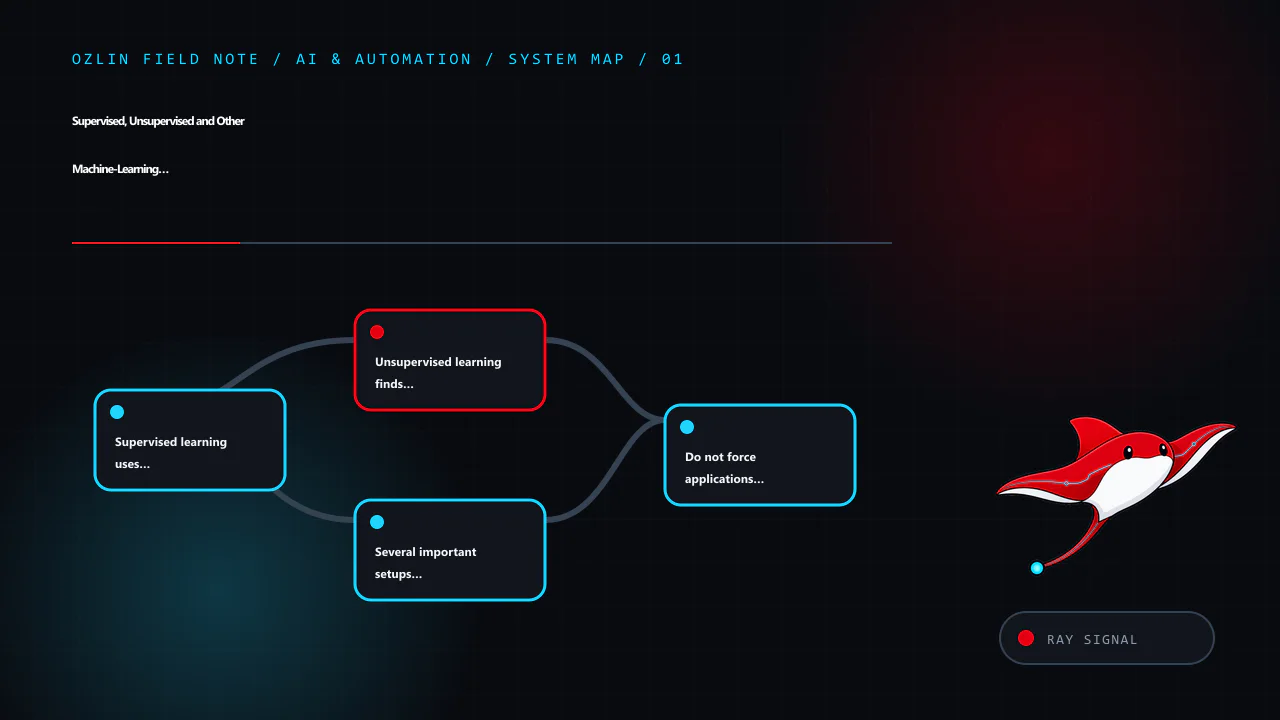
Supervised learning uses explicit targets
Supervised learning trains on examples containing input features and a target label or value. Classification predicts a category or probability; regression predicts a numeric quantity. Examples include identifying an invoice type, estimating delivery time or predicting whether a reviewed transaction belongs to a defined class.
The target must represent the real decision. Historical labels can contain inconsistent human judgement, policy changes or outcomes produced by the old process. A model may faithfully reproduce those artefacts. Document who created each label, under which rules, and how disagreement and uncertainty are represented.
Evaluation uses held-out labelled data and task-appropriate metrics. Accuracy is insufficient when classes are imbalanced or errors have asymmetric consequences. Depending on the decision, examine precision, recall, calibration, cost-weighted error, ranking quality and performance by meaningful cohort. Google’s introduction to supervised learning emphasises labelled examples, unseen data and generalisation.
Unsupervised learning finds structure without target labels
Unsupervised methods usually operate on unlabelled examples to identify patterns such as groups, lower-dimensional representations or unusual observations. Clustering can support exploration or segmentation, but a cluster is not automatically a real customer type. Results depend on representation, distance, scaling, algorithm and hyperparameters.
Validate whether a discovered structure is stable and useful outside the training sample. Compare multiple seeds and plausible preprocessing choices, inspect examples with domain experts, and test whether the segmentation improves a downstream decision. An internal cohesion score cannot establish that the groups are fair, causal or commercially meaningful.
Dimensionality-reduction visualisations require similar restraint. t-SNE was introduced as a method for visualising high-dimensional data; it is not a clustering algorithm, and apparent gaps in a two-dimensional plot are not proof of natural classes. The original t-SNE paper explains its local similarity objective and limitations.
Several important setups sit between or beyond the pair
Semi-supervised learning combines a smaller labelled set with a larger unlabelled set. It can reduce labelling demand when the unlabelled data resembles the intended operating distribution, but poor pseudo-labels or a distribution mismatch can reinforce errors.
Self-supervised learning creates a training signal from the data itself—for example, predicting masked content or contrasting related views—then adapts the learned representation to a downstream task. It still needs careful downstream evaluation; a useful pretraining objective does not guarantee appropriate behaviour in the final context.
Reinforcement learning learns a policy through interaction, observations, actions and reward. It is not simply supervised learning with delayed labels. Reward design, exploration, environment fidelity, safety constraints and off-policy evaluation can dominate the project. Sutton and Barto’s Reinforcement Learning: An Introduction provides the primary textbook treatment.
Active learning asks which examples should be labelled next. It can focus limited expert time but must account for sampling bias and the true cost of obtaining a reliable label.
The current Google machine-learning glossary distinguishes labelled, unlabelled, semi-supervised and unsupervised examples. Use these terms to describe the training signal, not to imply a quality ranking.
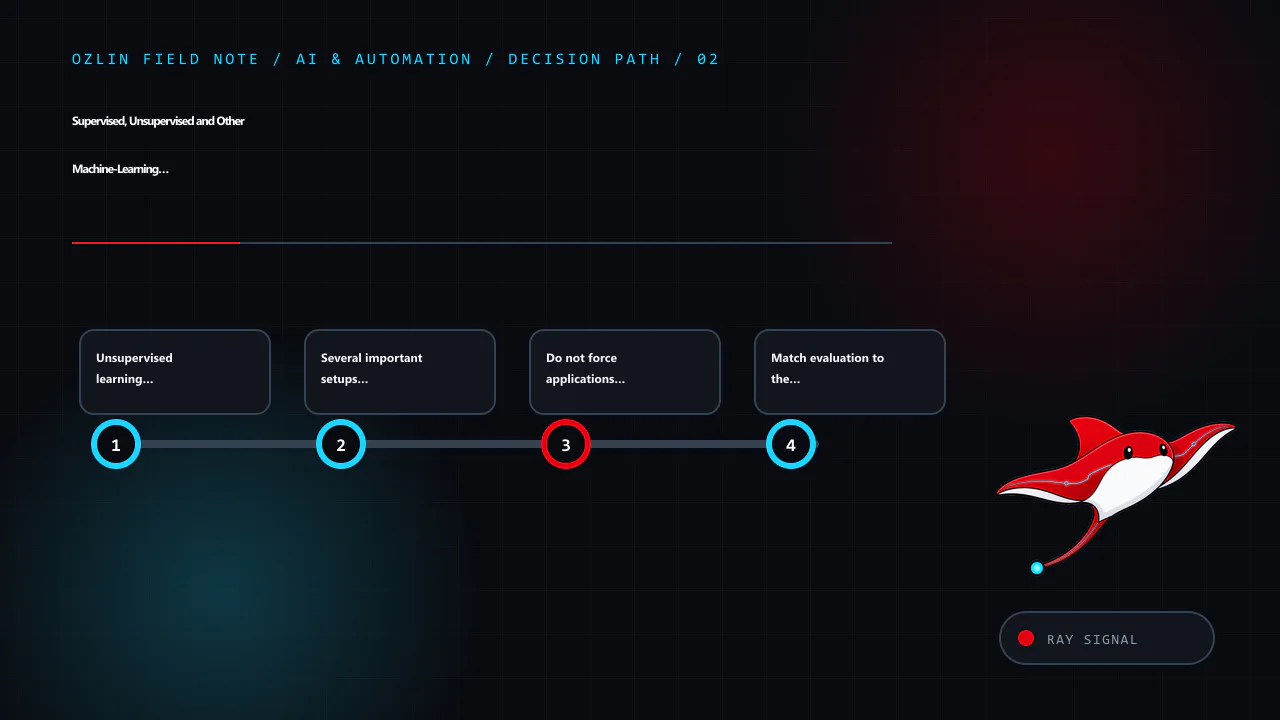
Do not force applications into one bucket
An autoencoder learns to reconstruct or otherwise represent its input. It may contribute an anomaly score, but the score still needs a threshold, representative validation cases and an operational response. Reconstruction error alone does not prove fraud, intrusion or equipment failure.
A recommender might use supervised ranking from observed outcomes, self-supervised representations, collaborative signals, content features, contextual bandits or business rules. The important questions are which feedback is observed, which is missing, how exposure biases the data, and whether the evaluation captures user and business effects.
Likewise, “anomaly” can mean a rare statistical point, a rule violation or a high-cost event. A rare point may be legitimate; a harmful event may look common in the available features. Define the review action and tolerated alert burden before selecting an outlier method.
Match evaluation to the learning signal
| Learning setup | Typical evidence | Evaluation warning |
|---|---|---|
| Supervised | held-out labelled outcomes | labels may leak, drift or encode the old policy |
| Unsupervised | stability, domain review, downstream utility | internal cluster scores do not prove real-world meaning |
| Semi-supervised | labelled holdout plus ablation against labelled-only baseline | pseudo-labels can amplify early mistakes |
| Self-supervised | downstream task performance and transfer tests | pretraining loss is not the business metric |
| Reinforcement learning | policy value, safety limits and online or simulator evidence | an exploitable reward can produce the wrong behaviour |
Create train, validation and final test boundaries before feature engineering. Group related records so the same customer, device, document family or future information cannot appear across the boundary. Compare against a simple baseline and include the human or rules-based process where relevant.
For consequential uses, evaluation also needs privacy, security, fairness, transparency and human-oversight criteria. The voluntary NIST AI Risk Management Framework calls for business context to be mapped, methods and metrics to be documented, and systems to be tested before deployment and monitored afterwards.
A practical selection sequence
- Write the decision, user and unacceptable outcome.
- Define the unit of prediction or analysis and when the output is needed.
- Inventory available features, labels, feedback delays and collection rights.
- Choose the simplest baseline that can be evaluated honestly.
- Design a leakage-resistant split and decision-relevant metrics.
- Prototype the data and review workflow before scaling the model.
- Record limits, owners, monitoring and a safe fallback.
For help framing an ML pilot or evidence plan, see Ozlin Info’s AI and automation services or contact Ozlin Info.
Related reading: Neural networks, gradients and evaluation and a transparent AI document-processing ROI example.
General-information disclaimer
This article provides general technical information, not a guarantee of model accuracy, fairness, safety, regulatory compliance or return on investment. Validate the learning setup and evidence requirements for the actual data, decision and affected people.
AI-assistance disclosure
AI tools assisted with source discovery, outlining and copyediting. A human reviewer must verify the terminology, links, evaluation design and risk controls against the intended use case before publication or use.
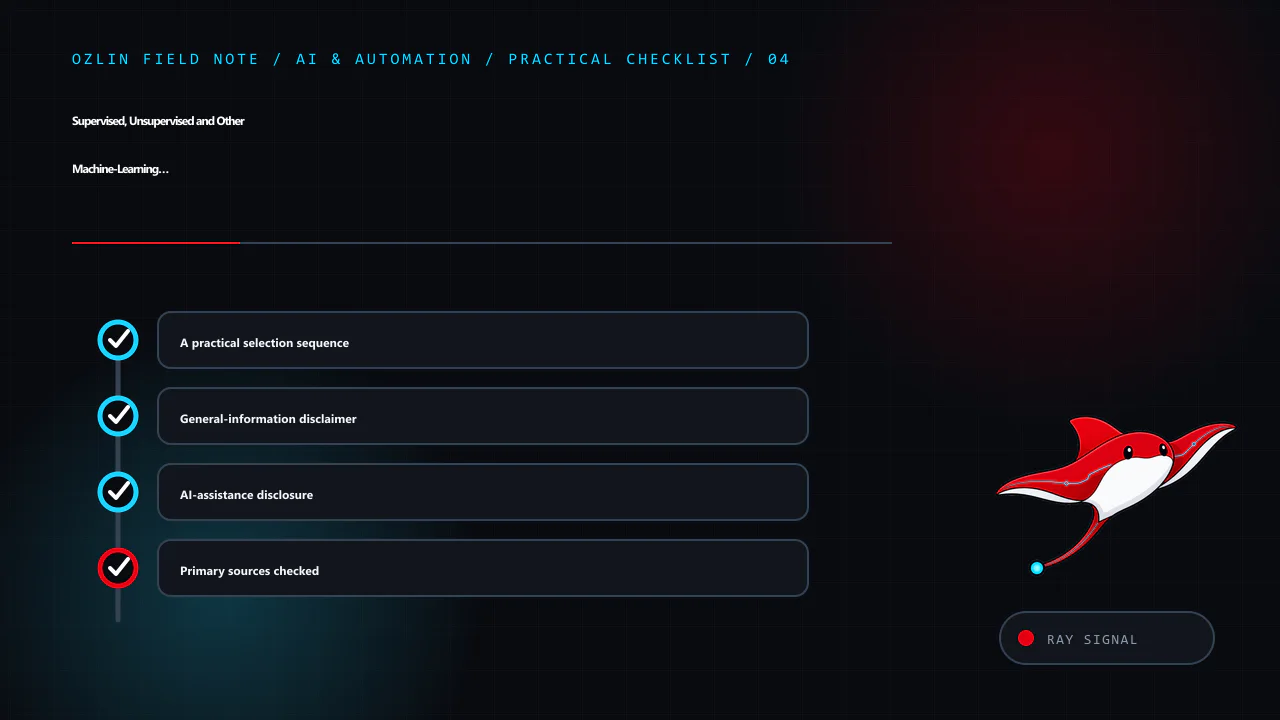
Primary sources checked
- Google for Developers — Supervised learning
- Google for Developers — Machine-learning glossary
- Journal of Machine Learning Research — Visualizing Data using t-SNE
- MIT Press — Sutton and Barto, Reinforcement Learning: An Introduction
- NIST AI Resource Center — AI RMF Core
Source access date: 29 August 2026.