
Tag: DDoS protection

  • Australia and New Zealand Server Hosting Guide: VPS, Cloud, Dedicated and Colocation

    Australia and New Zealand Server Hosting Guide: VPS, Cloud, Dedicated and Colocation

    The best server is not the one with the largest specification sheet. It is the one whose location, network, operating model and failure plan fit the workload. A Sydney VPS may be ideal for a small Australian website, while a New Zealand organisation with data-location requirements may prefer an Auckland or Wellington service. A busy game community may care more about single-thread CPU performance, packet loss and attack mitigation than about virtual CPU count. A regulated application may need contractual support, evidence and tested recovery that a low-cost unmanaged server does not include.

    Ozlin Info currently operates workloads on OVHcloud infrastructure in Sydney and uses Proxmox at a high level as part of its virtualisation experience. That operational background informs this guide, but no production IP address, host name, panel address, network topology or security control is disclosed here.

    This is an independent market guide, not a paid ranking. Ozlin has no disclosed affiliate relationship with the providers named below. Product availability, tax treatment and routing can change, so obtain a written quote and run workload-specific tests before committing.

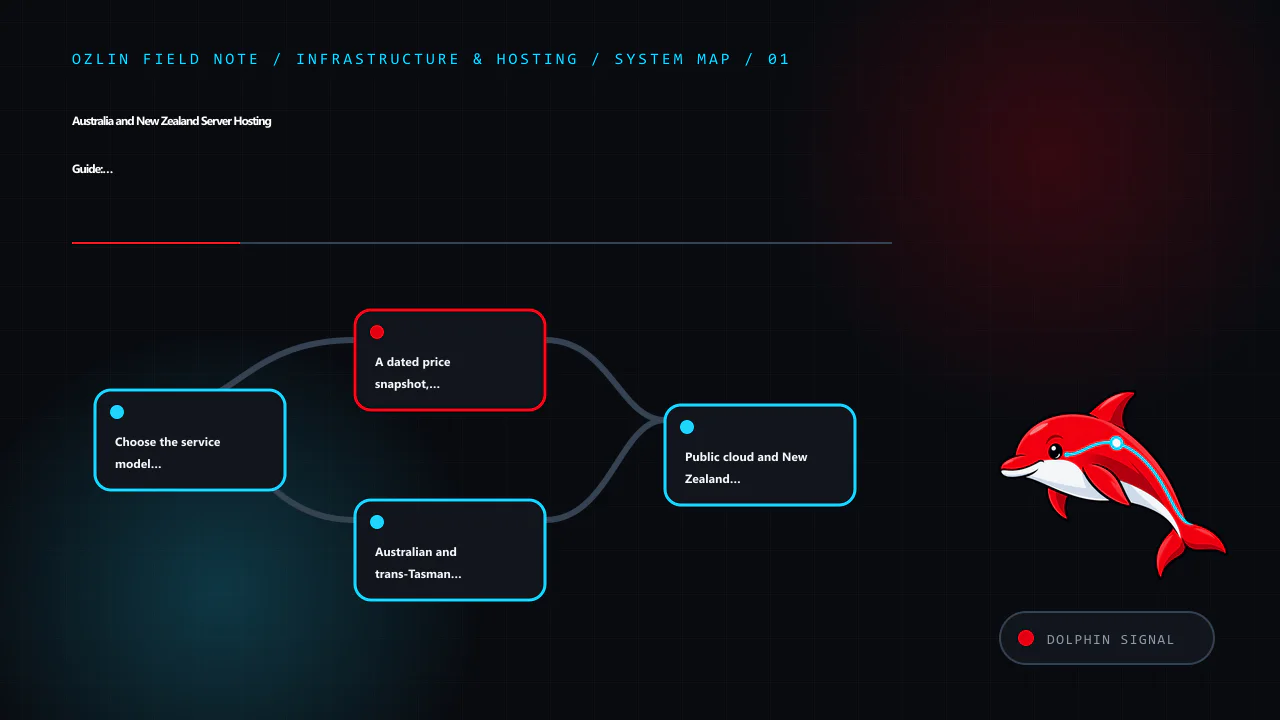
    Article map for Australia and New Zealand Server Hosting Guide: VPS, Cloud, Dedicated…, covering Choose the service model before the brand, A dated price snapshot, not a permanent price list, Australian and trans-Tasman…
    Article map: Choose the service model before the brand; A dated price snapshot, not a permanent price list; Australian and trans-Tasman providers worth shortlisting; Public cloud and New Zealand data-location options.

    Choose the service model before the brand

    A VPS divides a physical host into isolated virtual servers. It is inexpensive, quick to rebuild and usually gives root or administrator access. The trade-off is that storage, CPU scheduling and the host failure domain remain partly shared. Ask whether CPU is dedicated or burstable, what storage redundancy exists, and whether snapshots are backups or only convenient restore points.

    Public cloud infrastructure exposes compute, storage, networking and managed services through APIs. AWS, Microsoft Azure, Google Cloud and Oracle Cloud Infrastructure all operate Australian regions; AWS also opened its New Zealand region in 2025. Public cloud is useful for automation, managed databases, short-lived capacity and architectures that truly use multiple failure zones. It is not automatically cheaper. Instance runtime, disks, snapshots, public IPv4, support and outbound data should all enter the model.

    A dedicated server gives one customer the physical machine. It can deliver predictable CPU, memory, local NVMe and a large transfer allowance at an attractive monthly price. The customer still needs a plan for disk failure, hardware replacement, remote access, spare capacity and restore time. A single dedicated server is not a high-availability architecture merely because the components are powerful.

    Colocation places customer-owned hardware in a provider's facility. It offers the most hardware control and can make sense for specialised storage, GPU or long-lived workloads. It also shifts procurement, firmware, spares, freight, remote hands, power density and hardware disposal back to the customer. A low rack price can become expensive after power, cross-connects, transit, addresses and support are added.

    A dated price snapshot, not a permanent price list

    The following examples were observed on official provider pages on 29 August 2026. Australian prices are shown in AUD. Voyager publishes New Zealand dollars; the indicative AUD figures use the Reserve Bank of Australia's 28 August 2026 reference rate of A$1 = NZ$1.2084. The RBA cautions that its rates are not for commercial settlement. GST, card conversion and supplier tax treatment still need to be checked on the actual quote.

    Provider and example Advertised price GST and term Network/transfer shown Important omissions or caveats
    OVHcloud Advance-1 2026, selected AU configuration A$185.99/month plus A$185.99 setup Ex GST; configuration and commitment affect price Public bandwidth selectable within the product range; private network capability varies Region, hardware, IPv4, support and setup must be confirmed in cart
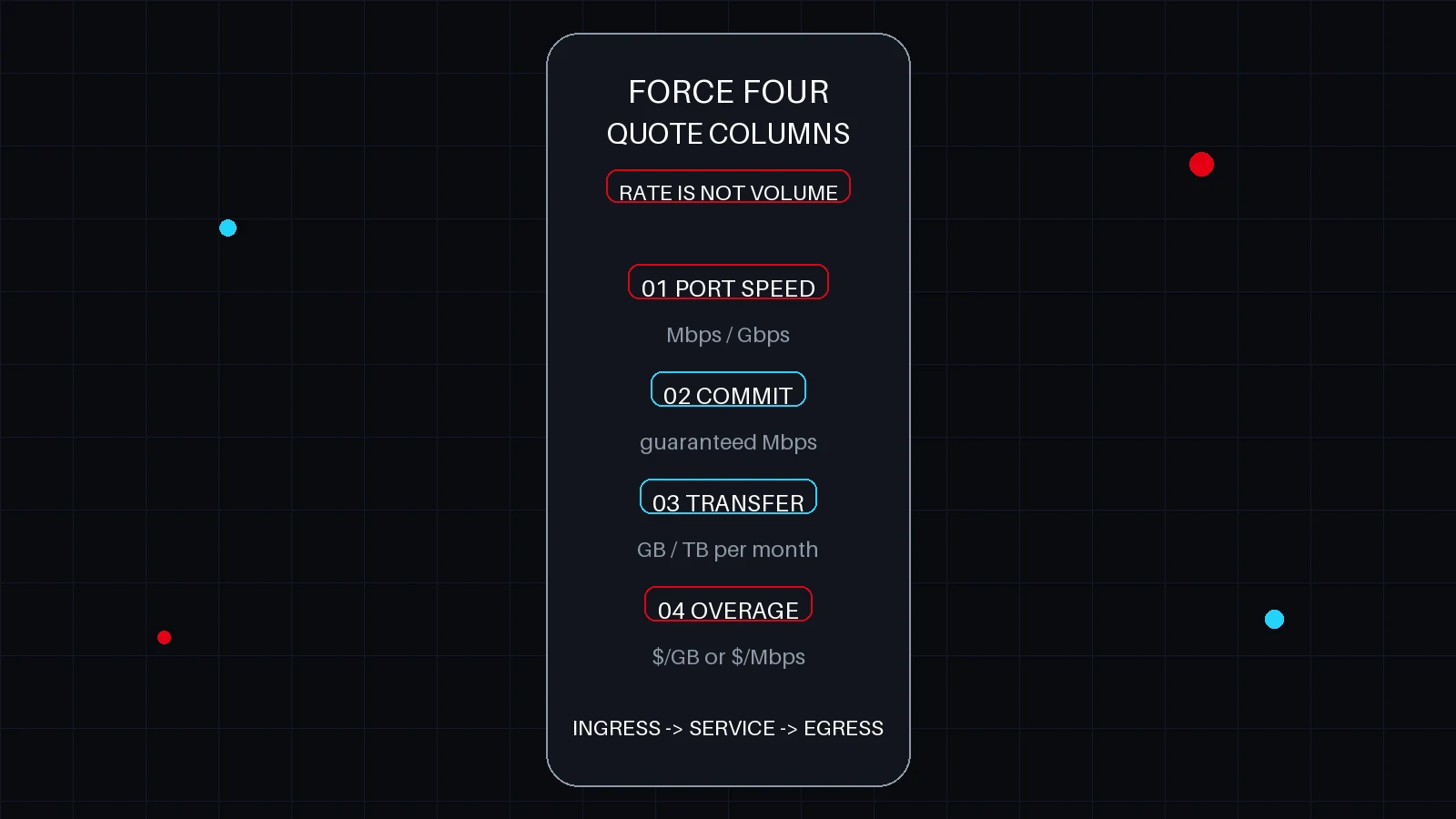
    Kimsufi KS-B in Sydney A$16.79/month plus A$16.79 setup Ex GST; setup advertised as waived on 12+ month commitment 500 Mbps; APAC page states 25 TB/month Entry hardware and support scope are limited; verify stock and recovery expectations
    Streamline Sydney i7-7700K example A$180/month Tax treatment and contract should be confirmed at checkout 15 TB on a 10 Gbps port advertised Older CPU; compare storage, DDoS, IPv4 and support on the final order
    Streamline Sydney Xeon E-2286G example A$320/month Confirm tax and term 30 TB on a 10 Gbps port advertised Provider network and latency statements require route testing from real users
    Voyager NZ VPS entry plan NZ$10.08, about A$8.34/month Ex NZ GST Provider advertises unlimited bandwidth Fair-use and cross-border tax conditions need review; entry plan is 1 vCPU/1 GB/15 GB
    Voyager NZ dedicated entry plan NZ$225, about A$186.20/month Ex NZ GST Provider advertises unmetered service subject to its terms Auckland location; confirm remote hands, replacement and address allocation
    Voyager device colocation NZ$190, about A$157.23/month Ex NZ GST Shared 1 Gbps PIR and a /29 advertised Power and form-factor limits matter; rack, cross-connect and support needs may change TCO
    Servers Australia, Micron21, Twisted Servers, Intergrid, Datacom Quote required Obtain an itemised GST quote Varies by facility and service Include power, rack units, transit, cross-connects, remote hands and support

    The table is deliberately not a benchmark. The OVH and Streamline examples are not identical machines, and a 10 Gbps port with a transfer quota is not the same commercial product as a lower-rate unmetered port. For public cloud, use each provider's current calculator with the same workload hours, disk type, snapshots, address count, support tier and outbound traffic instead of comparing a headline VM rate.

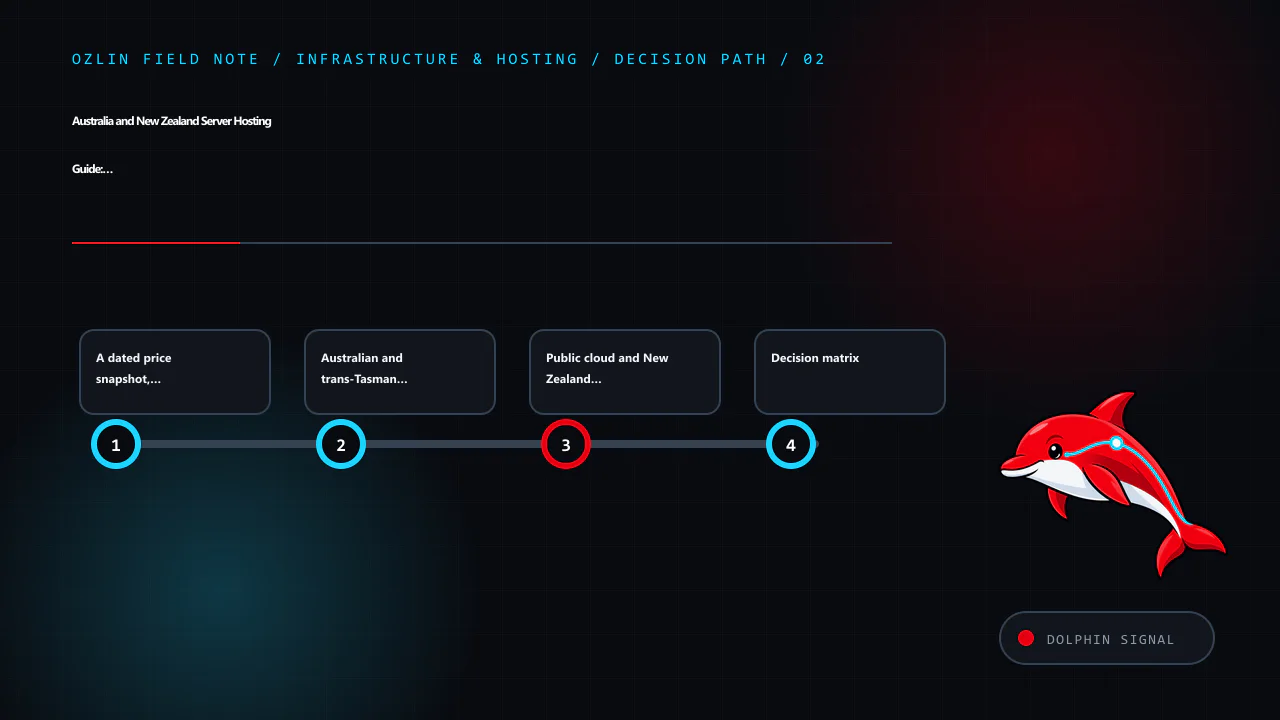
    Decision path for Australia and New Zealand Server Hosting Guide: VPS, Cloud, Dedicated…, covering A dated price snapshot, not a permanent price list, Australian and trans-Tasman providers worth shortlisting, Public clo…
    Decision path: A dated price snapshot, not a permanent price list; Australian and trans-Tasman providers worth shortlisting; Public cloud and New Zealand data-location options; Decision matrix.

    Australian and trans-Tasman providers worth shortlisting

    OVHcloud operates a broad bare-metal range in Sydney. Its Australian pages describe anti-DDoS protection as included with dedicated servers, and its game range adds game-oriented filtering. That is valuable for internet-facing services, but it should be described as built-in and comparatively strong—not infinite or guaranteed to stop every attack. Product and regional conditions, false positives, application-layer attacks, mitigation behaviour and traffic allowances remain relevant. Ozlin's operational lesson is equally important: provider mitigation does not replace server hardening. Patch the operating system and management plane, restrict administrative access, use least privilege and backups, and never install cracked or “nulled” software whose integrity cannot be verified. Such packages can carry credential stealers, web shells or other backdoors and turn a server into part of someone else's botnet.

    Kimsufi and So You Start are OVHcloud's lower-cost lines. Kimsufi can be attractive for labs, replicas, personal services and workloads that tolerate entry-level hardware and a narrower service envelope. The Australian page currently shows Sydney stock and a 25 TB monthly APAC transfer condition. So You Start can bridge the gap toward more capable dedicated hardware, but availability and current pricing are often configuration-dependent. Neither label should be treated as a promise of the same SLA, replacement process, network options or support as a higher-tier product. Model the cost of downtime and an independent backup before celebrating the monthly saving.

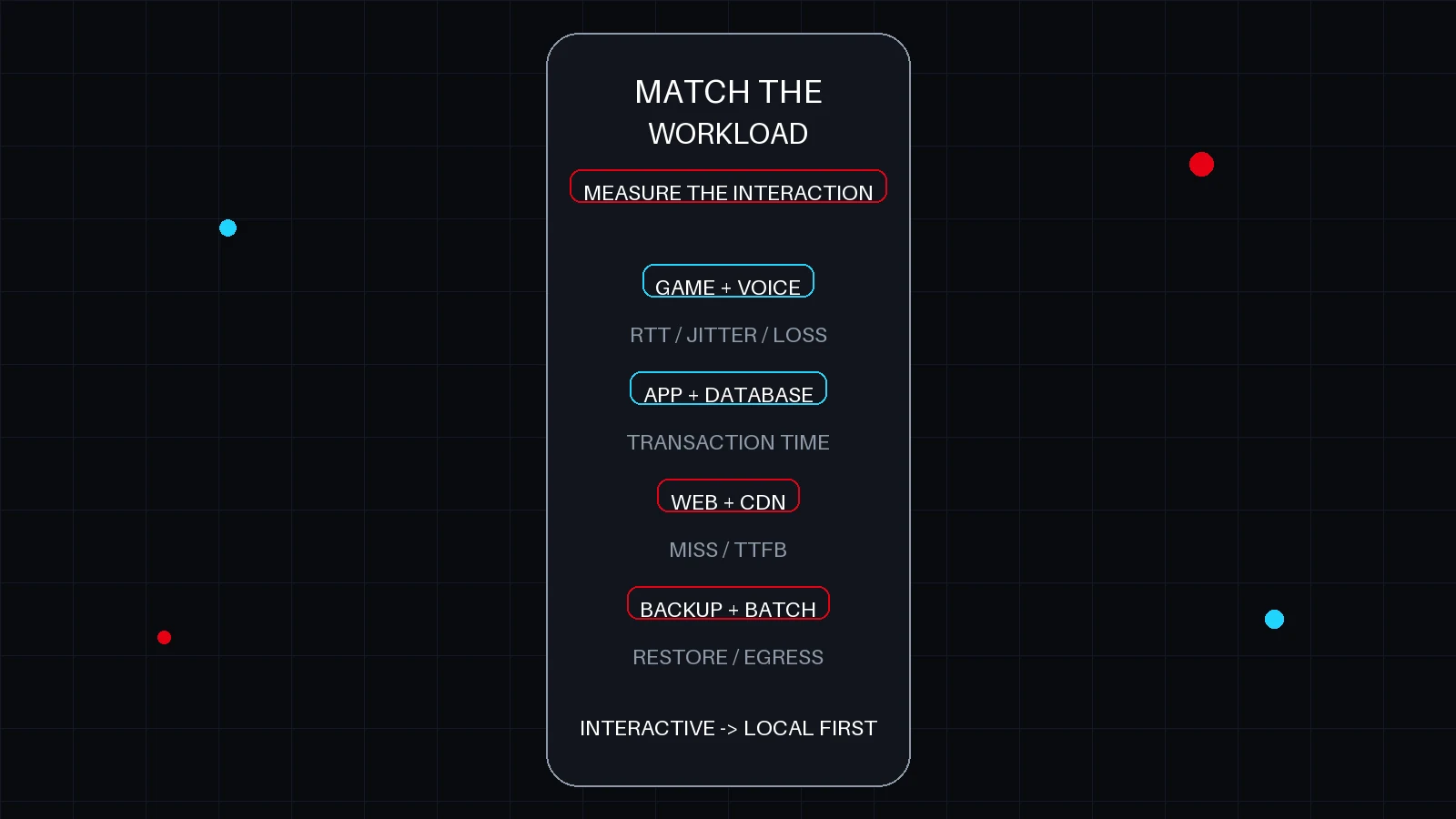
    Streamline Servers and GSL Networks advertise dedicated systems across Sydney, Melbourne, Brisbane, Adelaide, Perth and Auckland. Streamline attributes its offering to low-latency routing, DDoS protection and GSL's international network; these are provider claims and should be verified with route measurements from the actual ISPs and cities that matter. Its dated prices can be higher than a budget bare-metal plan, but a fair TCO comparison must hold CPU generation, RAM, storage, traffic, port speed, mitigation, support and contract term constant. For latency-sensitive games or trans-Tasman audiences, a week of representative ping, jitter, loss and route testing is more persuasive than a network map.

    Servers Australia offers colocation and connectivity around major Australian locations and into New Zealand. Its public colocation material is best used to start a requirements conversation; pricing is quote-based. Ask for the exact facility, usable power, A/B feeds, rack depth, cross-connect and transit pricing, remote-hands minimums, delivery procedure and termination costs.

    Micron21 is a Melbourne operator offering data-centre, cloud, connectivity and DDoS-related services. Certifications, facility tier language and protection capabilities on its site are provider statements: request the scope, current certificate, SLA and service design that apply to the proposed product rather than transferring a company-wide claim to one rack or VM.

    Twisted Servers is a useful Perth option. Its data-centre page identifies Equinix PE2 and a Western Australian presence, which may reduce latency for WA users and make local hands easier than an east-coast deployment. Perth does not automatically improve international paths to every destination; measure the relevant Australian and overseas routes.

    Intergrid advertises instant cloud, bare metal and colocation across Sydney, Brisbane, Melbourne, Perth, Adelaide and Auckland. It also states Tier 3 facilities, DDoS protection, an international network and a 100% network-uptime SLA. Those are attributed provider claims, and its own page contains inconsistent “six” and “seven” city wording, so this guide lists only the six named locations and recommends confirming the applicable SLA and exclusions in writing.

    Voyager adds a practical New Zealand VPS, virtual data centre, dedicated and colocation shortlist. Its public entry prices are unusually clear, and it advertises New Zealand hosting, 99.98% environmental uptime and unlimited or unmetered connectivity on relevant products. Check fair-use terms, support hours, architecture and tax treatment. A single Auckland VPS and a redundant virtual data centre solve different availability problems even when both are called cloud.

    Public cloud and New Zealand data-location options

    AWS, Azure, Google Cloud and OCI are strongest candidates when the workload benefits from managed services, policy APIs, temporary scaling or multiple availability zones. Their bills require disciplined tagging, budgets, egress modelling and architecture. Read the provider's shared-responsibility documentation and Ozlin's AWS and Azure cloud-security checklist before assuming a managed control covers the application or data.

    For New Zealand placement, AWS Asia Pacific (New Zealand) launched with three Availability Zones. Catalyst Cloud documents regions in Porirua and Hamilton, creating a locally operated alternative with OpenStack-based services. Datacom lists facilities in Auckland, Hamilton, Wellington and Christchurch and is relevant for data-centre, private-cloud and colocation conversations. Microsoft, Google and Oracle location portfolios change over time, so use their official region lists and verify that the exact service—not merely the company—exists in the intended region.

    Platform Relevant documented footprint on 29 August 2026 Commercial comparison
    AWS Sydney, Melbourne and New Zealand regions; AWS documents three Availability Zones in each Broad managed-service/API range; model compute, disks, snapshots, IPv4, support and egress in the official calculator
    Microsoft Azure Australia East, Australia Southeast and New Zealand North, with service and zone availability varying by region Strong Microsoft identity/data ecosystem; verify the precise service, reservation and outbound-data line
    Google Cloud Sydney (australia-southeast1) and Melbourne (australia-southeast2) Strong data, Kubernetes and managed-service options; use the product-by-region list and calculator rather than assuming parity
    Oracle Cloud Infrastructure Australia East (Sydney) and Australia Southeast (Melbourne) Relevant for Oracle workloads and general IaaS; both documented regions currently list one availability domain, so design failure domains explicitly
    Catalyst Cloud Porirua and Hamilton regions in New Zealand NZ-operated OpenStack option; compare service catalogue, support, network and workload portability
    Datacom Facilities listed in Auckland, Hamilton, Wellington and Christchurch Relevant to colocation/private-cloud and managed requirements; obtain an itemised quote and facility-specific scope

    This is a capability comparison, not a price ranking. Public-cloud prices change by service, purchase option and traffic direction too often for one small VM to represent the bill. Re-run the official calculators with the same 730 monthly hours, storage performance, snapshots, IP count, support plan and measured egress.

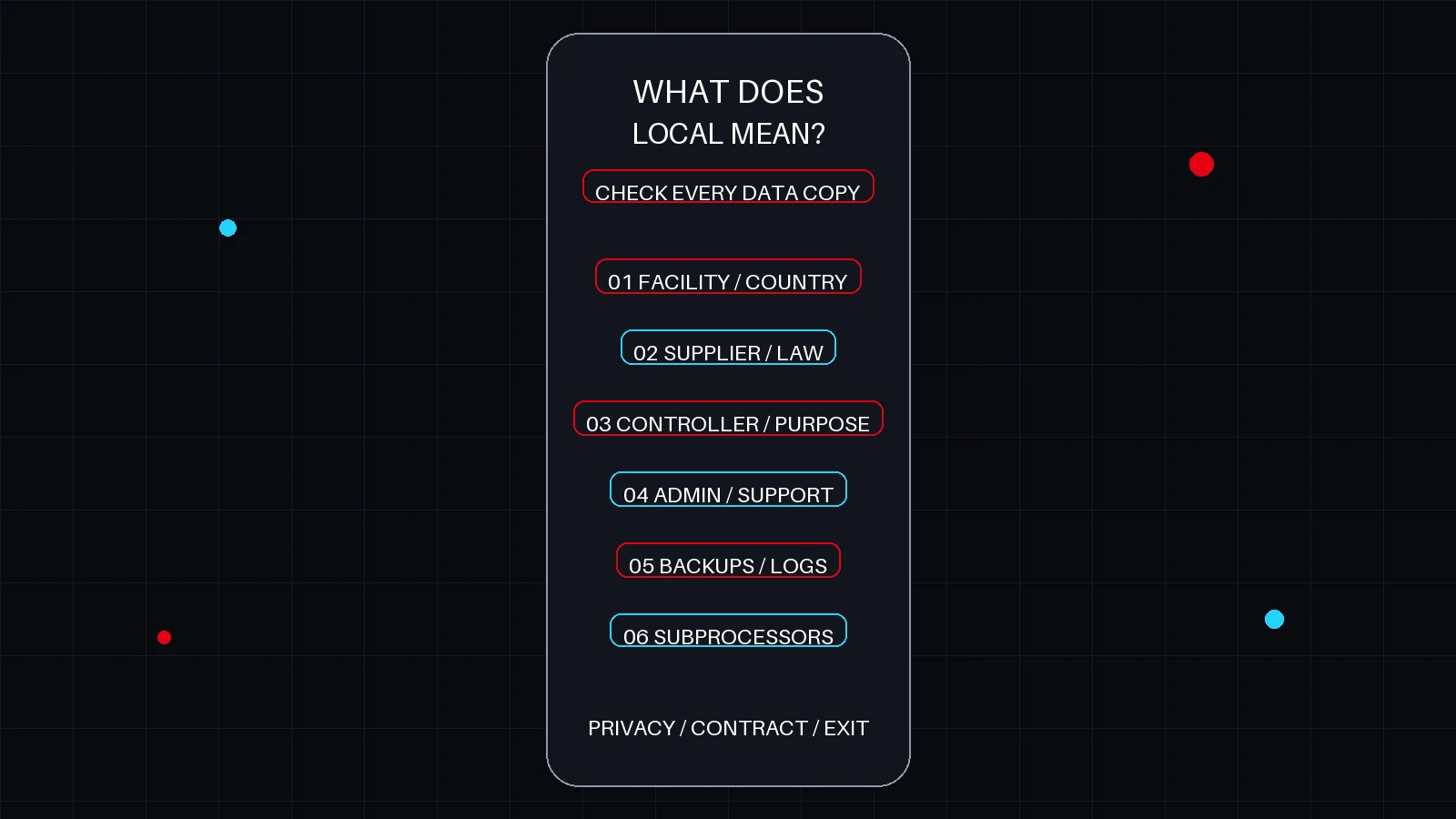
    Data location is not a complete privacy conclusion. Replication, backups, support access, logs, subprocessors and customer configuration can move or expose data beyond the compute region. Record the real data flows and obtain advice for contractual or regulatory decisions.

    Decision matrix

    Priority VPS Public cloud Dedicated Colocation
    Lowest entry cost Usually strong Strong for tiny or temporary use; egress may dominate later Budget ranges can be strong Usually weak after hardware and setup
    Rapid scaling and APIs Moderate Strong Limited to provisioned machine Slowest unless spare hardware exists
    Predictable raw compute cost Moderate Requires careful modelling Often strong Strong only at stable, sustained utilisation
    Hardware control Low Low High within supplier options Highest
    Managed services Limited Strong Customer or third party Customer or third party
    Latency-sensitive games Test noisy-neighbour and CPU Can work, but cost/CPU class matters Often strong with the right network Strong for mature operators
    DDoS exposure Product-specific Product and service-specific Product-specific; OVH/Streamline advertise mitigation Transit and mitigation contract-specific
    Operational burden Moderate Can be high despite managed components High Highest
    Data-location evidence Ask for host/backup locations Region and service documentation usually available Facility known; backups still matter Facility and hardware known; support paths still matter
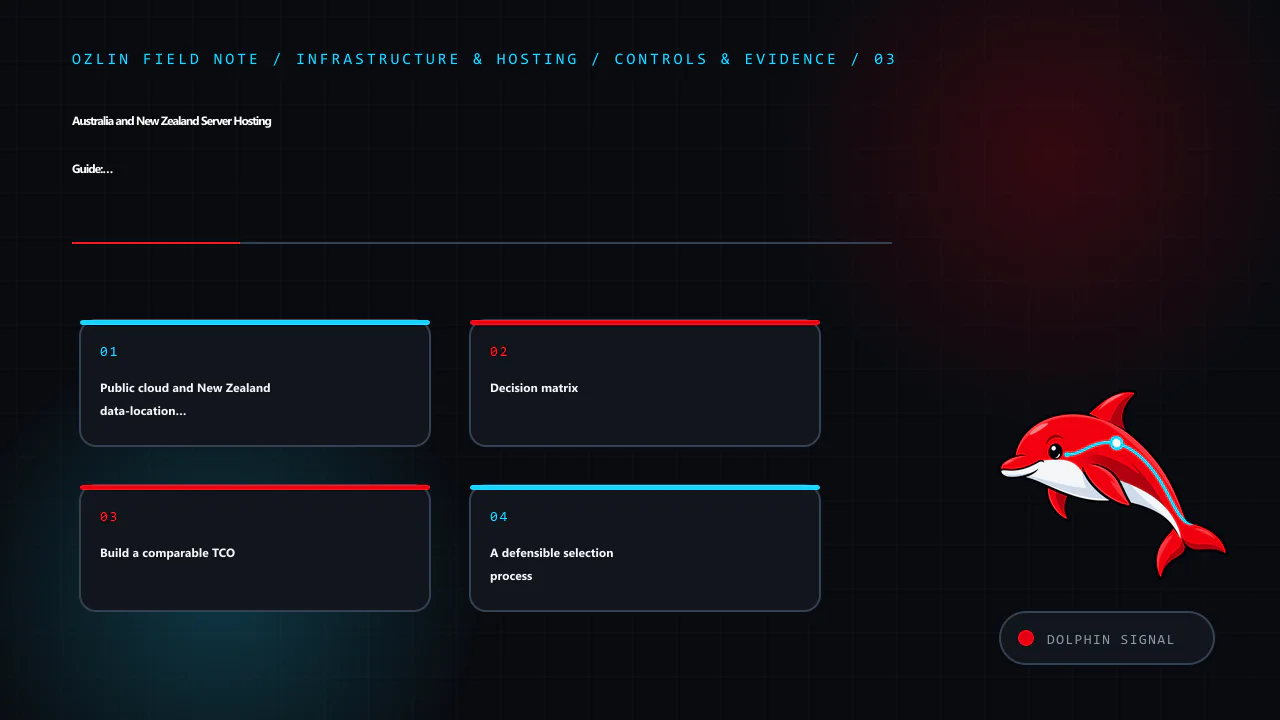
    Control and evidence map for Australia and New Zealand Server Hosting Guide: VPS, Cloud, Dedicated…, covering Public cloud and New Zealand data-location options, Decision matrix, Build a comparable TCO and related revie…
    Control and evidence map: Public cloud and New Zealand data-location options; Decision matrix; Build a comparable TCO; A defensible selection process.

    Build a comparable TCO

    Use the same workload assumptions for every candidate:

    monthly TCO = compute or rack + storage + backups + outbound traffic + public IPs + support + licences + remote hands + power + expected failure/downtime allowance

    For a dedicated server, annualise setup and expected replacement downtime. For colocation, include hardware purchase, freight, rails, PDUs, spares and disposal. For public cloud, model normal and incident months, because log retention, snapshots and egress can jump during recovery. For a New Zealand quote converted to AUD, retain both the supplier currency and an exchange-rate buffer.

    Then run evidence-producing tests: latency from real user ISPs; packet loss and jitter during peak periods; storage latency under the real queue depth; sustained CPU behaviour; restore time; mitigation escalation; and support response through the channel you would use during an incident.

    A defensible selection process

    1. Classify the workload, data, recovery target, expected traffic and attack exposure.
    2. Shortlist locations based on users and dependencies, not company headquarters.
    3. Obtain itemised quotes covering tax, term, setup, addresses, transfer, port rate, support and exit.
    4. Compare 12- and 36-month TCO under normal, growth and incident scenarios.
    5. Pilot using production-like traffic without importing sensitive data unnecessarily.
    6. Harden the operating system, hypervisor or control panel before exposure; remove defaults, restrict administration, monitor changes and test backups.
    7. Record why the choice was made and set a review date.

    Ozlin can help translate these requirements into a provider-neutral architecture and migration plan through its infrastructure and technology services. The commercial decision should remain traceable to measurements and contract terms rather than a logo or a single monthly price.

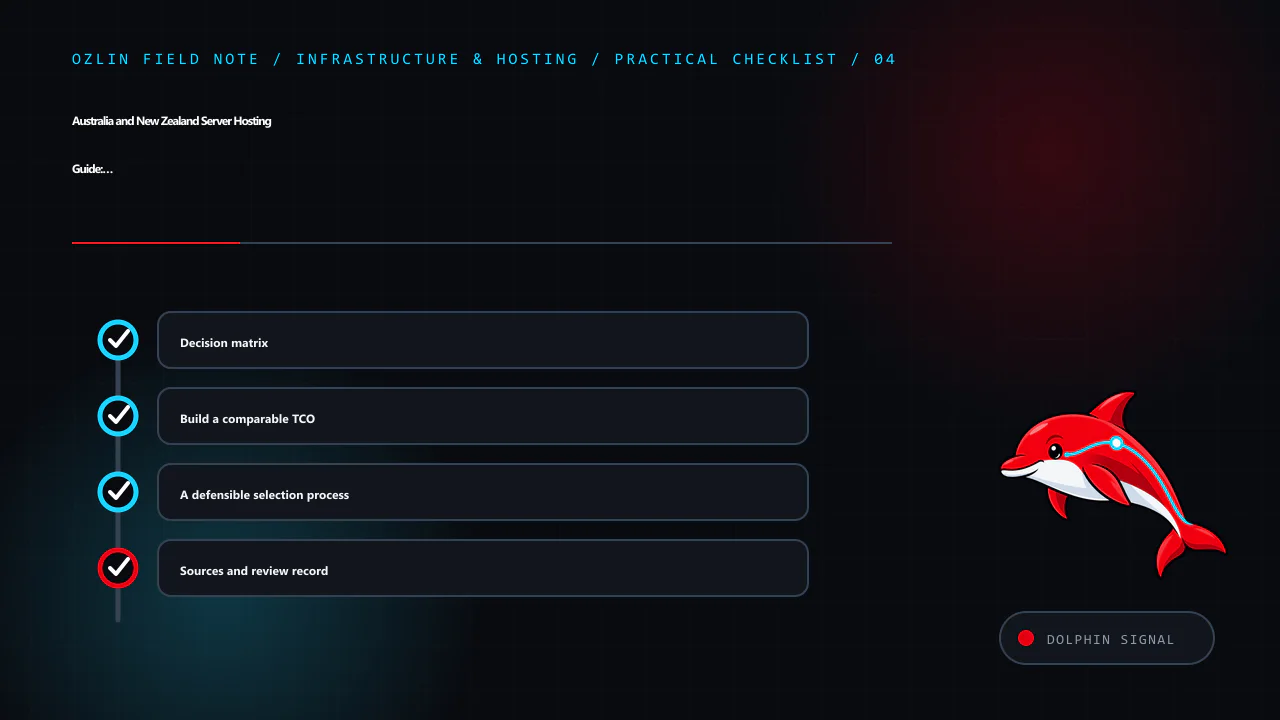
    Practical checklist for Australia and New Zealand Server Hosting Guide: VPS, Cloud, Dedicated…, covering Decision matrix, Build a comparable TCO, A defensible selection process and related review points.
    Practical checklist: Decision matrix; Build a comparable TCO; A defensible selection process; Sources and review record.

    Sources and review record

    Sources were accessed on 29 August 2026. Prices and regional availability are scheduled for review by 29 November 2026.

    AI assisted with source discovery, drafting and copyediting; Ozlin Info remains responsible for publication.

  • Why Hosting a Public Server on Home Broadband Is Usually a Bad Idea

    Why Hosting a Public Server on Home Broadband Is Usually a Bad Idea

    Running a server at home is excellent for learning. A small lab can teach Linux, containers, backups, monitoring and networking for less than a formal course. That does not automatically make a residential connection a sensible production platform for a public website, game service, file host or customer application.

    The problem is not that home hosting never works. It is that one inexpensive-looking computer inherits the limits of the house around it: consumer broadband, one power feed, domestic cooling, a shared router, changing addresses, household devices and an operator who also needs to sleep. A cloud VPS can fail too, but its network, power and replacement model are designed around hosted services. The honest comparison is total service risk, not “hardware already owned versus a monthly invoice.”

    This guide focuses on Australian residential broadband and uses public information checked on 29 August 2026. ISP addressing, plan speeds, acceptable-use rules and electricity prices change, so verify the current terms for the actual address before relying on any example.

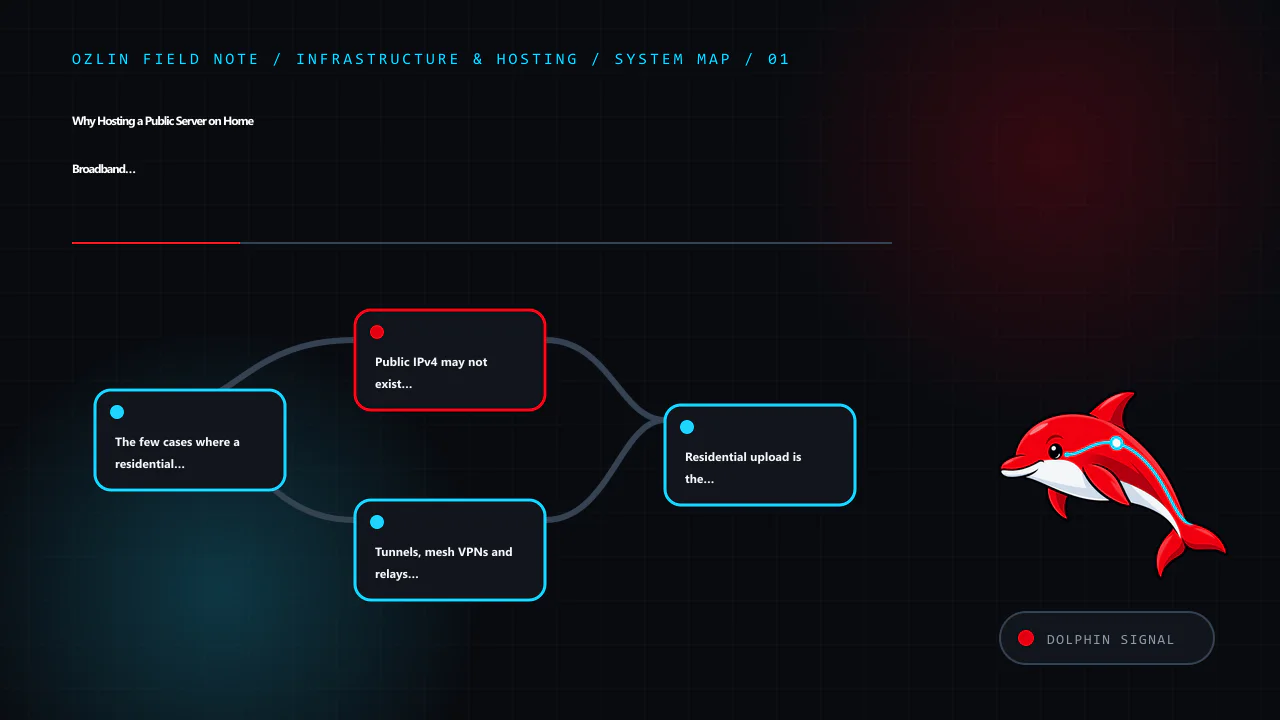
    Article map for Why Hosting a Public Server on Home Broadband Is Usually a Bad Idea, covering The few cases where a residential connection may be justifi…, Public IPv4 may not exist at your router, Tunnels, mesh VPNs an…
    Article map: The few cases where a residential connection may be justifi…; Public IPv4 may not exist at your router; Tunnels, mesh VPNs and relays solve different problems; Residential upload is the scarce direction.

    The few cases where a residential connection may be justified

    A home server can be reasonable when it is a non-critical lab, a private service reached through an authenticated overlay network, a local media or backup appliance, or a short-lived test with no customer dependency. It can also be useful for testing how a legitimate consumer service behaves from an ordinary residential network.

    Some streaming or registration platforms distinguish residential from data-centre addresses to manage licensing, fraud and abuse. That can create a genuine testing requirement, but it is not permission to evade geolocation, account, automation or anti-abuse rules. A public streaming site does not inherently need a residential IP. Check the platform contract, content rights and ISP acceptable-use policy; do not sell access to a household connection as a “clean residential proxy” or use it to disguise automated registrations.

    If the requirement is simply “customers must reach a reliable website,” residential identity is normally a disadvantage rather than a feature. Start with the Australia and New Zealand hosting guide and compare a VPS, dedicated server or colocation service first.

    Public IPv4 may not exist at your router

    Traditional port forwarding assumes the router owns a public IPv4 address. Many residential services instead use carrier-grade NAT, or CGNAT, where multiple subscribers share public IPv4 addresses and the ISP performs another translation outside the home. RFC 6598 defines a dedicated shared-address range for this purpose.

    Current Australian examples show why the ISP must be checked rather than assumed. Aussie Broadband says CGNAT is typically enabled by default and documents opt-out or static-IP paths. Superloop's residential Critical Information Summary dated 31 May 2025 says CGNAT is used where available, documents an opt-out path and lists one static IPv4 option at A$5 per month including GST. Those are provider-specific snapshots, not a promise that every ISP, access technology or future plan offers the same remedy; obtain the current CIS for the plan being purchased.

    Compare the router's WAN address with the address reported by an external service. A WAN address in private or shared space, or a different upstream address, suggests another NAT layer. Do not expose an administration page merely to test it.

    Dynamic DNS is not CGNAT traversal. DDNS updates an A or AAAA record when a routable address changes. Cloudflare's documentation describes monitoring the address and updating the DNS record through an API or client. If unsolicited packets cannot reach the subscriber through CGNAT, pointing a hostname at the shared address does not create a forwarding rule in the ISP's network.

    IPv6 can provide globally routable addresses without IPv4 NAT, but it does not remove the need for a stateful firewall. Confirm prefix stability, inbound filtering, client IPv6 support and a safe update process for dynamic AAAA records. Opening IPv6 while testing only IPv4 rules is a common way to create an unreviewed second exposure path.

    Tunnels, mesh VPNs and relays solve different problems

    An overlay product such as Radmin VPN or another mesh VPN can be useful for private access between enrolled devices. NAT traversal may establish a direct encrypted path; when that fails, a relay can add latency, throughput limits and an external dependency. This is suitable for administration or a small trusted group, not automatically for an anonymous public service.

    A reverse tunnel initiates an outbound connection from home to an edge provider. Cloudflare Tunnel, for example, documents outbound-only origin connections without opening an inbound router port. That reduces origin exposure and works behind CGNAT, but the connector, account, DNS, access policy and edge provider become part of the service. The origin still needs patches, least privilege and authentication. Protocol support and source-IP behaviour must be verified for the application.

    A VPS can also act as a WireGuard, TCP or application relay. Now both the home system and VPS must be patched, monitored and backed up; bandwidth crosses two links; client addresses may need explicit forwarding; and the relay bill may approach the price of hosting the workload there. Draw the complete data path before declaring tunnelling “free.”

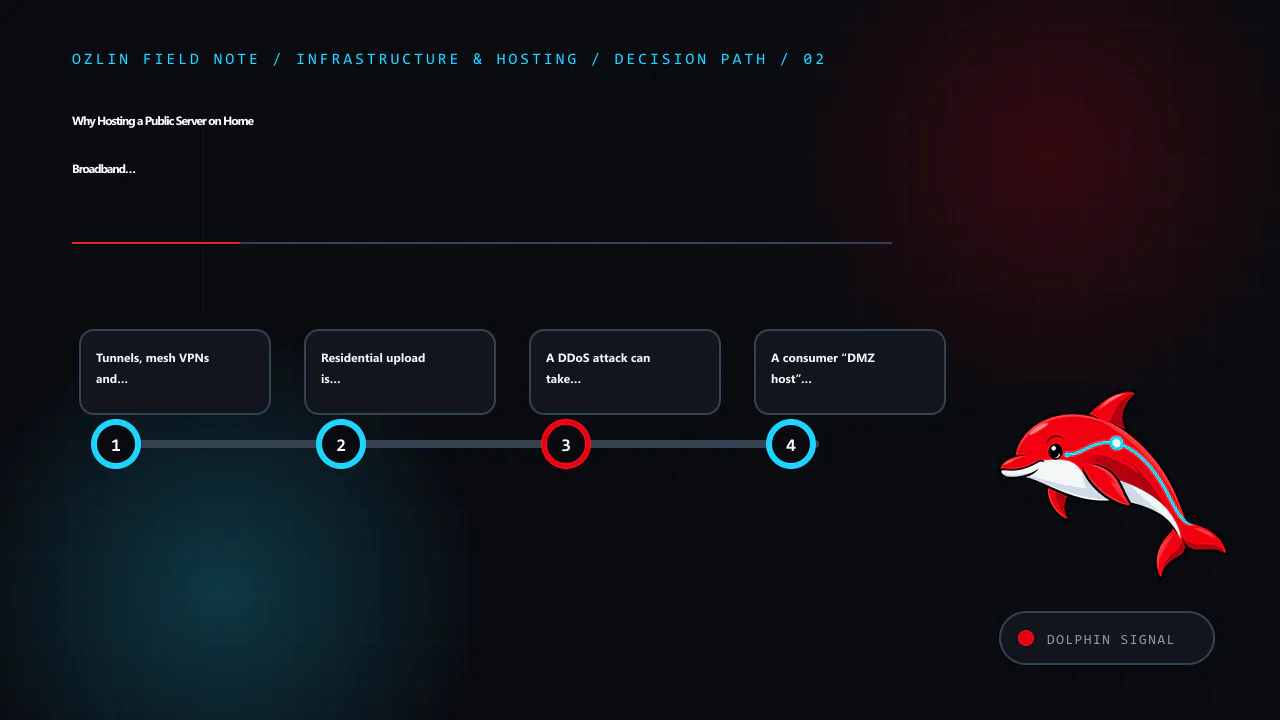
    Decision path for Why Hosting a Public Server on Home Broadband Is Usually a Bad Idea, covering Tunnels, mesh VPNs and relays solve different problems, Residential upload is the scarce direction, A DDoS attack can take…
    Decision path: Tunnels, mesh VPNs and relays solve different problems; Residential upload is the scarce direction; A DDoS attack can take the household offline; A consumer “DMZ host” is not network segmentation.

    Residential upload is the scarce direction

    Headline broadband speed usually emphasises download. A public server primarily sends data upstream. Concurrent game updates, video, backups and household video calls can contend for the same queue, increasing latency and packet loss before a monthly transfer total looks unusual.

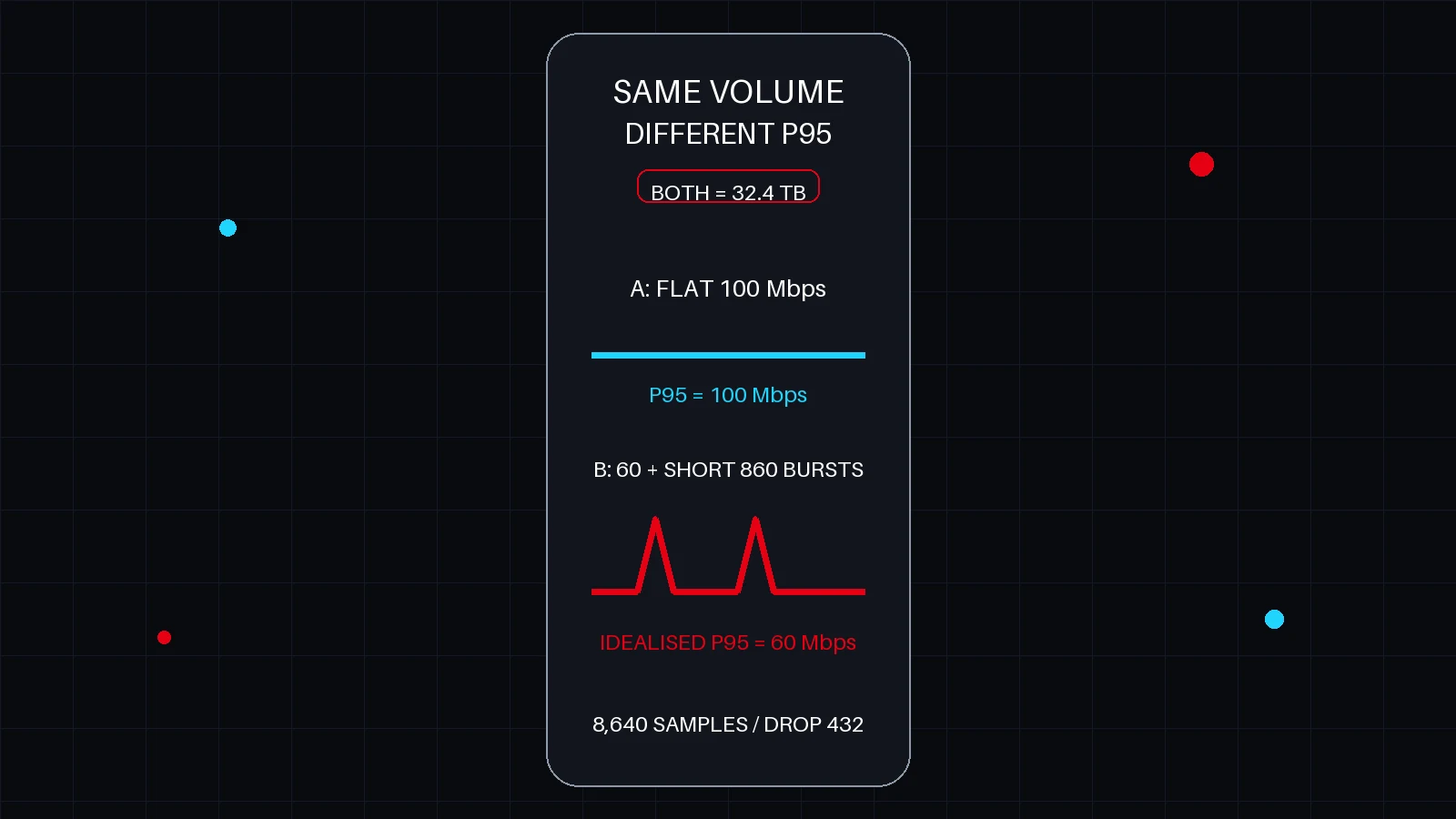
    Measure wired sustained upload, p95 latency under load, jitter and packet loss at busy times. Test with the real application, not one speed-test burst. A 50 Mbps upstream cannot deliver 50 Mbps of dependable application traffic after protocol overhead, contention and the headroom needed by the household. Traffic shaping can improve fairness but cannot create upstream capacity.

    Ozlin has observed one 64-player CS2 zombie-escape environment peak around 150 Mbps outbound under its particular map and plugin mix. That does not define all game servers, but it demonstrates why a residential uplink can fail on instantaneous demand even when average monthly traffic seems manageable. The Australian game-server sizing guide explains how to measure this rather than size from slot count alone.

    A DDoS attack can take the household offline

    A local firewall can discard packets after they arrive. It cannot restore a residential access link whose upstream capacity has already been consumed. A volumetric attack against the public address may therefore disrupt work, calls, entertainment, cameras and every other household service—not just the intended server. Changing a dynamic IP may provide temporary relief, but DNS history, game listings or another direct protocol can reveal it again.

    ASD's denial-of-service guidance recommends planning with upstream providers, resilient capacity, monitoring, CDNs and cloud-based mitigation before an incident. A CDN can help an HTTP service when the origin address is concealed and origin firewall rules accept only authorised edge traffic. It does not automatically protect arbitrary UDP, game, voice, mail or remote-administration protocols, and a DNS-only record can reveal the same origin address.

    Ask the ISP what happens under attack: whether it offers mitigation, rate-limits or null-routes the address, how long recovery takes, and whether abuse traffic affects the account. If availability matters, this conversation should occur before publication.

    A consumer “DMZ host” is not network segmentation

    On many home routers, the setting labelled DMZ host or exposed host forwards essentially all otherwise-unmapped inbound TCP and UDP traffic to one internal device. TP-Link's current explanation explicitly distinguishes this from a true DMZ. It should not be used as a shortcut when the operator is unsure which ports are required.

    Even precise port forwarding increases attack surface. If the public server shares a flat LAN with laptops, phones, network storage, printers, smart TVs, cameras and home-automation devices, compromise can create a foothold behind the router. It does not make every device instantly public, but it places an attacker on a network that was probably designed for convenience and discovery rather than hostile east-west traffic.

    Use a real isolated VLAN or physical segment with default-deny rules between the server, management devices and household/IoT networks. Disable UPnP when automatic inbound mappings are unnecessary. Expose only the required service ports, keep router administration private, use a host firewall and supported software, and never install cracked or nulled panels, plugins or server packages. Unknown privileged code can convert the home server—and sometimes vulnerable routers or IoT devices—into part of someone else's botnet.

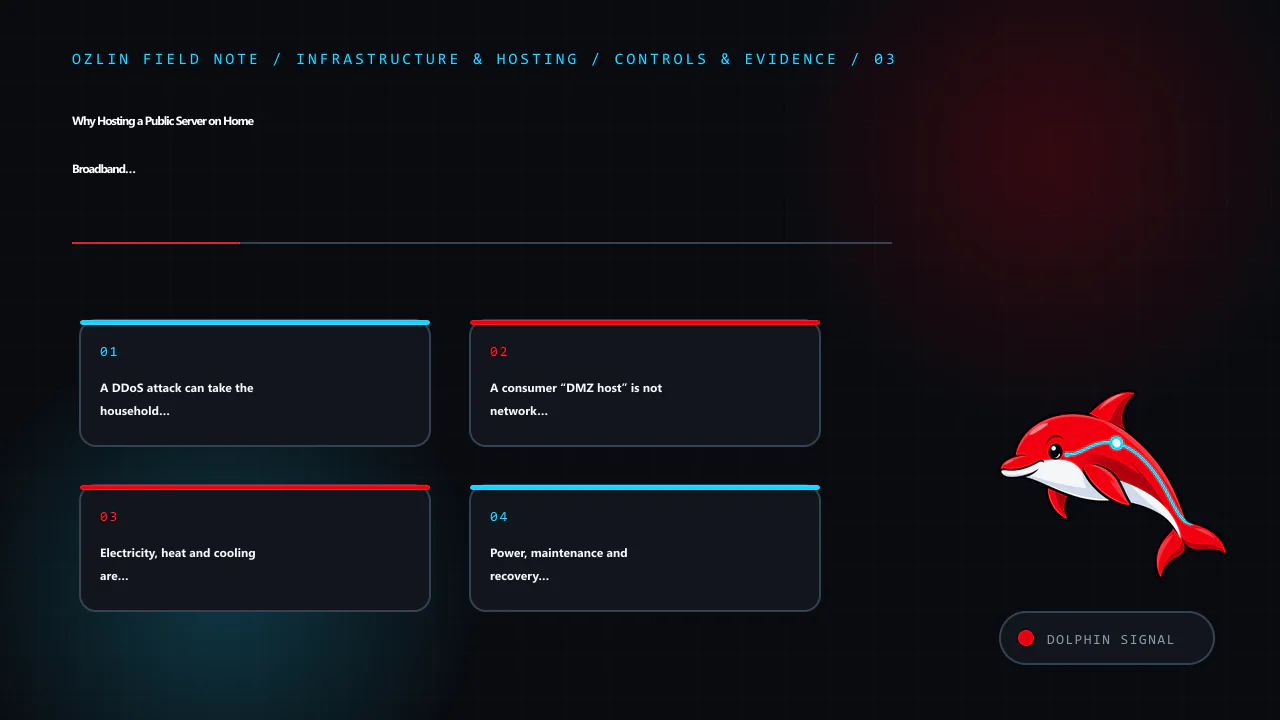
    Control and evidence map for Why Hosting a Public Server on Home Broadband Is Usually a Bad Idea, covering A DDoS attack can take the household offline, A consumer “DMZ host” is not network segmentation, Electricity, he…
    Control and evidence map: A DDoS attack can take the household offline; A consumer “DMZ host” is not network segmentation; Electricity, heat and cooling are recurring costs; Power, maintenance and recovery still need an owner.

    Electricity, heat and cooling are recurring costs

    An average load runs for 8,760 hours each year:

    annual kWh = average watts ÷ 1,000 × 8,760

    The AER's 2026–27 residential Default Market Offer flat usage caps for the three NSW distribution areas are 33.14–35.01 cents per kWh, including GST. They are safety-net tariff caps, not a prediction of any reader's bill; market offers, solar, time-of-use periods and location change the result.

    Average continuous load Annual energy Illustrative NSW electricity cost Excluded costs
    30 W mini PC 262.8 kWh A$87–A$92/year storage, UPS losses, cooling and broadband
    100 W compact server 876 kWh A$290–A$307/year same exclusions
    300 W rack server 2,628 kWh A$871–A$920/year same exclusions
    500 W server/GPU system 4,380 kWh A$1,452–A$1,533/year same exclusions

    Almost all consumed electricity becomes heat in the room. A garage or cupboard that is acceptable in winter may throttle disks, batteries and CPUs during a Sydney summer. Domestic air conditioning adds energy and another failure dependency. Measure inlet temperature, humidity, fan noise and power at the wall across seasons. Do not defeat server fan controls or electrical protections to make retired rack hardware tolerable beside a bedroom.

    Use this TCO rather than “the machine was free”:

    hardware + UPS + incremental electricity + cooling + public-IP/tunnel fees + replacement parts + off-site backup + administration and outage cost − residual value

    Power, maintenance and recovery still need an owner

    NBN states that mains-powered equipment connected to its network will not work during a power outage unless each required item has suitable backup. A UPS must cover the server, storage, router, access equipment and any tunnel dependency at the premises; runtime decreases as batteries age. It should trigger an orderly shutdown, not merely delay an uncontrolled one.

    Residential plans may not include business repair targets, proactive monitoring, redundant carriers or a service-level agreement. Firmware updates can reboot the router, a family member can unplug equipment, and a failed disk may wait until the operator returns home. Backups stored beside the server share theft, fire, flood and electrical risk. Maintain encrypted off-site backups and test restoration to different hardware.

    Operational minimums include patch windows, service and certificate monitoring, central logs, configuration backup, spare storage, a documented rebuild, remote access that does not expose management ports, and an out-of-band way to learn that the house is offline.

    If you still need a home-hosted service

    Proceed only when the consequence of failure is acceptable and the residential location is genuinely required. A defensible starting architecture is:

    1. confirm the ISP contract, public IPv4/IPv6 behaviour, static-address cost, upload capacity and abuse response;
    2. place the server on an isolated network with default-deny access to household and IoT devices;
    3. prefer an authenticated private overlay for administration and private services;
    4. for public HTTP, use an outbound tunnel or protected reverse proxy, hide and restrict the origin, and expose no router or server management UI;
    5. run supported software as a non-root service identity, minimise plugins, enable MFA where available and rotate scoped credentials;
    6. deploy UPS-backed graceful shutdown, temperature and availability alerts, rate limits and tested off-site recovery; and
    7. document a migration trigger—traffic, uptime, security, temperature or support load—at which the service moves to hosted infrastructure.

    For most public services, the cleaner design is a small VPS or protected dedicated server, with the home lab used for development and backups that do not contain the only copy. Colocation becomes attractive when owned hardware, power density and remote hands matter. Ozlin's infrastructure and hosting services can help compare the full path without publishing private network details.

    Home hosting is valuable as a laboratory. It becomes a poor bargain when customer availability, household safety or an irreplaceable residential connection is placed behind the same inexpensive router.

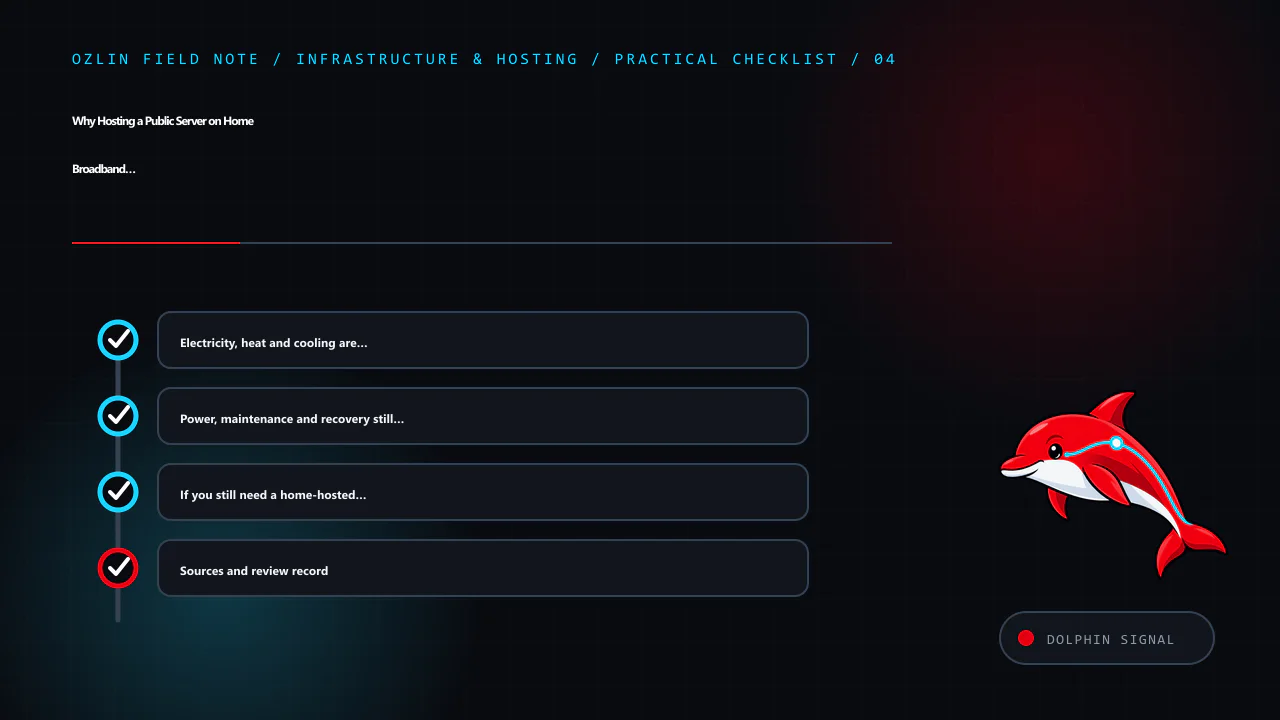
    Practical checklist for Why Hosting a Public Server on Home Broadband Is Usually a Bad Idea, covering Electricity, heat and cooling are recurring costs, Power, maintenance and recovery still need an owner, If you still…
    Practical checklist: Electricity, heat and cooling are recurring costs; Power, maintenance and recovery still need an owner; If you still need a home-hosted service; Sources and review record.

    Sources and review record

    Sources and prices were accessed on 29 August 2026. ISP addressing, tunnel behaviour and electricity figures are scheduled for review by 29 November 2026.

    AI assisted with source discovery, drafting and copyediting; Ozlin Info remains responsible for publication.