
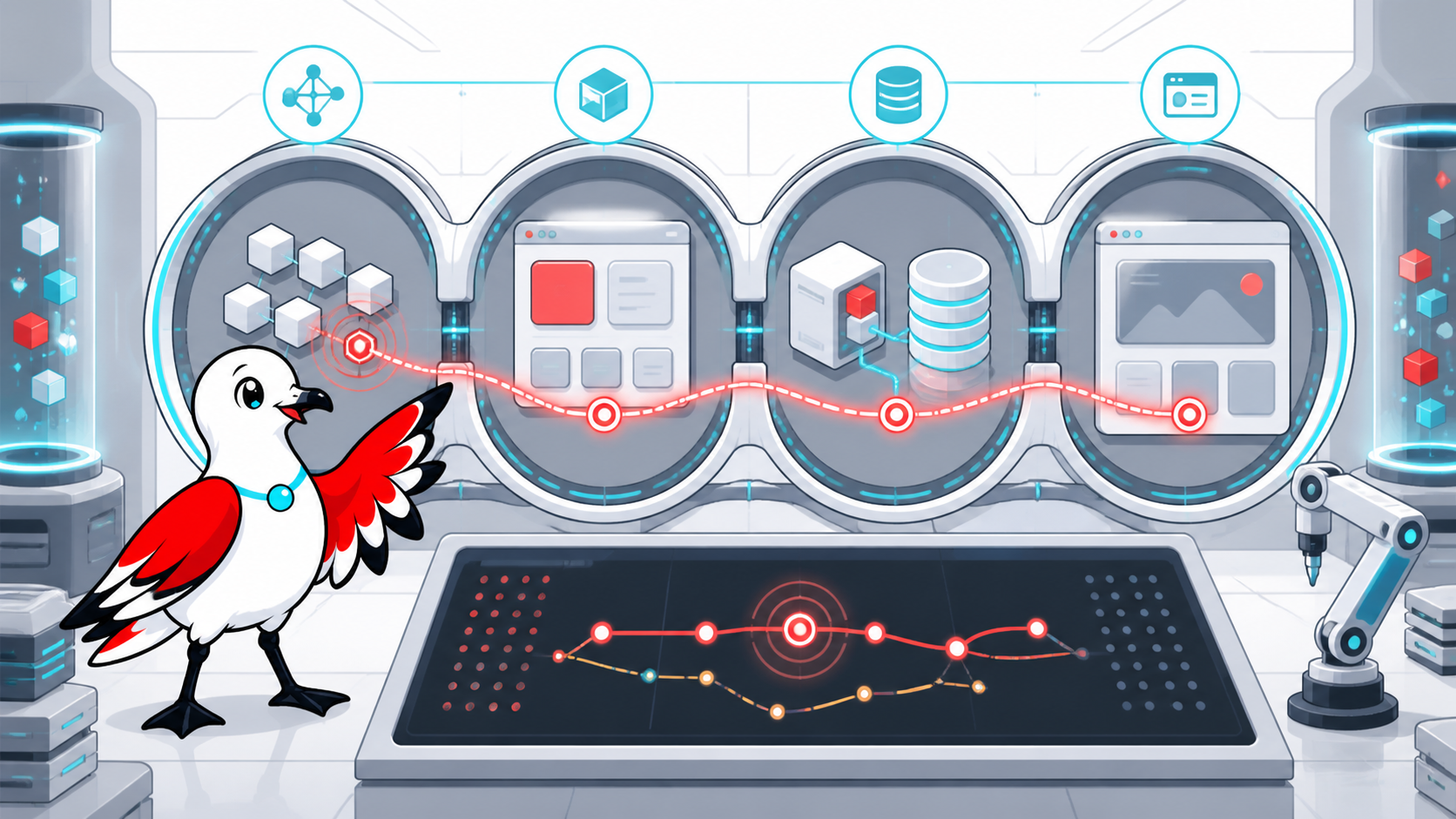
A useful web test suite is not the largest collection of tests. It is a feedback system that tells a team whether an important behaviour still works, where a failure is likely to be and whether a change is safe enough to release.
The right mix depends on the product's risks. A brochure site, an internal dashboard and a payment workflow should not receive identical automation. Start with business-critical tasks, failure consequences and architectural boundaries; then choose the cheapest test that provides credible evidence.
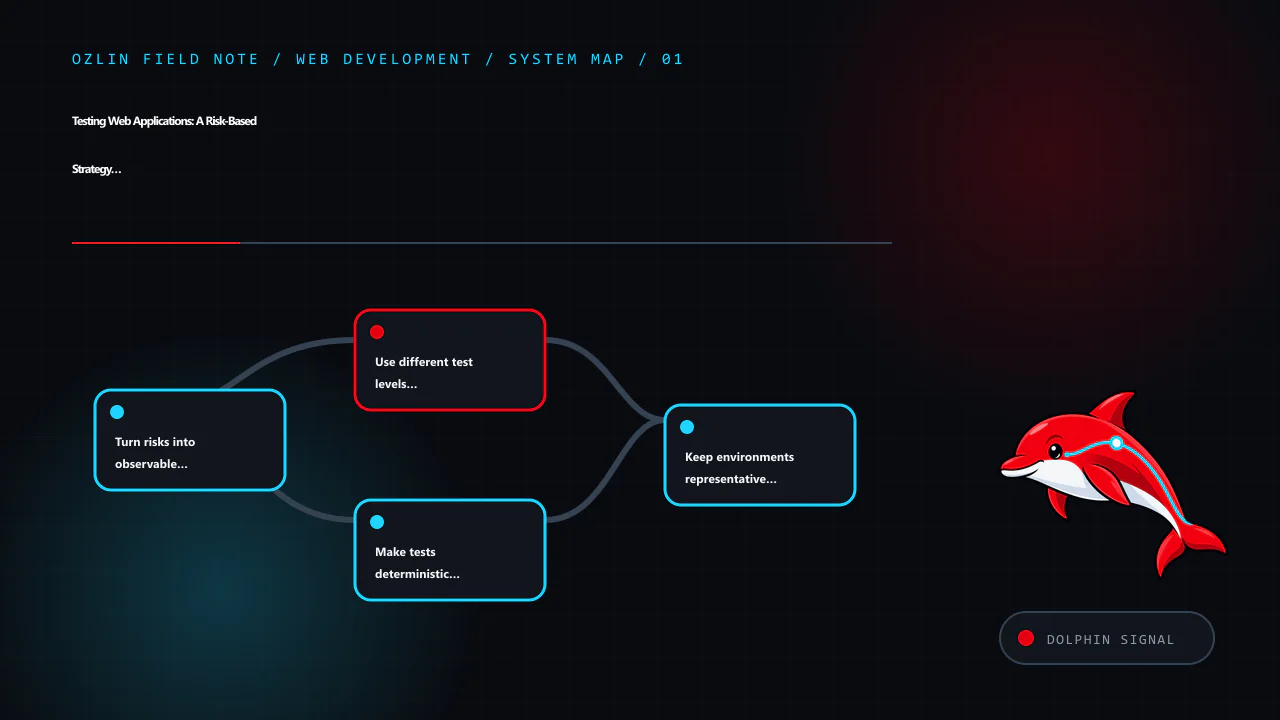
Turn risks into observable behaviours
Before choosing a framework, list what must remain true. Examples include:
- a visitor can submit a valid enquiry and receives an understandable result;
- invalid input cannot bypass server-side validation;
- an authorised user can see a record while an unauthorised user cannot;
- an order total uses the intended tax and discount rules;
- a third-party outage produces a controlled response rather than duplicate work;
- keyboard users can complete the critical journey; and
- monitoring receives enough context to investigate a production failure.
Write tests around these behaviours and interfaces, not private implementation details. If a harmless refactor breaks dozens of tests without changing user-visible behaviour, the suite is probably coupled to the code rather than protecting the product.
A simple risk register helps decide depth:
| Risk | Consequence | Useful evidence |
|---|---|---|
| Price calculation is wrong | Financial loss and customer dispute | Unit tests with boundary and property cases; integration against stored rules |
| Login is unavailable | Users cannot enter the service | Service integration, browser smoke journey and availability monitoring |
| Role check is bypassed | Confidentiality or integrity impact | Server-side authorisation tests, negative cases and security review |
| Form changes silently break analytics | Decision data becomes incomplete | Contract or integration check for the event schema |
| External API retries duplicate an action | Duplicate charge or record | Integration test with controlled failures and idempotency evidence |
Use different test levels for different questions
Unit tests protect deterministic logic
Unit tests are best for small decisions with controlled inputs: parsing, calculations, validation rules, state transitions and permission policies. They should be fast, deterministic and able to run without browsers, networks or shared databases.
Test useful partitions and boundaries rather than every line. For a date rule, include values before, at and after the boundary. For a reducer, cover valid transitions and rejected transitions. Code coverage can reveal unexecuted areas, but a percentage does not prove that assertions are meaningful. Vitest, for example, can collect V8 or Istanbul coverage; the team still has to decide which behaviours and branches matter (Vitest — Coverage).
Mock narrow, unstable boundaries such as a clock or remote client. Excessive mocking can create a fictional system in which every collaborator behaves exactly as the test assumes.
Component tests protect user interaction in a small scope
A component test can render a form, menu or data grid with realistic properties and exercise it through labels, roles and visible outcomes. Testing Library recommends queries that resemble how users interact and prioritises accessible roles and names over internal component state (Testing Library — About Queries).
This style can detect missing labels, incorrect disabled states and broken event flows while remaining faster and easier to diagnose than a complete browser journey. It does not replace testing the real application wiring.
Integration and contract tests protect boundaries
Integration tests verify that real parts work together: application code with a database, a queue, file storage or an HTTP service. Use an isolated database schema or disposable service and run the real migrations. Verify both data written and externally visible response.
For an external service, a contract test can check the request and response schema, authentication expectations and error mapping without depending on the provider for every build. Periodically test the real sandbox or staging integration as well; a local stub cannot reveal DNS, TLS, credential, quota or provider changes.
Avoid sharing mutable records between parallel tests. Generate unique identifiers, reset state deliberately and make cleanup idempotent.
End-to-end tests protect complete journeys
End-to-end tests run through the deployed user interface and connected services. They are valuable for a small number of critical paths: sign-in, search, purchase, content publication or contact submission. They are also slower and have more failure points, so using them for every edge case creates expensive, noisy feedback.
Playwright gives each test an isolated browser context by default, including separate cookies, local storage and session storage (Playwright — Test Isolation). Its role- and label-based locators are more resilient and closer to user perception than long CSS or XPath chains. Locator assertions retry until the expected condition or timeout, which is safer than arbitrary sleeps (Playwright — Locators; Playwright — Assertions).
For example:
import { test, expect } from '@playwright/test';

test('valid enquiry reaches confirmation', async ({ page }) => {
  await page.goto('/contact/');
  await page.getByLabel('Name').fill('Test Customer');
  await page.getByLabel('Email').fill('[email protected]');
  await page.getByLabel('Message').fill('Please contact me about a website review.');
  await page.getByRole('button', { name: 'Send enquiry' }).click();
  await expect(page.getByRole('status')).toContainText('received');
});
Use reserved test recipients and non-production credentials. The assertion should verify a meaningful result, not merely that a button accepted a click.
Make tests deterministic before adding retries
Flaky tests usually expose uncontrolled time, state, networks or selectors. Diagnose the source rather than automatically retrying everything until the pipeline turns green.
Common controls include:
- freeze or inject the clock for time-dependent logic;
- seed known data per test and use unique identifiers;
- wait for an observable state, not a fixed number of milliseconds;
- isolate third-party traffic behind a controlled contract or sandbox;
- keep browser tests independent of execution order;
- pin or deliberately update browsers and test dependencies; and
- capture console output, network records, screenshots and traces on failure.
A retry may be appropriate for known infrastructure instability, but report the first failure and retry count. A test that only passes after retries is evidence to investigate, not a clean pass.
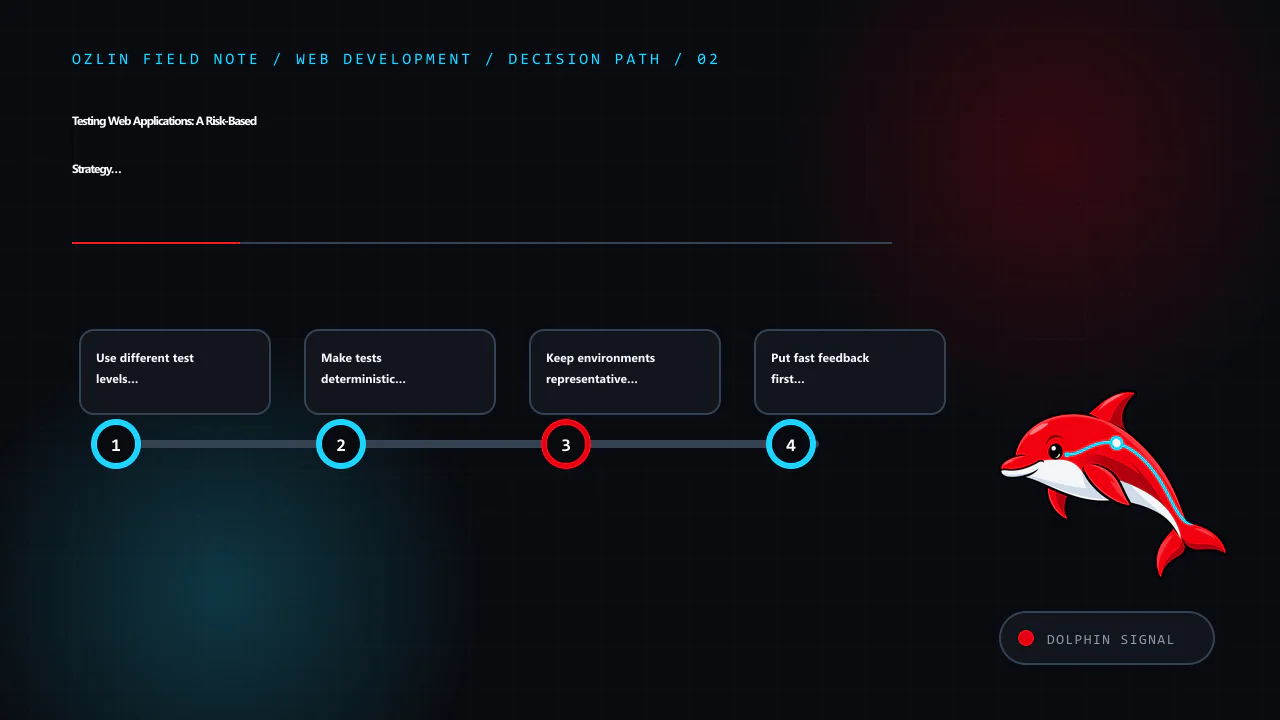
Keep environments representative without copying production data
Test environments should match production in material architecture, configuration shape, database migrations and deployment process. They do not need a copy of personal information. Prefer synthetic records designed around boundary cases. If production-derived data is genuinely necessary, minimise, de-identify, authorise and control it under an appropriate data-handling process.
Treat test credentials as secrets, rotate them and limit permissions. Ensure email, payment, notification and deletion actions cannot accidentally reach real customers.
Put fast feedback first in CI
A practical pipeline might run:
- formatting, static analysis and type checks;
- fast unit and component tests;
- integration and contract tests with disposable dependencies;
- build and dependency checks;
- a focused browser smoke suite against the release candidate; and
- broader scheduled, pre-release or post-deployment checks where justified.
Parallelise only tests that truly isolate their data and resources. Gate releases on defined critical failures rather than one undifferentiated pass-rate number. Track duration and flaky-test rate so feedback does not slowly become unusable.
Review the suite as part of product maintenance
For every defect that escapes, ask which layer could have caught it most cheaply. Add a regression test at that layer and correct the underlying design. Remove obsolete tests when behaviour is intentionally retired. Review slow, duplicate and low-value cases rather than letting the suite grow forever.
Important qualities still need human work: exploratory testing, usability, accessibility, threat modelling and review of ambiguous requirements. Automation repeats known checks; it does not discover every way a person or system may behave.
For help designing a release workflow or testing a web application within an agreed scope, see Ozlin Info's web development services or contact Ozlin Info.
Related reading: Authorised security testing: scope, evidence and safe delivery.
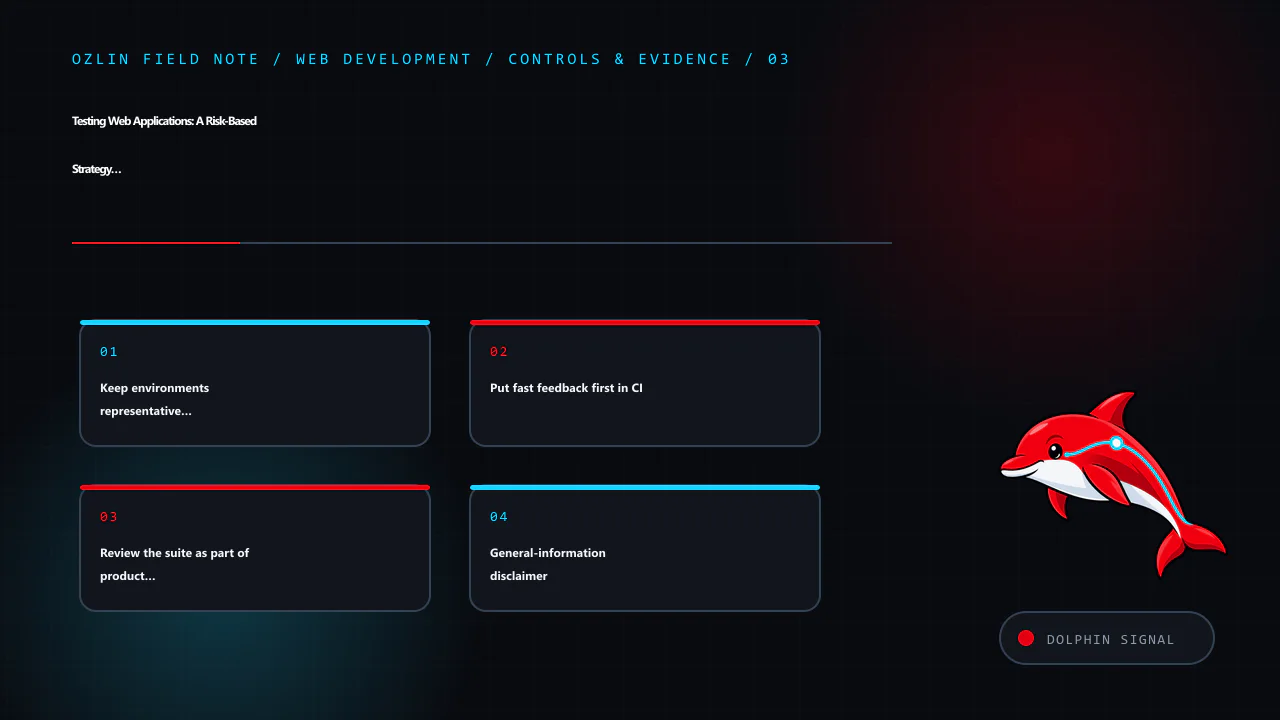
General-information disclaimer
This article provides general technical information only. A suitable test strategy depends on the application's risks, architecture, data, users and contractual or regulatory obligations. Testing reduces uncertainty but cannot prove that software has no defects or security weaknesses.
AI-assistance disclosure
AI tools assisted with source discovery, outlining and copyediting. A human reviewer must verify the examples, tool behaviour, service claims and publication decision before release. No test coverage or defect-prevention outcome is guaranteed.
Primary sources checked
- Playwright — Test Isolation
- Playwright — Locators
- Playwright — Assertions
- Playwright — Best Practices
- Vitest — Coverage
- Testing Library — Introduction
- Testing Library — About Queries
Source access date: 29 August 2026.
Leave a Reply