
Reviewed: 13 September 2026 · Next review: 13 December 2026
Author: Ozlin Info Editorial Team · Human review: Lin (accountable human); Codex assisted
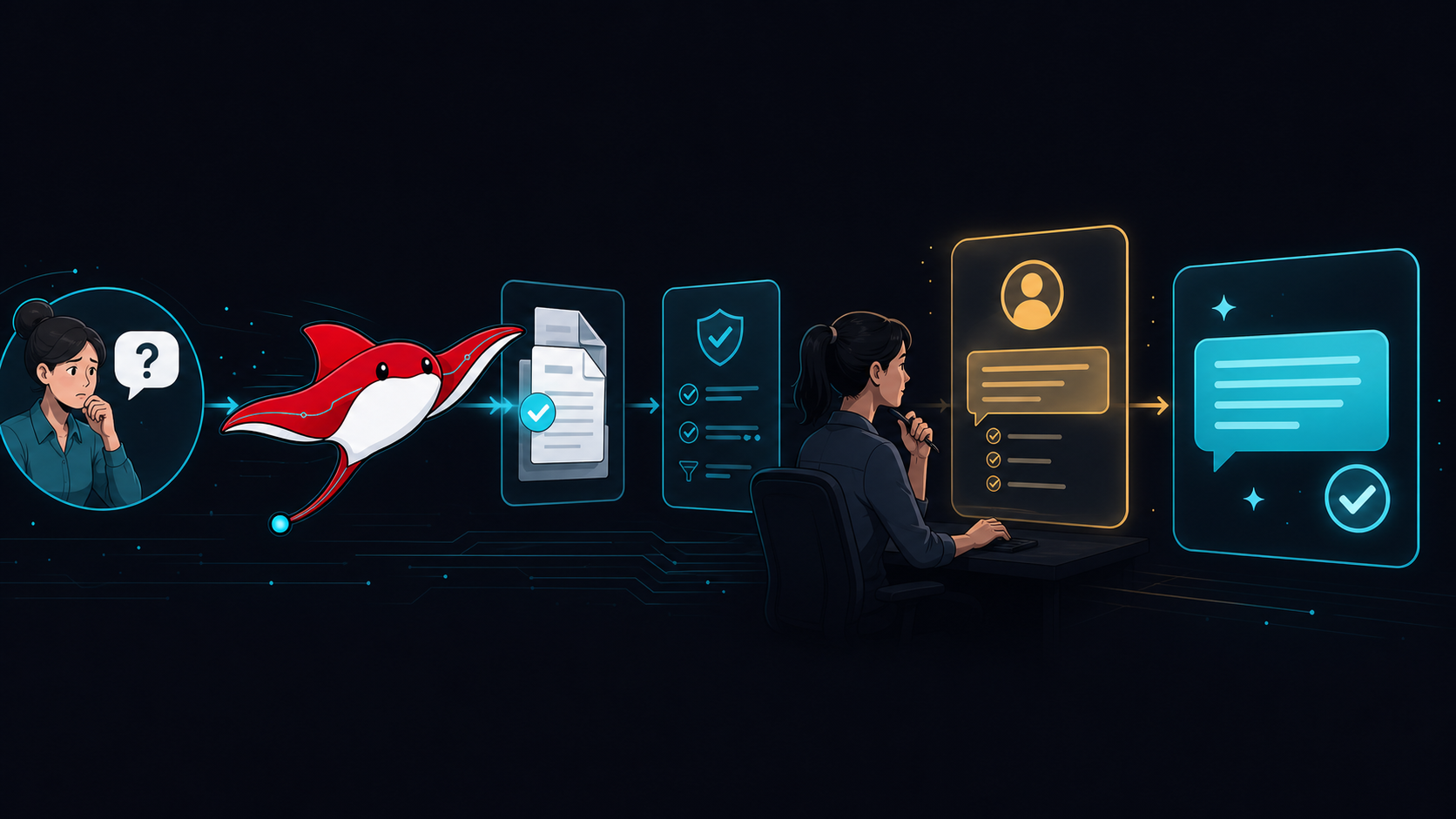
An AI chatbot can be useful without becoming the voice of your entire business. For a small team, the best first deployment is usually a narrow service task with a known answer, a clear boundary and an easy route to a person. The wrong first deployment is an open-ended bot that can make commitments, interpret complex cases or act on customer accounts without oversight.
That distinction matters because the main risks are operational, not merely technical. The Australian Cyber Security Centre’s 2026 guidance for small businesses identifies data leakage, unreliable or manipulated outputs, and supply-chain dependencies as key risks when adopting cloud-based AI. A chatbot project should therefore start with a business process and a risk decision—not with a model demonstration.
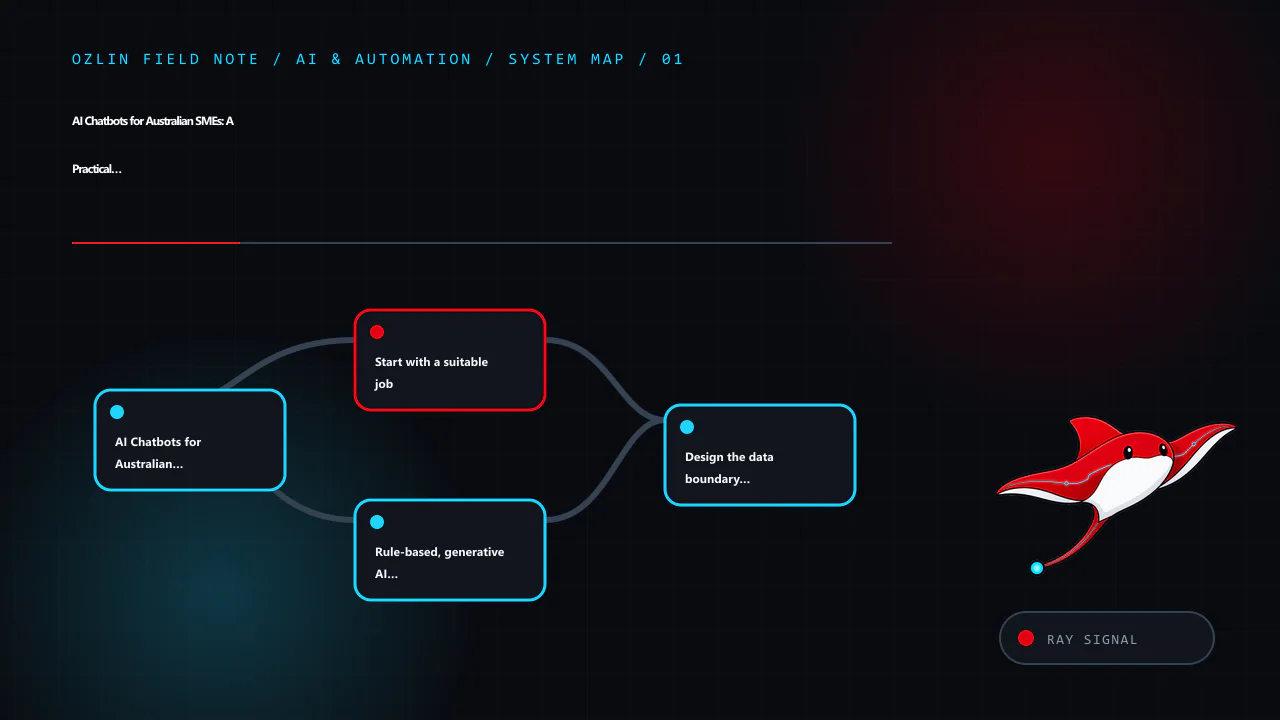
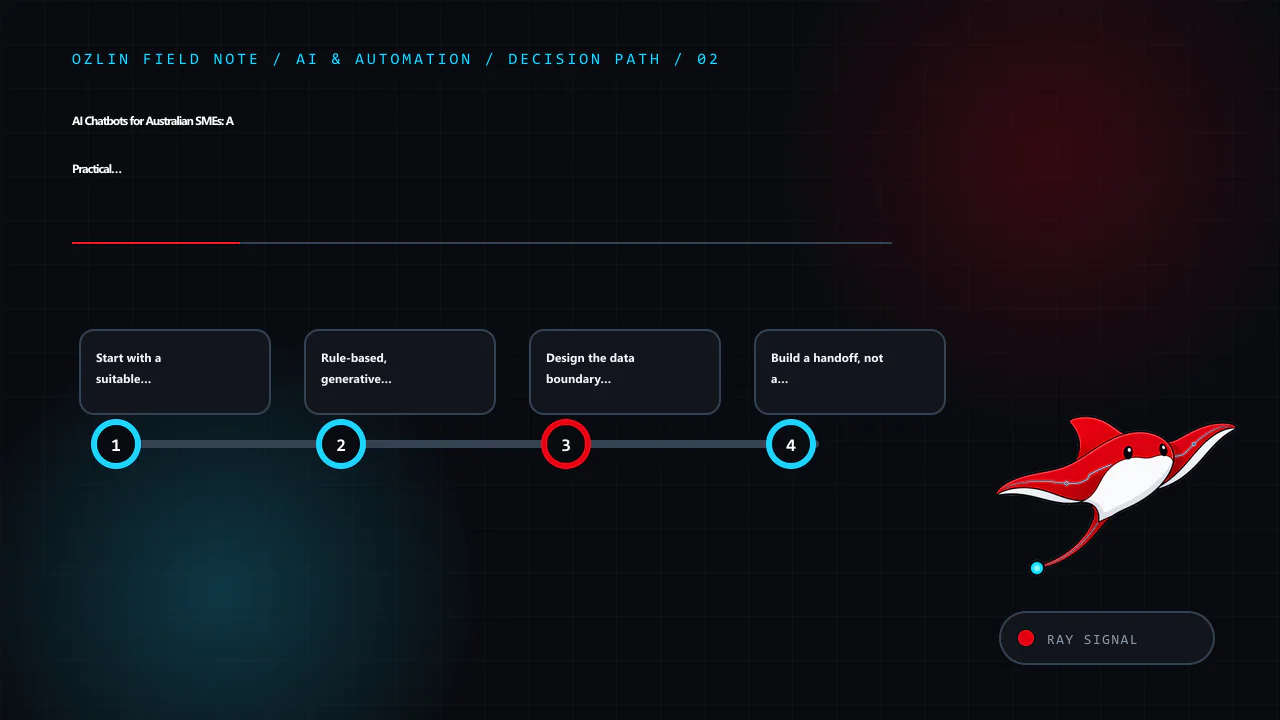
Start with a suitable job
A good first chatbot task is repetitive, low consequence and easy to check. Examples include:
- answering questions from approved opening hours, service-area and booking information;
- helping a visitor find the right service page or intake form;
- collecting the minimum details needed for a callback;
- asking structured triage questions before handing the conversation to staff; or
- summarising a conversation for an authorised team member to review.
Keep a human in control where an answer could materially affect a person, create a quote or contract, expose account information, or be mistaken for legal, medical, financial or security advice. The Australian Government’s Guidance for AI Adoption recommends documenting intended uses, foreseeable misuse, limitations, accountability and feedback paths. It also notes that risk increases when a simple, monitored chatbot becomes a 24/7 service handling more complex questions without human oversight.
Before choosing a product, write one sentence that completes this prompt:
The chatbot may [perform this task] using [these approved sources], but it must hand off when [these conditions occur].
If the sentence cannot be made specific, the proposed scope is probably too broad for a first release.
Rule-based, generative AI or a hybrid?
A rule-based flow is predictable. It can present buttons, collect fields and route a user according to explicit conditions. It is often the safer choice for consent, booking or eligibility steps where wording and sequence must remain fixed.
A generative AI chatbot is more flexible with natural language, but it can produce a plausible answer that is incomplete, unsupported or wrong. Connecting it to an approved knowledge base through retrieval-augmented generation can provide relevant context; it does not guarantee that every answer will be faithful to that context.
For many SMEs, a hybrid is sensible: use deterministic controls for identity, consent, transactions and escalation, while using an AI model to interpret ordinary questions and draft answers from a limited source set. The user should be told that they are interacting with AI, what it can do, and how to reach a person.
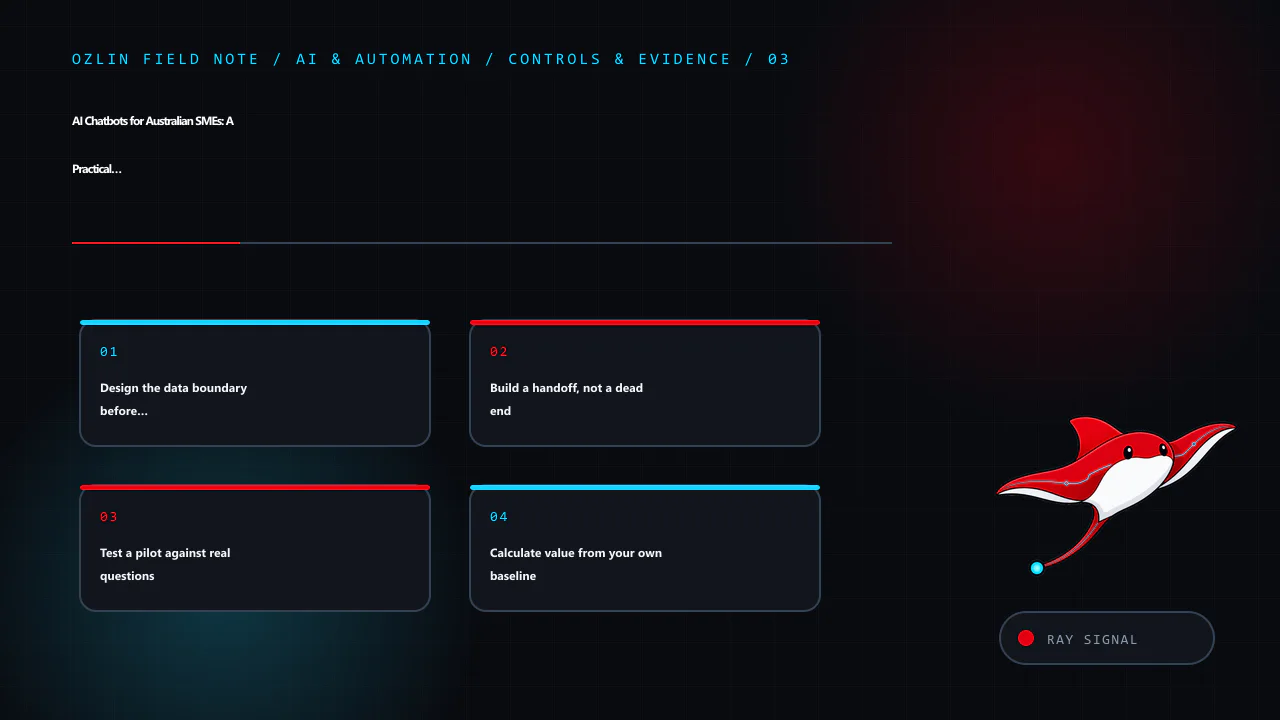
Design the data boundary before the conversation
Map the information that could enter the system: names, contact details, order references, free-text messages, uploaded files, chat transcripts, IP addresses and technical logs. Then decide which fields are genuinely needed, where they are stored, who can access them, how long they are retained and what reaches each supplier.
If your organisation is covered by the Privacy Act 1988, the Australian Privacy Principles apply when an AI system handles personal information. The OAIC’s guidance on commercially available AI products recommends due diligence, privacy by design, human oversight, clear notices and ongoing review. As a best-practice position, the OAIC also recommends not entering personal information—particularly sensitive information—into publicly available generative AI tools.
Do not assume that buying an “enterprise” plan resolves these questions. Check the actual configuration and contract:
- Is submitted data used to train or improve a provider’s models?
- Where can prompts, transcripts, embeddings, logs and backups be processed or stored?
- Which subprocessors can access them?
- Can retention be limited and deletion requests be actioned?
- How are administrators authenticated and audited?
- What is the incident-notification process?
- What happens to the data when the service ends?
The ACSC recommends reviewing vendor data handling, ownership, storage and security arrangements, and defining incident responsibilities. These checks apply whether the chatbot is a WordPress plugin, an embedded SaaS widget or a custom application.
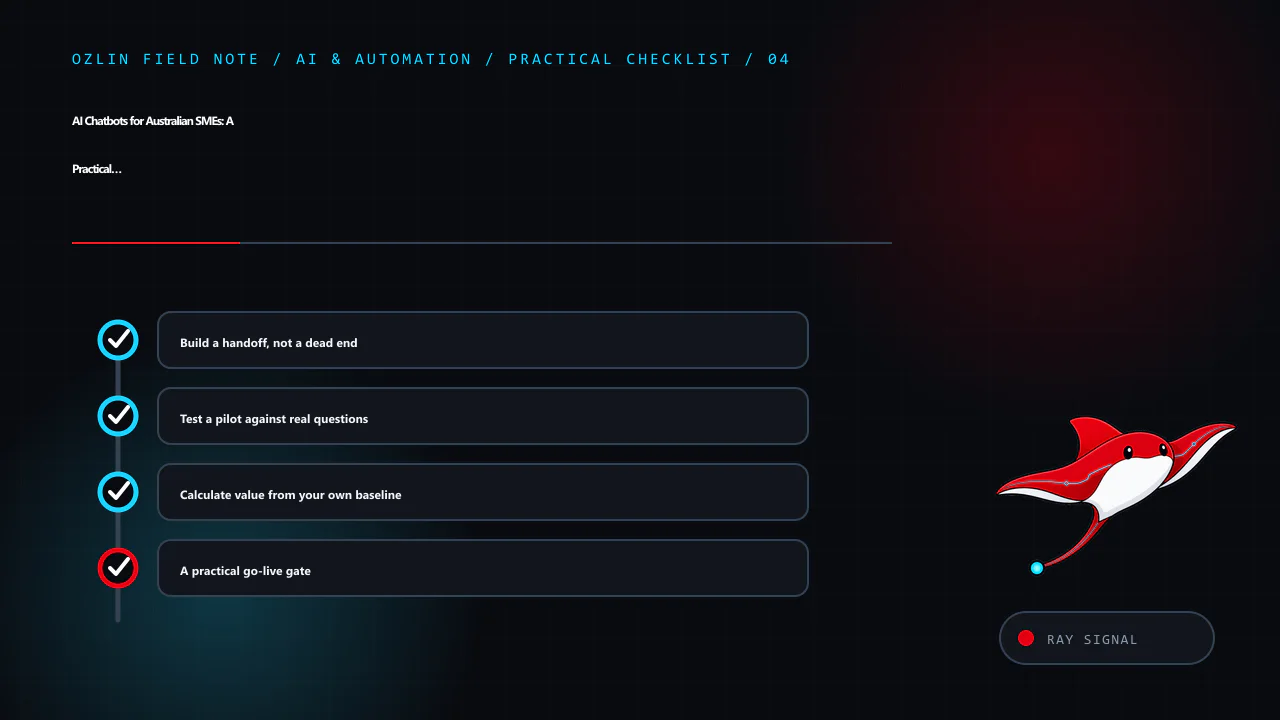
Build a handoff, not a dead end
A useful handoff preserves context without making the customer repeat everything. Give the user a visible option to reach a person, and trigger escalation when the bot lacks a reliable source, detects an account-specific issue, receives a complaint, encounters distress or abuse, or reaches a topic outside its approved scope.
The receiving staff member should see the transcript or a clearly labelled summary, the sources the bot used, and any uncertainty or safety flag. The chatbot must not invent an appointment, refund, warranty outcome or service commitment merely to complete the interaction.
Prepare a fallback for outages as well. A contact form, phone number or ticket pathway should remain usable if the model provider, integration or knowledge base is unavailable.
Test a pilot against real questions
Create a test set from de-identified, representative enquiries. Include ordinary wording, spelling errors, ambiguous questions, missing information, conflicting documents and attempts to make the bot ignore its rules. Do not use live customer records unless that use is authorised and appropriately controlled.
Define acceptance criteria before launch. Useful measures include:
| Measure | What to record |
|---|---|
| Answer quality | Whether the answer is supported by an approved source and answers the question asked |
| Safe refusal | Whether unsupported or prohibited requests are declined consistently |
| Handoff quality | Whether the right cases reach a person with enough context |
| Customer outcome | Whether the visitor completed the intended task or still needed another contact |
| Operations | Review time, supplier cost, failure rate and staff workload |
| Privacy and security | Unexpected data collection, disclosure, access or prompt-manipulation events |
Review failed conversations, not just averages. The Government guidance recommends documented pre-deployment testing, accountable approval and ongoing monitoring against risk-based criteria. A small pilot should also have a stop condition—for example, repeated unsupported answers or an unexpected disclosure—so the team knows when to disable or narrow it.
Calculate value from your own baseline
There is no credible universal percentage of enquiries that every chatbot will resolve. Start by sampling your current workload: enquiry types, handling time, repeat contacts, abandonment and staff escalation. During the pilot, compare the same measures and include all costs: setup, integration, content maintenance, review, vendor fees, incident handling and staff training.
The result may support automation, a simpler FAQ redesign, a better form, or no chatbot at all. That is still a useful project outcome. The goal is not maximum automation; it is a service pathway that is faster where appropriate and reliably human where judgment matters.
A practical go-live gate
Before launch, confirm that:
- the approved purpose, sources and prohibited uses are documented;
- the bot is clearly identified as AI;
- collection is minimised and supplier settings have been reviewed;
- administrators use appropriate access controls;
- high-impact and uncertain cases are handed to a person;
- the test set, acceptance criteria and approval are recorded;
- users have a feedback or complaint path;
- monitoring, incident response and a disable switch exist; and
- the owner and next review date are named.
For the related website data questions, read WordPress Privacy for Australian SMEs. Ozlin Info can also help scope a narrow pilot through its AI and automation services, with the deployment decision remaining with your business.
General information only. This article is not legal, privacy, cybersecurity or procurement advice. Requirements depend on your organisation, sector, contracts, data and intended use.
Limitations: This is a decision framework, not a performance or compliance claim. Outcomes depend on the use case, data, model or vendor, integrations, safeguards, human handoff and observed workload; pilot evidence is required.
Editorial disclosure: AI assisted with the first draft and source discovery. The article was checked against the linked Australian Government sources on 28 August 2026 and requires human editorial approval before publication.
Source access date: 2026-08-28
Leave a Reply