Author: Ozlin Info Editorial Team

  • 1U, 2U or Workstation? Designing a Practical Local AI Server

    1U, 2U or Workstation? Designing a Practical Local AI Server

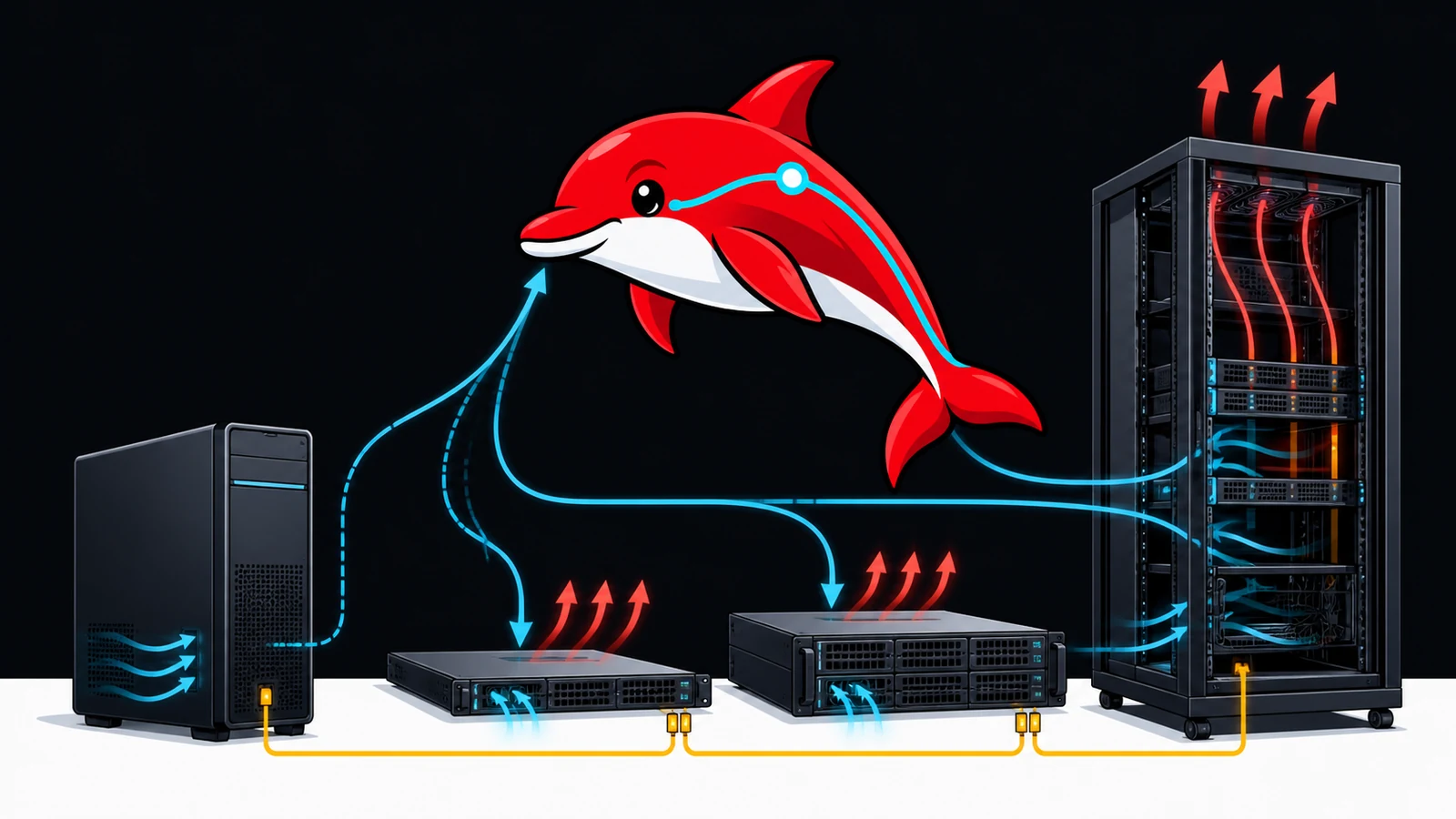
    A retired two-socket rack server can hold an impressive amount of memory for little money. A modern workstation can accept a large GPU without sounding like a small aircraft. A purpose-built multi-GPU server can supply power, cooling and PCIe connectivity that neither can imitate safely. These are different engineering products, not interchangeable boxes measured only by rack units or DIMM slots.

    Start with the model, latency and throughput target. Then design the memory tiers, accelerator count, PCIe topology, storage, power, cooling and recovery process around that target. Buying a cheap chassis first often leaves the owner solving expensive mechanical and electrical problems afterward.

    This guide covers practical design decisions, not instructions to bypass a manufacturer's GPU, power or thermal limits. Unsupported modifications can damage hardware, create fire or shock hazards, invalidate warranties and still deliver poor performance.
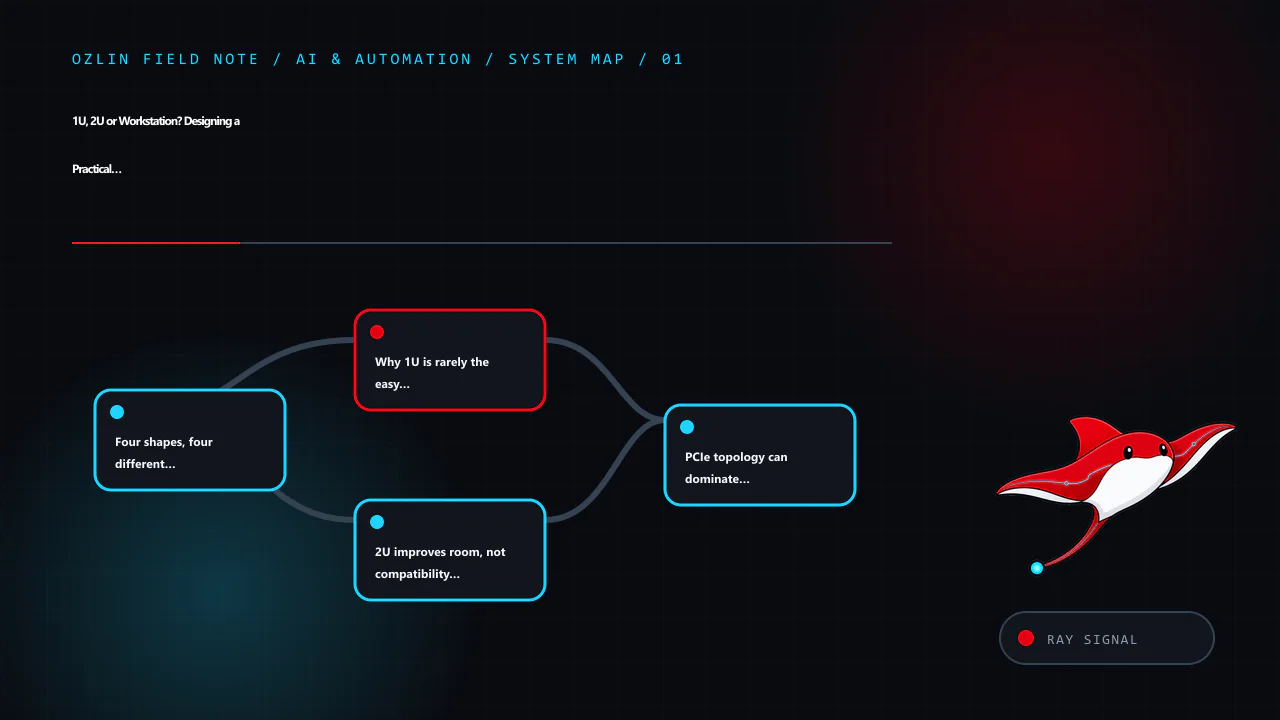
    Article map for 1U, 2U or Workstation? Designing a Practical Local AI Server, covering Four shapes, four different compromises, Why 1U is rarely the easy GPU answer, 2U improves room, not compatibility by magic and rela…
    Article map: Four shapes, four different compromises; Why 1U is rarely the easy GPU answer; 2U improves room, not compatibility by magic; PCIe topology can dominate multi-GPU behaviour.

    Four shapes, four different compromises

    Platform Strengths Common limits Best fit
    Tower/workstation Quiet relative to rack gear; accepts full-height, wide GPUs; accessible; ordinary office placement Fewer hot-swap components, less remote management, limited GPU spacing or PCIe lanes on consumer platforms One or two GPUs, development, creator workloads, small-office inference
    1U rack server Dense CPU and network deployment; mature rails and remote management Short heatsinks, very high fan speed, low-profile cards, severe GPU height/power limits CPU services, networking, compact inference accelerators explicitly supported by vendor
    2U rack server More drive bays, cooling area and PCIe room; some models designed for GPUs Still loud and deep; not every 2U chassis supports double-width accelerators or enough power Data-centre deployments with a validated GPU kit and suitable rack/power
    4U/GPU workstation server Best physical room for full-size accelerators, cables and lower-velocity fans; serviceable Expensive, large, high power density; may require 200–240 V and facility planning Modern multi-GPU inference or training where topology and cooling justify the cost

    Rack units describe height only. A 2U chassis may be more than 700 mm deep, need rear cable space and draw air front-to-back. It cannot be placed safely in a shallow communications cabinet just because it fits vertically. Check rail compatibility, weight, service clearance and floor loading.

    Why 1U is rarely the easy GPU answer

    A 1U server has little vertical space. Fans must move air through narrow passages at high static pressure, which produces substantial noise. Many consumer GPUs are full-height, two to four slots wide and use axial fans designed for an open case. Installing one behind a 1U riser is normally impossible; improvising an open lid or external power does not create a validated cooling path.

    There are 1U accelerator systems, but they use vendor-qualified cards, risers, cables, firmware, power supplies and airflow guides. The correct comparison is a complete supported configuration, not the cost of an empty retired chassis plus a desktop GPU.

    Choose 1U when density, standardised remote management and CPU/network workloads are primary. For a quiet office or home lab, a tower often offers more useful compute per unit of disruption even though it occupies more floor space.

    2U improves room, not compatibility by magic

    Two rack units allow taller heatsinks, more drive bays and more PCIe layouts. Some 2U platforms are designed for one or more accelerators. Others use that space for storage and do not support internal GPUs.

    The Dell PowerEdge R730 and R730xd illustrate the distinction. They share a generation and many components, but the R730xd prioritises dense storage. Dell's technical guide documents up to 24 DIMM slots and large LRDIMM capacities for supported dual-CPU configurations. The same guide states that internal GPU support is not available on the R730xd, while qualified GPU configurations exist for the R730. A search result saying “R730 supports GPUs” must not be transferred to an R730xd purchase.

    Before adding any accelerator, check the exact service tag/configuration and official manual for:

    • supported GPU models and quantity;
    • required CPU count, riser and slot topology;
    • double-width clearance and drive-backplane conflicts;
    • GPU enablement kit, power cables and PSU redundancy rules;
    • airflow shrouds, fan type and minimum fan policy;
    • firmware and operating-system support; and
    • whether other PCIe devices lose lanes or slots.

    Do not use an adapter cable to exceed a rail, connector or PSU rating. Do not silence fans below the thermal design because a short benchmark appears stable. Memory, VRM, storage and riser components also depend on the validated airflow.
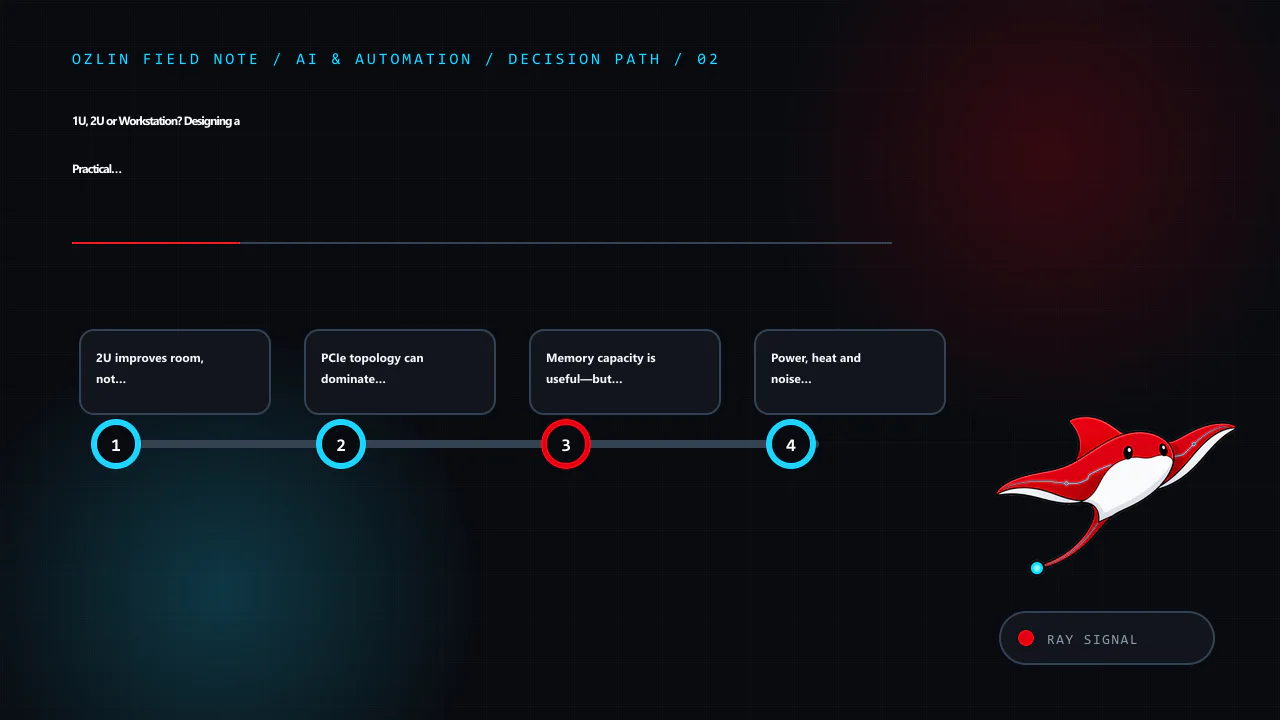
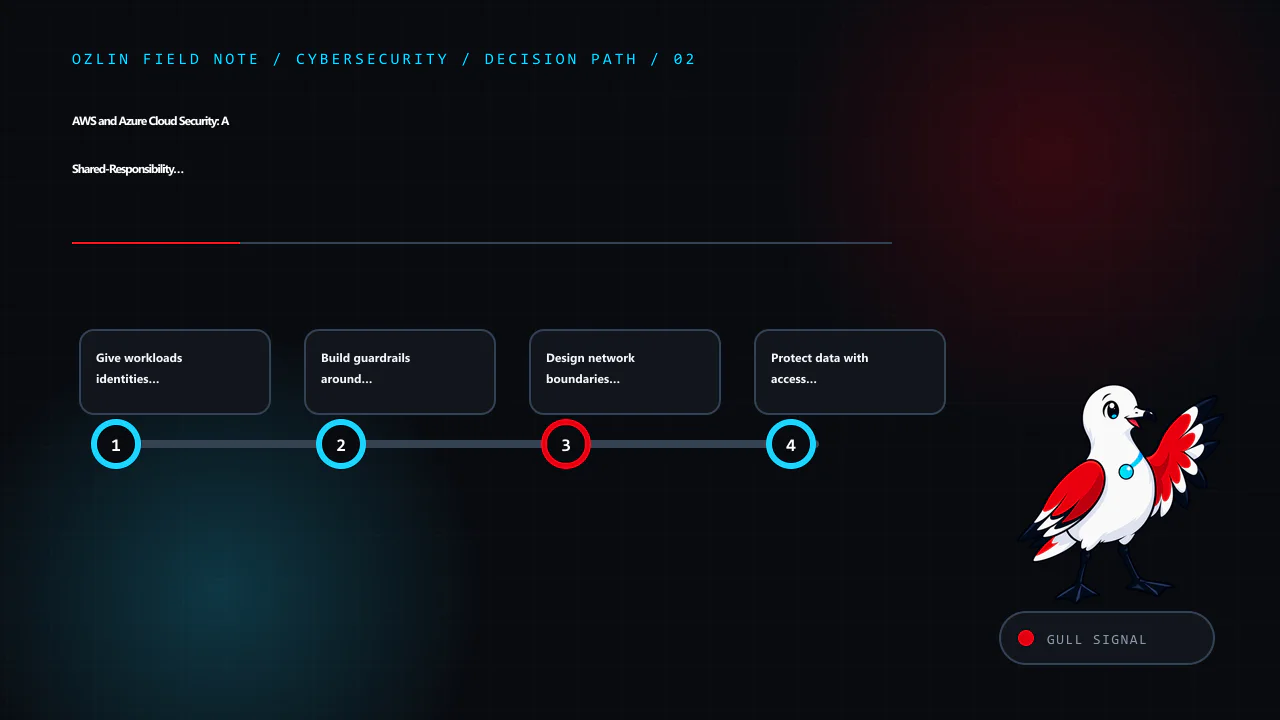
    Decision path for 1U, 2U or Workstation? Designing a Practical Local AI Server, covering 2U improves room, not compatibility by magic, PCIe topology can dominate multi-GPU behaviour, Memory capacity is useful—but bandwi…
    Decision path: 2U improves room, not compatibility by magic; PCIe topology can dominate multi-GPU behaviour; Memory capacity is useful—but bandwidth and CPU age remain; Power, heat and noise are first-class requirements.

    PCIe topology can dominate multi-GPU behaviour

    Count usable electrical lanes, not just physical slots. On a two-socket system, slots attach to different CPUs. Data crossing between a GPU on one socket and memory or a GPU on the other may traverse the inter-socket link. That can be acceptable for independent inference workers and inefficient for tightly coupled model parallelism.

    Record a topology diagram covering:

    • GPU-to-CPU and GPU-to-GPU placement;
    • link generation and negotiated width;
    • NUMA memory affinity;
    • storage and network cards sharing root complexes;
    • peer-to-peer support in the chosen runtime; and
    • any high-speed GPU interconnect actually present.

    VRAM does not automatically become one transparent pool. The inference framework must partition the model, and transfers can limit throughput. Test the final runtime and model with telemetry rather than assuming that two 24 GB cards behave like one 48 GB card.

    Memory capacity is useful—but bandwidth and CPU age remain

    Retired enterprise servers make ECC capacity affordable. They can be valuable for databases, virtualisation, preprocessing, embeddings and experimental CPU offload. The memory channels should be populated according to the service manual with compatible RDIMMs or LRDIMMs; more sticks can reduce speed depending on population.

    Capacity does not erase processor age. A model whose quantised weights fit in 512 GB of DDR4 may still generate too slowly for an interactive service because inference repeatedly moves and computes over a large working set. CPU instruction support, memory bandwidth, NUMA effects and runtime optimisation matter. Benchmark the intended prompt length, concurrency and output length, and report measured results rather than theoretical bandwidth.

    The companion DeepSeek 671B reality check applies this distinction to the R730xd. The used RAM and SSD guide covers compatibility and acceptance testing.

    Power, heat and noise are first-class requirements

    Nearly all electrical input becomes heat in the room. A system averaging 1 kW produces roughly 1 kW of heat continuously. The utility bill is only part of the problem: hot air needs a reliable path out, and cooling consumes additional power.

    Use measured wall power for normal, peak and idle states. Check the branch circuit, plug, PDU, UPS, power-supply input range and local electrical requirements with a qualified person. A standard residential outlet is not permission to run it continuously near its protective limit. Never construct improvised mains wiring or defeat a breaker.

    For an annual electricity scenario:

    annual compute electricity = average kW × 8,760 × AUD/kWh

    At an illustrative A$0.35/kWh—not a claim about your tariff—0.8 kW costs about A$2,453 per year, 1.6 kW about A$4,906, and 3.0 kW about A$9,198 before cooling. Replace the rate and duty cycle with values from the actual bill and measurements. A machine used eight hours a day should not be modelled as a 24×7 load.

    Office noise can be the deciding constraint. Published sound figures, where available, are configuration- and environment-specific. Listen to the candidate under sustained load or place it in a suitable server room. Do not hide a rack server in an unventilated cupboard to solve acoustics.
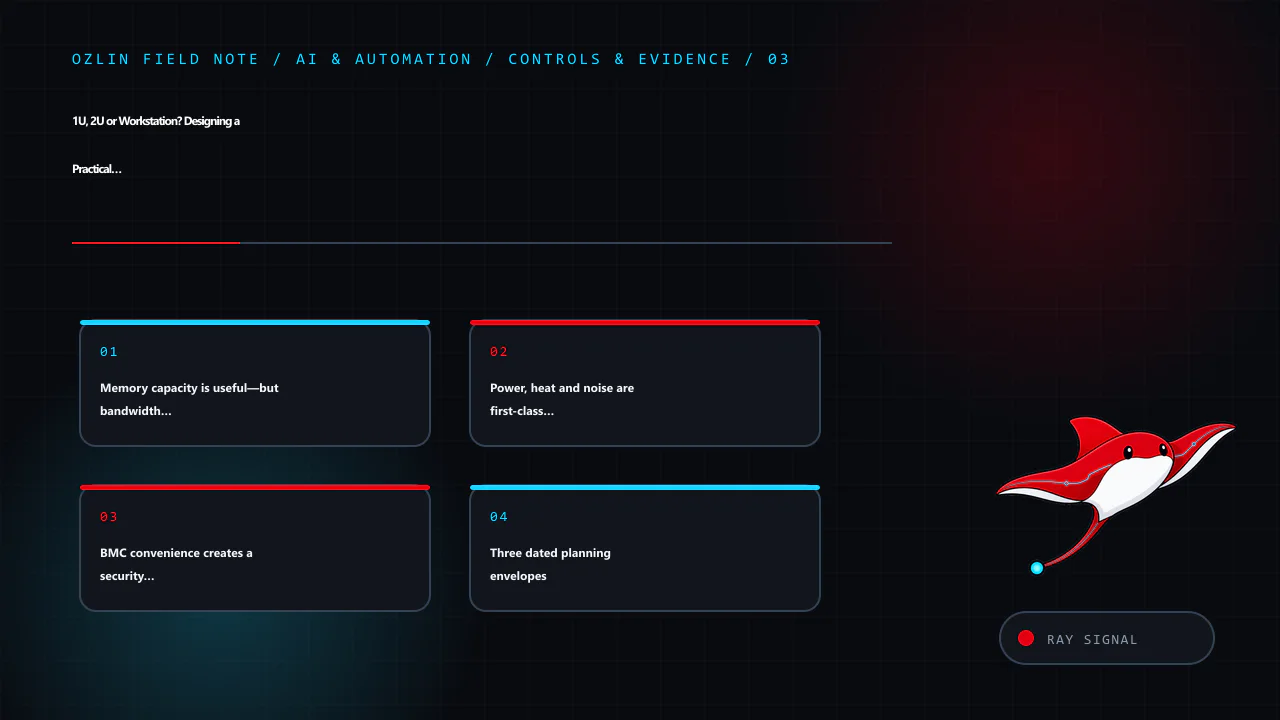
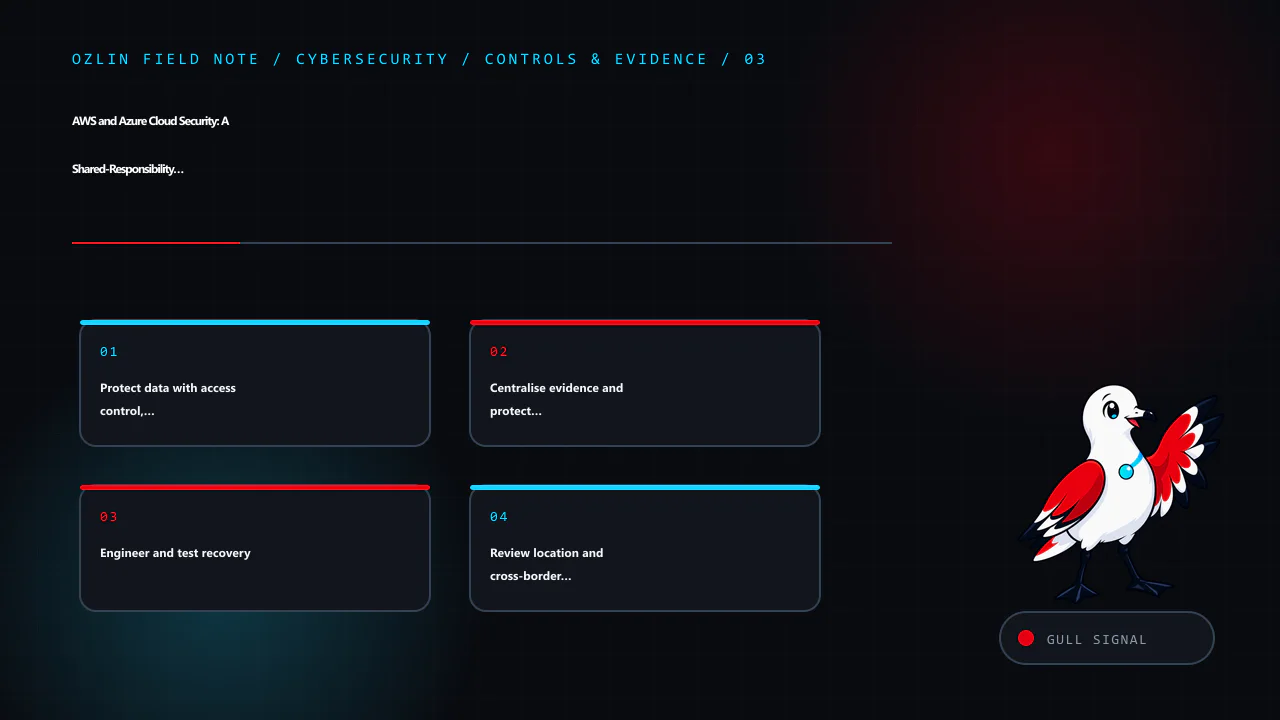
    Control and evidence map for 1U, 2U or Workstation? Designing a Practical Local AI Server, covering Memory capacity is useful—but bandwidth and CPU age remain, Power, heat and noise are first-class requirements, BMC con…
    Control and evidence map: Memory capacity is useful—but bandwidth and CPU age remain; Power, heat and noise are first-class requirements; BMC convenience creates a security boundary; Three dated planning envelopes.

    BMC convenience creates a security boundary

    Enterprise baseboard management controllers such as iDRAC or iLO can power-cycle a server, mount media and expose a remote console independently of the operating system. That makes them highly privileged.

    • Update BMC and platform firmware from the vendor.
    • Replace default accounts and remove unused users.
    • Keep management on a dedicated restricted network or VPN; do not expose it directly to the public internet.
    • Use MFA through an upstream access system where the BMC lacks it.
    • Restrict outbound access, certificates and DNS as the design permits.
    • Log administrative access and test recovery credentials.
    • Treat a used server as untrusted until configuration and firmware have been reviewed.

    Operating-system hardening remains separate: minimal services, timely patches, host firewall, least-privilege administration, protected secrets, monitored logs and tested offline or isolated backups. Never install cracked or nulled management software, operating systems, plugins or utilities. The discount cannot compensate for unknown code running at the most privileged layer.

    Three dated planning envelopes

    These are Ozlin planning baselines dated 29 August 2026, not retailer quotes or performance promises. Prices are AUD, ex GST where a business quote is used, and must be replaced by itemised supplier pricing before approval.

    Design Indicative acquisition envelope Included assumption Usually missing
    Modern single-GPU workstation A$4,000–A$10,000 Current platform, 64–128 GB RAM, one substantial GPU, quality PSU/cooling Backup target, monitor, UPS, labour and spare GPU
    Used 2U enterprise lab A$1,500–A$4,000 before accelerator Refurbished chassis, CPUs, ECC RAM and local storage Supported GPU kit, freight, rails, power/cooling, warranty, modern CPU performance
    Purpose-built modern multi-GPU server A$25,000–A$100,000+ Vendor-qualified chassis, accelerators, high-capacity RAM/network Rack, high-density power, cooling, support, tax and capacity redundancy

    The broad ranges are intentionally not a buying recommendation. GPU choice can move the last category by multiples. Obtain at least two comparable quotes showing model numbers, warranty, delivery, GST, support response and replacement terms.

    Full TCO is:

    TCO = purchase and modification + average kW × 8,760 × AUD/kWh + cooling/colocation + repair spares + downtime cost − residual value

    For colocation add rack units, committed power, overage, transit, cross-connects, addresses, remote hands and freight. For a workstation add staff time, room cooling and the business cost of occupying the same machine used for other work.

    Commissioning checklist

    Before ordering:

    • define model, quantisation, context, concurrency and latency targets;
    • produce a memory and PCIe topology;
    • verify vendor-supported accelerator, PSU, riser and airflow configuration;
    • calculate normal and peak electrical load;
    • confirm rack depth, rails, weight, cooling and noise location;
    • document BMC and operating-system management networks;
    • price backup, spares, support and exit; and
    • plan a smaller proof of concept if performance is uncertain.

    Before production:

    • inventory serials and firmware;
    • run memory, storage, GPU-memory and sustained thermal tests;
    • verify negotiated PCIe width and NUMA placement;
    • benchmark the real model and prompt mix, including concurrency;
    • simulate a failed drive, failed process and restore;
    • confirm monitoring covers temperature, power, ECC, storage, GPU and service health;
    • restrict management access and remove temporary credentials; and
    • capture an approved baseline configuration.

    A practical AI server is not the chassis that can be made to boot. It is the system that meets a measured service target, stays within vendor and electrical limits, can be patched, and can fail without destroying the project. Ozlin's AI and automation services can help frame that proof of concept and acceptance evidence. For the software-first route, start with Run LLMs Locally in 2026.
    Practical checklist for 1U, 2U or Workstation? Designing a Practical Local AI Server, covering BMC convenience creates a security boundary, Three dated planning envelopes, Commissioning checklist and related review poin…
    Practical checklist: BMC convenience creates a security boundary; Three dated planning envelopes; Commissioning checklist; Sources and review record.

    Sources and review record

    Sources were accessed on 29 August 2026. Hardware availability and planning envelopes are scheduled for review by 29 November 2026.

    AI assisted with source discovery, drafting and copyediting; Ozlin Info remains responsible for publication.

  • Buying RAM and SSDs During the AI Hardware Squeeze: A 2026 Guide

    Buying RAM and SSDs During the AI Hardware Squeeze: A 2026 Guide

    The AI infrastructure boom is placing unusual pressure on parts of the memory and storage supply chain, but “all chips are in shortage” is too broad to be useful. The clearest 2026 signals concern server DRAM, high-bandwidth memory, NAND and enterprise SSD demand. SK hynix reported significant quarter-on-quarter increases in DRAM and NAND pricing alongside AI-server demand. Samsung described robust demand for server DRAM, enterprise SSDs and HBM, with supply constraints. Micron's investor materials likewise tie investment and product mix to data-centre and AI demand.

    Those manufacturer reports do not prove that every consumer DIMM or SSD will rise by the same amount, or that a small business should buy immediately. Product cycles, channel inventory, exchange rates, controller shortages and promotions create different outcomes by model. The practical response is to separate a real capacity need from anxiety, then compare delay, targeted expansion, cloud bursting, refurbished stock and used equipment with the same total-cost model.

    This guide is general procurement and technical information, not a guarantee that a particular second-hand part is safe or compatible.

    Article map for Buying RAM and SSDs During the AI Hardware Squeeze: A 2026 Guide, covering Start with the bottleneck, not the shopping cart, A small dated price sample, RAM: compatibility is more than DDR generation and…
    Article map: Start with the bottleneck, not the shopping cart; A small dated price sample; RAM: compatibility is more than DDR generation; SSDs: ask for the health log before price negotiation.

    Start with the bottleneck, not the shopping cart

    Measure the system before purchasing. A local language model may be limited by GPU memory rather than system RAM. A database may be storage-latency constrained even when its disk has spare capacity. A workstation with 64 GB installed may be swapping because one process has an unbounded configuration, while another workload could be fixed by closing duplicate development environments.

    Record at least:

    • peak and typical committed memory, swap or page-file activity and memory errors;
    • GPU-memory allocation, model size, context length and CPU-offload behaviour;
    • SSD capacity, latency, write rate, queue depth and health counters;
    • the cost of the current wait, failure or cloud bill; and
    • the motherboard, CPU, firmware, slot and power constraints.

    Then choose among five strategies.

    1. Delay the upgrade when utilisation is comfortable and the purchase is speculative. Preserve the budget and recheck prices on a fixed date.
    2. Expand only the limiting tier—for example, add a scratch SSD instead of replacing the entire workstation.
    3. Burst to cloud or a rented GPU for occasional jobs, while accounting for data movement, storage and privacy.
    4. Buy manufacturer- or retailer-refurbished equipment where test evidence and a useful warranty justify a moderate premium.
    5. Buy used when compatibility can be established, failure is recoverable and the discount exceeds acceptance-test and spare-part costs.

    A small dated price sample

    Prices below were observed on 29 August 2026 and are not a market index. They are included to demonstrate the fields a buyer should capture. Australian retail prices generally include GST when sold to consumers unless the page states otherwise; marketplace treatment varies by seller. Delivery, adapters and warranty value can change the comparison. The two used-memory observations were captured in the internal editorial evidence rather than linked here because individual marketplace listings expire and should not become permanent evidence links.

    The links are not affiliate links, and no seller or brand paid for inclusion.

    Item and sample source Condition Observed AUD price GST/warranty note What the sample does and does not show
    Crucial T500 2 TB NVMe, BuyWisely retailer aggregation New retail offers From A$229 Check the chosen retailer's GST invoice and warranty A snapshot across listed retailers, not proof of stock or final delivered price
    Samsung 990 Pro 2 TB, Priceroo tracking page New retail offers From about A$483.04 Check seller, GST and local warranty Different controller/endurance positioning means this is not like-for-like with every 2 TB drive
    8 × 8 GB Samsung DDR4 ECC RDIMM marketplace listing Used A$269.55 Seller type, GST and return rights must be checked One listing, not a representative median; platform title is not test evidence
    4 × 16 GB SK hynix DDR4 ECC marketplace listing Used A$329.99 Seller type and warranty unclear until listing terms are read One observed configuration; rank, speed and server compatibility remain unverified

    Do not conclude from four samples that used RAM is always good value. Search sold listings where available, capture at least five genuinely comparable examples, remove shipping-only or faulty items, and retain screenshots or invoices. Compare cost per usable, compatible gigabyte, not per stick.

    RAM: compatibility is more than DDR generation

    A module that physically fits may still fail to train, down-clock the system or create an unsupported population. Before buying, record the exact motherboard or server model, CPU generation and current module labels. Check the system manual and qualified-vendor list where one exists.

    For each candidate, verify:

    • DDR generation and voltage: DDR4 and DDR5 are not interchangeable.
    • ECC and buffering: unbuffered ECC UDIMM, registered RDIMM and load-reduced LRDIMM are different electrical populations. Many platforms prohibit mixing them.
    • Rank and organisation: 1Rx8, 2Rx4 and 4Rx4 are not cosmetic labels. Rank count affects supported capacity and speed.
    • Capacity per slot and total capacity: firmware and CPU memory controllers impose limits.
    • Speed: faster modules often run at the slowest supported population speed; mixed populations may reduce frequency further.
    • Population rules: server manuals specify channels, slots and balanced arrangements. Installing every spare DIMM without following them can reduce bandwidth or prevent boot.
    • Part-number match: identical marketing capacity is weaker evidence than exact part numbers and revision details.

    Ask a used seller for clear photographs of every label and a booted-system inventory. Treat screenshots as evidence about that test moment, not proof of future health. On arrival, photograph the package, inspect contacts and components, install according to the service manual, update firmware only through an approved change process, and run multiple passes of a reputable memory test such as MemTest86. Follow with the actual workload and review corrected and uncorrected ECC logs. Any unexplained error should stop deployment into production.

    Decision path for Buying RAM and SSDs During the AI Hardware Squeeze: A 2026 Guide, covering A small dated price sample, RAM: compatibility is more than DDR generation, SSDs: ask for the health log before price negotiat…
    Decision path: A small dated price sample; RAM: compatibility is more than DDR generation; SSDs: ask for the health log before price negotiation; Used GPU acceptance in brief.

    SSDs: ask for the health log before price negotiation

    An SSD has no moving parts, but flash cells, capacitors, controllers and firmware still age or fail. Model number and capacity alone say little about remaining life.

    Request the full SMART or NVMe health log in machine-readable or unedited form. Important fields include:

    • Percentage Used or equivalent vendor wear indicator;
    • total bytes or data units written and the rated TBW;
    • available spare and spare threshold;
    • media and data-integrity errors;
    • critical warnings and temperature history;
    • unsafe shutdowns and power cycles;
    • error log entries; and
    • firmware revision.

    NVMe's open-source nvme-cli can retrieve standard health and error information on supported Linux systems. Vendor utilities may add model-specific interpretation. A zero media-error counter is helpful, but it does not prove the drive is genuine, unused or free from intermittent faults. Compare serial numbers across the label, firmware utility and invoice. Check the manufacturer's warranty status where possible.

    Workload fit matters. A lightly used consumer drive may suit a replaceable game cache; a database or write-heavy virtualisation host may justify an enterprise SSD with power-loss protection, documented endurance and predictable sustained writes. An adapter can add cost or prevent correct cooling, bifurcation or boot support. M.2, U.2/U.3, E1.S and add-in cards are not interchangeable merely because they use NVMe.

    For acceptance, secure-erase the drive using a method appropriate to the device and policy, update approved firmware, perform a full read test and a bounded write/read validation, monitor temperature and re-read the health log. Do not run destructive tests on a drive containing the seller's or your own required data. The Australian Cyber Security Centre's device-disposal guidance is a useful baseline when storage will leave organisational control.

    Used GPU acceptance in brief

    GPU listings attract more attention during an AI boom because memory capacity appears to set the model ceiling. Check the exact board, VRAM amount, connector and physical dimensions; available PCIe lanes; PSU capacity and native cables; cooling clearance; driver and compute-backend support; and whether the intended framework supports the architecture.

    Ask for a current diagnostic screenshot with serial or model evidence, but assume screenshots can be reused. On arrival, inspect the PCB and connectors for corrosion, repair marks or damage. Run a VRAM test, a sustained compute workload and the intended inference job while recording temperature, clock, power and errors. Coil noise is not the same as computational failure, while corrected bus errors, crashes or visual corruption deserve investigation. Never bypass a server vendor's documented power, airflow or GPU-support limitations merely because a card can be made to fit.

    For model sizing, see Run LLMs Locally in 2026 and the 1U, 2U or workstation design guide.

    Australian consumer rights depend on the seller

    The Australian Consumer Law's consumer guarantees can apply to second-hand goods sold by a business. The expected durability and acceptable quality are assessed in context, including age, price, description and disclosed defects. A business cannot remove applicable statutory guarantees merely by writing “no refunds”.

    Most one-off private sales are not covered by the same consumer guarantees. Marketplace payment protection or a platform return policy is separate and has its own deadlines and evidence rules. Before paying, capture whether the seller is acting as a business, the description, represented condition, return terms and payment method. For a business-critical purchase, an invoice, serial list and written acceptance condition can be more valuable than a small discount.

    If a listing says “untested”, “for parts” or discloses a fault, price it as a risky repair input—not as working stock. Do not pressure a seller to misdescribe goods for tax or platform purposes.

    Control and evidence map for Buying RAM and SSDs During the AI Hardware Squeeze: A 2026 Guide, covering SSDs: ask for the health log before price negotiation, Used GPU acceptance in brief, Australian consumer rights dep…
    Control and evidence map: SSDs: ask for the health log before price negotiation; Used GPU acceptance in brief; Australian consumer rights depend on the seller; Use total cost, not purchase price.

    Use total cost, not purchase price

    For each option calculate:

    TCO = purchase price + shipping/adapters + expected-failure reserve + electricity + downtime cost − residual value

    Add acceptance labour and secure-disposal cost where material. A used SSD that saves A$80 but consumes three hours of skilled testing and carries a credible A$1,000 outage exposure is not automatically cheaper. Conversely, a pool of matched, tested ECC DIMMs with one cold spare may be an excellent value for a non-critical lab.

    Estimate the failure reserve transparently. If ten used units cost A$300 each, you budget one A$300 spare, and you expect A$200 in testing labour, the acquisition line is A$3,500 before power or downtime—not A$3,000. Do not invent a precise failure probability from anecdotes.

    Procurement and acceptance checklist

    Before purchase:

    • define the performance and capacity requirement;
    • confirm exact compatibility from primary documentation;
    • compare new, refurbished, used and temporary cloud options;
    • record condition, seller status, GST, warranty, return window and included accessories;
    • request labels, serials and current health evidence;
    • calculate delivered TCO and a failure reserve; and
    • obtain approval against an asset and data-handling policy.

    On receipt:

    • document packaging, labels and physical condition;
    • isolate unknown storage until it is securely sanitised;
    • test memory, storage or VRAM before production use;
    • update asset, firmware and warranty records;
    • retain evidence until the return window has passed; and
    • keep the old known-good component until the new configuration survives a burn-in and restore test.

    The goal is not to eliminate all second-hand risk. It is to make the risk visible, bounded and recoverable. Ozlin's AI and automation services can help plan a right-sized local or hybrid environment without treating a shopping list as an architecture.

    Practical checklist for Buying RAM and SSDs During the AI Hardware Squeeze: A 2026 Guide, covering Australian consumer rights depend on the seller, Use total cost, not purchase price, Procurement and acceptance checklis…
    Practical checklist: Australian consumer rights depend on the seller; Use total cost, not purchase price; Procurement and acceptance checklist; Sources and review record.

    Sources and review record

    Sources and price samples were accessed on 29 August 2026. Supply commentary and price samples are scheduled for review by 29 November 2026.

    AI assisted with source discovery, drafting and copyediting; Ozlin Info remains responsible for publication.
  • Australia and New Zealand Server Hosting Guide: VPS, Cloud, Dedicated and Colocation

    Australia and New Zealand Server Hosting Guide: VPS, Cloud, Dedicated and Colocation

    Reviewed: 13 September 2026 · Next review: 13 December 2026
    Author: Ozlin Info Editorial Team · Human review: Lin (accountable human); Codex assisted

    The best server is not the one with the largest specification sheet. It is the one whose location, network, operating model and failure plan fit the workload. A Sydney VPS may be ideal for a small Australian website, while a New Zealand organisation with data-location requirements may prefer an Auckland or Wellington service. A busy game community may care more about single-thread CPU performance, packet loss and attack mitigation than about virtual CPU count. A regulated application may need contractual support, evidence and tested recovery that a low-cost unmanaged server does not include.

    Ozlin Info currently operates workloads on OVHcloud infrastructure in Sydney and uses Proxmox at a high level as part of its virtualisation experience. That operational background informs this guide, but no production IP address, host name, panel address, network topology or security control is disclosed here.

    This is an independent market guide, not a paid ranking. Ozlin has no disclosed affiliate relationship with the providers named below. Product availability, tax treatment and routing can change, so obtain a written quote and run workload-specific tests before committing.

    Choose the service model before the brand

    A VPS divides a physical host into isolated virtual servers. It is inexpensive, quick to rebuild and usually gives root or administrator access. The trade-off is that storage, CPU scheduling and the host failure domain remain partly shared. Ask whether CPU is dedicated or burstable, what storage redundancy exists, and whether snapshots are backups or only convenient restore points.

    Public cloud infrastructure exposes compute, storage, networking and managed services through APIs. AWS, Microsoft Azure, Google Cloud and Oracle Cloud Infrastructure all operate Australian regions; AWS also opened its New Zealand region in 2025. Public cloud is useful for automation, managed databases, short-lived capacity and architectures that truly use multiple failure zones. It is not automatically cheaper. Instance runtime, disks, snapshots, public IPv4, support and outbound data should all enter the model.

    A dedicated server gives one customer the physical machine. It can deliver predictable CPU, memory, local NVMe and a large transfer allowance at an attractive monthly price. The customer still needs a plan for disk failure, hardware replacement, remote access, spare capacity and restore time. A single dedicated server is not a high-availability architecture merely because the components are powerful.

    Colocation places customer-owned hardware in a provider's facility. It offers the most hardware control and can make sense for specialised storage, GPU or long-lived workloads. It also shifts procurement, firmware, spares, freight, remote hands, power density and hardware disposal back to the customer. A low rack price can become expensive after power, cross-connects, transit, addresses and support are added.

    A dated price snapshot, not a permanent price list

    The following examples were observed on official provider pages on 29 August 2026. Australian prices are shown in AUD. Voyager publishes New Zealand dollars; the indicative AUD figures use the Reserve Bank of Australia's 28 August 2026 reference rate of A$1 = NZ$1.2084. The RBA cautions that its rates are not for commercial settlement. GST, card conversion and supplier tax treatment still need to be checked on the actual quote.

    Provider and example Advertised price GST and term Network/transfer shown Important omissions or caveats
    OVHcloud Advance-1 2026, selected AU configuration A$185.99/month plus A$185.99 setup Ex GST; configuration and commitment affect price Public bandwidth selectable within the product range; private network capability varies Region, hardware, IPv4, support and setup must be confirmed in cart
    Kimsufi KS-B in Sydney A$16.79/month plus A$16.79 setup Ex GST; setup advertised as waived on 12+ month commitment 500 Mbps; APAC page states 25 TB/month Entry hardware and support scope are limited; verify stock and recovery expectations
    Streamline Sydney i7-7700K example A$180/month Tax treatment and contract should be confirmed at checkout 15 TB on a 10 Gbps port advertised Older CPU; compare storage, DDoS, IPv4 and support on the final order
    Streamline Sydney Xeon E-2286G example A$320/month Confirm tax and term 30 TB on a 10 Gbps port advertised Provider network and latency statements require route testing from real users
    Voyager NZ VPS entry plan NZ$10.08, about A$8.34/month Ex NZ GST Provider advertises unlimited bandwidth Fair-use and cross-border tax conditions need review; entry plan is 1 vCPU/1 GB/15 GB
    Voyager NZ dedicated entry plan NZ$225, about A$186.20/month Ex NZ GST Provider advertises unmetered service subject to its terms Auckland location; confirm remote hands, replacement and address allocation
    Voyager device colocation NZ$190, about A$157.23/month Ex NZ GST Shared 1 Gbps PIR and a /29 advertised Power and form-factor limits matter; rack, cross-connect and support needs may change TCO
    Servers Australia, Micron21, Twisted Servers, Intergrid, Datacom Quote required Obtain an itemised GST quote Varies by facility and service Include power, rack units, transit, cross-connects, remote hands and support

    The table is deliberately not a benchmark. The OVH and Streamline examples are not identical machines, and a 10 Gbps port with a transfer quota is not the same commercial product as a lower-rate unmetered port. For public cloud, use each provider's current calculator with the same workload hours, disk type, snapshots, address count, support tier and outbound traffic instead of comparing a headline VM rate.

    Australian and trans-Tasman providers worth shortlisting

    OVHcloud operates a broad bare-metal range in Sydney. Its Australian pages describe anti-DDoS protection as included with dedicated servers, and its game range adds game-oriented filtering. That is valuable for internet-facing services, but it should be described as built-in and comparatively strong—not infinite or guaranteed to stop every attack. Product and regional conditions, false positives, application-layer attacks, mitigation behaviour and traffic allowances remain relevant. Ozlin's operational lesson is equally important: provider mitigation does not replace server hardening. Patch the operating system and management plane, restrict administrative access, use least privilege and backups, and never install cracked or “nulled” software whose integrity cannot be verified. Such packages can carry credential stealers, web shells or other backdoors and turn a server into part of someone else's botnet.

    Kimsufi and So You Start are OVHcloud's lower-cost lines. Kimsufi can be attractive for labs, replicas, personal services and workloads that tolerate entry-level hardware and a narrower service envelope. The Australian page currently shows Sydney stock and a 25 TB monthly APAC transfer condition. So You Start can bridge the gap toward more capable dedicated hardware, but availability and current pricing are often configuration-dependent. Neither label should be treated as a promise of the same SLA, replacement process, network options or support as a higher-tier product. Model the cost of downtime and an independent backup before celebrating the monthly saving.

    Streamline Servers and GSL Networks advertise dedicated systems across Sydney, Melbourne, Brisbane, Adelaide, Perth and Auckland. Streamline attributes its offering to low-latency routing, DDoS protection and GSL's international network; these are provider claims and should be verified with route measurements from the actual ISPs and cities that matter. Its dated prices can be higher than a budget bare-metal plan, but a fair TCO comparison must hold CPU generation, RAM, storage, traffic, port speed, mitigation, support and contract term constant. For latency-sensitive games or trans-Tasman audiences, a week of representative ping, jitter, loss and route testing is more persuasive than a network map.

    Servers Australia offers colocation and connectivity around major Australian locations and into New Zealand. Its public colocation material is best used to start a requirements conversation; pricing is quote-based. Ask for the exact facility, usable power, A/B feeds, rack depth, cross-connect and transit pricing, remote-hands minimums, delivery procedure and termination costs.

    Micron21 is a Melbourne operator offering data-centre, cloud, connectivity and DDoS-related services. Certifications, facility tier language and protection capabilities on its site are provider statements: request the scope, current certificate, SLA and service design that apply to the proposed product rather than transferring a company-wide claim to one rack or VM.

    Twisted Servers is a useful Perth option. Its data-centre page identifies Equinix PE2 and a Western Australian presence, which may reduce latency for WA users and make local hands easier than an east-coast deployment. Perth does not automatically improve international paths to every destination; measure the relevant Australian and overseas routes.

    Intergrid advertises instant cloud, bare metal and colocation across Sydney, Brisbane, Melbourne, Perth, Adelaide and Auckland. It also states Tier 3 facilities, DDoS protection, an international network and a 100% network-uptime SLA. Those are attributed provider claims, and its own page contains inconsistent “six” and “seven” city wording, so this guide lists only the six named locations and recommends confirming the applicable SLA and exclusions in writing.

    Voyager adds a practical New Zealand VPS, virtual data centre, dedicated and colocation shortlist. Its public entry prices are unusually clear, and it advertises New Zealand hosting, 99.98% environmental uptime and unlimited or unmetered connectivity on relevant products. Check fair-use terms, support hours, architecture and tax treatment. A single Auckland VPS and a redundant virtual data centre solve different availability problems even when both are called cloud.

    Public cloud and New Zealand data-location options

    AWS, Azure, Google Cloud and OCI are strongest candidates when the workload benefits from managed services, policy APIs, temporary scaling or multiple availability zones. Their bills require disciplined tagging, budgets, egress modelling and architecture. Read the provider's shared-responsibility documentation and Ozlin's AWS and Azure cloud-security checklist before assuming a managed control covers the application or data.

    For New Zealand placement, AWS Asia Pacific (New Zealand) launched with three Availability Zones. Catalyst Cloud documents regions in Porirua and Hamilton, creating a locally operated alternative with OpenStack-based services. Datacom lists facilities in Auckland, Hamilton, Wellington and Christchurch and is relevant for data-centre, private-cloud and colocation conversations. Microsoft, Google and Oracle location portfolios change over time, so use their official region lists and verify that the exact service—not merely the company—exists in the intended region.

    Platform Relevant documented footprint on 29 August 2026 Commercial comparison
    AWS Sydney, Melbourne and New Zealand regions; AWS documents three Availability Zones in each Broad managed-service/API range; model compute, disks, snapshots, IPv4, support and egress in the official calculator
    Microsoft Azure Australia East, Australia Southeast and New Zealand North, with service and zone availability varying by region Strong Microsoft identity/data ecosystem; verify the precise service, reservation and outbound-data line
    Google Cloud Sydney (australia-southeast1) and Melbourne (australia-southeast2) Strong data, Kubernetes and managed-service options; use the product-by-region list and calculator rather than assuming parity
    Oracle Cloud Infrastructure Australia East (Sydney) and Australia Southeast (Melbourne) Relevant for Oracle workloads and general IaaS; both documented regions currently list one availability domain, so design failure domains explicitly
    Catalyst Cloud Porirua and Hamilton regions in New Zealand NZ-operated OpenStack option; compare service catalogue, support, network and workload portability
    Datacom Facilities listed in Auckland, Hamilton, Wellington and Christchurch Relevant to colocation/private-cloud and managed requirements; obtain an itemised quote and facility-specific scope

    This is a capability comparison, not a price ranking. Public-cloud prices change by service, purchase option and traffic direction too often for one small VM to represent the bill. Re-run the official calculators with the same 730 monthly hours, storage performance, snapshots, IP count, support plan and measured egress.

    Data location is not a complete privacy conclusion. Replication, backups, support access, logs, subprocessors and customer configuration can move or expose data beyond the compute region. Record the real data flows and obtain advice for contractual or regulatory decisions.

    Decision matrix

    Priority VPS Public cloud Dedicated Colocation
    Lowest entry cost Usually strong Strong for tiny or temporary use; egress may dominate later Budget ranges can be strong Usually weak after hardware and setup
    Rapid scaling and APIs Moderate Strong Limited to provisioned machine Slowest unless spare hardware exists
    Predictable raw compute cost Moderate Requires careful modelling Often strong Strong only at stable, sustained utilisation
    Hardware control Low Low High within supplier options Highest
    Managed services Limited Strong Customer or third party Customer or third party
    Latency-sensitive games Test noisy-neighbour and CPU Can work, but cost/CPU class matters Often strong with the right network Strong for mature operators
    DDoS exposure Product-specific Product and service-specific Product-specific; OVH/Streamline advertise mitigation Transit and mitigation contract-specific
    Operational burden Moderate Can be high despite managed components High Highest
    Data-location evidence Ask for host/backup locations Region and service documentation usually available Facility known; backups still matter Facility and hardware known; support paths still matter

    Build a comparable TCO

    Use the same workload assumptions for every candidate:

    monthly TCO = compute or rack + storage + backups + outbound traffic + public IPs + support + licences + remote hands + power + expected failure/downtime allowance

    For a dedicated server, annualise setup and expected replacement downtime. For colocation, include hardware purchase, freight, rails, PDUs, spares and disposal. For public cloud, model normal and incident months, because log retention, snapshots and egress can jump during recovery. For a New Zealand quote converted to AUD, retain both the supplier currency and an exchange-rate buffer.

    Then run evidence-producing tests: latency from real user ISPs; packet loss and jitter during peak periods; storage latency under the real queue depth; sustained CPU behaviour; restore time; mitigation escalation; and support response through the channel you would use during an incident.

    A defensible selection process

    1. Classify the workload, data, recovery target, expected traffic and attack exposure.
    2. Shortlist locations based on users and dependencies, not company headquarters.
    3. Obtain itemised quotes covering tax, term, setup, addresses, transfer, port rate, support and exit.
    4. Compare 12- and 36-month TCO under normal, growth and incident scenarios.
    5. Pilot using production-like traffic without importing sensitive data unnecessarily.
    6. Harden the operating system, hypervisor or control panel before exposure; remove defaults, restrict administration, monitor changes and test backups.
    7. Record why the choice was made and set a review date.

    Ozlin can help translate these requirements into a provider-neutral architecture and migration plan through its infrastructure and technology services. The commercial decision should remain traceable to measurements and contract terms rather than a logo or a single monthly price.

    Sources and review record

    Sources were accessed on 29 August 2026. Prices and regional availability are scheduled for review by 29 November 2026.

    Limitations: Prices, availability, capacity, terms, taxes, exchange rates and performance change. The provider list is not an endorsement; verify a current quote, region, SLA, data-residency terms and support before choosing.

    AI assisted with source discovery, drafting and copyediting; Ozlin Info remains responsible for publication.
    Source access date: 2026-08-29

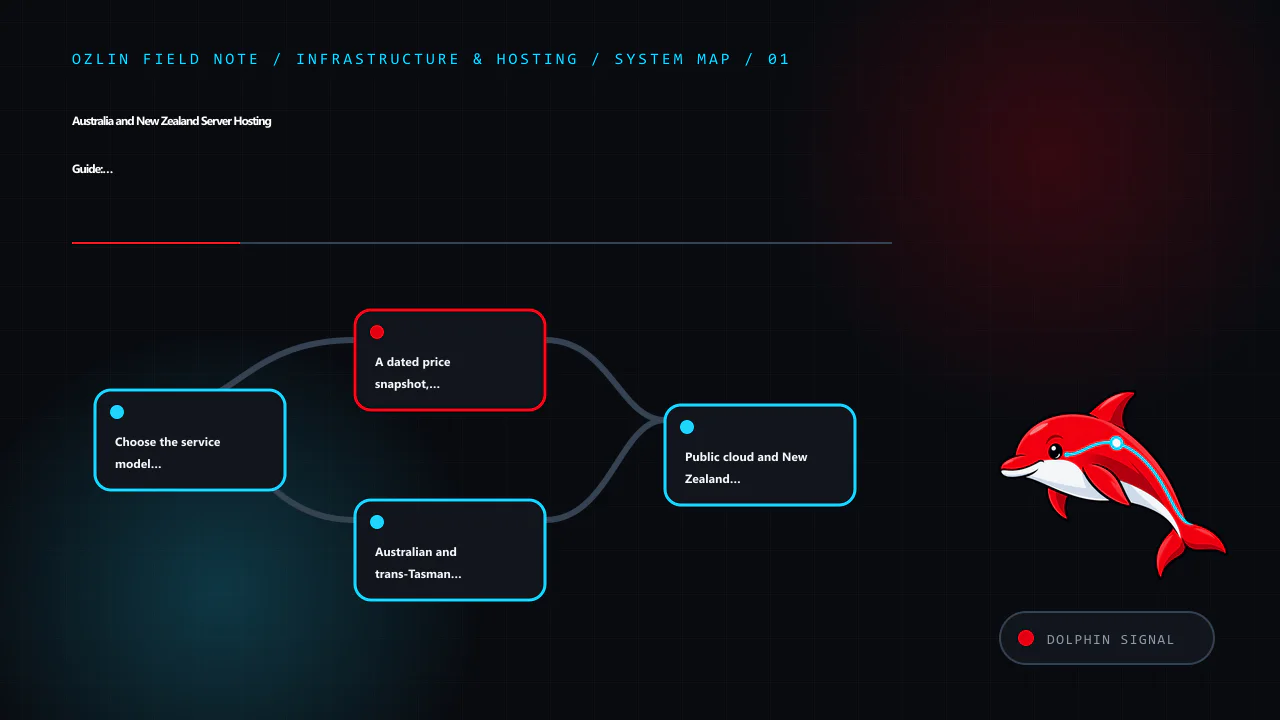
    Article map for Australia and New Zealand Server Hosting Guide: VPS, Cloud, Dedicated…, covering Choose the service model before the brand, A dated price snapshot, not a permanent price list, Australian and trans-Tasman…
    Article map: Choose the service model before the brand; A dated price snapshot, not a permanent price list; Australian and trans-Tasman providers worth shortlisting; Public cloud and New Zealand data-location options.
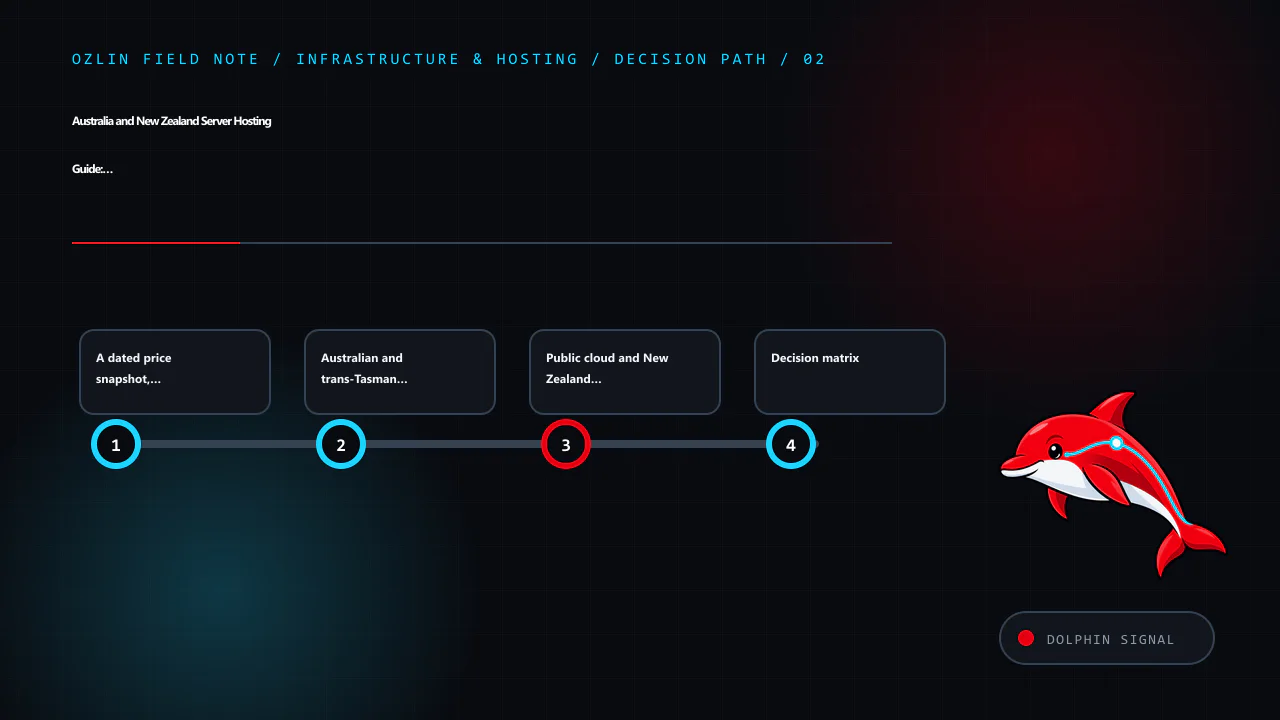
    Decision path for Australia and New Zealand Server Hosting Guide: VPS, Cloud, Dedicated…, covering A dated price snapshot, not a permanent price list, Australian and trans-Tasman providers worth shortlisting, Public clo…
    Decision path: A dated price snapshot, not a permanent price list; Australian and trans-Tasman providers worth shortlisting; Public cloud and New Zealand data-location options; Decision matrix.
    Control and evidence map for Australia and New Zealand Server Hosting Guide: VPS, Cloud, Dedicated…, covering Public cloud and New Zealand data-location options, Decision matrix, Build a comparable TCO and related revie…
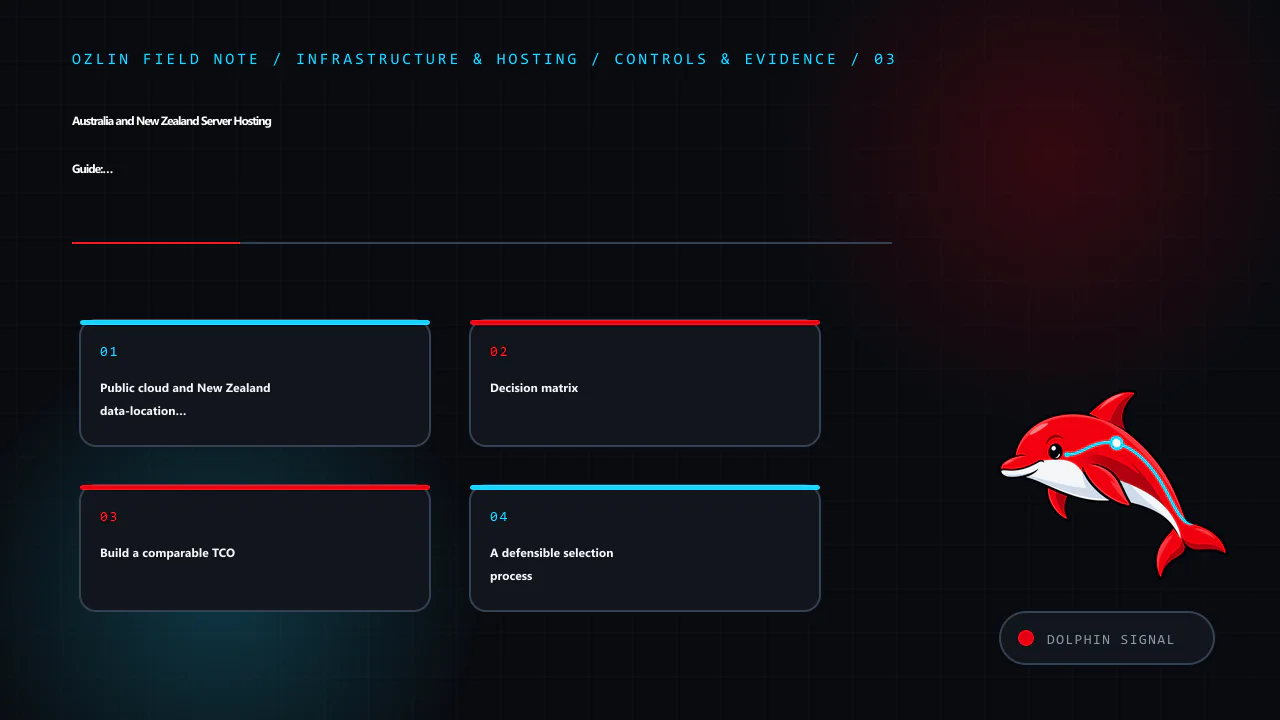
    Control and evidence map: Public cloud and New Zealand data-location options; Decision matrix; Build a comparable TCO; A defensible selection process.
    Practical checklist for Australia and New Zealand Server Hosting Guide: VPS, Cloud, Dedicated…, covering Decision matrix, Build a comparable TCO, A defensible selection process and related review points.
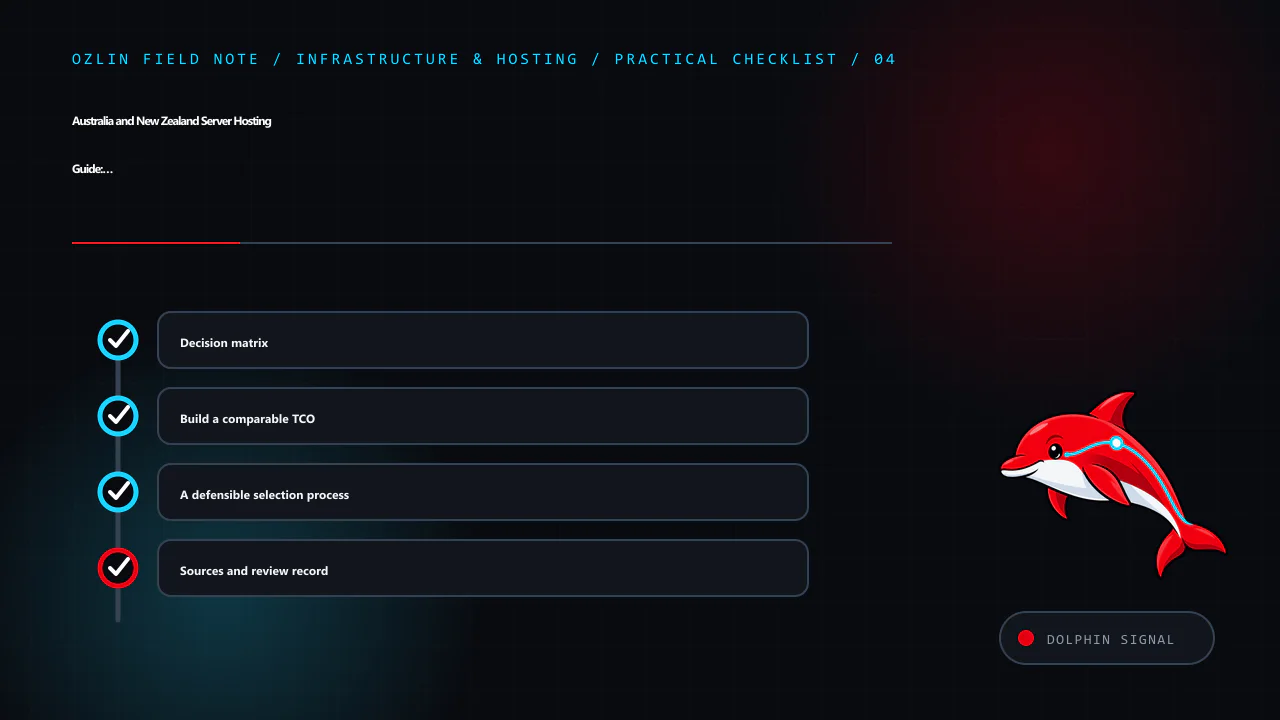
    Practical checklist: Decision matrix; Build a comparable TCO; A defensible selection process; Sources and review record.
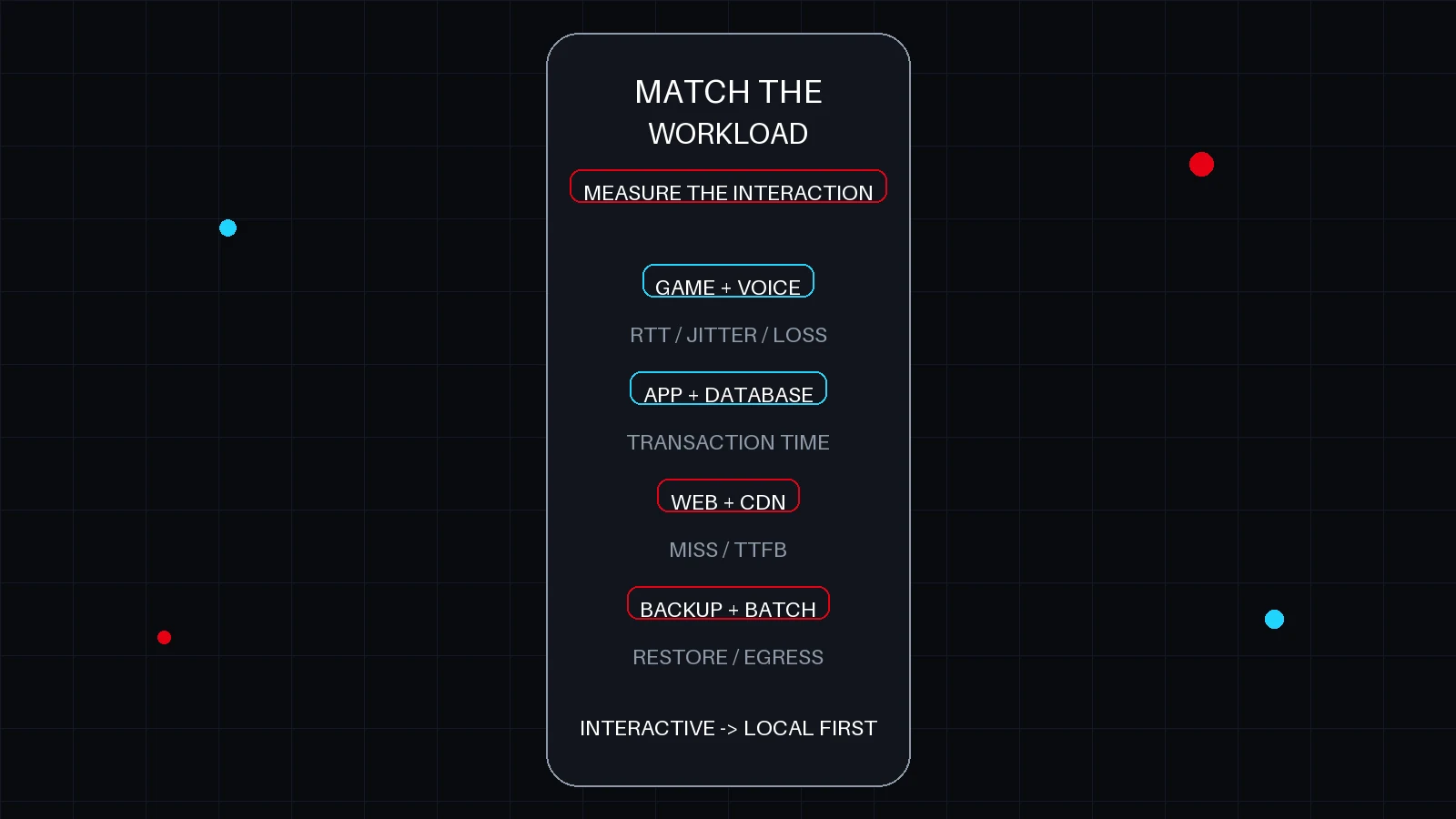
    A matrix places interactive workloads toward the low-latency end and asynchronous workloads toward the price-flexible end, with measurement checkpoints alongside.
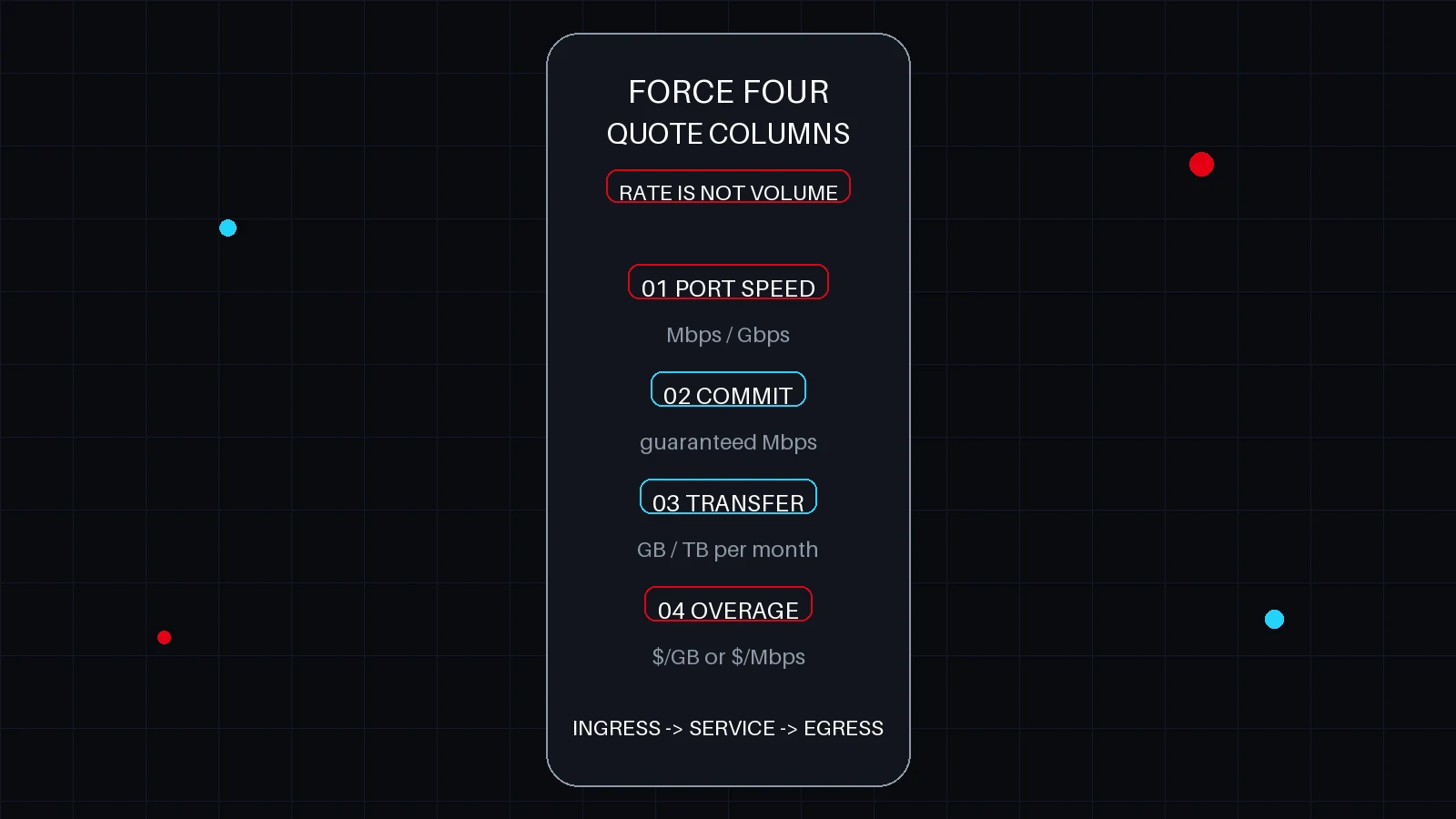
    Four quote cards separate port speed, committed rate, monthly transfer and overage, with ingress and egress directions explicitly labelled.
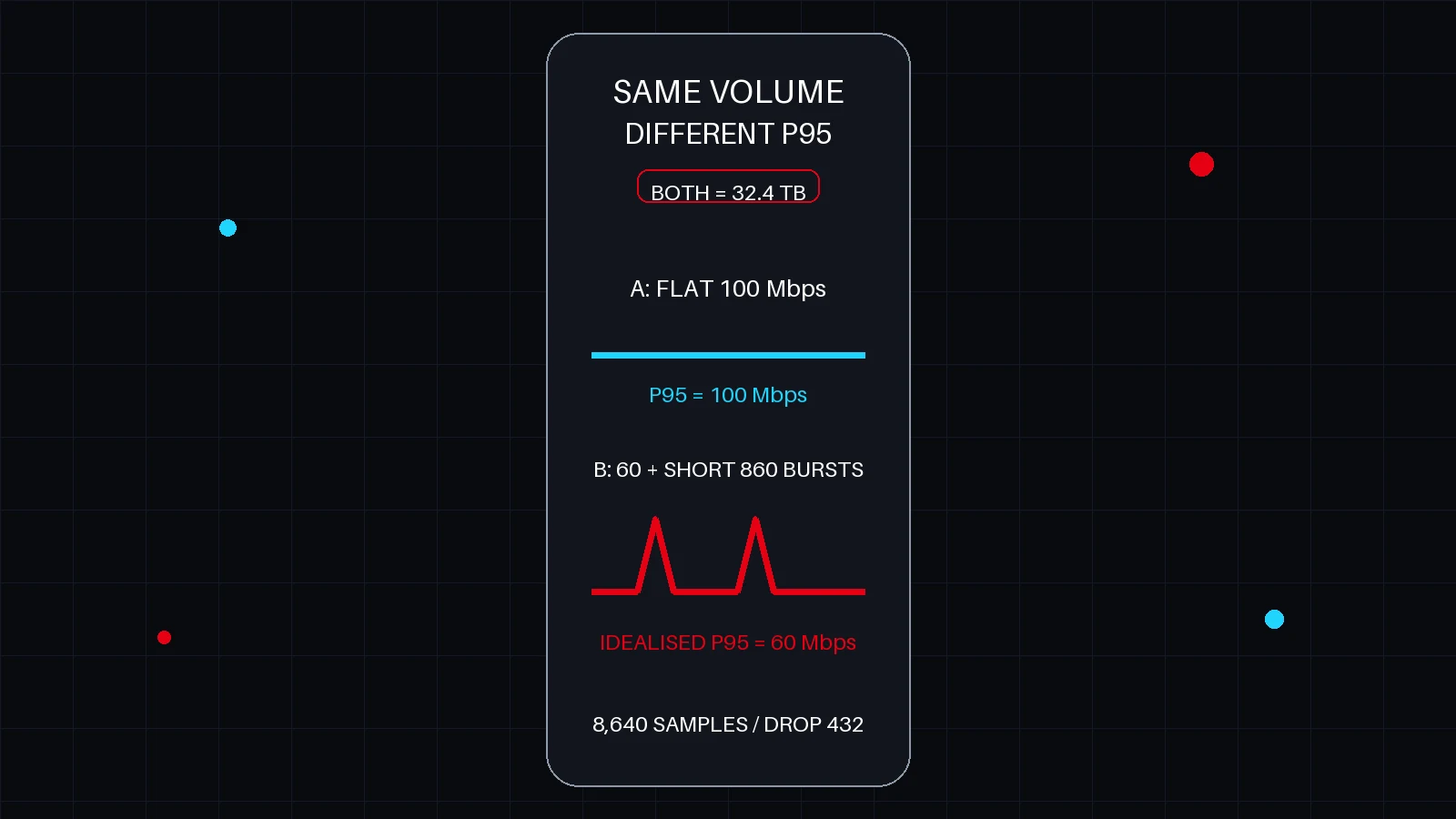
    Two traffic traces contain the same monthly volume: a flat 100 Mbps line bills at p95 100, while short 860 Mbps bursts above a 60 Mbps baseline yield an idealised p95 of 60.
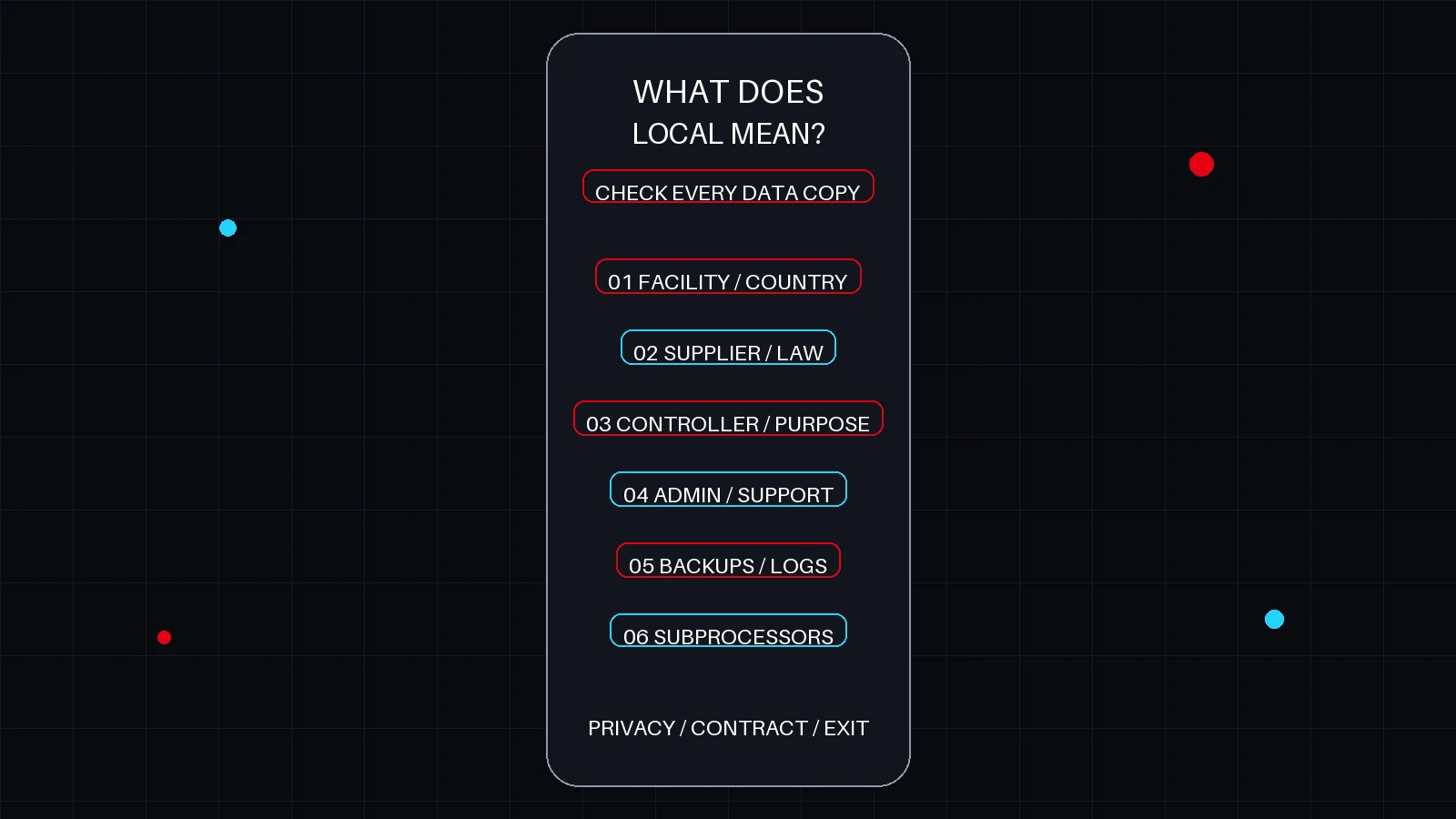
    A six-layer checklist separates facility, supplier jurisdiction, data controller, administrator access, replicas and subprocessors, then routes the buyer to contract and exit checks.
  • Post-Quantum Cryptography for Australian Organisations: A 2026 Transition Guide

    Post-Quantum Cryptography for Australian Organisations: A 2026 Transition Guide

    Reviewed: 13 September 2026 · Next review: 13 December 2026
    Author: Ozlin Info Editorial Team · Human review: Lin (accountable human); Codex assisted

    Post-quantum cryptography is now a migration programme, not a prediction contest. An organisation does not need to guess the date of a cryptographically relevant quantum computer before it can locate vulnerable dependencies, assess the lifetime of protected information and ask suppliers for an upgrade path.

    The Australian Signals Directorate (ASD) recommends a refined transition plan by the end of 2026, commencement of migration for critical systems and data by the end of 2028, and completion by the end of 2030. That is a demanding timetable for environments containing legacy systems, hardware security modules, certificates, embedded devices, external APIs and long-lived vendor contracts (ASD — Planning for post-quantum cryptography).

    Correct the threat model first

    The original version of this article said quantum computers perform calculations “exponentially faster” and treated RSA and elliptic-curve cryptography as if both depended on integer factoring. That is inaccurate.

    Shor's algorithm threatens the mathematical problems used by widely deployed public-key systems. RSA relies on integer factorisation; Diffie–Hellman and elliptic-curve systems rely on discrete-logarithm problems in different groups. A sufficiently capable, fault-tolerant quantum computer would undermine both families, but not because they use the same problem.

    Symmetric encryption and hash functions have a different risk profile. Quantum search can reduce the effective work factor of brute-force search, which influences key-size and design choices, but it does not mean every cryptographic primitive instantly fails or that quantum speed-up is universal.

    The practical risk is broader than encrypted archives. Vulnerable asymmetric cryptography is used for:

    • TLS authentication and key establishment;
    • VPNs and remote administration;
    • software and firmware signing;
    • document and email signatures;
    • device identity and update chains;
    • public-key infrastructure and certificates; and
    • machine, workload and API authentication.
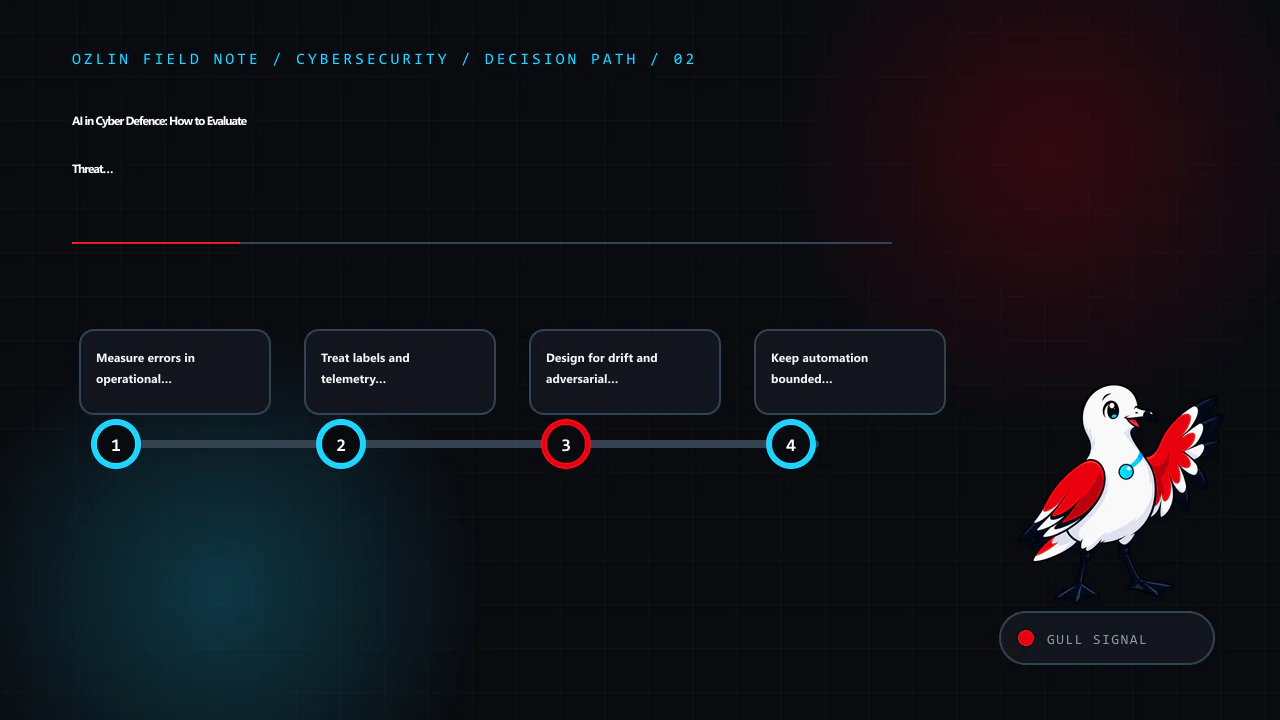
    Information with long-lived confidentiality requirements may also be exposed to “harvest now, decrypt later”: encrypted traffic or data captured today could be retained for an attempt to decrypt it in the future. ASD advises organisations to begin planning even though the arrival date of a cryptographically relevant quantum computer remains uncertain (ASD — Planning for post-quantum cryptography).

    Use final standards, not old candidate names

    In August 2024, the US National Institute of Standards and Technology (NIST) approved three post-quantum standards:

    Standard Function Important distinction
    FIPS 203 — ML-KEM Establishing shared secrets A key-encapsulation mechanism, not general-purpose “encryption” by itself
    FIPS 204 — ML-DSA Digital signatures Derived from the CRYSTALS-Dilithium submission
    FIPS 205 — SLH-DSA Digital signatures A stateless hash-based signature scheme derived from SPHINCS+

    These are final standards, not merely candidates under evaluation (NIST — Post-Quantum Cryptography FIPS Approved). NIST says the standards are ready to implement, while work continues on additional algorithms and migration guidance (NIST — Post-quantum cryptography).

    For Australian organisations that apply the Information Security Manual, current ASD-approved choices, parameters and transition rules should be checked directly in ASD guidance. Do not assume that a library exposing an algorithm name is approved, interoperable or safely configured for the intended use.

    Follow a Locate–Assess–Triage–Implement–Communicate path

    ASD's LATICE framework provides a useful migration sequence.

    1. Locate cryptography and its owners

    Build a cryptographic inventory. Begin with high-impact services and record:

    • the business function and information protected;
    • algorithm, key size, protocol, certificate type and library;
    • product, version, hardware or managed service involved;
    • whether the organisation controls the configuration or depends on a supplier;
    • key and certificate lifetimes;
    • data-confidentiality lifetime;
    • interoperability and external-party dependencies; and
    • accountable business and technical owners.

    A cryptographic bill of materials can mature from a simple list into a machine-readable record, but perfect tooling is not a prerequisite for beginning. Certificates alone are not a complete inventory: cryptography may be compiled into applications, embedded in devices or hidden behind a SaaS interface.

    2. Assess value, lifetime and business impact

    Prioritise more than secrecy. A future loss of signature trust could affect software updates, device identity, records, contracts or evidence. Ask how long the protected information or authenticity decision must remain trustworthy and what happens if a dependency cannot be updated.

    Document regulatory, contractual and customer requirements without assuming that adopting a NIST algorithm automatically proves compliance.

    3. Triage difficult and externally connected systems

    Critical, sensitive, long-lived and slow-to-change systems usually need earlier attention. Include operational technology, appliances, mobile applications, identity platforms and services whose vendors control the implementation. Record legacy interoperability that may delay a clean cutover.
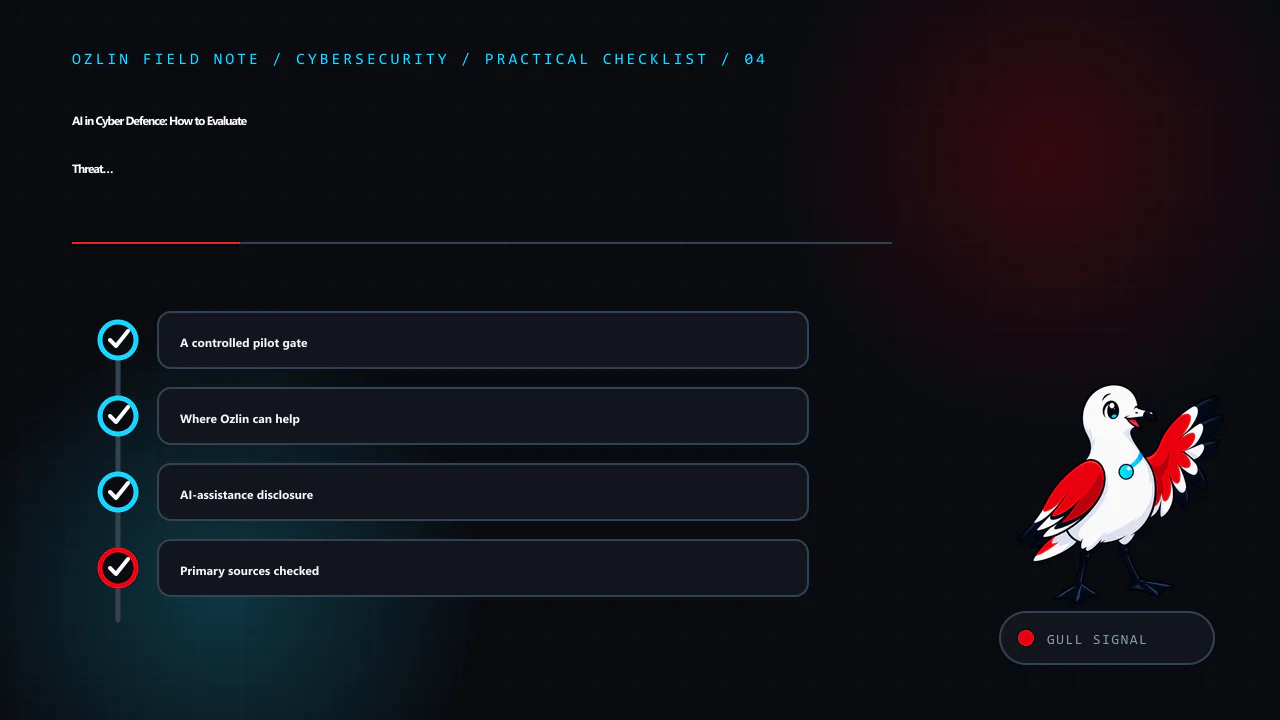
    4. Implement through supported products and controlled tests

    Do not design proprietary cryptography or rush an unreviewed library into production. Prefer standardised implementations, supported products and vendor guidance. Test in a representative non-production environment for:
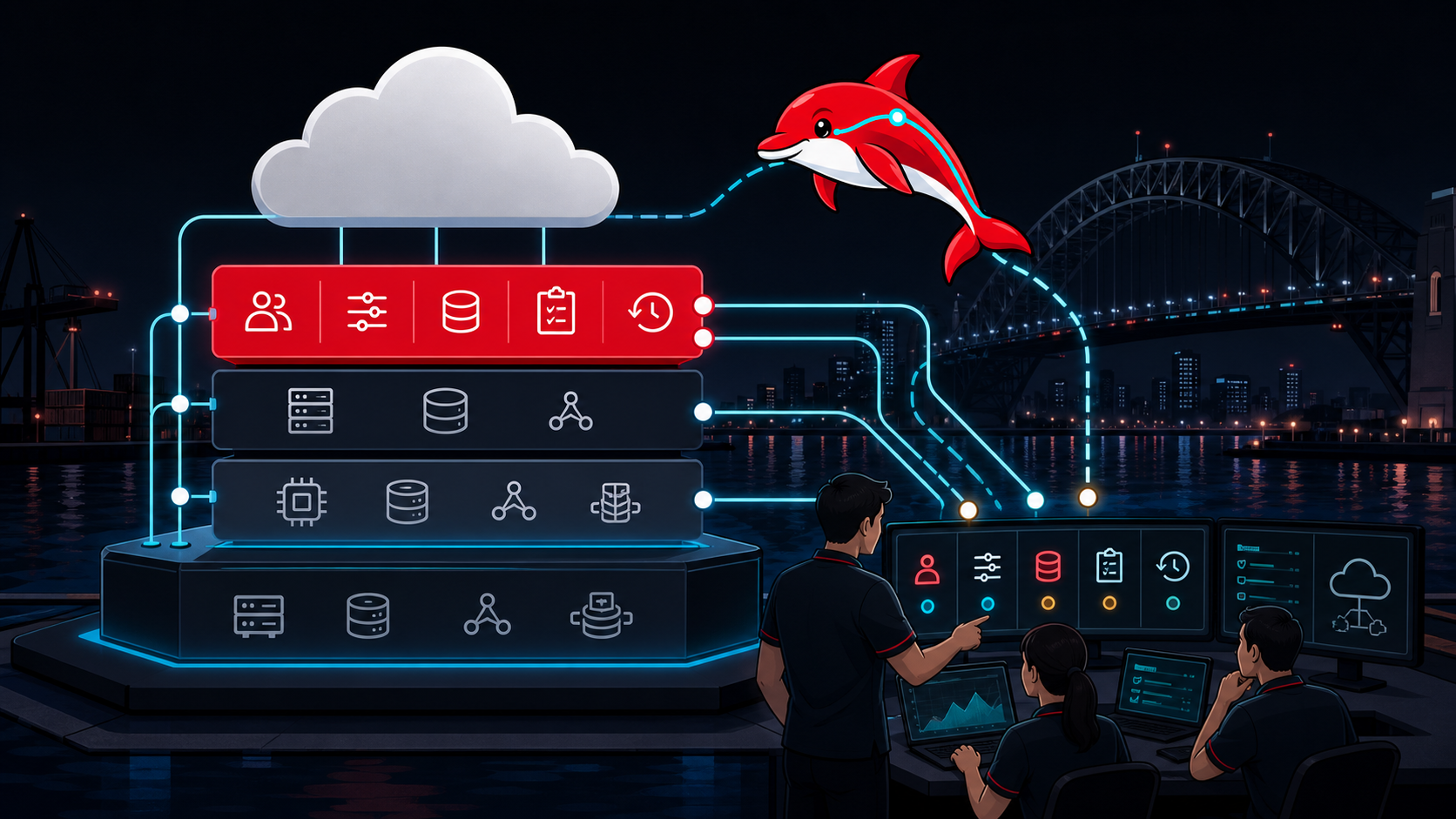
    • protocol and certificate interoperability;
    • larger keys, signatures, certificates and messages;
    • latency, memory, CPU and storage effects;
    • monitoring, logging and failure behaviour;
    • downgrade and fallback handling;
    • key lifecycle, backup and recovery; and
    • rollback without silently returning to an insecure state.

    ASD does not recommend, but does not prohibit, post-quantum/traditional hybrid schemes. A hybrid can support interoperability and resilience during transition, but its traditional component remains vulnerable to a future cryptographically relevant quantum computer. Treat it as a transition design requiring review, not a permanent endpoint.

    5. Communicate with vendors and stakeholders

    Ask each critical supplier:

    • Which cryptographic dependencies are in the product, including third-party libraries and hardware?
    • Which final standards and profiles will be supported?
    • Is the implementation production-ready, independently tested and enabled by default or by configuration?
    • What versions, contracts, hardware replacements or downtime are required?
    • How will keys, certificates, backups, logs and rollback be handled?
    • Does the roadmap align with ASD's 2030 objective?
    • How will vulnerabilities or standards changes be communicated?

    ASD published a current vendor-question set in 2026 that can be adapted to procurement and renewal reviews (ASD — Post-quantum questions to ask your vendors).

    A realistic 2026 starting point

    For a smaller organisation, the first deliverable is not a fleet-wide cryptographic replacement. It is an owned transition plan:

    1. name the accountable owner and affected teams;
    2. identify the ten most critical services and their suppliers;
    3. document certificates, libraries, protocols and long-lived data for those services;
    4. ask vendors for current evidence and dates;
    5. rank dependencies by impact and difficulty;
    6. select one supported non-production pilot; and
    7. fund the next inventory and migration milestones.

    Measure progress by inventory coverage, supplier evidence, tested compatibility and closed migration risks—not by the number of products that display a “quantum-safe” badge.

    For help turning an infrastructure and software inventory into a scoped security roadmap, see Ozlin Info's cybersecurity services or contact Ozlin Info.

    Related reading: Cybersecurity fundamentals for business risk.


    General-information disclaimer

    This article provides general technical information only. It is not cryptographic, legal, regulatory, procurement or compliance advice. Approved algorithms, profiles and transition obligations depend on the organisation, information, jurisdiction, system and applicable ASD or sector requirements. Obtain qualified cryptographic and legal advice for high-consequence systems.

    Limitations: Transition timing and algorithm or product choices depend on inventories, standards, vendors, data lifetime, interoperability and sector requirements. No quantum-readiness or compliance conclusion is made.

    AI-assistance disclosure

    AI tools assisted with source discovery, outlining and copyediting. A human reviewer must verify every source, technical statement, organisational claim and publication decision before release. No claim is made that any Ozlin or client system is quantum-ready.

    Primary sources checked

    Source access date: 29 August 2026.

    Article map for Post-Quantum Cryptography for Australian Organisations: A 2026 Transi…, covering Correct the threat model first, Use final standards, not old candidate names, Follow a Locate–Assess–Triage–Implement–Comm…
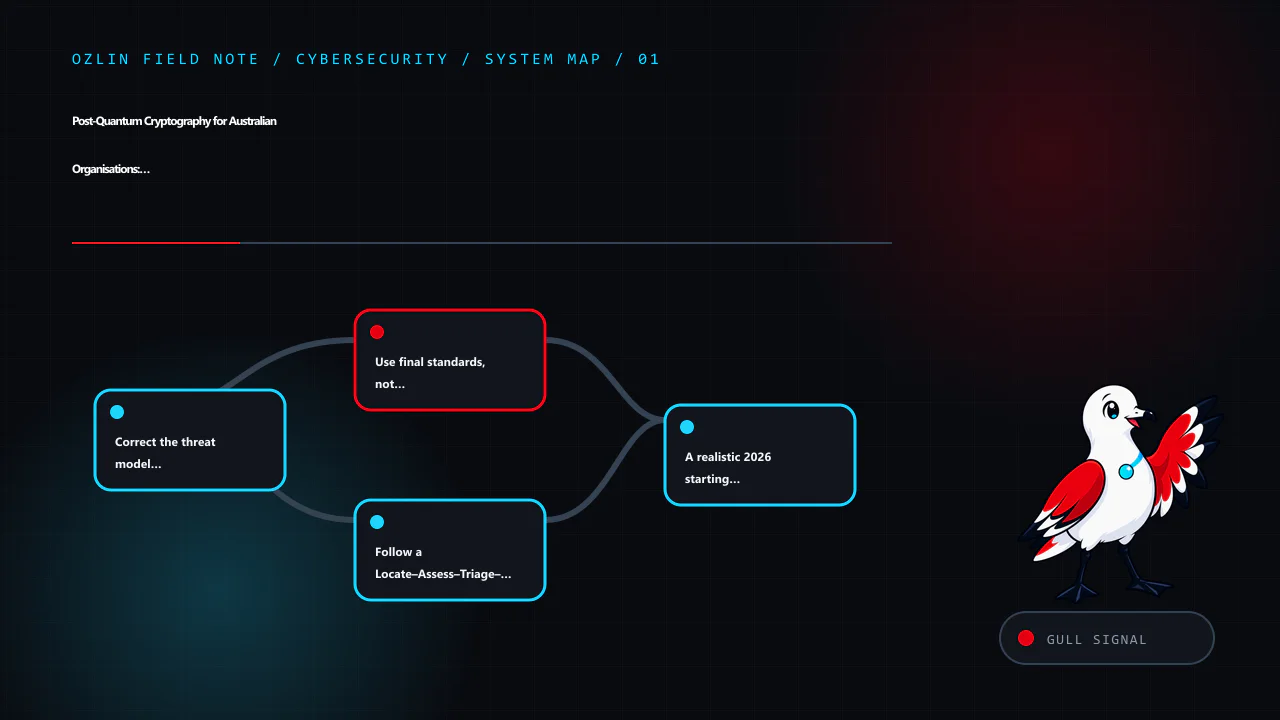
    Article map: Correct the threat model first; Use final standards, not old candidate names; Follow a Locate–Assess–Triage–Implement–Communicate path; A realistic 2026 starting point.
    Decision path for Post-Quantum Cryptography for Australian Organisations: A 2026 Transi…, covering Use final standards, not old candidate names, Follow a Locate–Assess–Triage–Implement–Communicate path, A realistic 2026…
    Decision path: Use final standards, not old candidate names; Follow a Locate–Assess–Triage–Implement–Communicate path; A realistic 2026 starting point; General-information disclaimer.
    Control and evidence map for Post-Quantum Cryptography for Australian Organisations: A 2026 Transi…, covering Follow a Locate–Assess–Triage–Implement–Communicate path, A realistic 2026 starting point, General-informatio…
    Control and evidence map: Follow a Locate–Assess–Triage–Implement–Communicate path; A realistic 2026 starting point; General-information disclaimer; AI-assistance disclosure.
    Practical checklist for Post-Quantum Cryptography for Australian Organisations: A 2026 Transi…, covering A realistic 2026 starting point, General-information disclaimer, AI-assistance disclosure and related review point…
    Practical checklist: A realistic 2026 starting point; General-information disclaimer; AI-assistance disclosure; Primary sources checked.
  • Incident Response and Disaster Recovery: A Practical Australian Playbook

    Incident Response and Disaster Recovery: A Practical Australian Playbook

    Reviewed: 13 September 2026 · Next review: 13 December 2026
    Author: Ozlin Info Editorial Team · Human review: Lin (accountable human); Codex assisted

    Incident response and disaster recovery are related, but they are not interchangeable. An organisation can contain an attacker and still be unable to operate. It can also restore a server quickly while restoring the same compromise, losing evidence or making an unapproved public statement.

    A useful plan connects four disciplines:

    • cyber incident response — detecting, analysing, containing, remediating and learning from a security incident;
    • business continuity — maintaining the organisation's critical activities during disruption;
    • disaster recovery — restoring technology and data to an acceptable state; and
    • crisis communication and decision-making — coordinating leaders, workers, suppliers, customers, regulators and other stakeholders.

    The previous version of this article asserted that breaches are inevitable, quoted an unverified average Australian breach cost and prescribed quarterly testing for every organisation. Those claims are removed. Risk, impact and exercise frequency depend on the organisation and its obligations; readiness should be demonstrated by evidence, not fear-based statistics.
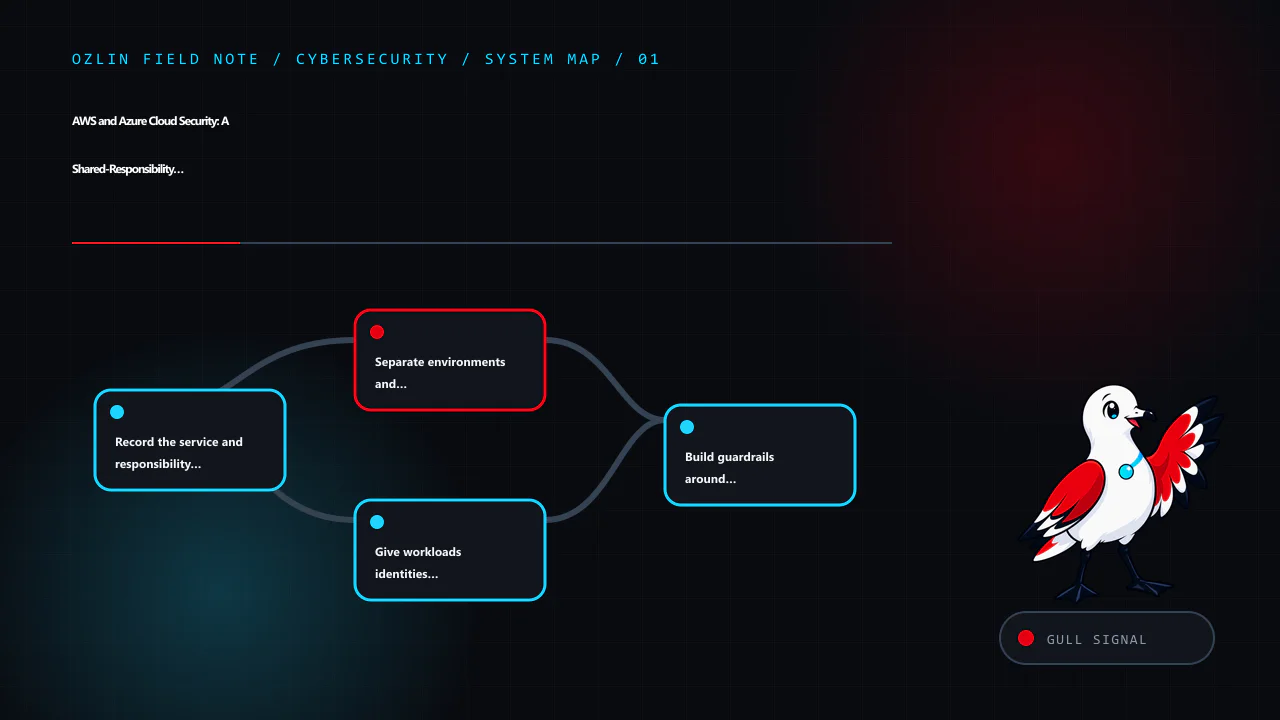
    Prepare before the alert arrives

    ASD's current practitioner guidance says a cyber incident response plan should align with emergency, crisis, business continuity and disaster-recovery arrangements, be tailored to the environment, and be regularly tested and reviewed (ASD — Cyber security incident response planning).

    Begin with decision rights and reliable contact paths. Record:

    • the incident lead and deputy;
    • technical, business, legal/privacy and communications decision-makers;
    • critical service owners and recovery priorities;
    • cyber insurer or broker contacts and relevant policy conditions;
    • hosting, cloud, identity, banking and managed-service escalation paths;
    • law-enforcement and government reporting routes where relevant;
    • who can isolate systems, disable accounts, restore data and approve public statements; and
    • an offline, protected copy of the plan and key contacts.

    Create short playbooks for likely scenarios such as phishing/business email compromise, compromised administrator access, ransomware, lost devices, website compromise, cloud-key exposure and data breach. A playbook should support judgement; it should not force responders to follow a damaging action merely because it appears as step three.

    Detect and triage with business context

    Define how workers and suppliers report a concern at any time. Record the first observation, source, time, affected accounts or services and actions already taken. Establish an incident log early and preserve the original alert, relevant timestamps and decision rationale.

    Triage should ask:

    1. What is known and what is only suspected?
    2. Which identities, data, systems and business processes may be affected?
    3. Is the activity ongoing?
    4. Could a containment action disrupt a critical service or destroy evidence?
    5. Who has authority to make the next decision?
    6. Is specialist incident-response, legal, privacy, insurer or law-enforcement help required now?

    NIST SP 800-61 Rev.3, finalised in April 2025, integrates incident response across the Govern, Identify, Protect, Detect, Respond and Recover functions of the Cybersecurity Framework 2.0 rather than treating response as an isolated technical phase (NIST SP 800-61 Rev.3).

    Contain without making the situation worse

    “Isolate everything immediately” is not a universal rule. Isolation may be appropriate, but responders should consider operational impact, evidence preservation, attacker visibility and the time required for a safer alternative. ASD's guidance explicitly asks organisations to consider the additional effects, duration and effectiveness of containment options.

    Possible authorised actions include disabling a compromised session, account, API key or forwarding rule; restricting network access; blocking a malicious indicator; preserving a system image or relevant logs; and moving a critical service to a known-clean path. The exact action depends on the incident and must stay within legal authority and the agreed response role.

    Do not delete logs, wipe a system or “hack back”. Protect collected evidence from unnecessary access and record who collected it, when, from where and how its integrity was maintained. Engage a qualified forensic specialist where evidence may support litigation, insurance, employment or regulatory decisions.

    Define recovery through business impact

    Recovery objectives should be based on the business processes a system supports. NIST's contingency-planning guide distinguishes:

    • maximum tolerable downtime (MTD): the total outage or disruption the process can tolerate;
    • recovery time objective (RTO): the maximum time a system resource can remain unavailable before unacceptable impact; and
    • recovery point objective (RPO): the point in time to which data must be recoverable, which expresses tolerable data loss (NIST SP 800-34 Rev.1).

    Do not copy a supplier's advertised recovery figure into the plan without validating dependencies. A website may depend on DNS, identity, secrets, database, storage, mail, payment, third-party APIs and staff access. Recovery should specify the order, prerequisites, owners and acceptance tests.

    A safe recovery sequence normally includes:

    1. approve a remediation and recovery plan;
    2. establish a known-clean identity and administration path;
    3. remediate the entry point and affected trust relationships;
    4. restore systems and data from an appropriate source;
    5. rotate exposed credentials and keys according to impact;
    6. validate integrity, security configuration and business function;
    7. monitor for recurrence or missed persistence; and
    8. obtain accountable approval before returning to normal operation.
    A backup is not recovery evidence. Run restoration exercises, record duration and missing dependencies, and protect recovery administration from the identities used for everyday work.

    Handle notification as a scoped decision

    Not every security event is a notifiable data breach, and not every Australian organisation has the same obligations. The OAIC's current quick-reference guide applies to entities covered by the Notifiable Data Breaches scheme and uses a contain–assess–notify if required–review sequence (OAIC — Responding to data breaches).

    Assess coverage, the information involved, likely serious harm, remedial action and statutory timeframes with appropriate advice. Preserve the basis for the decision. Sector-specific obligations can also apply. For example, APRA's CPS 230 and CPS 234 apply to APRA-regulated entities, not to every Australian business (APRA — CPS 230). Contractual, insurer, customer and platform notification requirements may be separate again.
    Report active cybercrime or incidents through the appropriate official channel when relevant. Do not delay urgent containment solely to perfect a report, but do not make unsupported public attribution or promise an outcome before facts are established.

    Exercise the decisions, not just the document

    Choose exercise frequency from risk, change, obligations and prior findings rather than a universal quarterly rule. Useful exercise types include:

    • a contact-tree and escalation test;
    • a tabletop decision exercise;
    • a technical restore test;
    • a failover or alternate-workflow exercise; and
    • a combined incident, recovery and communications simulation.

    Define observable acceptance criteria: contacts reached within the expected window, correct authority identified, evidence preserved, backup restored, critical transaction completed, notification question escalated and unresolved actions assigned.

    After an incident or exercise, run a blameless review that still assigns ownership. Update the plan, architecture, controls, supplier agreements and funded work backlog. An incident is not “closed” merely because production is available again.

    For a scoped review of response roles, backups, restoration evidence and website/cloud dependencies, see Ozlin Info's cybersecurity services or contact Ozlin Info.

    Related reading: Phishing response playbook for Australian businesses.


    General-information disclaimer

    This article provides general information only. It is not incident-response, forensic, legal, privacy, regulatory, insurance or business-continuity advice. Actions and notification obligations depend on the facts, authority, systems, information, contracts, sector and jurisdiction. Seek urgent qualified help when an incident may be active.

    Limitations: A generic response sequence cannot replace a current plan, forensic advice or an incident commander. Recovery and notification outcomes depend on facts, contracts, jurisdiction and tested capabilities.

    AI-assistance disclosure

    AI tools assisted with source discovery, outlining and copyediting. A human reviewer must verify every factual statement, link, scope decision and publication choice before release. No recovery time or incident outcome is promised.

    Primary sources checked

    Source access date: 29 August 2026.

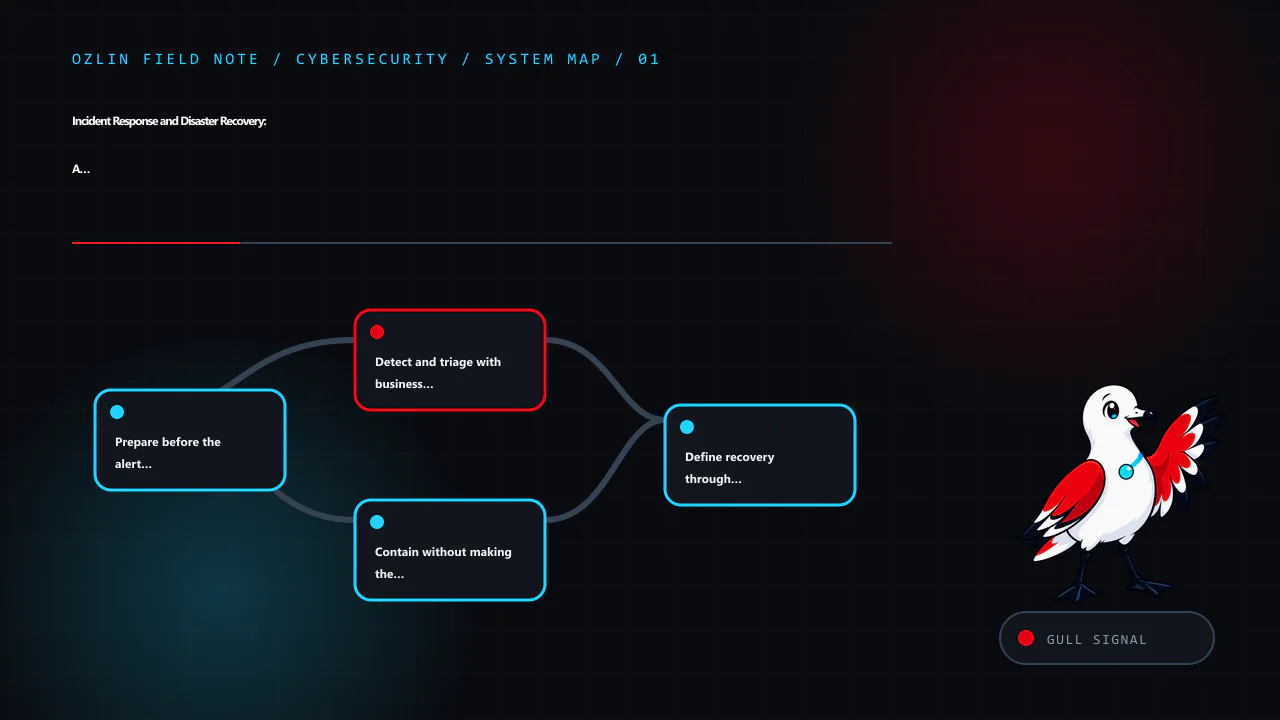
    Article map for Incident Response and Disaster Recovery: A Practical Australian Playb…, covering Prepare before the alert arrives, Detect and triage with business context, Contain without making the situation worse and…
    Article map: Prepare before the alert arrives; Detect and triage with business context; Contain without making the situation worse; Define recovery through business impact.
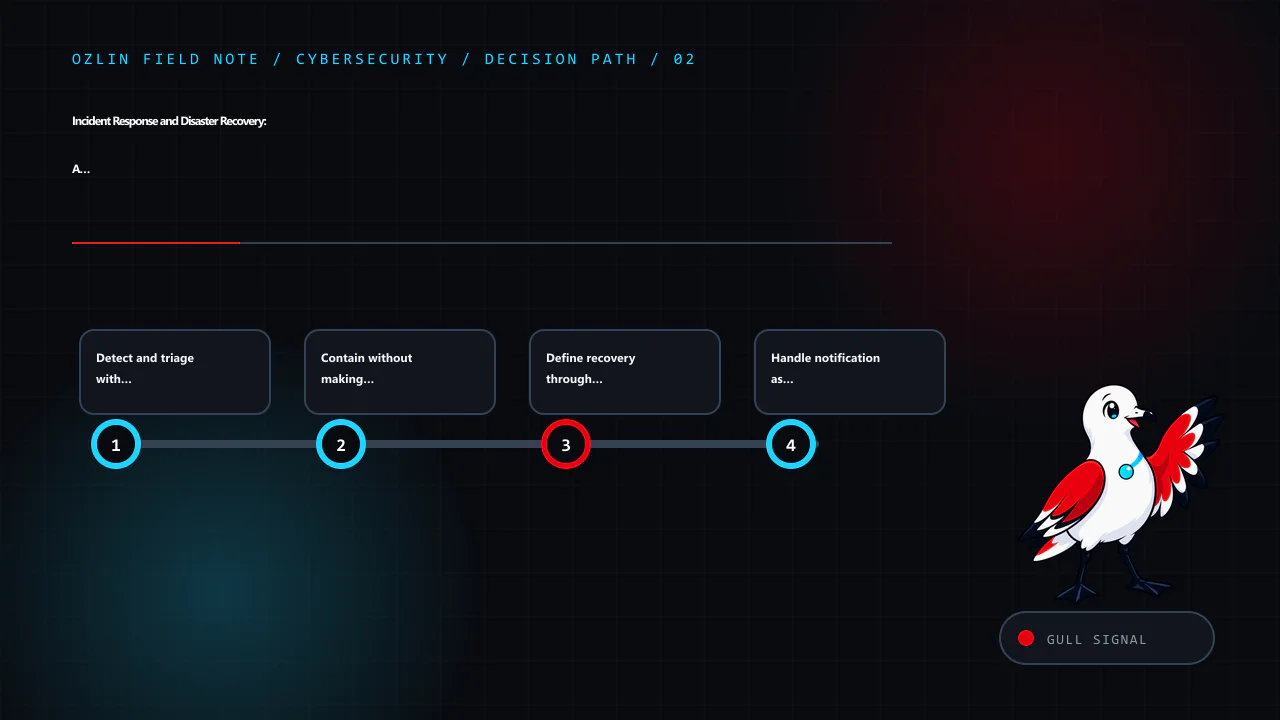
    Decision path for Incident Response and Disaster Recovery: A Practical Australian Playb…, covering Detect and triage with business context, Contain without making the situation worse, Define recovery through business im…
    Decision path: Detect and triage with business context; Contain without making the situation worse; Define recovery through business impact; Handle notification as a scoped decision.
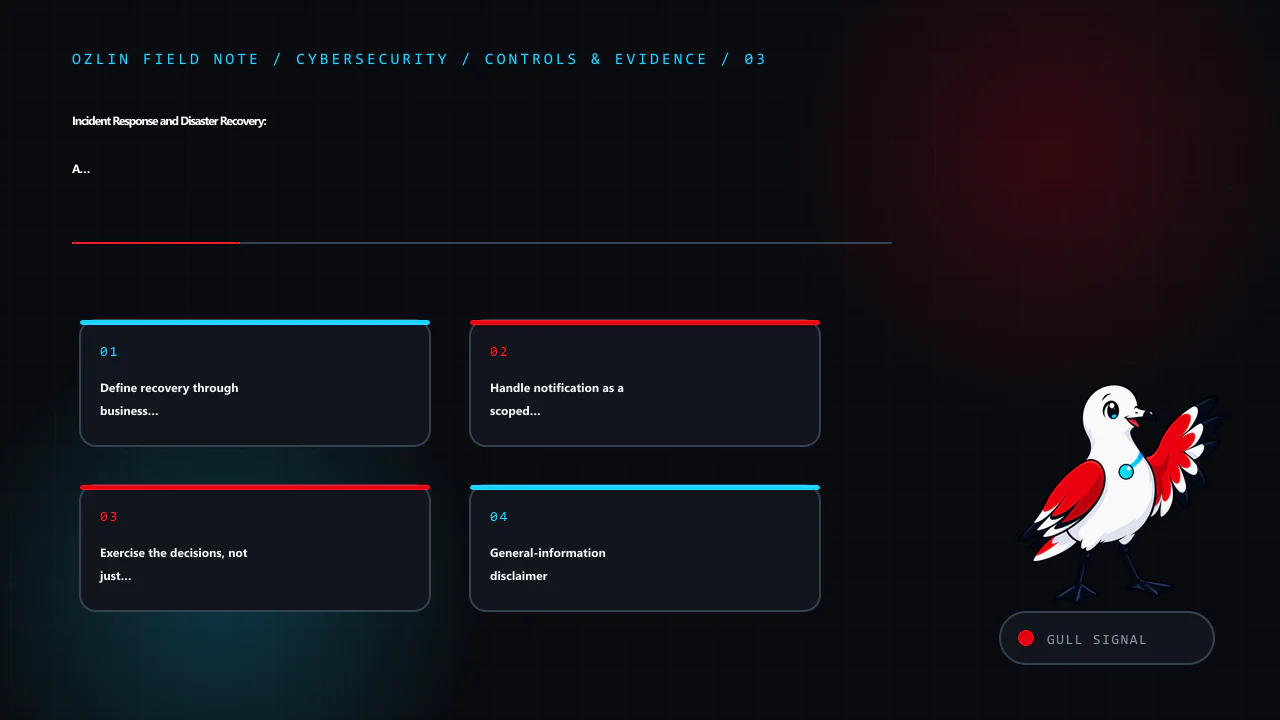
    Control and evidence map for Incident Response and Disaster Recovery: A Practical Australian Playb…, covering Define recovery through business impact, Handle notification as a scoped decision, Exercise the decisions, no…
    Control and evidence map: Define recovery through business impact; Handle notification as a scoped decision; Exercise the decisions, not just the document; General-information disclaimer.
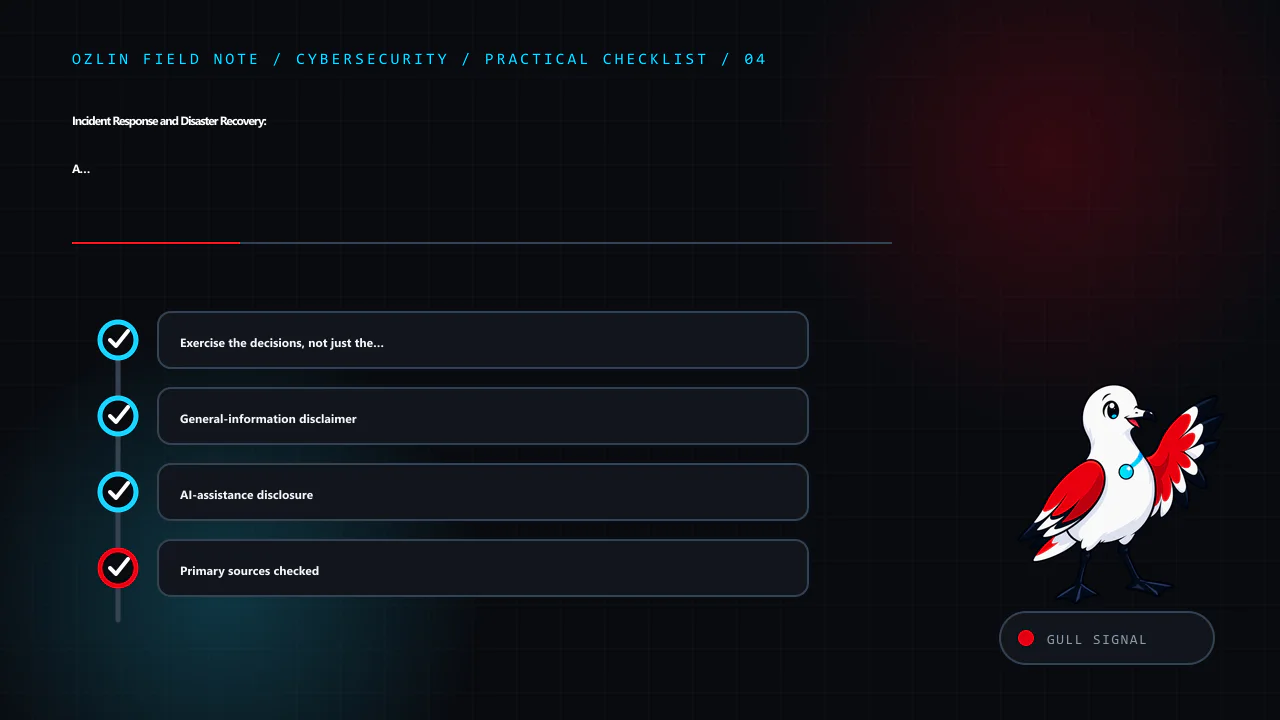
    Practical checklist for Incident Response and Disaster Recovery: A Practical Australian Playb…, covering Exercise the decisions, not just the document, General-information disclaimer, AI-assistance disclosure and relate…
    Practical checklist: Exercise the decisions, not just the document; General-information disclaimer; AI-assistance disclosure; Primary sources checked.
  • Zero Trust for Australian Organisations: A Practical Migration Guide

    Zero Trust for Australian Organisations: A Practical Migration Guide

    Reviewed: 13 September 2026 · Next review: 13 December 2026
    Author: Ozlin Info Editorial Team · Human review: Lin (accountable human); Codex assisted

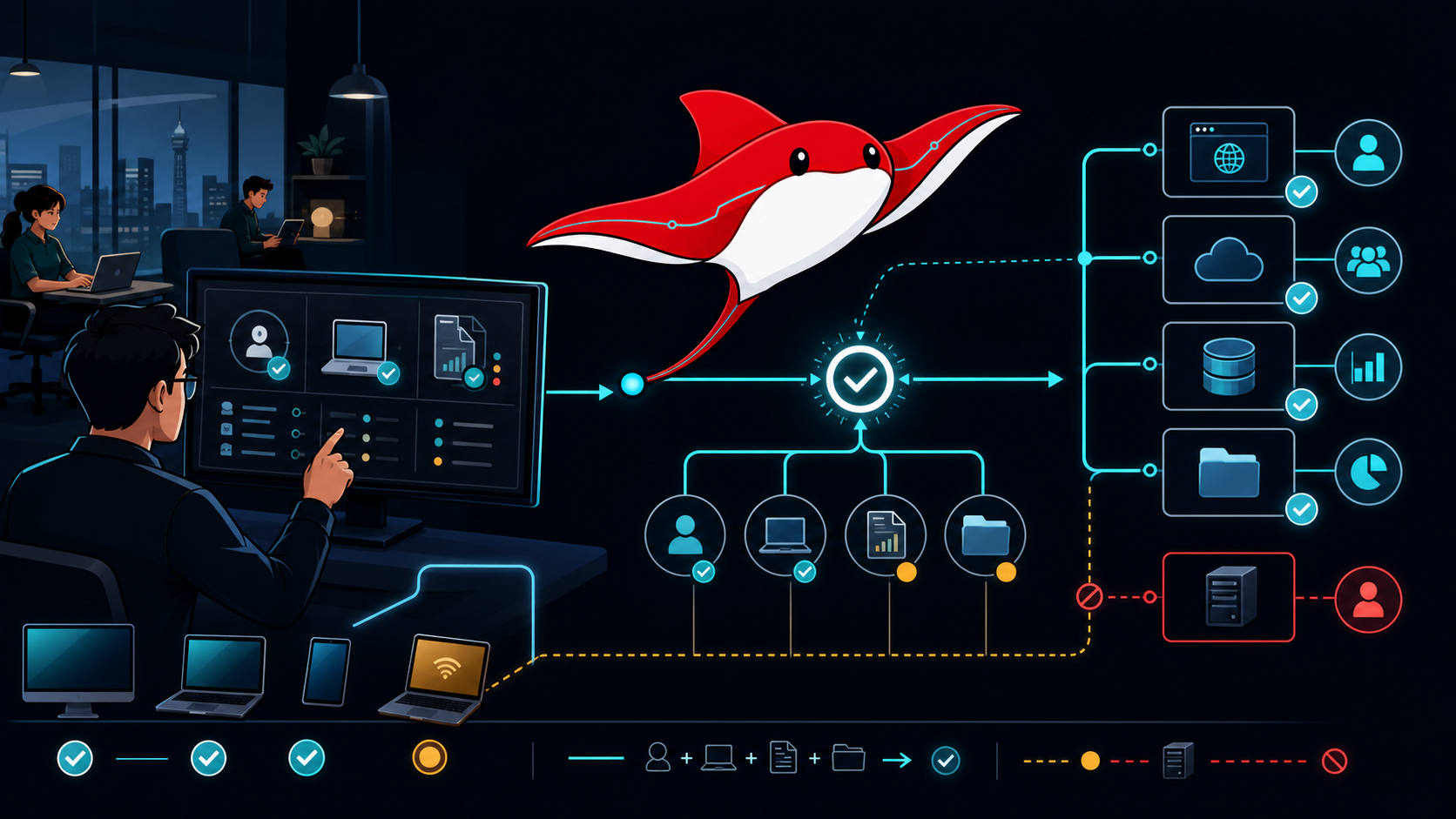
    Zero trust is not a product, a VPN replacement or a requirement to interrupt people with a new login prompt every few minutes. It is an architecture and operating approach that removes implicit trust based only on network location, device ownership or organisational affiliation.

    NIST SP 800-207 defines zero trust around users, assets and resources. Authentication and authorisation occur before a session to a protected resource is established, and policy decisions use available evidence rather than treating “inside the network” as sufficient proof (NIST SP 800-207).

    ASD now places zero trust within its modern defensible architecture guidance alongside layered architecture and secure-by-design practices. Its foundations describe three principles: never trust, always verify; assume breach; and verify explicitly (ASD — Foundations for modern defensible architecture).

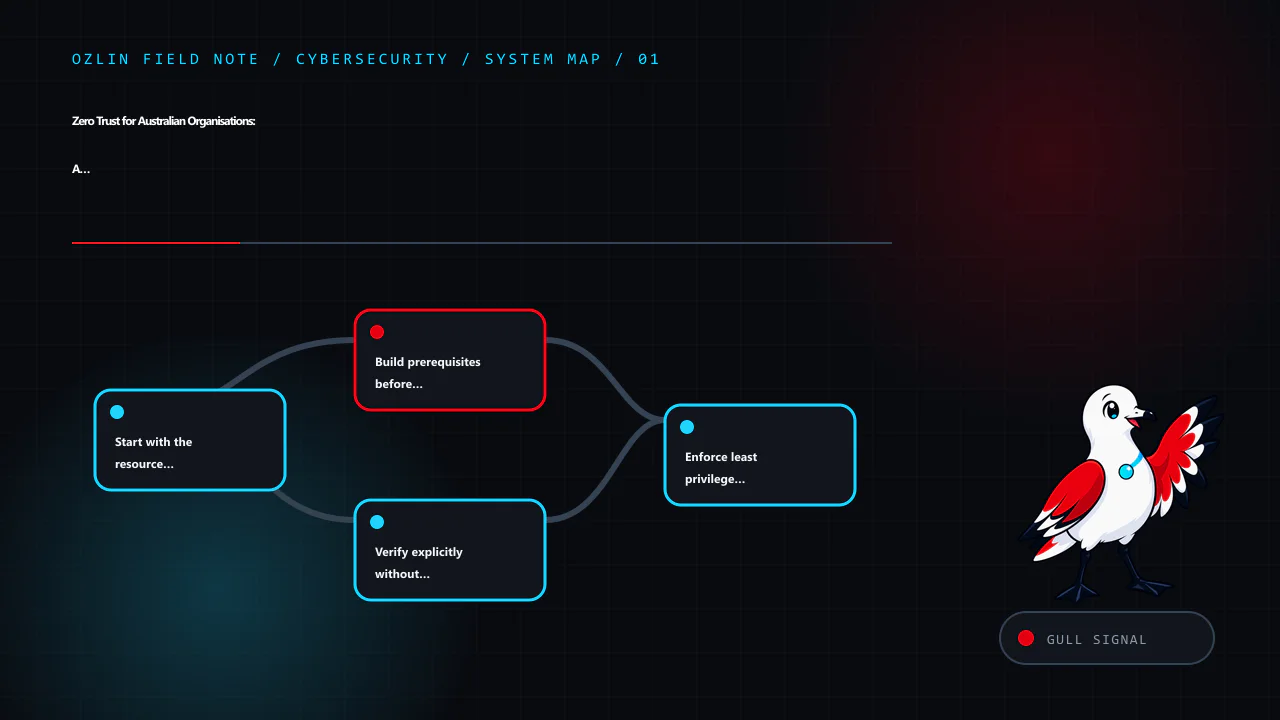
    Start with the resource and business decision

    A weak zero trust programme begins by buying tools. A stronger one begins by identifying a business resource and writing the access decision that must be enforced.

    For example:

    Finance records may be accessed by a current finance worker using an approved account and compliant managed device for an authorised task. High-risk sessions require stronger evidence or are denied. Privileged changes use a separate role and are logged.

    That statement exposes the required capabilities: reliable identity, device information, resource ownership, policy, enforcement, logging, exception handling and recovery. It also gives the organisation something testable.

    Do not try to transform every system at once. Select a workflow where the resource, users, risks and dependencies are understood. Common pilots include privileged administration, contractor access, a cloud application containing sensitive data or an internal application currently reachable by a broad network group.

    Build prerequisites before dynamic policy

    Zero trust decisions are only as reliable as their inputs. Establish:

    • an inventory of important resources, data and services;
    • named business and technical owners;
    • unique human, workload and device identities;
    • controlled account lifecycle and prompt removal of stale access;
    • device registration and meaningful posture signals where appropriate;
    • data classification that can influence access decisions;
    • central policy and change control; and
    • logs that allow a decision to be reconstructed.

    If a directory contains shared accounts, devices cannot be identified and no one owns the application, a highly dynamic policy may add complexity without adding assurance.

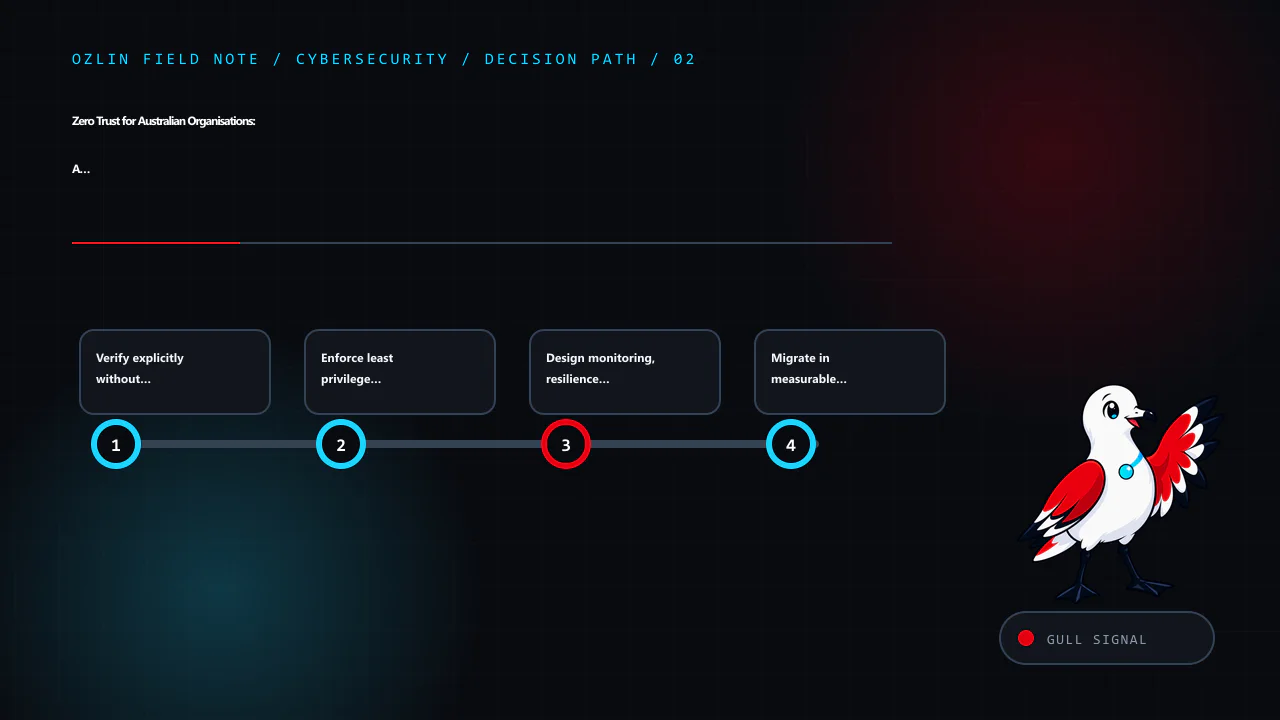
    Verify explicitly without creating permanent friction

    Explicit verification means using evidence appropriate to the requested action. Evidence can include:

    • identity and authentication strength;
    • device identity, management and security posture;
    • requested resource and action;
    • user, service or workload role;
    • location, network and time as contextual signals—not sole proof;
    • recent risk events or impossible behaviour;
    • data sensitivity; and
    • session and transaction risk.

    Phishing-resistant MFA is valuable for high-impact access, but zero trust is larger than MFA. Likewise, conditional access is not useful if emergency accounts, service identities, API keys and legacy protocols bypass it.

    Good design reduces unnecessary prompts by reusing strong, current evidence and raising requirements when risk or consequence changes. It should remain possible to explain why access was allowed, denied or escalated.

    Enforce least privilege at several layers

    Least privilege should cover people, administrators, applications, machines and automated agents. Review both standing access and what can be requested temporarily.

    Useful controls include:

    • role or attribute-based access tied to a defined job;
    • just-in-time elevation for high-impact administration;
    • separate routine and privileged identities;
    • workload identities instead of embedded shared secrets;
    • resource-specific application and API permissions;
    • approval and logging for exceptional access; and
    • automatic expiry where the business need is temporary.

    Micro-segmentation can reduce lateral movement, but it is one possible capability—not the definition of zero trust and not mandatory in the same form for every environment. NIST SP 800-207A shows how cloud-native access can focus on application and service identity in addition to network controls (NIST SP 800-207A).

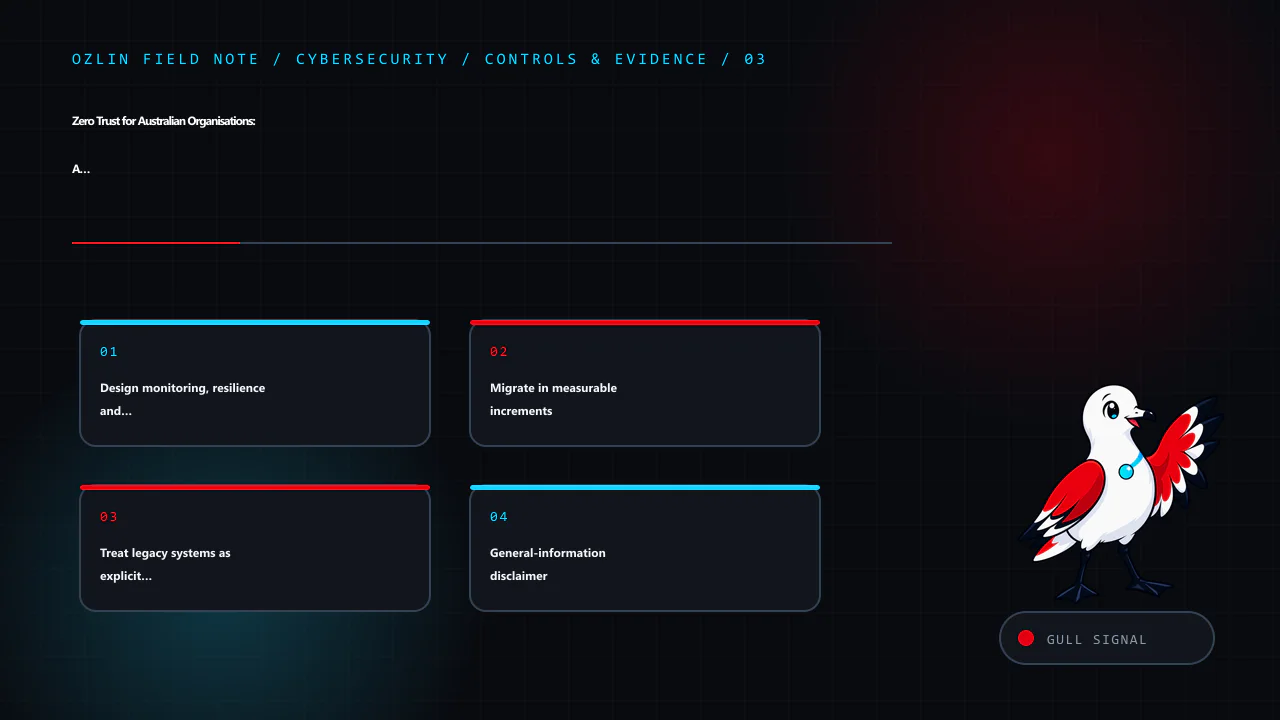
    Design monitoring, resilience and exceptions together

    Policy engines, identity providers, device services and enforcement points become critical dependencies. Plan what happens when one is unavailable or supplies stale information. A zero trust programme that locks out every responder during an incident is not resilient.

    Document:

    • high-availability and recovery requirements;
    • protected emergency access with independent monitoring;
    • safe behaviour when a dependency is unavailable;
    • alert ownership and expected response;
    • policy versioning and rollback;
    • how false denials and false allowances are investigated; and
    • how compromised identities or devices are revoked quickly.

    “Assume breach” means designing so one compromised account or device does not automatically reach every resource. It does not mean assuming every employee is malicious or blocking work without evidence.

    Migrate in measurable increments

    A practical sequence is:

    1. Discover: map the selected workflow, resources, identities, data and current trust assumptions.
    2. Define: write the intended access rules, evidence, exceptions and owners.
    3. Observe: collect data without blocking to identify unexpected dependencies and policy errors.
    4. Pilot: enforce for a limited population with support and rollback available.
    5. Validate: test expected access, denial, elevation, revocation, outage and recovery cases.
    6. Expand: add resources only after the operating model works.

    Useful measures include:

    Measure Evidence
    Resource coverage Important resources with named owners and explicit policy
    Identity hygiene Shared, dormant and excessive accounts removed
    Privilege exposure Standing high-impact access converted or justified
    Revocation Time to remove access across connected systems
    Decision quality Sampled allow/deny decisions supported by expected evidence
    User impact Failed legitimate access, support effort and workaround attempts
    Resilience Successful identity/policy outage and emergency-access exercise

    Do not claim that a drop in breaches proves the zero trust programme caused it. Security incidents are sparse, affected by exposure and detection, and not a clean single-control metric.

    Treat legacy systems as explicit risk

    Some systems cannot consume modern identity, device or workload signals. Record the limitation, business need, compensating controls, monitoring, owner and retirement or upgrade date. A network gateway may provide a temporary policy boundary, but it does not magically give the legacy application resource-level authorisation.

    Use current ASD modern defensible architecture guidance rather than the obsolete “DSD” wording in the original article. Also avoid saying that zero trust itself proves Privacy Act, APRA, ISO or other compliance. It may support control objectives; applicability and compliance require separate assessment and evidence.

    For help mapping an identity, website, cloud or administration workflow into a scoped access-control roadmap, see Ozlin Info's cybersecurity services or contact Ozlin Info.

    Related reading: Cybersecurity fundamentals for business risk.


    General-information disclaimer

    This article provides general technical information only. It is not architecture, legal, privacy, regulatory or compliance advice and does not define a complete zero trust implementation. Appropriate policy and controls depend on the organisation, data, systems, users, risks and obligations.

    Limitations: Zero-trust migration depends on legacy constraints, identity and device signals, architecture, user impact, funding and measured tests. These steps do not guarantee security or compliance.

    AI-assistance disclosure

    AI tools assisted with source discovery, outlining and copyediting. A human reviewer must verify each source, architectural statement, service claim and publication decision before release. No security or compliance outcome is guaranteed.

    Primary sources checked

    Source access date: 29 August 2026.

    Article map for Zero Trust for Australian Organisations: A Practical Migration Guide, covering Start with the resource and business decision, Build prerequisites before dynamic policy, Verify explicitly without creating…
    Article map: Start with the resource and business decision; Build prerequisites before dynamic policy; Verify explicitly without creating permanent friction; Enforce least privilege at several layers.
    Decision path for Zero Trust for Australian Organisations: A Practical Migration Guide, covering Verify explicitly without creating permanent friction, Enforce least privilege at several layers, Design monitoring, resil…
    Decision path: Verify explicitly without creating permanent friction; Enforce least privilege at several layers; Design monitoring, resilience and exceptions together; Migrate in measurable increments.
    Control and evidence map for Zero Trust for Australian Organisations: A Practical Migration Guide, covering Design monitoring, resilience and exceptions together, Migrate in measurable increments, Treat legacy systems a…
    Control and evidence map: Design monitoring, resilience and exceptions together; Migrate in measurable increments; Treat legacy systems as explicit risk; General-information disclaimer.
    Practical checklist for Zero Trust for Australian Organisations: A Practical Migration Guide, covering Treat legacy systems as explicit risk, General-information disclaimer, AI-assistance disclosure and related review p…
    Practical checklist: Treat legacy systems as explicit risk; General-information disclaimer; AI-assistance disclosure; Primary sources checked.
  • AI in Cyber Defence: How to Evaluate Threat Detection Without the Hype

    AI in Cyber Defence: How to Evaluate Threat Detection Without the Hype

    Reviewed: 13 September 2026 · Next review: 13 December 2026
    Author: Ozlin Info Editorial Team · Human review: Lin (accountable human); Codex assisted

    Artificial intelligence can help a security team sort events, enrich investigations and identify patterns that are difficult to express as static rules. It can also amplify bad data, produce persuasive but incorrect explanations, expose sensitive telemetry or automate the wrong response at machine speed.

    The useful question is therefore not “Does this product use AI?” It is: for a defined security task, under our conditions, does the system improve a measured operational outcome without creating unacceptable new risk?

    The Australian Signals Directorate (ASD) says AI may help cyber defenders analyse large volumes of data and support tasks such as detection and response, while emphasising cyber fundamentals, human oversight, secure integrations and controls for AI-specific risks (ASD — Opportunities for AI in cyber defence).

    Start with a bounded use case

    “AI security” is not one capability. Define the decision being assisted and the person who remains accountable. Examples include:

    • clustering related endpoint alerts into a candidate incident;
    • prioritising suspicious authentication events for an analyst;
    • summarising a known set of investigation records;
    • recommending a query or playbook step;
    • identifying anomalous cloud activity for review; or
    • extracting indicators from a report in a controlled workspace.

    For each use case, document the input, expected output, permitted data, latency requirement, failure cost and action that follows. A system that produces a useful morning summary may be unsuitable for automatically disabling accounts. A detector evaluated on endpoint data may say little about its performance on identity, email or operational-technology telemetry.

    Establish a baseline before adding a model

    Measure the existing workflow first. Useful baselines may include:

    • number of events reviewed and alerts escalated;
    • median and upper-percentile triage time;
    • confirmed incidents missed or detected late;
    • false escalations and unnecessary response actions;
    • analyst time spent on repetitive enrichment; and
    • evidence quality at handoff.

    The comparison should be against the current rule, query or human process—not against a marketing demo. A model that finds more suspicious events can still make operations worse if the extra volume overwhelms the team.

    Measure errors in operational terms

    Accuracy alone can conceal poor performance when genuine incidents are rare. At minimum, inspect:

    • precision: of the alerts the system raised, how many were relevant under the agreed label definition;
    • recall: of the relevant cases in the evaluation set, how many the system identified;
    • false-positive volume: how much avoidable work reaches analysts;
    • false-negative impact: which meaningful cases were missed and how they would otherwise be detected;
    • time to useful disposition: whether the system speeds a correct decision, not merely produces text sooner; and
    • calibration: whether confidence scores correspond to observed reliability.

    Thresholds involve trade-offs. A suitable threshold for a low-impact investigation queue may be unsafe for account suspension or network isolation. Record performance by environment, event source and risk class rather than relying only on a single aggregate figure.

    Use representative, time-separated data where possible. Randomly mixing near-duplicate events across training and evaluation sets can exaggerate performance. A later-period holdout is useful because attacker behaviour, infrastructure and normal business activity change over time.

    Treat labels and telemetry as security-critical inputs

    A detector inherits the limitations of its data. Ask:

    • Who defined the ground truth, and how were disagreements resolved?
    • Are incident labels based on completed investigations or only earlier alerts?
    • Does the data include relevant seasons, offices, cloud services and user populations?
    • Which identities, hosts or event sources are missing?
    • Can an attacker influence logs, text, URLs or other model inputs?
    • Does the integration expose secrets, personal information or privileged investigation data?

    Generative systems can be influenced by untrusted content embedded in logs, tickets, webpages or documents. An apparent instruction inside an artefact is data to investigate, not authority to run a command. ASD recommends constrained integrations, appropriate isolation and human oversight for higher-impact actions (ASD — Opportunities for AI in cyber defence).

    Design for drift and adversarial behaviour

    Production performance will change. Software updates alter event formats; a new office changes normal login patterns; attackers adapt to visible controls; and a vendor may update a hosted model without reproducing the original evaluation.

    Monitor:

    • input schema and missing-field rates;
    • alert volume and score distribution;
    • precision and recall on reviewed samples;
    • performance by data source and business unit;
    • overrides, rejected recommendations and response reversals;
    • changes to model, prompt, rules, dependencies and provider terms; and
    • security incidents involving the AI system itself.

    NIST describes evasion, poisoning, privacy and misuse risks across AI system lifecycles in its adversarial-machine-learning taxonomy (NIST AI 100-2e2025). MITRE ATLAS catalogues observed techniques against AI-enabled systems and can help structure threat modelling; it is not a certification checklist (MITRE ATLAS).

    Keep automation bounded and reversible

    Begin in observe-only mode. Let the system recommend or enrich while humans compare results with the established process. Progressively automate only when evidence supports it.

    Safer early actions often have all of these properties:

    • limited effect and short duration;
    • a clear owner and audit trail;
    • an independent check before high-impact execution;
    • a tested rollback path;
    • rate and blast-radius limits; and
    • continued operation if the model or provider is unavailable.

    For example, adding a temporary investigation tag is easier to reverse than deleting data or disabling a workforce account. Isolation, credential revocation, firewall changes and external notifications normally require stronger evidence, explicit authority and a human decision.

    Questions to put to a vendor

    Request evidence that matches the intended environment:

    1. What exact task is the model performing, and what remains rule-based or human-operated?
    2. Which data is collected, retained, transferred or used to improve a provider service?
    3. Can customer data, prompts and outputs be excluded from model training?
    4. How are tenants separated, administrators controlled and access logged?
    5. How was performance measured, on what prevalence and against which baseline?
    6. Can results be broken down by source, environment and error type?
    7. How are model, rule and prompt changes communicated and rolled back?
    8. What happens during service degradation, a provider breach or contract termination?
    9. Can the customer export alerts, evidence, configuration and audit history?
    10. What independent security assessment applies to the actual service being purchased?

    A benchmark percentage without the dataset, label definition, threshold, base rate and operating context is not enough to support a deployment decision.

    A controlled pilot gate

    Before production use, agree on:

    • a named owner and decision authority;
    • the bounded task and prohibited actions;
    • privacy, retention and cross-border-data review;
    • a representative evaluation set and baseline;
    • error and workload thresholds;
    • human review and escalation paths;
    • logging, monitoring and model-change controls;
    • rollback and provider-outage procedures; and
    • a date for reassessment.

    The NIST AI Risk Management Framework organises AI risk work around Govern, Map, Measure and Manage. It is voluntary guidance rather than a guarantee or one-size-fits-all compliance regime (NIST AI RMF Core).

    Where Ozlin can help

    Ozlin can help a small organisation define a bounded AI-assisted security workflow, map data and integrations, establish a baseline, design a pilot and document human review and rollback. Any engagement must define scope, data handling and decision ownership before testing begins. Ozlin does not promise zero-day detection, automatic accuracy improvement, breach prevention or autonomous incident resolution.

    See Cybersecurity services or contact Ozlin to discuss a scoped assessment.

    Related reading: AI chatbots for Australian SMEs.

    This article provides general technical information, not legal, compliance or security assurance. Results depend on data, configuration, people, threat conditions and the specific service evaluated.

    Limitations: Evaluation results do not generalise across models, data, attacks or operations. Measure false positives and negatives, drift, privacy and human workload on representative data; no detection or assurance guarantee is made.

    AI-assistance disclosure

    AI tools assisted with source discovery, outlining and copyediting. A human reviewer must verify every factual statement, source, service claim and publication decision before release. No model, product or control is endorsed by inclusion.

    Primary sources checked

    Source access date: 29 August 2026.

    Article map for AI in Cyber Defence: How to Evaluate Threat Detection Without the Hype, covering Start with a bounded use case, Establish a baseline before adding a model, Measure errors in operational terms and related…
    Article map: Start with a bounded use case; Establish a baseline before adding a model; Measure errors in operational terms; Treat labels and telemetry as security-critical inputs.
    Decision path for AI in Cyber Defence: How to Evaluate Threat Detection Without the Hype, covering Measure errors in operational terms, Treat labels and telemetry as security-critical inputs, Design for drift and advers…
    Decision path: Measure errors in operational terms; Treat labels and telemetry as security-critical inputs; Design for drift and adversarial behaviour; Keep automation bounded and reversible.
    Control and evidence map for AI in Cyber Defence: How to Evaluate Threat Detection Without the Hype, covering Design for drift and adversarial behaviour, Keep automation bounded and reversible, Questions to put to a ven…
    Control and evidence map: Design for drift and adversarial behaviour; Keep automation bounded and reversible; Questions to put to a vendor; A controlled pilot gate.
    Practical checklist for AI in Cyber Defence: How to Evaluate Threat Detection Without the Hype, covering A controlled pilot gate, Where Ozlin can help, AI-assistance disclosure and related review points.
    Practical checklist: A controlled pilot gate; Where Ozlin can help; AI-assistance disclosure; Primary sources checked.
  • AWS and Azure Cloud Security: A Shared-Responsibility Checklist

    AWS and Azure Cloud Security: A Shared-Responsibility Checklist

    Reviewed: 13 September 2026 · Next review: 13 December 2026
    Author: Ozlin Info Editorial Team · Human review: Lin (accountable human); Codex assisted

    Moving a workload to AWS or Microsoft Azure changes who operates parts of the technology stack; it does not transfer every security decision to the cloud provider. Identity configuration, data access, workload code, logging, recovery and many network choices normally remain customer responsibilities.

    Both AWS and Microsoft describe security as a shared-responsibility model. The exact boundary changes with the service. A virtual machine leaves the customer responsible for more operating-system and application work than a managed database or software-as-a-service product. The contract, architecture and configuration—not the word “cloud”—determine the real boundary (AWS — Shared responsibility model; Microsoft — Shared responsibility in the cloud).

    1. Record the service and responsibility boundary

    For each production service, maintain a short record of:

    • business owner and technical owner;
    • cloud account, subscription, project or tenant;
    • data classification and relevant people or jurisdictions;
    • service model and provider/customer responsibilities;
    • internet exposure and trust dependencies;
    • identity and privileged-access path;
    • logging destination and retention decision;
    • backup, restore and continuity design; and
    • critical supplier and exit dependencies.

    Do not copy a generic responsibility diagram into a policy and assume the job is done. Confirm responsibilities for the precise service and support plan in use.

    2. Separate environments and reduce root-level access

    Use organisational structures, accounts, management groups, subscriptions or projects to separate production, development, security logging and shared services. Apply centrally governed controls where they are testable and appropriate, while maintaining an exception process for legitimate workloads.

    Protect the highest-privilege identities:

    • avoid everyday use of AWS root or Microsoft tenant-wide administrative accounts;
    • require phishing-resistant MFA where supported, with controlled recovery methods;
    • use workforce federation and short-lived sessions rather than distributing long-lived access keys;
    • separate administrative and normal-user identities where risk justifies it;
    • maintain emergency-access procedures, monitoring and periodic tests; and
    • review effective permissions, not only group names.

    AWS recommends federation and temporary credentials for human users and workloads where possible (AWS — IAM security best practices). In Azure, managed identities and other workload-identity patterns can reduce stored secrets; the correct design still depends on the workload and trust boundary (Microsoft — Secure service accounts).

    3. Give workloads identities instead of embedded secrets

    Static credentials copied into source repositories, container images, scripts or virtual-machine configuration are difficult to rotate and easy to leak. Prefer workload identities, instance or task roles, managed identities and short-lived tokens when supported.

    Where a secret remains necessary:

    • store it in an approved secrets service;
    • restrict who and what may retrieve it;
    • rotate it according to risk and provider capability;
    • audit access and failed retrievals; and
    • define a revocation procedure that does not require rebuilding the entire environment.

    Least privilege is an ongoing measurement problem. Start with a documented purpose, monitor use, remove unused permissions and review privilege escalation paths across identity, resource and key-management policies.

    4. Build guardrails around change

    Infrastructure as code can make cloud configuration reviewable and repeatable, but it can also reproduce a dangerous mistake quickly. Use version control, peer review, automated checks, separate deployment identities and tested rollback.

    Useful guardrails may detect or prevent:

    • public storage or database exposure;
    • unrestricted administrative ports;
    • resources without accountable ownership or environment tags;
    • disabled or diverted audit logging;
    • overly broad identity or key policies;
    • unapproved regions or services; and
    • backups that do not meet the workload's recovery design.

    Not every preventive policy is safe to deploy globally without testing. Roll out in stages, measure legitimate exceptions and ensure responders can diagnose policy-caused outages.

    5. Design network boundaries around flows, not appearances

    A virtual network is not automatically private merely because resources have private addresses. Map inbound, outbound and east–west flows, including provider control planes, managed-service endpoints, DNS, update sources and third-party APIs.

    Where appropriate:

    • remove public endpoints that have no business requirement;
    • use private endpoints and explicit routing for sensitive services;
    • constrain administrative access through managed paths rather than open source ranges;
    • control outbound traffic where the operational benefit justifies the complexity;
    • protect internet applications with layered application, rate and abuse controls; and
    • verify that security groups, network-security groups, firewalls and load balancers express the intended path.

    Network controls supplement identity and resource policy. They do not repair an over-privileged application identity or a public data policy.

    6. Protect data with access control, encryption and lifecycle decisions

    Cloud-provider encryption defaults are useful, but “encrypted” is not a complete security decision. Since January 2023, Amazon S3 automatically encrypts new object uploads with server-side encryption using Amazon S3 managed keys by default (AWS — Setting default server-side encryption behavior for Amazon S3 buckets). That does not decide who can read the bucket, whether a customer-managed key is required, how exports are controlled, or whether the design meets a legal or contractual obligation.

    Record:

    • data classification and minimisation decisions;
    • resource and identity access paths;
    • key ownership, rotation, separation and recovery;
    • replication, backup and deletion behaviour;
    • snapshots, logs and non-production copies; and
    • what can be exported by users, services and administrators.

    Microsoft Purview Information Protection can support classification and protection workflows in relevant Microsoft environments, but product deployment does not by itself establish a compliant information-governance programme (Microsoft — Learn about information protection).

    7. Centralise evidence and protect the logging path

    Enable the logs required to answer who changed what, from where, through which identity and with what result. Send security-relevant evidence to a location that a compromised workload administrator cannot silently rewrite.

    Cover at least:

    • control-plane and identity activity;
    • workload, application and authentication events;
    • network and name-resolution evidence where justified;
    • key, secret and data-access events for sensitive resources;
    • changes to logging, monitoring and security controls; and
    • time synchronisation and asset context needed for investigation.

    Test alerts with benign simulations. An enabled service that no one receives, can query or knows how to interpret is not an operational control.

    8. Engineer and test recovery

    High availability inside one service or region is not the same as recoverability. Define recovery time and recovery point objectives from business impact, then choose architecture and backups to meet them.

    Test:

    • restoration into an isolated or clean environment;
    • dependencies, identities, secrets, DNS and certificates—not only data files;
    • recovery from malicious deletion or encryption;
    • provider-account lockout and emergency access;
    • cross-region or alternate-service assumptions where used; and
    • evidence that the restored application is complete and trustworthy.

    Keep restoration authority and backup deletion paths appropriately separated. Record measured results rather than saying that a service is “fully redundant.”

    9. Review location and cross-border disclosure separately

    Choosing an Australian region can be relevant to latency, contractual commitments, resilience and information handling. It does not prove that all support, logs, backups, administrators or subprocessors remain in Australia.

    For organisations covered by the Australian Privacy Act, APP 8 addresses cross-border disclosure of personal information and includes requirements and exceptions that depend on the circumstances (OAIC — APP 8). A region selection is not a substitute for mapping recipients, provider terms, access, subprocessors and applicable exceptions. Obtain qualified advice for legal conclusions.

    A practical review sequence

    1. Inventory production accounts, subscriptions, owners and critical data.
    2. Protect root and tenant-wide identities and establish emergency access.
    3. Remove unused credentials, public endpoints and broad permissions.
    4. Centralise control-plane and identity logs, then test alerts.
    5. Review infrastructure code and high-impact guardrails.
    6. Map sensitive data, keys, copies, transfers and deletion paths.
    7. Restore a critical workload and record the measured outcome.
    8. Track exceptions and repeat the review after material changes.

    Where Ozlin can help

    Ozlin can help a small organisation inventory AWS or Azure resources, review identity and configuration, map exposed services, check logging and document a backup/restore exercise within a written scope. Ozlin does not certify an environment, guarantee breach prevention or provide legal compliance determinations.

    See Cybersecurity services or contact Ozlin for a scoped review.

    Related reading: Eight cybersecurity priorities for Australian SMEs.

    This article is general technical information, not legal advice, certification or a warranty that a particular cloud design is secure or compliant.

    Limitations: Provider documentation does not prove the configured environment is secure. Actual exposure depends on services, regions, identities, network, workloads, data and recovery tests; no certification or security guarantee is made.

    AI-assistance disclosure

    AI tools assisted with source discovery, outlining and copyediting. A human reviewer must verify every source, platform statement, service claim and publication decision before release.

    Primary sources checked

    Source access date: 29 August 2026.

    Article map for AWS and Azure Cloud Security: A Shared-Responsibility Checklist, covering Record the service and responsibility boundary, Separate environments and reduce root-level access, Give workloads identities ins…
    Article map: Record the service and responsibility boundary; Separate environments and reduce root-level access; Give workloads identities instead of embedded secrets; Build guardrails around change.
    Decision path for AWS and Azure Cloud Security: A Shared-Responsibility Checklist, covering Give workloads identities instead of embedded secrets, Build guardrails around change, Design network boundaries around flows,…
    Decision path: Give workloads identities instead of embedded secrets; Build guardrails around change; Design network boundaries around flows, not appearances; Protect data with access control, encryption and lifecycle….
    Control and evidence map for AWS and Azure Cloud Security: A Shared-Responsibility Checklist, covering Protect data with access control, encryption and lifecycle…, Centralise evidence and protect the logging path, Engin…
    Control and evidence map: Protect data with access control, encryption and lifecycle…; Centralise evidence and protect the logging path; Engineer and test recovery; Review location and cross-border disclosure separately.
    Practical checklist for AWS and Azure Cloud Security: A Shared-Responsibility Checklist, covering A practical review sequence, Where Ozlin can help, AI-assistance disclosure and related review points.
    Practical checklist: A practical review sequence; Where Ozlin can help; AI-assistance disclosure; Primary sources checked.
  • Privacy Scope for Australian Businesses: Australia, EU GDPR and California CCPA

    Privacy Scope for Australian Businesses: Australia, EU GDPR and California CCPA

    Reviewed: 13 September 2026 · Next review: 13 December 2026
    Author: Ozlin Info Editorial Team · Human review: Lin (accountable human); Codex assisted

    An Australian website is not automatically subject to every privacy law wherever a visitor lives. Nor is a small business automatically outside the Australian Privacy Act merely because its turnover is below a threshold.

    Privacy scope begins with facts: which entity performs which activity, involving what information, about whom, in which places and for what purpose? Only then can an organisation identify applicable law, notices, contracts, technical controls and review obligations.

    This article compares three common questions for Australian online businesses: the Australian Privacy Act 1988, the European Union General Data Protection Regulation (GDPR), and California's Consumer Privacy Act as amended by the CPRA (collectively referred to here as the CCPA framework). It is general information, not legal advice.

    Build a processing and disclosure map first

    Create a plain-language record of:

    • the legal entities, contractors and brands involved;
    • types of personal information collected or inferred;
    • whose information it is and where those people are located;
    • websites, forms, applications, analytics, advertising and support channels;
    • purposes, decisions and retention periods;
    • systems, cloud regions, recipients and subprocessors;
    • disclosures, sales, sharing and international transfers; and
    • who decides the purpose and means of processing.

    Do not treat a cookie banner, privacy-policy generator or plugin inventory as a complete map. Server logs, email delivery, backups, payment providers, security services, customer-relationship systems and human support processes can all matter.

    Australia: the small-business exemption has important exceptions

    The Australian Privacy Principles (APPs) apply to Australian Government agencies and many private-sector organisations. Most small-business operators with annual turnover of $3 million or less are not covered by the Privacy Act, but there are important exceptions. Coverage can arise from the nature of the entity or activity—for example, some health-service providers, businesses that trade in personal information, Commonwealth-contracted service providers and related corporate structures (OAIC — Small business).

    An organisation can also opt in. State or territory laws, surveillance, direct-marketing, telecommunications, employment, consumer, health-record and contractual obligations may remain relevant even where the federal small-business exemption applies.

    Questions to record include:

    • Is each relevant entity an APP entity, exempt small-business operator or covered for only a particular activity?
    • Does it provide a health service or handle health information?
    • Does it disclose personal information for a benefit, service or advantage, or collect it for that purpose?
    • Does a Commonwealth contract or another regulated relationship change the position?
    • Is an overseas recipient handling information on its behalf?

    Do not publish a blanket statement that “the Privacy Act does not apply” without checking the entity and activity.

    Notifiable Data Breaches

    The Notifiable Data Breaches (NDB) scheme applies to entities covered by the Privacy Act. A notification decision is not triggered by every security event. It requires assessment of the statutory criteria, including whether there has been unauthorised access to, disclosure of, or loss of personal information likely to result in serious harm, and whether remedial action prevents the likely harm.

    Prepare an evidence-preserving response process and obtain appropriate legal advice rather than relying on an automatic 30-day countdown or a generic breach template. The OAIC provides a current response guide (OAIC — Responding to data breaches).

    Automated decisions from 10 December 2026

    For covered APP entities in scope, Privacy and Other Legislation Amendment Act provisions introduce additional privacy-policy transparency about certain substantially automated decisions from 10 December 2026. The organisation should identify decisions that use personal information and have a significant effect on people's rights or interests, then check the final statutory wording and OAIC guidance before the commencement date (OAIC — APP 1 guidance).

    That is a transparency requirement with defined scope—not a statement that all analytics, workflow automation or AI is prohibited.

    European Union: GDPR territorial scope is more specific than “EU visitors”

    The GDPR can apply outside the EU, but an Australian website does not enter scope merely because it is technically accessible by someone in Europe.

    Article 3 addresses processing:

    • in the context of the activities of an establishment in the EU, regardless of where processing occurs; or
    • by a controller or processor not established in the EU where the processing relates to offering goods or services to people in the EU, or monitoring their behaviour insofar as that behaviour takes place in the EU.

    Whether an Australian organisation is offering goods or services to people in the EU requires a fact-specific assessment. Relevant indicators can include intentional targeting rather than mere accessibility. Behavioural monitoring also needs analysis of the actual processing and purpose. Consult the official text and obtain qualified advice (EUR-Lex — Regulation (EU) 2016/679, Article 3).

    If the GDPR applies, determine the organisation's role and processing basis before copying a generic checklist. Obligations can include transparent information, rights handling, processor terms, security, records, breach assessment and international-transfer controls.

    Neither a data-protection officer nor a data-protection impact assessment is universally mandatory for every business. Their requirements depend on defined conditions, including the nature, scale and risk of processing. The need for an EU representative also has conditions and exceptions. Treat each as a scoped legal question.

    California: check the statutory business thresholds and the activity

    The CCPA framework applies to a for-profit business doing business in California that meets statutory conditions. As summarised by the California Privacy Protection Agency, a business generally falls within scope if it meets at least one of the applicable thresholds, including:

    • annual gross revenue above the indexed threshold—$26.625 million effective 1 January 2025;
    • buying, selling or sharing the personal information of 100,000 or more California consumers or households; or
    • deriving 50% or more of annual revenue from selling or sharing California consumers' personal information.

    Associated entities and contractual roles can also affect the analysis. A Californian IP address or one customer does not itself establish that every CCPA obligation applies. Confirm current thresholds and definitions directly with the regulator or counsel (California Privacy Protection Agency — CCPA FAQs).

    Where in scope, map collection, use, disclosure, sale and “sharing” for cross-context behavioural advertising. Consumer notices and rights, opt-out mechanisms, service-provider/contractor terms, sensitive-personal-information rules and reasonable security may apply according to the activity.

    California's regulations continue to evolve. The CPPA's current regulations include phased requirements concerning risk assessments, cybersecurity audits and automated decisionmaking technology for entities meeting defined conditions and timelines. Do not assume every small online business has the same duties or implementation date (CPPA — Laws and regulations).

    Scope comparison

    Question Australia EU GDPR California CCPA framework
    First scope check Entity and activity; turnover plus statutory exceptions Establishment, offering goods/services to people in the EU, or monitoring behaviour in the EU For-profit business doing business in California plus statutory thresholds/relationships
    People covered “Individuals” under the Privacy Act and relevant APP activity Data subjects in the territorial and material scope California consumers/households under the statutory framework
    Key role concepts APP entity; contracted service provider; overseas recipient Controller, processor, joint controller, representative Business, service provider, contractor, third party
    Breach question NDB eligible-data-breach criteria for covered entities Personal-data-breach duties and risk-based notification tests CCPA private right/action and other California breach/security laws require separate analysis
    Cross-border issue APP 8 and accountability/exceptions where applicable Chapter V transfer mechanisms and conditions Disclosure/sale/sharing, contracts and other applicable transfer requirements

    This table is an orientation aid, not a legal crosswalk. Definitions and exemptions are not interchangeable.

    Cross-border processing is more than a region selector

    For a cloud, analytics, email or support service, ask:

    • Which legal entity receives the information?
    • In which countries can staff and subprocessors access it?
    • Where are primary data, logs, backups and support records stored?
    • Is the transfer a disclosure, outsourced handling, sale or sharing under the applicable framework?
    • Which contract terms, transfer mechanisms, notices and risk assessments are required?
    • Can the organisation meet deletion, access and export obligations across copies?

    For APP entities, APP 8 can make an Australian entity accountable for some acts or practices of an overseas recipient, subject to the legislation's structure and exceptions (OAIC — APP 8). Australian hosting alone does not prove all access and subprocessors are domestic; overseas hosting is not automatically unlawful.

    A defensible sequence for a small business

    1. Inventory entities, people, purposes, systems, recipients and retention.
    2. Determine Australian coverage and exceptions by entity and activity.
    3. Check whether the business intentionally offers goods or services to, or monitors, people in the EU.
    4. Check California business thresholds, relationships, sale and sharing definitions.
    5. Align notices and consent choices with the actual processing.
    6. Put appropriate contracts and access controls around providers.
    7. Establish rights, deletion, breach and evidence procedures.
    8. Review material changes, new markets and regulator updates.

    Collect less information where possible. A smaller, well-understood dataset is generally easier to secure, explain, retain and delete than a broad “collect now, decide later” pool.

    Where Ozlin can help

    Ozlin can help map website and application data flows, document technical configurations, reduce unnecessary collection, review WordPress integrations and prepare an evidence pack for a client's legal or privacy adviser. Ozlin does not provide legal advice, determine that a client is compliant or replace qualified counsel.

    See Privacy-aware web services or contact Ozlin to discuss a scoped technical review.

    Related reading: WordPress privacy for Australian SMEs.

    Limitations: Scope analysis is fact-specific and laws and thresholds change. This overview cannot determine coverage or compliance for a particular business and requires qualified legal review.

    AI-assistance disclosure

    AI tools assisted with source discovery, outlining and copyediting. A qualified human reviewer must verify every legal statement, threshold, source and publication decision before release. This article must not be used as a substitute for legal advice.

    Primary sources checked

    Source access date: 29 August 2026.

    Article map for Privacy Scope for Australian Businesses: Australia, EU GDPR and Calif…, covering Build a processing and disclosure map first, Australia: the small-business exemption has important excep…, European Union:…
    Article map: Build a processing and disclosure map first; Australia: the small-business exemption has important excep…; European Union: GDPR territorial scope is more specific tha…; California: check the statutory business thresholds and the….
    Decision path for Privacy Scope for Australian Businesses: Australia, EU GDPR and Calif…, covering European Union: GDPR territorial scope is more specific tha…, California: check the statutory business thresholds and th…
    Decision path: European Union: GDPR territorial scope is more specific tha…; California: check the statutory business thresholds and the…; Scope comparison; Cross-border processing is more than a region selector.
    Control and evidence map for Privacy Scope for Australian Businesses: Australia, EU GDPR and Calif…, covering Scope comparison, Cross-border processing is more than a region selector, A defensible sequence for a small b…
    Control and evidence map: Scope comparison; Cross-border processing is more than a region selector; A defensible sequence for a small business; Where Ozlin can help.
    Practical checklist for Privacy Scope for Australian Businesses: Australia, EU GDPR and Calif…, covering A defensible sequence for a small business, Where Ozlin can help, AI-assistance disclosure and related review poin…
    Practical checklist: A defensible sequence for a small business; Where Ozlin can help; AI-assistance disclosure; Primary sources checked.
  • Authorised Security Testing: Scope, Rules of Engagement and Safe Evidence

    Authorised Security Testing: Scope, Rules of Engagement and Safe Evidence

    Reviewed: 13 September 2026 · Next review: 13 December 2026
    Author: Ozlin Info Editorial Team · Human review: Lin (accountable human); Codex assisted

    A penetration test is not made lawful or safe by good intentions. The people who own or validly control the systems must provide written authorisation for the exact activity, assets, time and conditions. A domain appearing to belong to a client does not prove the client can authorise testing of every hosting provider, SaaS tenant, payment service, network or user behind it.

    The first deliverable in a security test is therefore a defensible scope and rules of engagement—not a scanner report.

    This article provides general technical information. It is not legal advice or permission to test any system.

    Distinguish the type of work

    Terms are often used loosely, so state what will actually occur.

    • Configuration review: compares selected settings and evidence against an agreed baseline or product guidance.
    • Vulnerability scan: uses automated checks to identify potential weaknesses; results require validation and may include false positives and false negatives.
    • Security assessment: evaluates selected controls, architecture, processes and evidence against defined objectives.
    • Penetration test: attempts controlled exploitation within written rules to demonstrate whether particular attack paths are feasible and what impact could follow.
    • Red-team exercise: tests broader detection and response against agreed objectives, usually with more realistic adversary behaviour and specialised safety governance.

    A scan is not automatically a penetration test. A penetration test is not proof that no vulnerability remains. An exercise covers only its agreed time, assets, methods and visibility.

    ASD's security-assurance guidance similarly distinguishes vulnerability assessments, penetration tests and other assurance activities, and emphasises suitable scope and assessor capability (ASD — Guidelines for security assurance).

    Obtain written authorisation from the right parties

    Before active testing, identify:

    • the legal client entity and authorised representative;
    • asset owners and operators;
    • hosting, cloud, SaaS, ISP and managed-service providers;
    • shared infrastructure and other tenants;
    • third-party code, APIs, networks and data;
    • internal system owners and change authorities; and
    • any employee, customer or member population that could be affected.

    Provider terms may prohibit or condition security testing even when a client controls a tenant. Obtain required provider approval and keep the evidence with the engagement record. If ownership or authority cannot be resolved, exclude the asset until it can.

    In Australia, the Criminal Code defines when access, modification or impairment is unauthorised and contains computer offences with specific elements and circumstances. A contract and rules of engagement help document permission, but legal effect depends on the facts and law. Seek qualified advice for uncertainty (Federal Register of Legislation — Criminal Code Act 1995, current compilation).

    Write exact scope—not “all company systems”

    Identify assets using stable, testable descriptions:

    • domain and subdomain names;
    • IP addresses and ranges;
    • cloud account, subscription, project or tenant identifiers;
    • application environments and API versions;
    • wireless locations and network names;
    • source repositories, container registries or mobile builds;
    • test accounts, roles and authentication states; and
    • explicit exclusions.

    Record how dynamic cloud addresses, content-delivery networks, redirects and newly discovered assets will be handled. Discovery of a related hostname does not expand permission. Stop and request a written scope change.

    Production and non-production environments require separate treatment. A staging system can contain production data or connect to live services; a production system can be too critical for particular techniques. Confirm the actual dependencies.

    Rules of engagement checklist

    NIST defines rules of engagement as detailed guidelines and constraints established before a security test, giving the team authority to conduct defined activities without additional permission (NIST — Rules of Engagement definition). A practical document should cover:

    Purpose and success criteria

    • business objective and threat scenarios;
    • type and depth of test;
    • deliverables and retest conditions; and
    • what would constitute sufficient evidence without increasing harm.

    Allowed activity

    • approved assets, paths, techniques and tools;
    • authenticated and unauthenticated roles;
    • source IP addresses and tester identities;
    • test windows, time zone, rate and concurrency limits; and
    • approved test data and accounts.

    Prohibited or separately approved activity

    Unless the engagement specifically authorises and controls them, exclude:

    • denial-of-service, stress or resource-exhaustion testing;
    • destructive payloads, data modification or deletion;
    • malware deployment, persistence or actions that survive the test;
    • credential stuffing or use of credentials from unrelated breaches;
    • phishing, pretexting, physical entry or other social engineering;
    • access to real personal, health, financial or secret data beyond minimal proof;
    • testing suppliers, staff devices or neighbouring tenants; and
    • public disclosure or contact with customers, media or law enforcement.

    These activities are not prohibited because they are never useful. They require separate authority, specialist controls and a risk decision appropriate to their potential impact.

    Safety and communication

    • primary and backup contacts on both sides;
    • authenticated communication channels;
    • health checks and change freezes;
    • critical-system owners and provider escalation paths;
    • stop conditions and who can invoke them;
    • incident-versus-test differentiation; and
    • emergency restoration or credential-revocation procedures.

    Examples of stop conditions include unexpected access to highly sensitive data, service instability, possible impact to another tenant, evidence of an unrelated active compromise, loss of reliable communication or uncertainty about scope.

    Evidence and data handling

    • minimum evidence needed to substantiate a finding;
    • approved capture methods and prohibited data;
    • encrypted storage and transfer;
    • role-based access and access logging;
    • retention and verified deletion dates;
    • treatment of credentials, tokens, keys and screenshots; and
    • procedure for reporting accidental access or a high-impact finding.

    Do not copy entire databases to prove that one record was accessible. Prefer metadata, a controlled test record, a redacted screenshot, a hash or another minimal artefact when it provides adequate evidence.

    Execute progressively and preserve safety

    Begin with passive review and low-impact discovery, then move to increasingly active techniques only where the rules allow and previous evidence justifies it.

    A typical controlled sequence is:

    1. Validate written scope, contacts and target ownership.
    2. Record the starting configuration and service health.
    3. Map approved attack surfaces and authentication states.
    4. Run limited checks at agreed rates.
    5. Validate likely findings to reduce false positives.
    6. Demonstrate impact using the least harmful sufficient proof.
    7. Notify the client immediately when the agreed severity or safety trigger is reached.
    8. Remove test accounts, artefacts and changes; confirm restoration.
    9. Reconcile and protect evidence.

    The OWASP Web Security Testing Guide provides structured test areas for web applications, but it is a methodology reference—not permission, a universal checklist or a substitute for system-specific threat modelling (OWASP Web Security Testing Guide).

    Report evidence, uncertainty and business context

    Each finding should state:

    • affected asset and tested condition;
    • evidence collected and time observed;
    • prerequisite access or assumptions;
    • plausible impact without exaggeration;
    • confidence and limitations;
    • prioritised remediation options;
    • owner and target decision date; and
    • retest result when completed.

    Separate confirmed findings from unvalidated scanner output. A severity score can support prioritisation, but business exposure, exploit preconditions, existing controls, data sensitivity and operational consequences still require analysis.

    Also document what was not tested. A clear limitations section prevents the report from being read as a certification that the environment is free of vulnerabilities.

    Retesting closes findings, not risk forever

    A retest should reproduce the original condition where safe, verify the intended control and check for obvious regression or workaround paths within scope. Record whether the issue is resolved, partially resolved, accepted, transferred or still open.

    The result applies to the tested version and time. New code, configuration, dependencies, identities and threat conditions can change exposure immediately afterward.

    Ozlin's current public service boundary

    Subject to a signed scope and capability assessment, Ozlin may offer small-business work such as:

    • WordPress, server and cloud configuration review;
    • scoped vulnerability scanning and validation;
    • authenticated web-security checks using agreed test accounts;
    • internet-exposure and identity-permission review;
    • backup and restore evidence exercises; and
    • hardening recommendations with a documented retest.

    Ozlin does not offer destructive payloads, denial-of-service, covert persistence, unauthorised testing, surprise social engineering or real-data extraction as routine services. Specialist or higher-risk work requires separate assessment and may be declined or referred.

    See Cybersecurity services or contact Ozlin to define a written scope.

    Related reading: Cybersecurity fundamentals for business risk.

    This article is general information, not legal advice, authorisation, certification or a promise that a test will identify every vulnerability.

    Limitations: This guidance cannot authorise activity or guarantee that all weaknesses will be found. Legality and safety depend on the exact written scope, systems, identities, data, timing, tooling and jurisdiction; re-evaluate after material changes.

    AI-assistance disclosure

    AI tools assisted with source discovery, outlining and copyediting. A qualified human reviewer must verify every legal statement, scope rule, source, service capability and publication decision before release.

    Primary sources checked

    Source access date: 29 August 2026.

    Article map for Authorised Security Testing: Scope, Rules of Engagement and Safe Evid…, covering Distinguish the type of work, Obtain written authorisation from the right parties, Write exact scope—not “all company syst…
    Article map: Distinguish the type of work; Obtain written authorisation from the right parties; Write exact scope—not “all company systems”; Rules of engagement checklist.
    Decision path for Authorised Security Testing: Scope, Rules of Engagement and Safe Evid…, covering Write exact scope—not “all company systems”, Rules of engagement checklist, Execute progressively and preserve safety an…
    Decision path: Write exact scope—not “all company systems”; Rules of engagement checklist; Execute progressively and preserve safety; Report evidence, uncertainty and business context.
    Control and evidence map for Authorised Security Testing: Scope, Rules of Engagement and Safe Evid…, covering Execute progressively and preserve safety, Report evidence, uncertainty and business context, Retesting close…
    Control and evidence map: Execute progressively and preserve safety; Report evidence, uncertainty and business context; Retesting closes findings, not risk forever; Ozlin's current public service boundary.
    Practical checklist for Authorised Security Testing: Scope, Rules of Engagement and Safe Evid…, covering Retesting closes findings, not risk forever, Ozlin's current public service boundary, AI-assistance disclosure and…
    Practical checklist: Retesting closes findings, not risk forever; Ozlin's current public service boundary; AI-assistance disclosure; Primary sources checked.