
Author: Ozlin Info Editorial Team

  • Cybersecurity Fundamentals for Small Business Owners

    Cybersecurity Fundamentals for Small Business Owners

    Reviewed: 13 September 2026 · Next review: 13 December 2026
    Author: Ozlin Info Editorial Team · Human review: Lin (accountable human); Codex assisted

    Cybersecurity becomes easier to manage when it is translated from technical products into business questions:

    • What services and information matter?
    • What could go wrong, and what would the impact be?
    • Who owns the decision?
    • Which safeguards are proportionate?
    • How will we know they are operating?
    • How will the business respond and recover when prevention is not enough?

    These are fundamentals because they remain useful when products, threats and business models change. They also prevent a common mistake: buying a tool before defining the problem it is supposed to reduce.

    Begin with business outcomes and risk

    A risk discussion needs context. A public brochure website, an accounting platform, a developer's source-code repository and a health-services booking system do not have the same data, dependencies or consequences.

    List the activities the business must continue and the technology, people, data and suppliers that support them. For each important scenario, describe the plausible business impact: interrupted delivery, fraudulent payment, lost records, exposed personal information, unsafe decisions, contractual breach or reputational harm. Estimate likelihood only as carefully as the available evidence allows; false precision does not improve the decision.

    Record a responsible owner and a chosen treatment. The business might reduce the risk, avoid the activity, transfer some financial consequences through contract or insurance, or consciously accept residual risk. Acceptance should be an informed business decision with a review date—not what happens silently when nobody acts.

    NIST describes its Cybersecurity Framework 2.0 as a taxonomy of high-level outcomes for organisations of any size to understand, assess, prioritise and communicate cybersecurity work. The framework is deliberately non-prescriptive: it describes desired outcomes rather than requiring one product or implementation (NIST CSF 2.0).

    Confidentiality, integrity and availability

    Three enduring security objectives are confidentiality, integrity and availability, often shortened to CIA (NIST glossary). In practical terms:

    • Confidentiality: information is not disclosed to people or systems that should not receive it. Examples include protecting credentials and limiting access to client records.
    • Integrity: information and systems are accurate and changed only in authorised ways. Examples include detecting altered bank details, unauthorised website changes or tampered backups.
    • Availability: authorised users can access the service or information when the business needs it. Examples include recovering invoices after device failure or continuing customer communication during an email outage.

    The priorities vary by service. Encryption can protect confidentiality in storage or transit, but it does not ensure that a compromised authorised account uses the data correctly. A backup can support availability, but an untested or attacker-accessible backup may not recover the business. A control should be connected to a specific objective and failure scenario.

    Other concepts fit around the same model. Identification claims who a user or system is. Authentication checks that claim. Authorisation decides what the authenticated identity may do. Accountability depends on records that are reliable enough to connect important actions with identities and time. None of these should be described as absolute “non-repudiation” unless the specific technical and legal context supports that conclusion.

    Use six functions to avoid prevention-only security

    NIST CSF 2.0 groups outcomes into six concurrent functions: Govern, Identify, Protect, Detect, Respond and Recover. Govern was made explicit in version 2.0 because cybersecurity risk belongs in organisational decision-making, alongside operational, financial and reputational risk (NIST CSF 2.0 overview).

    For a small business, the functions can be translated as follows:

    1. Govern: set risk ownership, priorities, policy, supplier expectations and relevant legal or contractual obligations.
    2. Identify: know critical assets, data flows, dependencies, vulnerabilities and plausible threats.
    3. Protect: apply safeguards such as MFA, least privilege, secure configuration, patching, backups and staff procedures.
    4. Detect: collect and review useful signals, including privileged sign-ins, backup failures and unexpected account or data changes.
    5. Respond: assess, contain, communicate, preserve evidence and coordinate the people needed during an incident.
    6. Recover: restore services and information, communicate appropriately and improve the plan from lessons learned.

    The functions happen together. Recovery cannot wait until after an incident to be designed, and detection cannot be improvised from logs that were never enabled.

    Controls need layers, owners and evidence

    Controls can be administrative, technical or physical. A payment-fraud risk might be reduced by a written approval process, independent callback, role-based access, email protections and staff reporting. If one layer fails, another can still limit harm.

    Avoid treating familiar tools as complete solutions:

    • A firewall filters defined traffic; it does not make an allowed application secure.
    • Endpoint security can detect some malicious activity; it does not prove an endpoint is uncompromised.
    • A VPN protects a connection in particular circumstances; it does not make an untrusted device or fraudulent website safe.
    • Encryption protects data under defined conditions; it does not correct excessive access or a stolen authorised session.
    • Training supports decisions; it should not be the only control protecting a high-value payment.

    Every important control needs an owner, an expected operating state and evidence. Evidence might be a current access review, a successful restore test, patch-status records, a verified alert, an incident-exercise result or a supplier report. ASD's Essential Eight assessment guidance emphasises credible evidence when assessing both implementation and control effectiveness (ASD's ACSC Essential Eight assessment process guide).

    Build a current profile and a target profile

    A practical first assessment can fit in a short table:

    Business outcome Current state Target state Evidence Owner Due date
    Important accounts resist password theft MFA varies by service MFA on all high-impact accounts; recovery methods reviewed Provider export and access review Operations owner Set locally
    Critical records can be restored Backups report success A clean restore is demonstrated within the required time Dated restore-test record System owner Set locally
    Payment changes are independently verified Informal checking Known-number callback and second approval Sampled approval record Finance owner Set locally
    Incidents can be escalated Contacts are scattered Offline contact list and exercised response plan Exercise notes and actions Business owner Set locally

    NIST calls these Current and Target Profiles. Comparing them helps expose gaps and build an action plan aligned with business needs, risk tolerance and resources (NIST CSF frequently asked questions). Do not copy somebody else's target blindly; sector obligations, client contracts, technical complexity and threat exposure can justify a different outcome.

    Ask better questions of suppliers and security tools

    Before buying a product or managed service, ask:

    • Which documented risk and target outcome does this address?
    • What data and administrator access will the supplier receive?
    • How are privileged actions authenticated and logged?
    • What happens when the supplier or integration is unavailable?
    • How are vulnerabilities, incidents and material changes communicated?
    • Can the business export its data and logs in a usable form?
    • What evidence will show that the control works after deployment?
    • Who remains responsible for configuration, monitoring and recovery?

    A contract can allocate tasks, but outsourcing does not remove the need to understand critical dependencies. NIST's small-business material similarly recommends considering business objectives, high-value assets, obligations and dependencies before deciding whether to build capability internally or outsource it (NIST small-business team guidance).

    Establish a small operating rhythm

    Security improves through repeated, owned work:

    • Monthly: review critical alerts, failed backups, privileged accounts, new integrations and overdue high-priority actions.
    • Quarterly or risk-based: test a restore, review access, sample payment verification and rehearse one incident scenario.
    • On material change: review risks when adopting a new SaaS platform, collecting new data, exposing a service to the internet or changing a critical supplier.
    • After an incident or exercise: record what happened, which assumptions failed and which change has an owner and date.

    The related Australian SME cybersecurity baseline turns these principles into an implementation sequence. The phishing response playbook covers one common scenario in more depth.

    For help defining a proportionate target state and evidence plan, see Ozlin Info's cybersecurity uplift service or contact Ozlin Info.


    General-information disclaimer

    This article provides general information only. It is not legal, privacy, insurance, compliance, financial or incident-response advice, and it does not establish that any control set is sufficient for a particular organisation. Appropriate safeguards depend on your data, systems, contracts, sector, threat exposure and risk decisions.

    Limitations: Framework concepts do not establish a complete control set or a measured reduction in risk. Effectiveness depends on implementation, evidence, threat environment, resources, supplier dependencies and business priorities.

    AI-assistance disclosure

    AI tools assisted with outlining and copyediting this draft. A human reviewer must verify every factual claim, link, scope statement and publication decision before release. The draft avoids product endorsements and does not promise prevention or compliance.

    Primary sources checked

    Source access date: 28 August 2026.
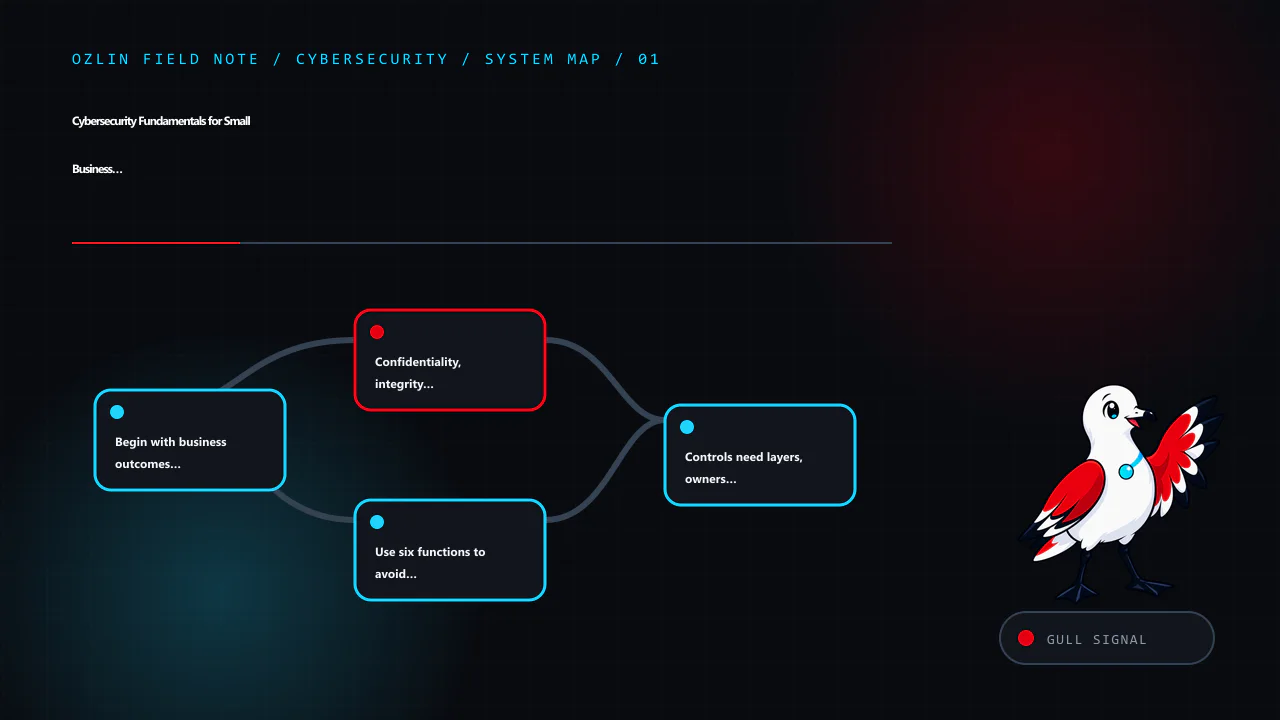
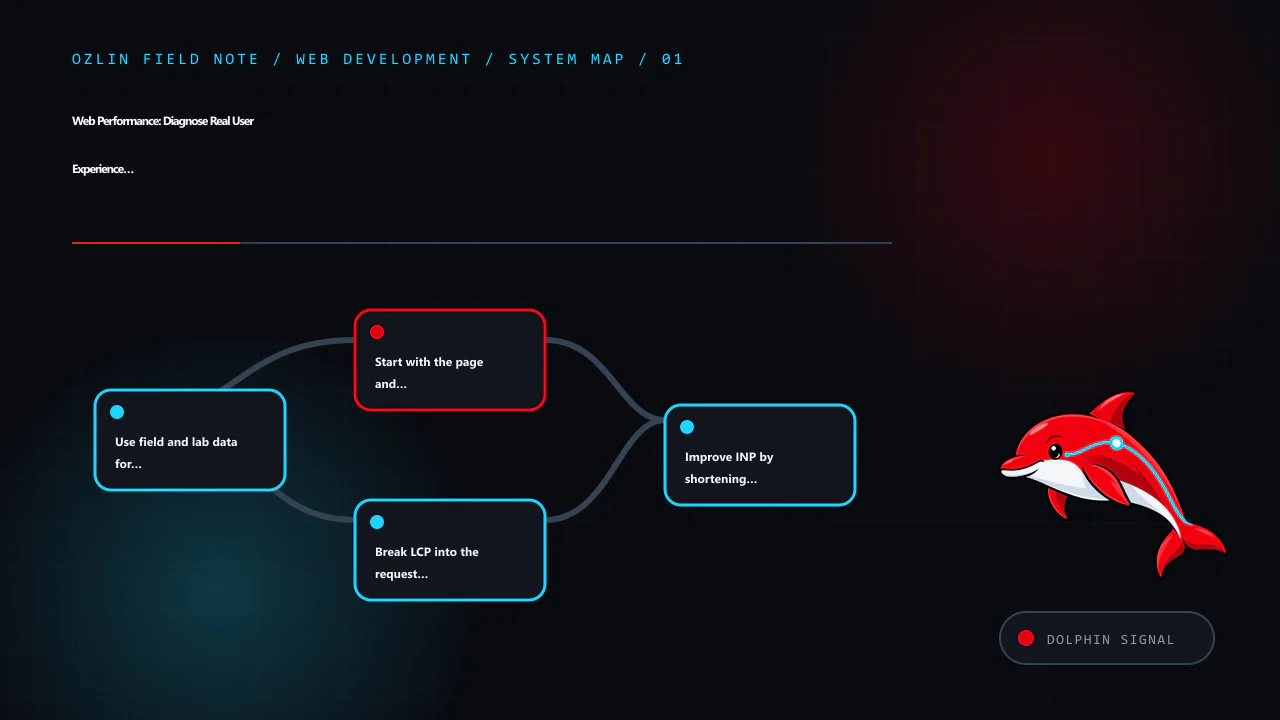
    Article map for Cybersecurity Fundamentals for Small Business Owners, covering Begin with business outcomes and risk, Confidentiality, integrity and availability, Use six functions to avoid prevention-only security and…
    Article map: Begin with business outcomes and risk; Confidentiality, integrity and availability; Use six functions to avoid prevention-only security; Controls need layers, owners and evidence.
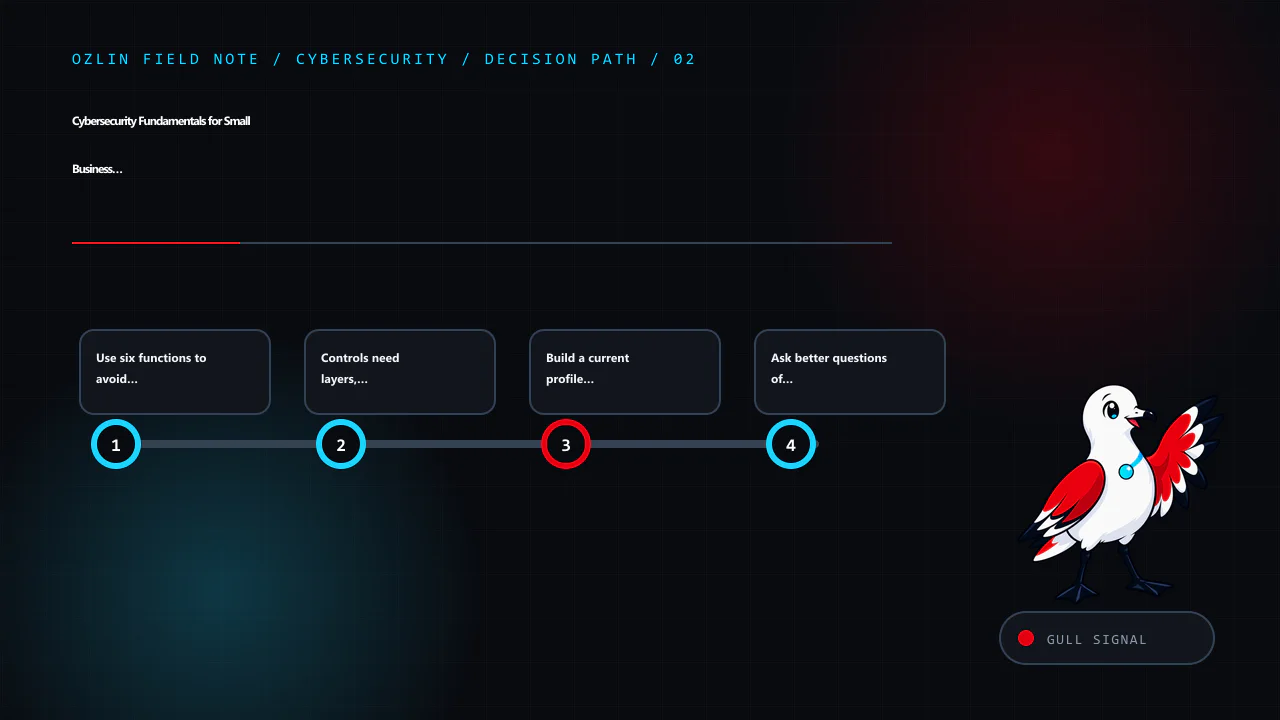
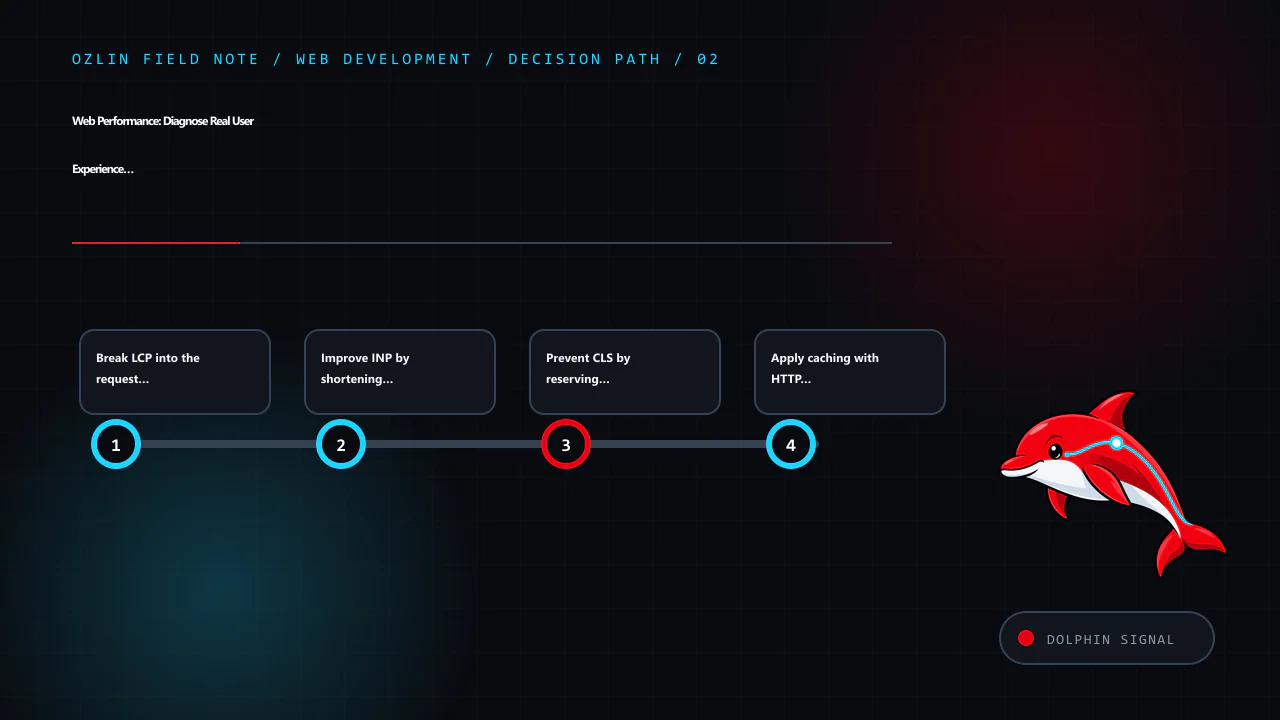
    Decision path for Cybersecurity Fundamentals for Small Business Owners, covering Use six functions to avoid prevention-only security, Controls need layers, owners and evidence, Build a current profile and a target profi…
    Decision path: Use six functions to avoid prevention-only security; Controls need layers, owners and evidence; Build a current profile and a target profile; Ask better questions of suppliers and security tools.
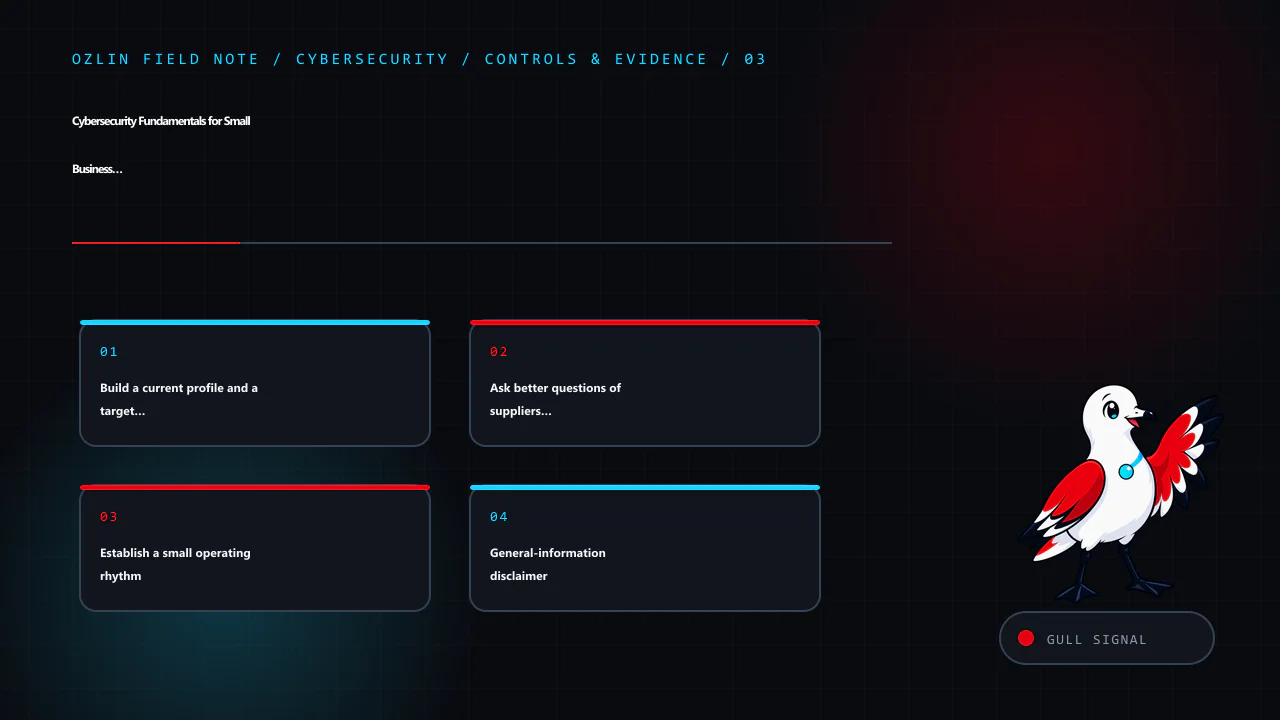
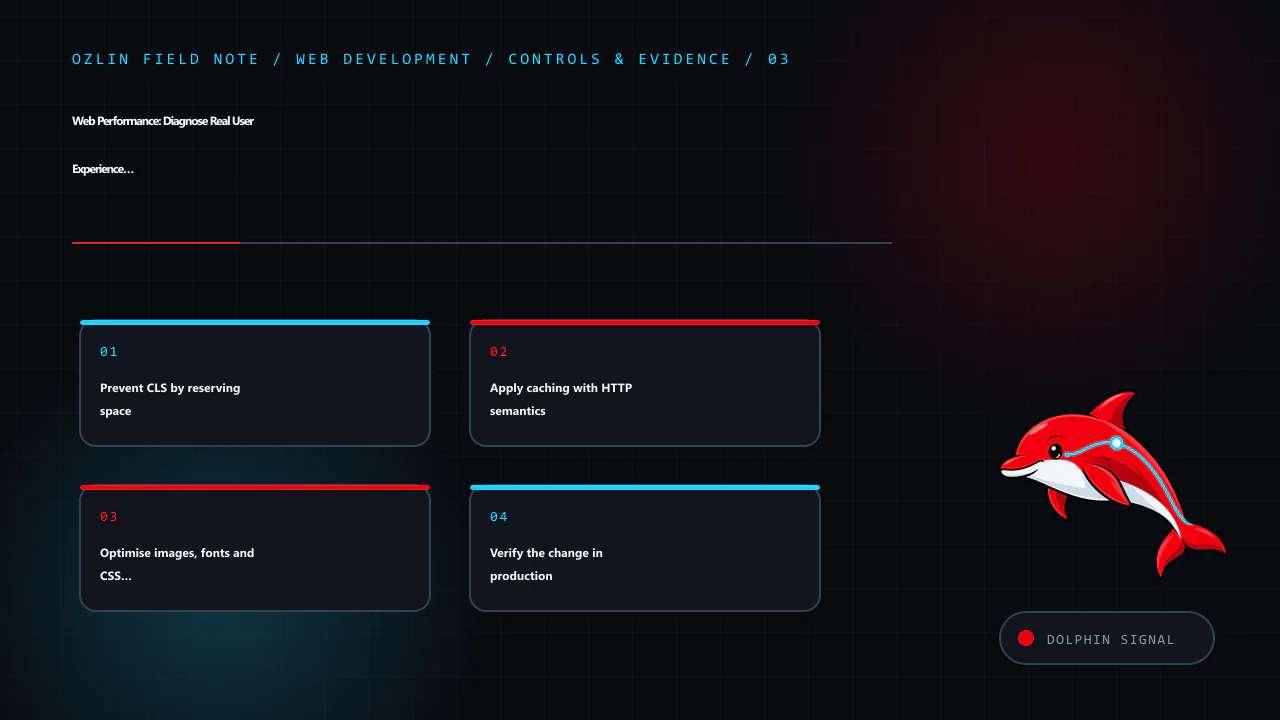
    Control and evidence map for Cybersecurity Fundamentals for Small Business Owners, covering Build a current profile and a target profile, Ask better questions of suppliers and security tools, Establish a small operating…
    Control and evidence map: Build a current profile and a target profile; Ask better questions of suppliers and security tools; Establish a small operating rhythm; General-information disclaimer.
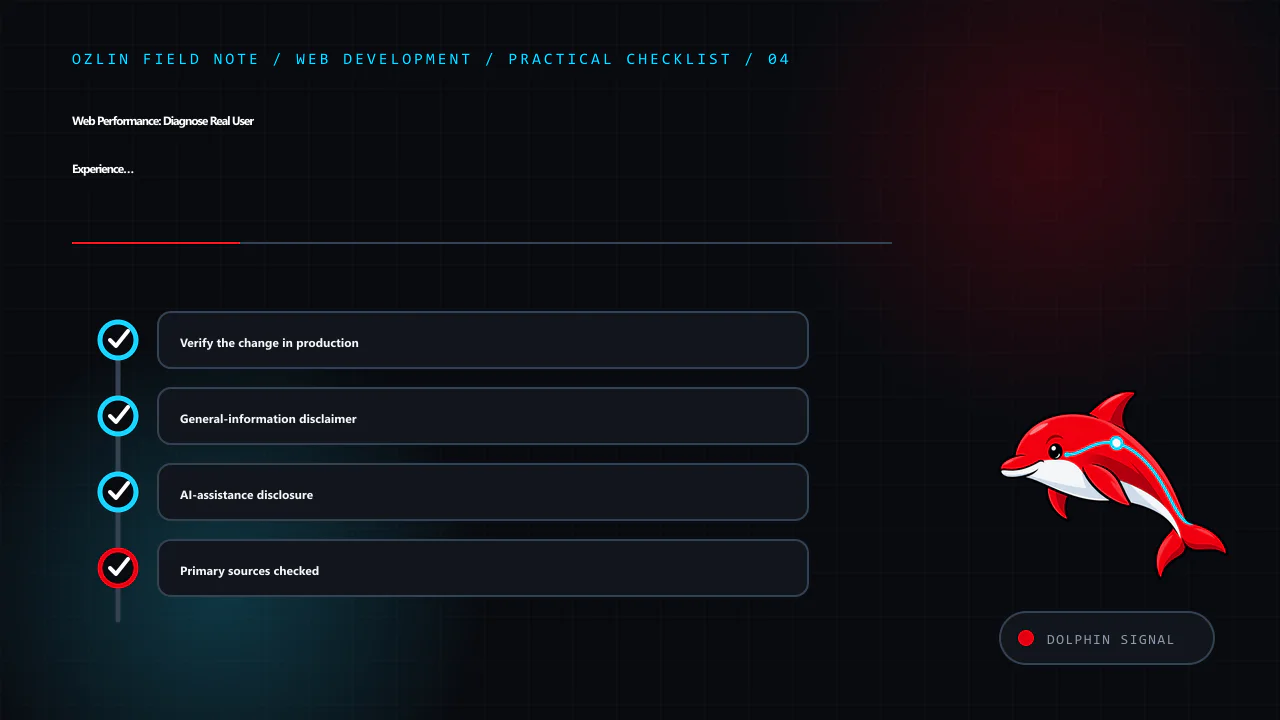
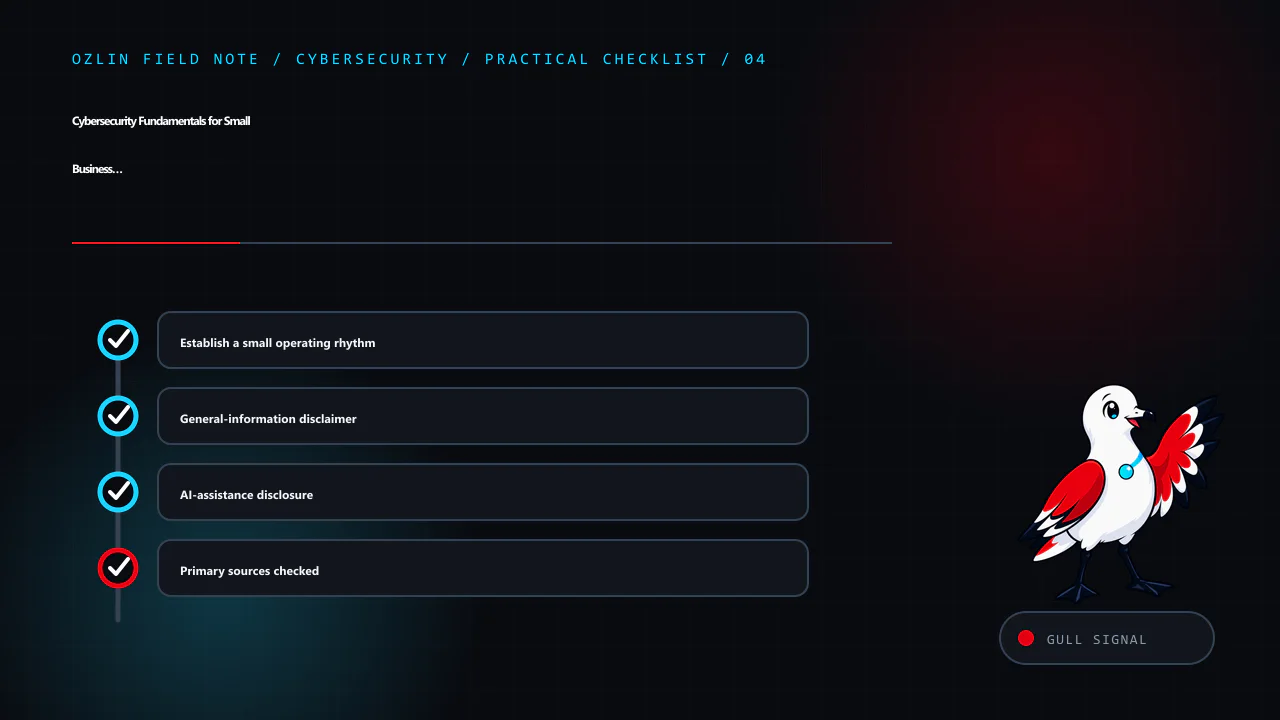
    Practical checklist for Cybersecurity Fundamentals for Small Business Owners, covering Establish a small operating rhythm, General-information disclaimer, AI-assistance disclosure and related review points.
    Practical checklist: Establish a small operating rhythm; General-information disclaimer; AI-assistance disclosure; Primary sources checked.
  • Neural Networks Explained: Gradients, Optimisers and Evaluation

    Neural Networks Explained: Gradients, Optimisers and Evaluation

    A neural network is a parameterised function. It transforms input features through layers of weighted operations and nonlinear activations, then produces an output such as a probability, numeric estimate, embedding or generated sequence. “Deep” learning usually means that the model contains multiple representation-building layers; it does not mean that the result is automatically intelligent, correct or suitable for production.

    The useful question is not whether a model sounds advanced. It is whether its inputs, target, evaluation and operating controls fit a defined decision or workflow.

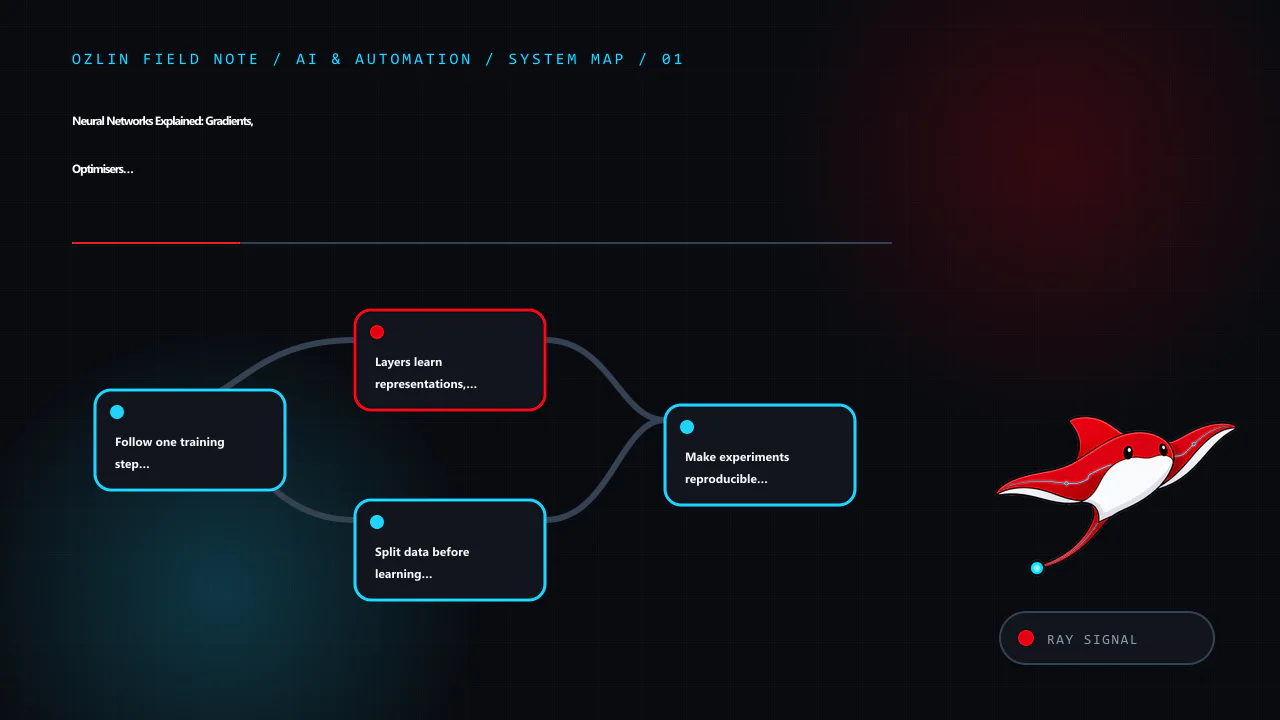
    Article map for Neural Networks Explained: Gradients, Optimisers and Evaluation, covering Follow one training step precisely, Layers learn representations, not explanations, Split data before learning from it and relate…
    Article map: Follow one training step precisely; Layers learn representations, not explanations; Split data before learning from it; Make experiments reproducible enough to investigate.

    Follow one training step precisely

    Training is easier to reason about when four operations are kept separate:

    1. Forward pass: the current parameters transform a batch of inputs into predictions.
    2. Loss calculation: a chosen loss function measures disagreement between predictions and the training target.
    3. Backpropagation or automatic differentiation: the system applies the chain rule through the recorded computation to calculate gradients of the loss with respect to parameters.
    4. Optimiser step: an algorithm such as stochastic gradient descent or Adam uses those gradients and its own state to update the parameters.

    Backpropagation does not select the learning rate and does not itself update weights. Conversely, an optimiser needs gradients but is not the mechanism that differentiates the model. PyTorch documents these responsibilities separately in its autograd mechanics and optimisation API.

    A simplified iteration looks like this:

    clear old gradients
    predictions = model(batch.features)
    loss = loss_function(predictions, batch.targets)
    compute gradients of loss
    optimiser updates parameters
    record metrics and diagnostics

    Frameworks may combine or reorder implementation details, use gradient accumulation, mixed precision or distributed execution, but the conceptual distinction remains important when debugging exploding gradients, stale accumulation or an unexpected update.

    Layers learn representations, not explanations

    A dense layer combines its inputs and parameters, while an activation such as ReLU introduces nonlinearity. Convolutional layers encode useful locality assumptions for grid-like data. Recurrent designs maintain a sequential state. Attention allows elements to condition on other elements and underpins modern transformer architectures.

    These are design biases, not proof that a model has learned the intended concept. A classifier may exploit a watermark, scanner type, postcode proxy or annotation habit instead of the phenomenon the team meant to model. Inspect slices, counterexamples and failure modes rather than treating a high aggregate score as an explanation.

    Start with the simplest credible baseline. A linear model, ruleset or manual workflow can expose whether a neural network creates enough additional value to justify its data, latency, operational and governance costs. Google’s current Machine Learning Crash Course places neural networks alongside data quality, generalisation, production systems and fairness rather than presenting architecture alone as the project.

    Split data before learning from it

    Use separate training, validation and test data, with the split designed around how the model will encounter the real world. Random row splits can leak information when records from the same customer, document, device or time period appear on both sides. For a future-facing forecast, use a temporal holdout. For a system expected to generalise to new organisations, consider holding out entire organisations.

    Any learned preprocessing—normalisation statistics, feature selection, vocabulary building, imputation or synthetic sampling—must be fitted using training data only. Duplicate and near-duplicate examples require deliberate handling. A test set repeatedly consulted during tuning is no longer an untouched final test.

    Choose metrics from the cost of errors. Accuracy can conceal failure on a rare but important class. Depending on the task, review precision, recall, false-positive and false-negative rates, calibration, ranking measures, latency and abstention behaviour. Report uncertainty and results for meaningful cohorts. Do not optimise one convenient metric while leaving the business decision undefined.

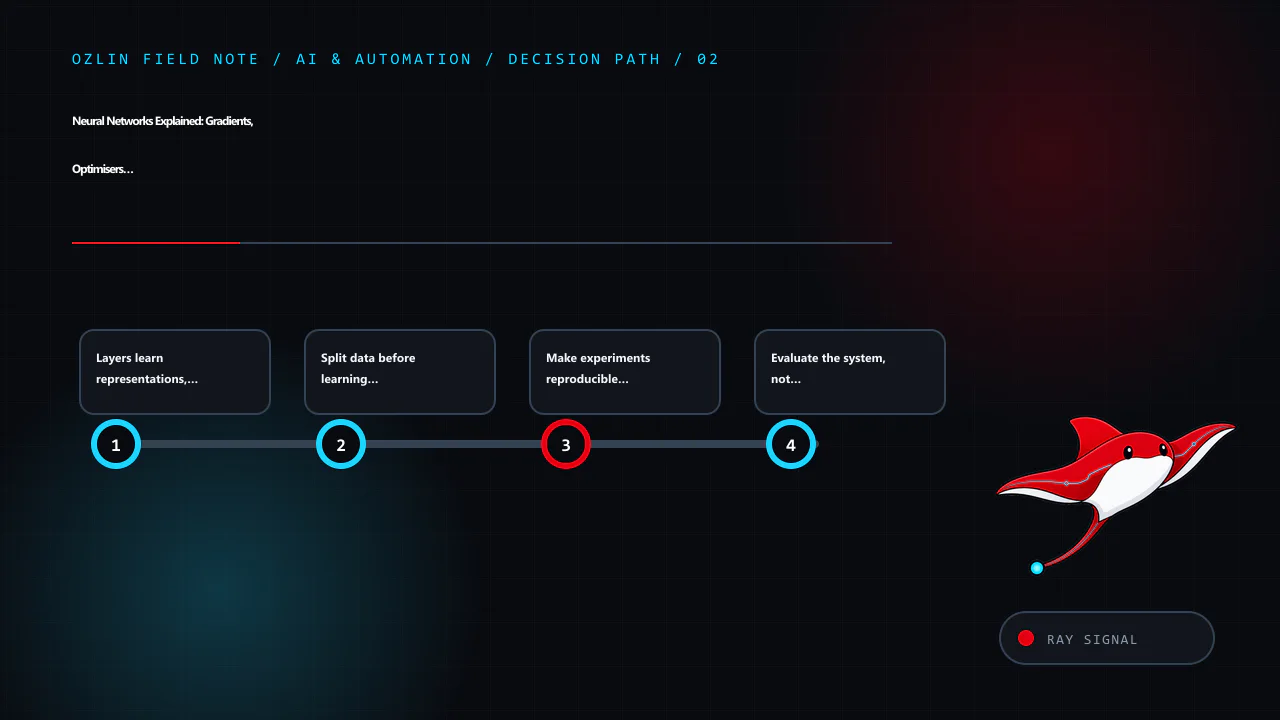
    Decision path for Neural Networks Explained: Gradients, Optimisers and Evaluation, covering Layers learn representations, not explanations, Split data before learning from it, Make experiments reproducible enough to inv…
    Decision path: Layers learn representations, not explanations; Split data before learning from it; Make experiments reproducible enough to investigate; Evaluate the system, not only the checkpoint.

    Make experiments reproducible enough to investigate

    Record the code revision, framework and library versions, data snapshot and query, preprocessing configuration, random seeds, model configuration, hardware, checkpoint and evaluation script. Reproducibility is not equivalent to typing one seed. Parallel execution and some hardware kernels can be nondeterministic, while deterministic alternatives can be slower.

    PyTorch explicitly warns that completely reproducible results are not guaranteed across releases, commits, platforms or CPU and GPU execution in its reproducibility notes. TensorFlow likewise documents the software, hardware, input-pipeline and random-state conditions around deterministic operations. Treat those settings as debugging and assurance tools, then measure their performance impact.

    Evaluate the system, not only the checkpoint

    A production model sits inside a larger system: collection, validation, feature computation, inference, human review, logging, fallback, appeal and retraining. Test malformed and missing inputs, out-of-distribution cases, dependency failures, timeouts, rollback and version compatibility. Define what the system must do when confidence is low or a required input is unavailable.

    Monitoring should cover input quality, operational health, outcome quality where ground truth eventually arrives, and effects on people. Drift is not automatically harmful, and a stable input distribution does not guarantee stable outcomes. Establish a named owner, review cadence, incident path and retirement condition.

    The voluntary NIST AI Risk Management Framework organises risk work around Govern, Map, Measure and Manage. Its emphasis on validity, reliability, transparency, privacy and harmful-bias management is a useful reminder that a model can be technically functional yet unsuitable in context.

    Choose tools after defining the constraints

    TensorFlow, PyTorch and other frameworks can all support serious work. Select on required operators, deployment target, team competence, maintenance horizon, observability and ecosystem compatibility—not an outdated claim that one framework is only for research and another only for production. Prototype the riskiest deployment path early and pin versions before a reproducible evaluation.

    Before release, require evidence for:

    • a documented task, user and unacceptable outcome;
    • a leakage-resistant data split and representative test set;
    • a baseline and decision-relevant metrics;
    • cohort and edge-case evaluation;
    • reproducible artefacts and dependency records;
    • privacy, security and access controls;
    • human review or safe fallback where consequences justify it; and
    • monitoring, rollback and accountable ownership.

    For help framing a responsible prototype or evaluation plan, see Ozlin Info’s AI and automation services or contact Ozlin Info.

    Related reading: Machine-learning paradigms and evaluation and reading an older PyTorch HMER project responsibly.


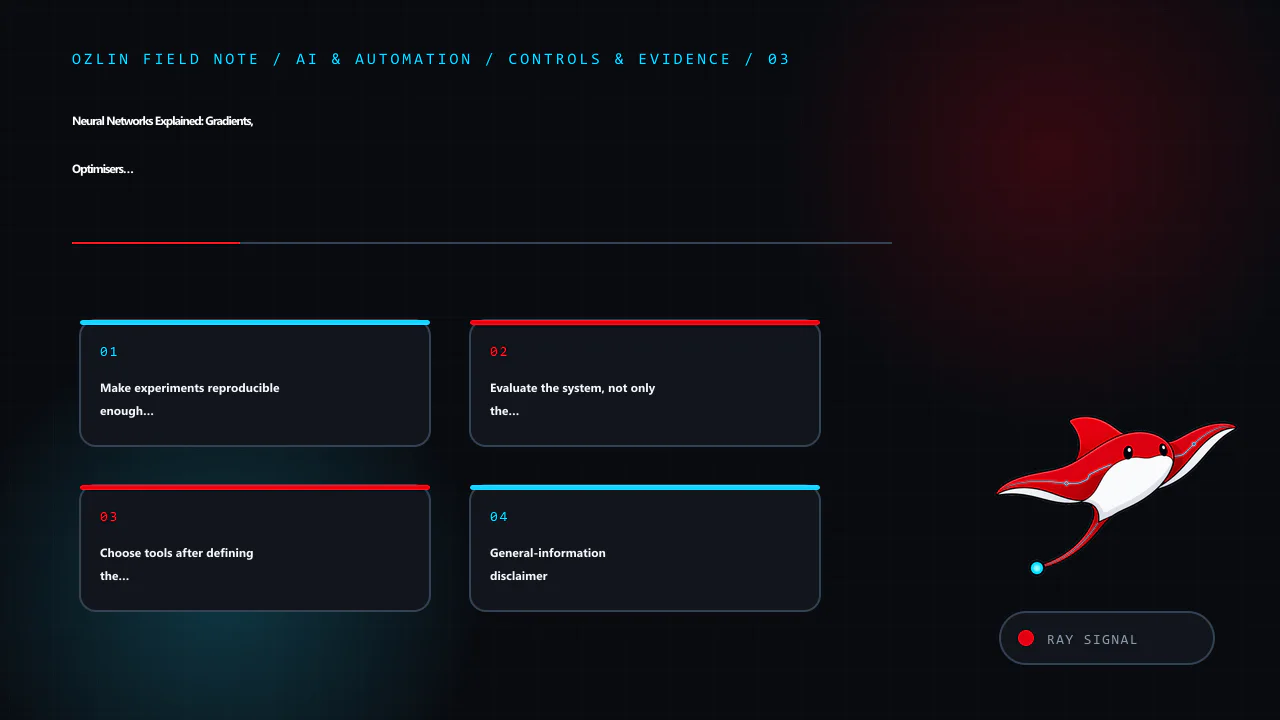
    Control and evidence map for Neural Networks Explained: Gradients, Optimisers and Evaluation, covering Make experiments reproducible enough to investigate, Evaluate the system, not only the checkpoint, Choose tools afte…
    Control and evidence map: Make experiments reproducible enough to investigate; Evaluate the system, not only the checkpoint; Choose tools after defining the constraints; General-information disclaimer.

    General-information disclaimer

    This article provides general technical information, not a guarantee of model accuracy, fairness, safety, regulatory compliance or business outcomes. Independent domain, privacy, legal, security and statistical review may be required for the actual use case.

    AI-assistance disclosure

    AI tools assisted with source discovery, outlining and copyediting. A human reviewer must verify the technical claims, examples, links and risk controls against the intended dataset, framework version and deployment context before publication or use.

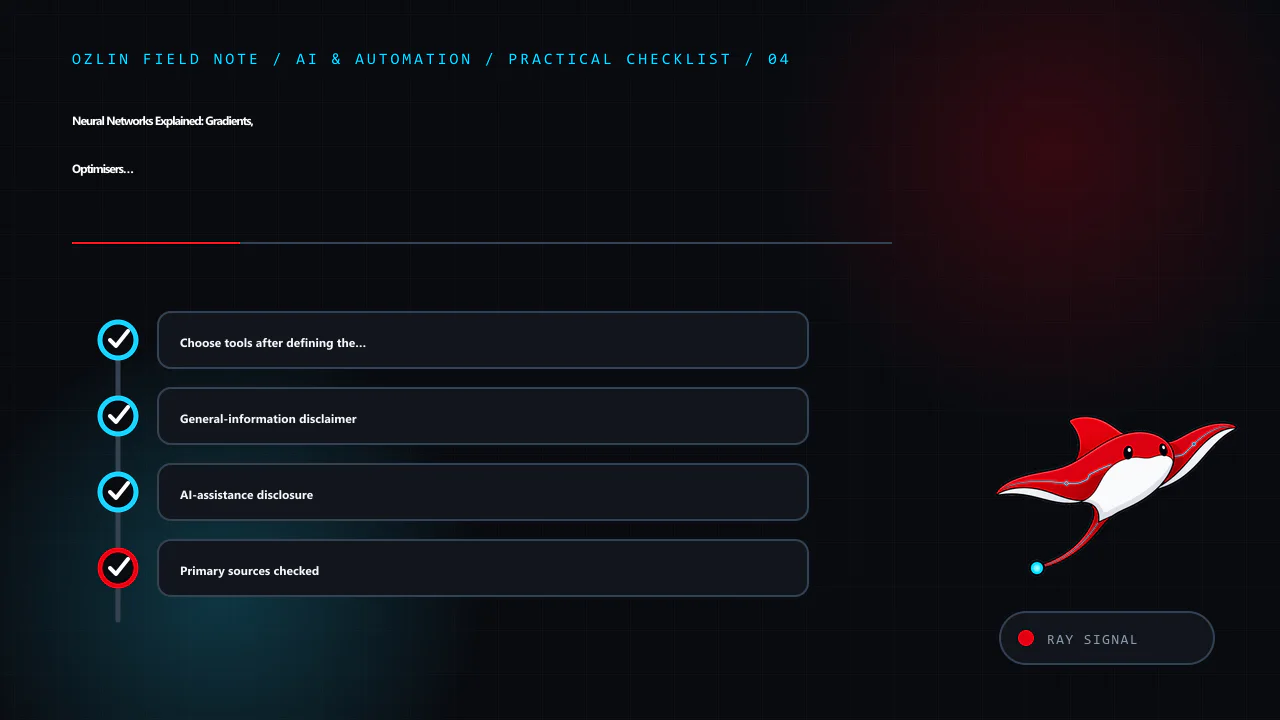
    Practical checklist for Neural Networks Explained: Gradients, Optimisers and Evaluation, covering Choose tools after defining the constraints, General-information disclaimer, AI-assistance disclosure and related review…
    Practical checklist: Choose tools after defining the constraints; General-information disclaimer; AI-assistance disclosure; Primary sources checked.

    Primary sources checked

    Source access date: 29 August 2026.
  • Supervised, Unsupervised and Other Machine-Learning Paradigms

    Supervised, Unsupervised and Other Machine-Learning Paradigms

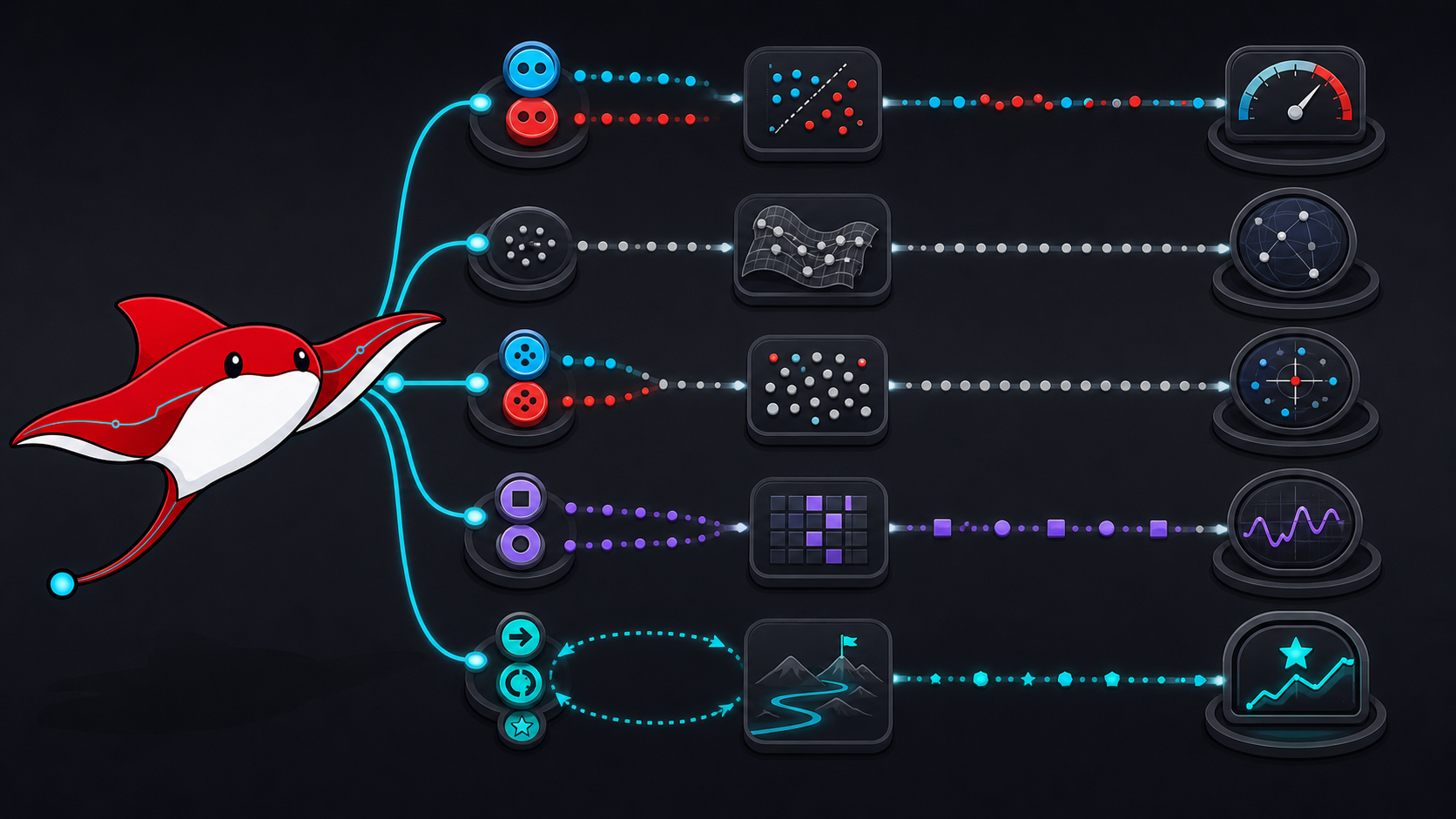
    “Supervised or unsupervised?” is a useful opening question, but it is not a complete project brief. The right learning setup depends on the decision to support, what feedback exists, when it arrives, what mistakes cost and how success can be evaluated on data the system did not learn from.

    Algorithms are also not permanently owned by one paradigm. The same neural architecture can be trained with labelled targets, a self-supervised objective or reinforcement feedback. Recommendation and anomaly-detection systems often combine several approaches. Start with the source of the learning signal rather than a list of fashionable model names.

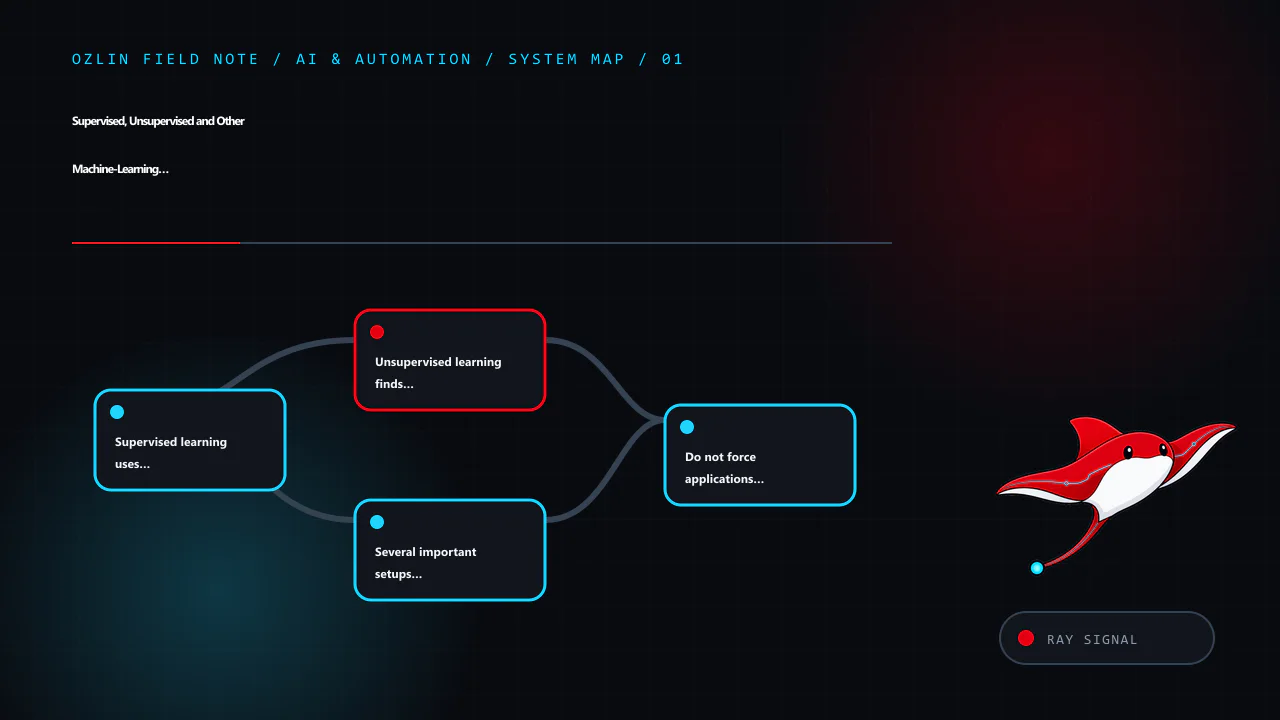
    Article map for Supervised, Unsupervised and Other Machine-Learning Paradigms, covering Supervised learning uses explicit targets, Unsupervised learning finds structure without target labels, Several important setups si…
    Article map: Supervised learning uses explicit targets; Unsupervised learning finds structure without target labels; Several important setups sit between or beyond the pair; Do not force applications into one bucket.

    Supervised learning uses explicit targets

    Supervised learning trains on examples containing input features and a target label or value. Classification predicts a category or probability; regression predicts a numeric quantity. Examples include identifying an invoice type, estimating delivery time or predicting whether a reviewed transaction belongs to a defined class.

    The target must represent the real decision. Historical labels can contain inconsistent human judgement, policy changes or outcomes produced by the old process. A model may faithfully reproduce those artefacts. Document who created each label, under which rules, and how disagreement and uncertainty are represented.

    Evaluation uses held-out labelled data and task-appropriate metrics. Accuracy is insufficient when classes are imbalanced or errors have asymmetric consequences. Depending on the decision, examine precision, recall, calibration, cost-weighted error, ranking quality and performance by meaningful cohort. Google’s introduction to supervised learning emphasises labelled examples, unseen data and generalisation.

    Unsupervised learning finds structure without target labels

    Unsupervised methods usually operate on unlabelled examples to identify patterns such as groups, lower-dimensional representations or unusual observations. Clustering can support exploration or segmentation, but a cluster is not automatically a real customer type. Results depend on representation, distance, scaling, algorithm and hyperparameters.

    Validate whether a discovered structure is stable and useful outside the training sample. Compare multiple seeds and plausible preprocessing choices, inspect examples with domain experts, and test whether the segmentation improves a downstream decision. An internal cohesion score cannot establish that the groups are fair, causal or commercially meaningful.

    Dimensionality-reduction visualisations require similar restraint. t-SNE was introduced as a method for visualising high-dimensional data; it is not a clustering algorithm, and apparent gaps in a two-dimensional plot are not proof of natural classes. The original t-SNE paper explains its local similarity objective and limitations.

    Several important setups sit between or beyond the pair

    Semi-supervised learning combines a smaller labelled set with a larger unlabelled set. It can reduce labelling demand when the unlabelled data resembles the intended operating distribution, but poor pseudo-labels or a distribution mismatch can reinforce errors.

    Self-supervised learning creates a training signal from the data itself—for example, predicting masked content or contrasting related views—then adapts the learned representation to a downstream task. It still needs careful downstream evaluation; a useful pretraining objective does not guarantee appropriate behaviour in the final context.

    Reinforcement learning learns a policy through interaction, observations, actions and reward. It is not simply supervised learning with delayed labels. Reward design, exploration, environment fidelity, safety constraints and off-policy evaluation can dominate the project. Sutton and Barto’s Reinforcement Learning: An Introduction provides the primary textbook treatment.

    Active learning asks which examples should be labelled next. It can focus limited expert time but must account for sampling bias and the true cost of obtaining a reliable label.

    The current Google machine-learning glossary distinguishes labelled, unlabelled, semi-supervised and unsupervised examples. Use these terms to describe the training signal, not to imply a quality ranking.

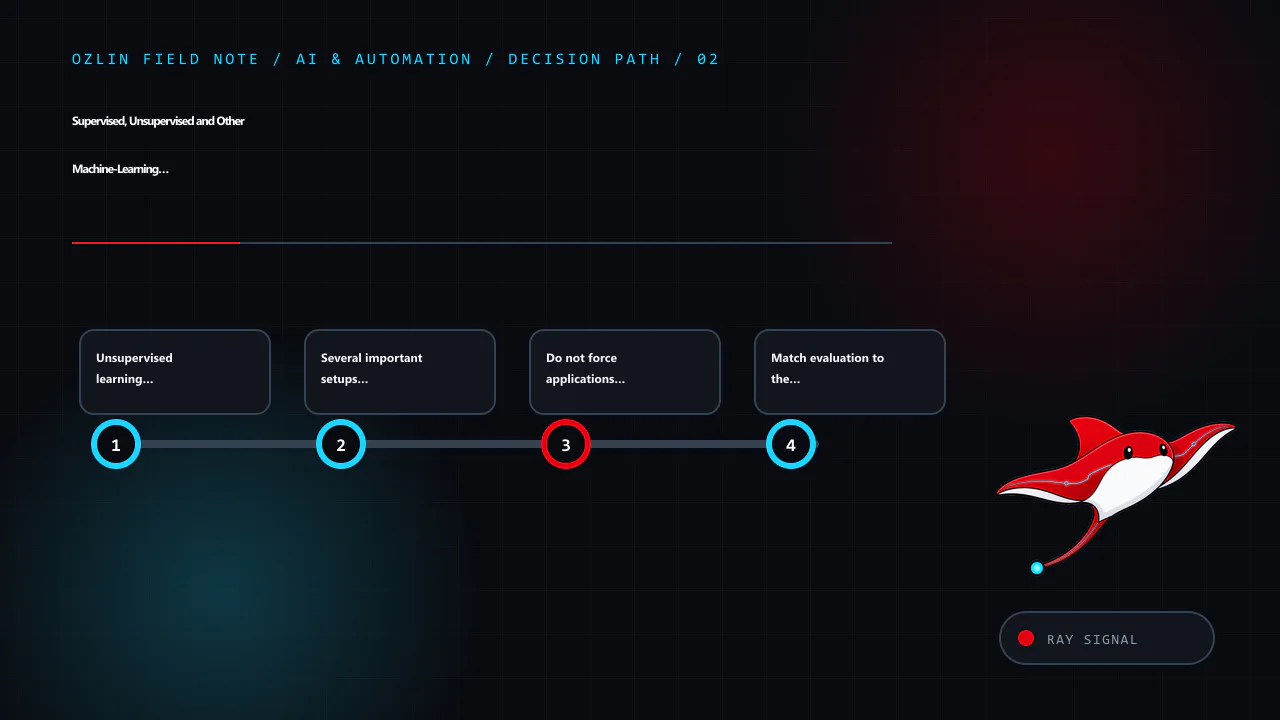
    Decision path for Supervised, Unsupervised and Other Machine-Learning Paradigms, covering Unsupervised learning finds structure without target labels, Several important setups sit between or beyond the pair, Do not forc…
    Decision path: Unsupervised learning finds structure without target labels; Several important setups sit between or beyond the pair; Do not force applications into one bucket; Match evaluation to the learning signal.

    Do not force applications into one bucket

    An autoencoder learns to reconstruct or otherwise represent its input. It may contribute an anomaly score, but the score still needs a threshold, representative validation cases and an operational response. Reconstruction error alone does not prove fraud, intrusion or equipment failure.

    A recommender might use supervised ranking from observed outcomes, self-supervised representations, collaborative signals, content features, contextual bandits or business rules. The important questions are which feedback is observed, which is missing, how exposure biases the data, and whether the evaluation captures user and business effects.

    Likewise, “anomaly” can mean a rare statistical point, a rule violation or a high-cost event. A rare point may be legitimate; a harmful event may look common in the available features. Define the review action and tolerated alert burden before selecting an outlier method.

    Match evaluation to the learning signal

    Learning setup Typical evidence Evaluation warning
    Supervised held-out labelled outcomes labels may leak, drift or encode the old policy
    Unsupervised stability, domain review, downstream utility internal cluster scores do not prove real-world meaning
    Semi-supervised labelled holdout plus ablation against labelled-only baseline pseudo-labels can amplify early mistakes
    Self-supervised downstream task performance and transfer tests pretraining loss is not the business metric
    Reinforcement learning policy value, safety limits and online or simulator evidence an exploitable reward can produce the wrong behaviour

    Create train, validation and final test boundaries before feature engineering. Group related records so the same customer, device, document family or future information cannot appear across the boundary. Compare against a simple baseline and include the human or rules-based process where relevant.

    For consequential uses, evaluation also needs privacy, security, fairness, transparency and human-oversight criteria. The voluntary NIST AI Risk Management Framework calls for business context to be mapped, methods and metrics to be documented, and systems to be tested before deployment and monitored afterwards.

    A practical selection sequence

    1. Write the decision, user and unacceptable outcome.
    2. Define the unit of prediction or analysis and when the output is needed.
    3. Inventory available features, labels, feedback delays and collection rights.
    4. Choose the simplest baseline that can be evaluated honestly.
    5. Design a leakage-resistant split and decision-relevant metrics.
    6. Prototype the data and review workflow before scaling the model.
    7. Record limits, owners, monitoring and a safe fallback.

    For help framing an ML pilot or evidence plan, see Ozlin Info’s AI and automation services or contact Ozlin Info.

    Related reading: Neural networks, gradients and evaluation and a transparent AI document-processing ROI example.


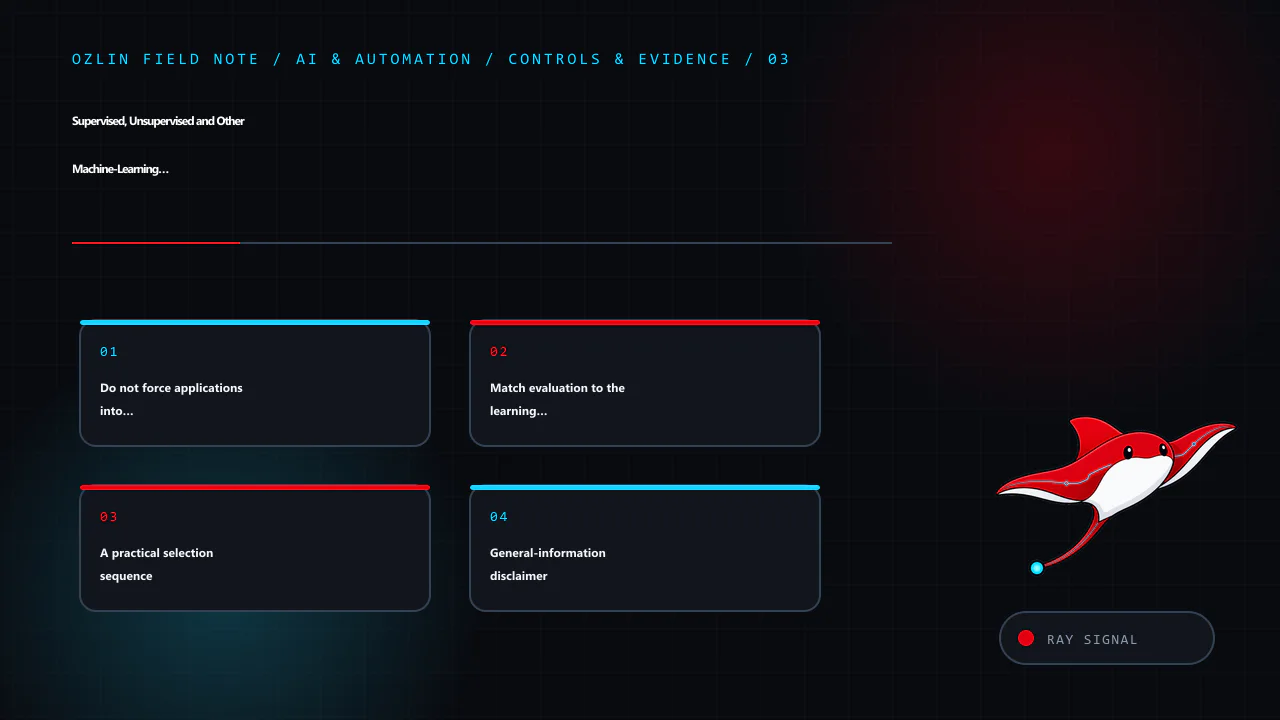
    Control and evidence map for Supervised, Unsupervised and Other Machine-Learning Paradigms, covering Do not force applications into one bucket, Match evaluation to the learning signal, A practical selection sequence and…
    Control and evidence map: Do not force applications into one bucket; Match evaluation to the learning signal; A practical selection sequence; General-information disclaimer.

    General-information disclaimer

    This article provides general technical information, not a guarantee of model accuracy, fairness, safety, regulatory compliance or return on investment. Validate the learning setup and evidence requirements for the actual data, decision and affected people.

    AI-assistance disclosure

    AI tools assisted with source discovery, outlining and copyediting. A human reviewer must verify the terminology, links, evaluation design and risk controls against the intended use case before publication or use.

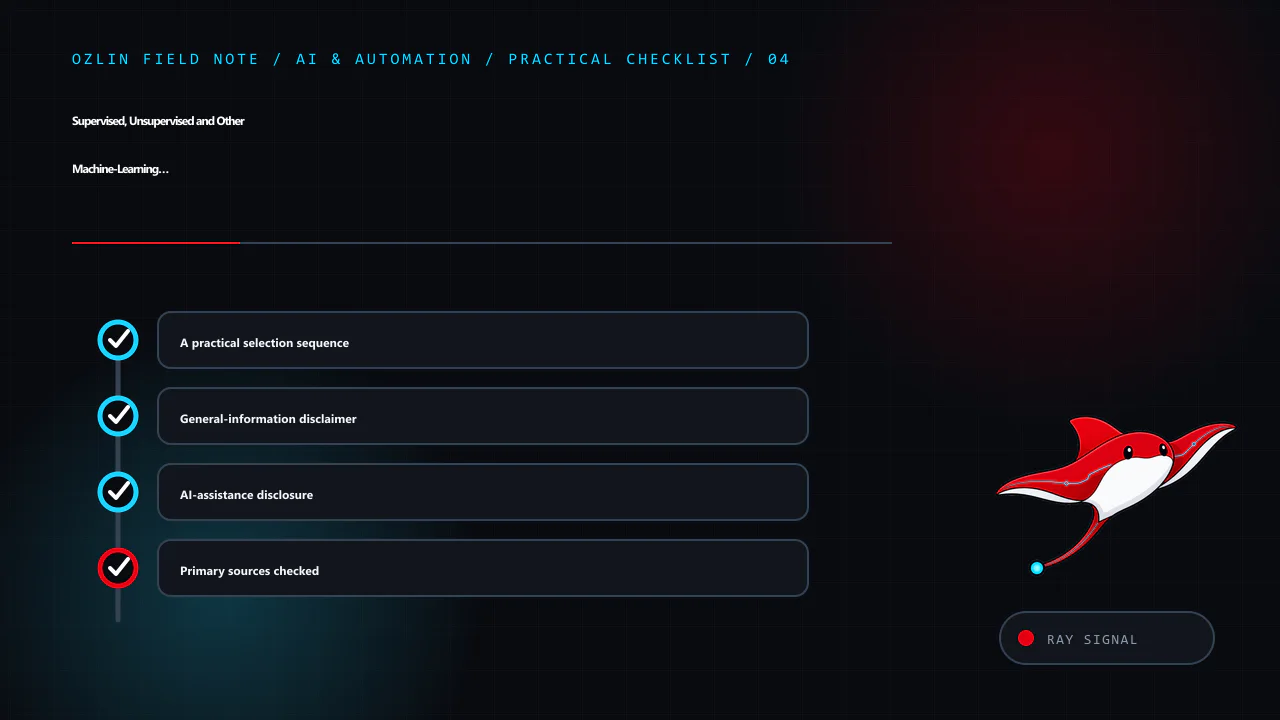
    Practical checklist for Supervised, Unsupervised and Other Machine-Learning Paradigms, covering A practical selection sequence, General-information disclaimer, AI-assistance disclosure and related review points.
    Practical checklist: A practical selection sequence; General-information disclaimer; AI-assistance disclosure; Primary sources checked.

    Primary sources checked

    Source access date: 29 August 2026.
  • Web Accessibility with WCAG 2.2: A Practical Delivery Guide

    Web Accessibility with WCAG 2.2: A Practical Delivery Guide

    Reviewed: 13 September 2026 · Next review: 13 December 2026
    Author: Ozlin Info Editorial Team · Human review: Lin (accountable human); Codex assisted

    Reviewed: 29 August 2026 · Next review: 28 February 2027
    Author: Ozlin Info Editorial Team · Human review: Lin

    Web accessibility is the practice of making digital content and functionality usable by people with a wide range of disabilities, technologies and situations. It is not a final audit checkbox. Decisions made in research, content, visual design, component design, development, procurement and maintenance all affect whether people can complete a task.

    The current W3C Recommendation is Web Content Accessibility Guidelines (WCAG) 2.2. WCAG is organised around four principles: content must be perceivable, operable, understandable and robust. A Level AA conformance claim requires every applicable Level A and Level AA success criterion to be satisfied for the full pages in scope—not an average score across selected checks (W3C — WCAG 2.2).

    WCAG is a technical standard, not a complete description of every person's experience and not, by itself, a legal opinion. An organisation should separately determine which laws, procurement rules, contracts or policies apply to its website.

    Define scope and target before changing components

    Begin with the service people need to use. Record:

    • the pages, templates, states, documents and third-party journeys in scope;
    • target users, assistive technologies and supported browsers;
    • the intended WCAG version and conformance level;
    • critical tasks such as finding information, purchasing, registering or contacting support;
    • who owns design, code, content and external widgets; and
    • how defects will be prioritised, accepted and retested.

    For a new or substantially redesigned business site, WCAG 2.2 Level AA is a sensible engineering target. It includes the earlier WCAG 2.1 criteria and adds requirements such as focus not being obscured, alternatives to dragging, minimum target size, consistent help, avoiding unnecessary repeated entry and accessible authentication. WCAG 2.2 removed the obsolete 4.1.1 Parsing criterion, although a contract or policy that explicitly names an earlier WCAG version may still require separate reporting (W3C — What's New in WCAG 2.2).

    Do not publish “WCAG compliant” based only on a home-page scanner. A formal claim has specific scope and documentation requirements, and third-party content can affect the outcome.

    Prefer native, semantic HTML

    Native elements carry established keyboard and accessibility behaviour. Use a real <button> for an action, an <a href> for navigation, labelled form controls, ordered heading levels and landmarks such as header, nav, main and footer. Add ARIA only where native HTML cannot express the required name, role, state or relationship.

    A styled div with a click handler does not automatically gain button semantics, keyboard activation, focus behaviour or disabled state. Recreating these features increases code and test burden. If a custom widget is necessary, follow the appropriate WAI-ARIA Authoring Practices pattern and test the implemented behaviour; adding a role alone does not make it accessible.

    Content also needs structure and meaning:

    • give each page a descriptive title and one clear primary heading;
    • write link text that makes sense in context;
    • provide useful alternative text for informative images and empty alt text for decorative images;
    • provide captions for prerecorded video and an appropriate transcript for audio information;
    • identify the page language and language changes; and
    • present instructions and errors in text, not colour or position alone.

    Alternative text should communicate the image's purpose in that context. It is not a keyword field and does not need to describe every visible detail.

    Design for more than one way to interact

    Every interactive task should work without a mouse. Test forward and reverse keyboard navigation, logical focus order, visible focus, modal entry and exit, menus, disclosures, validation and any custom control. Focus must not be trapped or hidden behind sticky headers, cookie banners or other author-created content.

    Colour contrast matters, but colour is only one part of perceivability. Check text, controls, focus indicators and meaningful graphical objects against the applicable criterion. Do not use colour alone to communicate an error, status or selection.

    Responsive layouts must remain usable when people enlarge text or zoom. Check narrow viewports and 400% zoom for lost content, overlapping controls and two-dimensional scrolling where the criterion does not permit it. Fixed-height cards and clipped navigation often fail before the colour palette does.

    Authentication deserves particular attention. WCAG 2.2's Accessible Authentication criterion limits cognitive function tests such as memorising or transcribing information unless an alternative or assistance is available. Support password managers and paste; do not block them in the name of security without a carefully assessed reason.

    Make forms understandable and recoverable

    Each control needs a programmatically associated, visible label. Group related radio buttons or checkboxes with fieldset and legend when appropriate. Explain required formats before they are needed and identify required fields without relying on colour alone.

    When validation fails:

    1. retain safe values the user already entered;
    2. provide a clear summary and field-specific message;
    3. associate the error with its field;
    4. move or manage focus deliberately so the error is discoverable; and
    5. tell the user how to correct it.

    For an asynchronous submission, expose the result as a programmatically determinable status message. Do not unexpectedly move focus for every small update.

    Combine tools with human evaluation

    Automated tools are useful for repeatable checks such as missing accessible names, some contrast failures and certain invalid relationships. They cannot reliably judge whether alternative text is meaningful, focus order follows the task, instructions make sense or a screen-reader experience is coherent. W3C explicitly says no tool alone can determine whether a site meets accessibility guidelines (W3C — Introduction to Web Accessibility).

    A practical test set includes:

    Method What it can reveal
    Automated rules in CI Repeatable detectable regressions across known templates
    Keyboard-only walkthrough Reachability, order, traps, focus visibility and operability
    Zoom and reflow checks Clipping, overlap, loss of content and excessive scrolling
    Screen-reader checks Names, roles, headings, landmarks, reading order, status and errors
    High-contrast or forced-colour checks Information lost when authored colours are overridden
    Content review Heading logic, link purpose, instructions, captions and alternatives
    Disabled-user evaluation Barriers, workarounds and priorities that technical inspection can miss

    Test representative pages and every distinct component or state, not just URLs selected at random. Include errors, empty results, loading, authentication, session expiry and third-party flows. W3C's Easy Checks are a useful first review but are explicitly not exhaustive (W3C — Easy Checks).

    Keep an evidence-based remediation backlog

    Record each finding with the affected task, URL or component, WCAG criterion, reproducible steps, observed and expected behaviour, severity, owner, target release and retest evidence. Prioritise barriers that block critical tasks, affect many pages or create safety, privacy or financial consequences.

    Reusable components create leverage: correcting a shared navigation, dialog, form field or error summary can remove the same barrier across many pages. Add a regression test where automation is reliable, but retain manual checks in the definition of done.

    An accessibility statement should be accurate about scope, known limitations and contact paths. It should not claim perfection or replace a working way for people to report a barrier. Give accessibility reports an owner and response process.

    Treat accessibility as ongoing quality

    Content edits, plugin updates, third-party scripts and new features can reintroduce barriers. Review accessibility during discovery and design, test components before release, run automated rules in continuous integration and schedule periodic task-based evaluation. Train the people who publish content as well as the developers who build templates.

    For help reviewing a website workflow, component library or remediation backlog, see Ozlin Info's web development services or contact Ozlin Info.

    Related reading: 10 WordPress performance checks before optimisation.


    General-information disclaimer

    This article provides general technical information only. It is not legal, regulatory, procurement or accessibility-conformance advice. A conformance claim requires evaluation of the complete defined scope against the relevant standard and may require qualified legal or accessibility advice.

    AI-assistance disclosure

    AI tools assisted with source discovery, outlining and copyediting. A human reviewer must verify every technical statement, link, service claim and publication decision before release. Automated or AI-assisted checks do not prove accessibility or WCAG conformance.

    Primary sources checked

    Source access date: 29 August 2026.
    nn
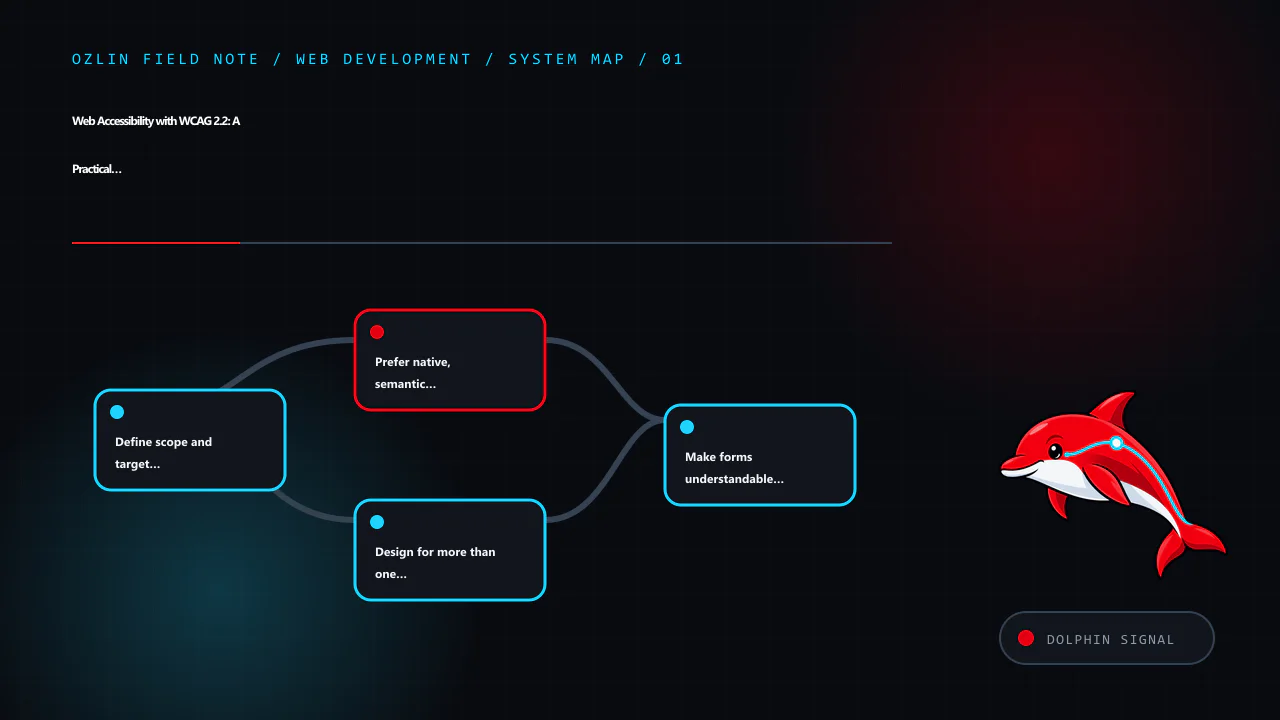
    Article map for Web Accessibility with WCAG 2.2: A Practical Delivery Guide, covering Define scope and target before changing components, Prefer native, semantic HTML, Design for more than one way to interact and relate…
    Article map: Define scope and target before changing components; Prefer native, semantic HTML; Design for more than one way to interact; Make forms understandable and recoverable.
    n
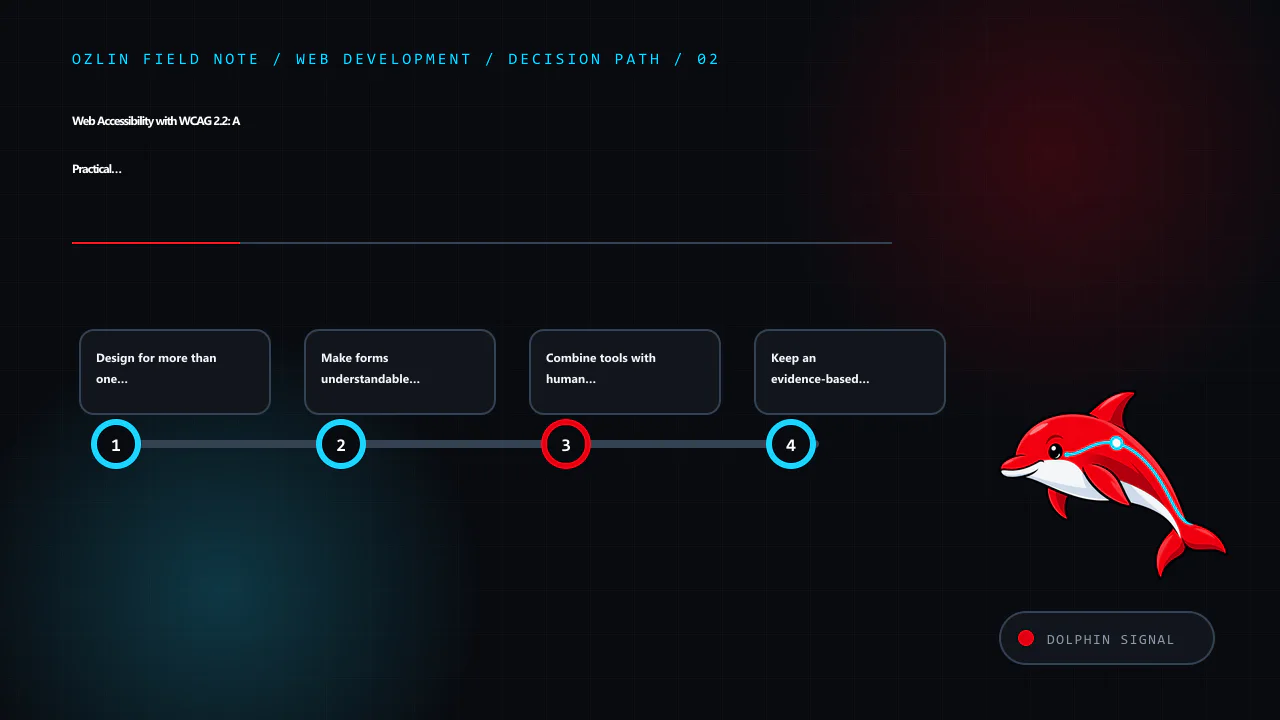
    Decision path for Web Accessibility with WCAG 2.2: A Practical Delivery Guide, covering Design for more than one way to interact, Make forms understandable and recoverable, Combine tools with human evaluation and relate…
    Decision path: Design for more than one way to interact; Make forms understandable and recoverable; Combine tools with human evaluation; Keep an evidence-based remediation backlog.
    n
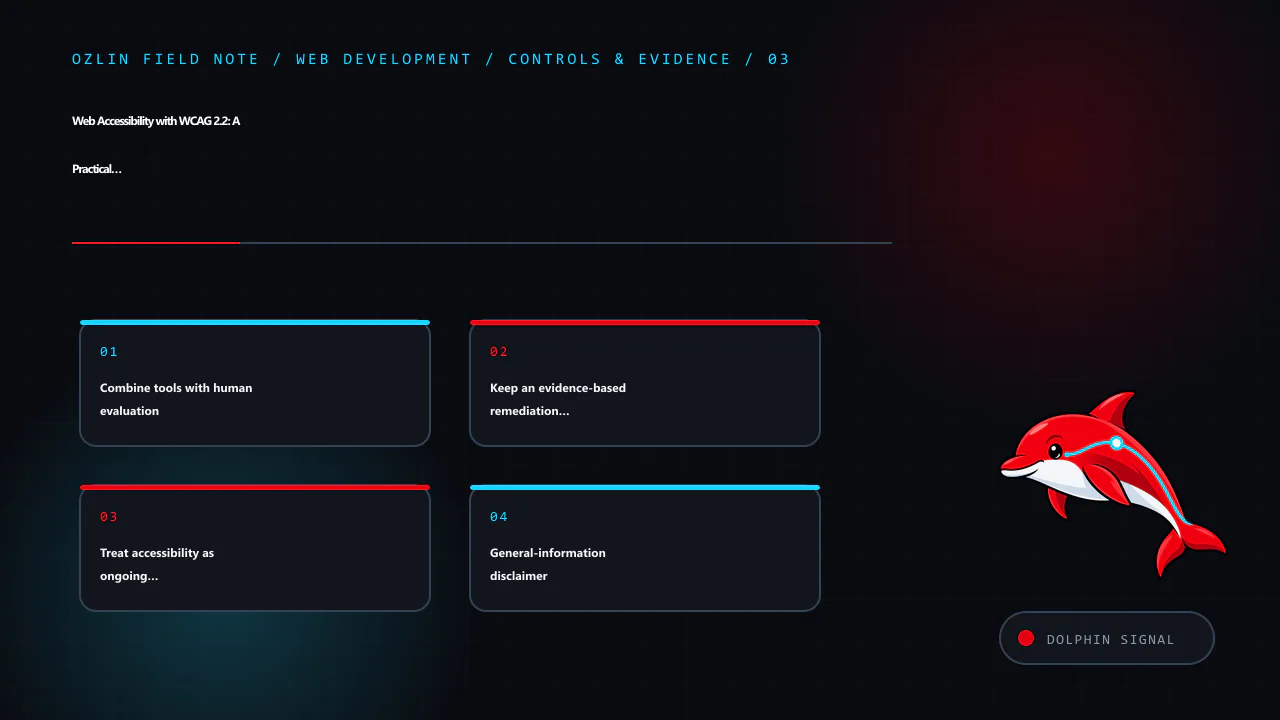
    Control and evidence map for Web Accessibility with WCAG 2.2: A Practical Delivery Guide, covering Combine tools with human evaluation, Keep an evidence-based remediation backlog, Treat accessibility as ongoing quality…
    Control and evidence map: Combine tools with human evaluation; Keep an evidence-based remediation backlog; Treat accessibility as ongoing quality; General-information disclaimer.
    n
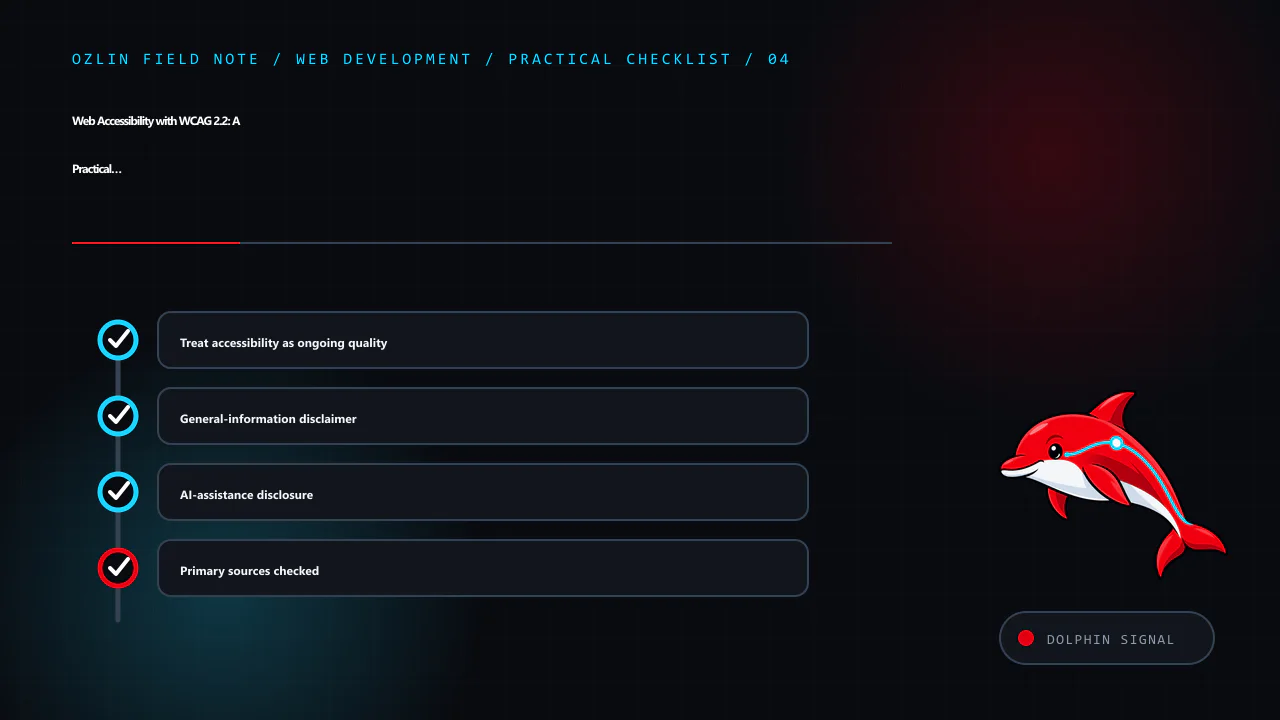
    Practical checklist for Web Accessibility with WCAG 2.2: A Practical Delivery Guide, covering Treat accessibility as ongoing quality, General-information disclaimer, AI-assistance disclosure and related review points.
    Practical checklist: Treat accessibility as ongoing quality; General-information disclaimer; AI-assistance disclosure; Primary sources checked.

    Limitations: Accessibility conformance depends on the defined scope, user journeys, assistive technologies and testing; this is not a conformance claim or legal advice.

  • Testing Web Applications: A Risk-Based Strategy That Scales

    Testing Web Applications: A Risk-Based Strategy That Scales

    A useful web test suite is not the largest collection of tests. It is a feedback system that tells a team whether an important behaviour still works, where a failure is likely to be and whether a change is safe enough to release.

    The right mix depends on the product's risks. A brochure site, an internal dashboard and a payment workflow should not receive identical automation. Start with business-critical tasks, failure consequences and architectural boundaries; then choose the cheapest test that provides credible evidence.

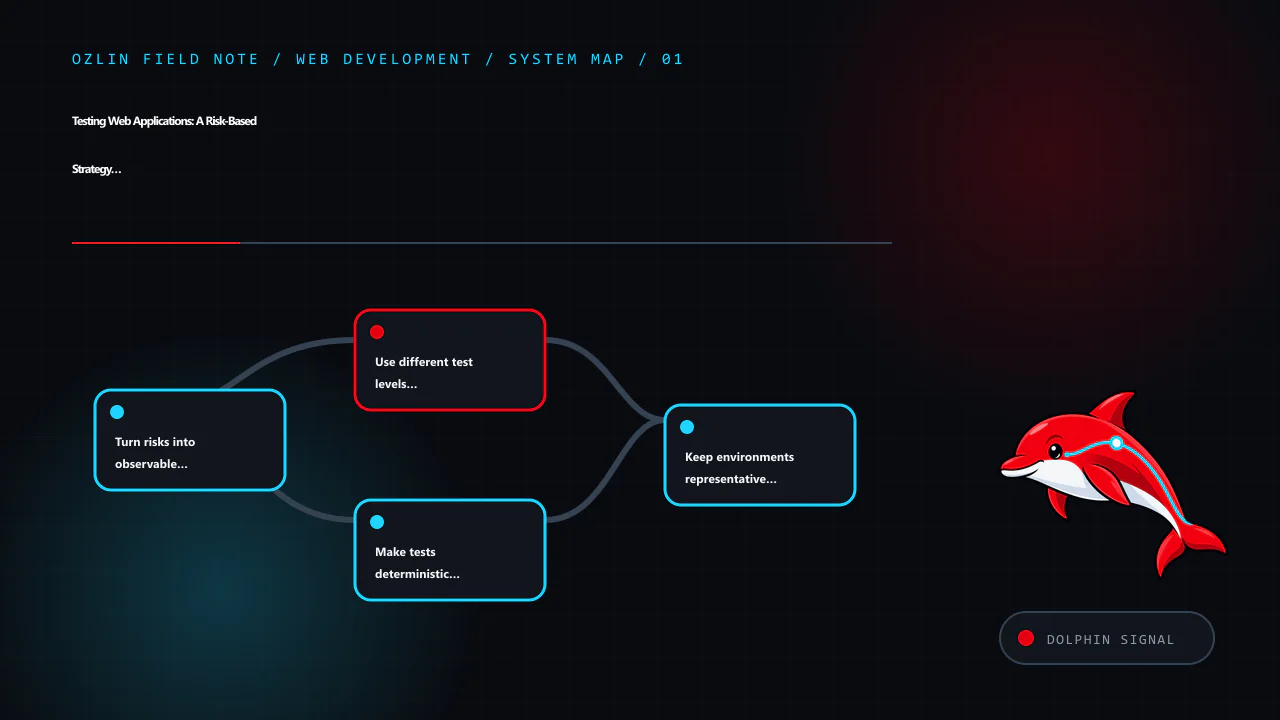
    Article map for Testing Web Applications: A Risk-Based Strategy That Scales, covering Turn risks into observable behaviours, Use different test levels for different questions, Make tests deterministic before adding retr…
    Article map: Turn risks into observable behaviours; Use different test levels for different questions; Make tests deterministic before adding retries; Keep environments representative without copying production….

    Turn risks into observable behaviours

    Before choosing a framework, list what must remain true. Examples include:

    • a visitor can submit a valid enquiry and receives an understandable result;
    • invalid input cannot bypass server-side validation;
    • an authorised user can see a record while an unauthorised user cannot;
    • an order total uses the intended tax and discount rules;
    • a third-party outage produces a controlled response rather than duplicate work;
    • keyboard users can complete the critical journey; and
    • monitoring receives enough context to investigate a production failure.

    Write tests around these behaviours and interfaces, not private implementation details. If a harmless refactor breaks dozens of tests without changing user-visible behaviour, the suite is probably coupled to the code rather than protecting the product.

    A simple risk register helps decide depth:

    Risk Consequence Useful evidence
    Price calculation is wrong Financial loss and customer dispute Unit tests with boundary and property cases; integration against stored rules
    Login is unavailable Users cannot enter the service Service integration, browser smoke journey and availability monitoring
    Role check is bypassed Confidentiality or integrity impact Server-side authorisation tests, negative cases and security review
    Form changes silently break analytics Decision data becomes incomplete Contract or integration check for the event schema
    External API retries duplicate an action Duplicate charge or record Integration test with controlled failures and idempotency evidence

    Use different test levels for different questions

    Unit tests protect deterministic logic

    Unit tests are best for small decisions with controlled inputs: parsing, calculations, validation rules, state transitions and permission policies. They should be fast, deterministic and able to run without browsers, networks or shared databases.

    Test useful partitions and boundaries rather than every line. For a date rule, include values before, at and after the boundary. For a reducer, cover valid transitions and rejected transitions. Code coverage can reveal unexecuted areas, but a percentage does not prove that assertions are meaningful. Vitest, for example, can collect V8 or Istanbul coverage; the team still has to decide which behaviours and branches matter (Vitest — Coverage).

    Mock narrow, unstable boundaries such as a clock or remote client. Excessive mocking can create a fictional system in which every collaborator behaves exactly as the test assumes.

    Component tests protect user interaction in a small scope

    A component test can render a form, menu or data grid with realistic properties and exercise it through labels, roles and visible outcomes. Testing Library recommends queries that resemble how users interact and prioritises accessible roles and names over internal component state (Testing Library — About Queries).

    This style can detect missing labels, incorrect disabled states and broken event flows while remaining faster and easier to diagnose than a complete browser journey. It does not replace testing the real application wiring.

    Integration and contract tests protect boundaries

    Integration tests verify that real parts work together: application code with a database, a queue, file storage or an HTTP service. Use an isolated database schema or disposable service and run the real migrations. Verify both data written and externally visible response.

    For an external service, a contract test can check the request and response schema, authentication expectations and error mapping without depending on the provider for every build. Periodically test the real sandbox or staging integration as well; a local stub cannot reveal DNS, TLS, credential, quota or provider changes.

    Avoid sharing mutable records between parallel tests. Generate unique identifiers, reset state deliberately and make cleanup idempotent.

    End-to-end tests protect complete journeys

    End-to-end tests run through the deployed user interface and connected services. They are valuable for a small number of critical paths: sign-in, search, purchase, content publication or contact submission. They are also slower and have more failure points, so using them for every edge case creates expensive, noisy feedback.

    Playwright gives each test an isolated browser context by default, including separate cookies, local storage and session storage (Playwright — Test Isolation). Its role- and label-based locators are more resilient and closer to user perception than long CSS or XPath chains. Locator assertions retry until the expected condition or timeout, which is safer than arbitrary sleeps (Playwright — Locators; Playwright — Assertions).

    For example:

    import { test, expect } from '@playwright/test';
    
    test('valid enquiry reaches confirmation', async ({ page }) => {
      await page.goto('/contact/');
      await page.getByLabel('Name').fill('Test Customer');
      await page.getByLabel('Email').fill('[email protected]');
      await page.getByLabel('Message').fill('Please contact me about a website review.');
      await page.getByRole('button', { name: 'Send enquiry' }).click();
      await expect(page.getByRole('status')).toContainText('received');
    });

    Use reserved test recipients and non-production credentials. The assertion should verify a meaningful result, not merely that a button accepted a click.

    Make tests deterministic before adding retries

    Flaky tests usually expose uncontrolled time, state, networks or selectors. Diagnose the source rather than automatically retrying everything until the pipeline turns green.

    Common controls include:

    • freeze or inject the clock for time-dependent logic;
    • seed known data per test and use unique identifiers;
    • wait for an observable state, not a fixed number of milliseconds;
    • isolate third-party traffic behind a controlled contract or sandbox;
    • keep browser tests independent of execution order;
    • pin or deliberately update browsers and test dependencies; and
    • capture console output, network records, screenshots and traces on failure.

    A retry may be appropriate for known infrastructure instability, but report the first failure and retry count. A test that only passes after retries is evidence to investigate, not a clean pass.

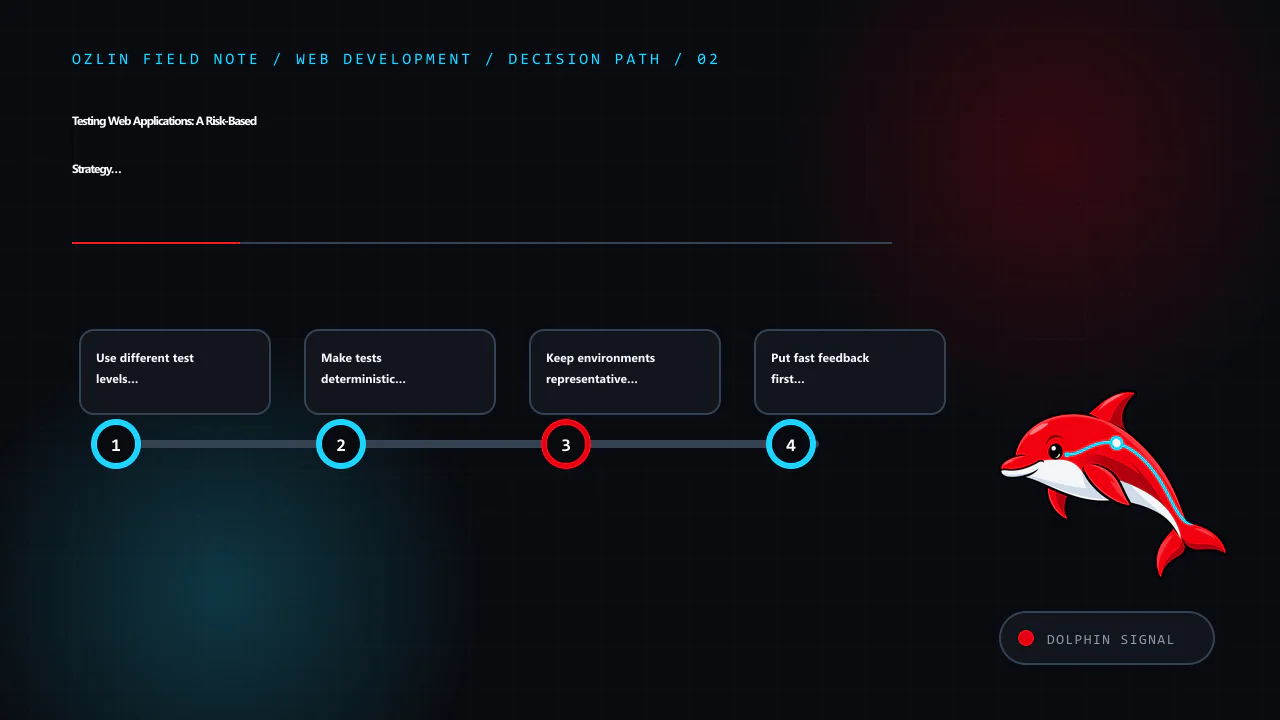
    Decision path for Testing Web Applications: A Risk-Based Strategy That Scales, covering Use different test levels for different questions, Make tests deterministic before adding retries, Keep environments representative…
    Decision path: Use different test levels for different questions; Make tests deterministic before adding retries; Keep environments representative without copying production…; Put fast feedback first in CI.

    Keep environments representative without copying production data

    Test environments should match production in material architecture, configuration shape, database migrations and deployment process. They do not need a copy of personal information. Prefer synthetic records designed around boundary cases. If production-derived data is genuinely necessary, minimise, de-identify, authorise and control it under an appropriate data-handling process.

    Treat test credentials as secrets, rotate them and limit permissions. Ensure email, payment, notification and deletion actions cannot accidentally reach real customers.

    Put fast feedback first in CI

    A practical pipeline might run:

    1. formatting, static analysis and type checks;
    2. fast unit and component tests;
    3. integration and contract tests with disposable dependencies;
    4. build and dependency checks;
    5. a focused browser smoke suite against the release candidate; and
    6. broader scheduled, pre-release or post-deployment checks where justified.

    Parallelise only tests that truly isolate their data and resources. Gate releases on defined critical failures rather than one undifferentiated pass-rate number. Track duration and flaky-test rate so feedback does not slowly become unusable.

    Review the suite as part of product maintenance

    For every defect that escapes, ask which layer could have caught it most cheaply. Add a regression test at that layer and correct the underlying design. Remove obsolete tests when behaviour is intentionally retired. Review slow, duplicate and low-value cases rather than letting the suite grow forever.

    Important qualities still need human work: exploratory testing, usability, accessibility, threat modelling and review of ambiguous requirements. Automation repeats known checks; it does not discover every way a person or system may behave.

    For help designing a release workflow or testing a web application within an agreed scope, see Ozlin Info's web development services or contact Ozlin Info.

    Related reading: Authorised security testing: scope, evidence and safe delivery.


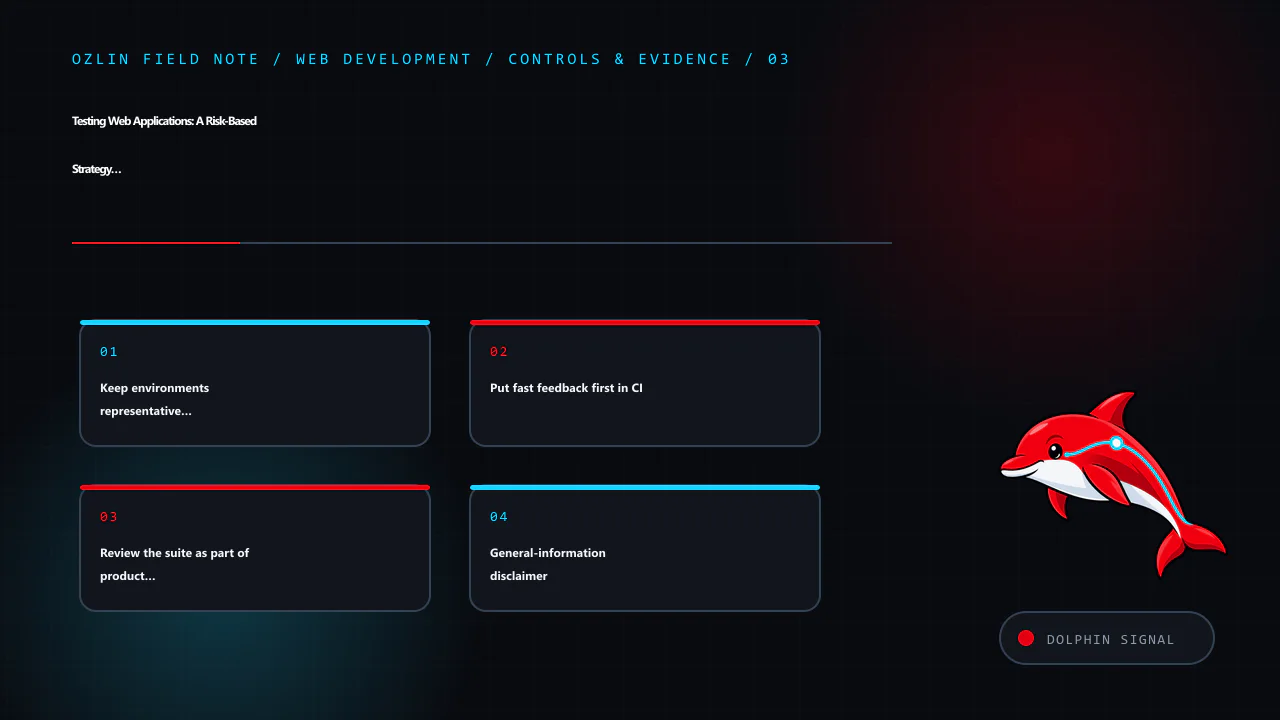
    Control and evidence map for Testing Web Applications: A Risk-Based Strategy That Scales, covering Keep environments representative without copying production…, Put fast feedback first in CI, Review the suite as part of…
    Control and evidence map: Keep environments representative without copying production…; Put fast feedback first in CI; Review the suite as part of product maintenance; General-information disclaimer.

    General-information disclaimer

    This article provides general technical information only. A suitable test strategy depends on the application's risks, architecture, data, users and contractual or regulatory obligations. Testing reduces uncertainty but cannot prove that software has no defects or security weaknesses.

    AI-assistance disclosure

    AI tools assisted with source discovery, outlining and copyediting. A human reviewer must verify the examples, tool behaviour, service claims and publication decision before release. No test coverage or defect-prevention outcome is guaranteed.

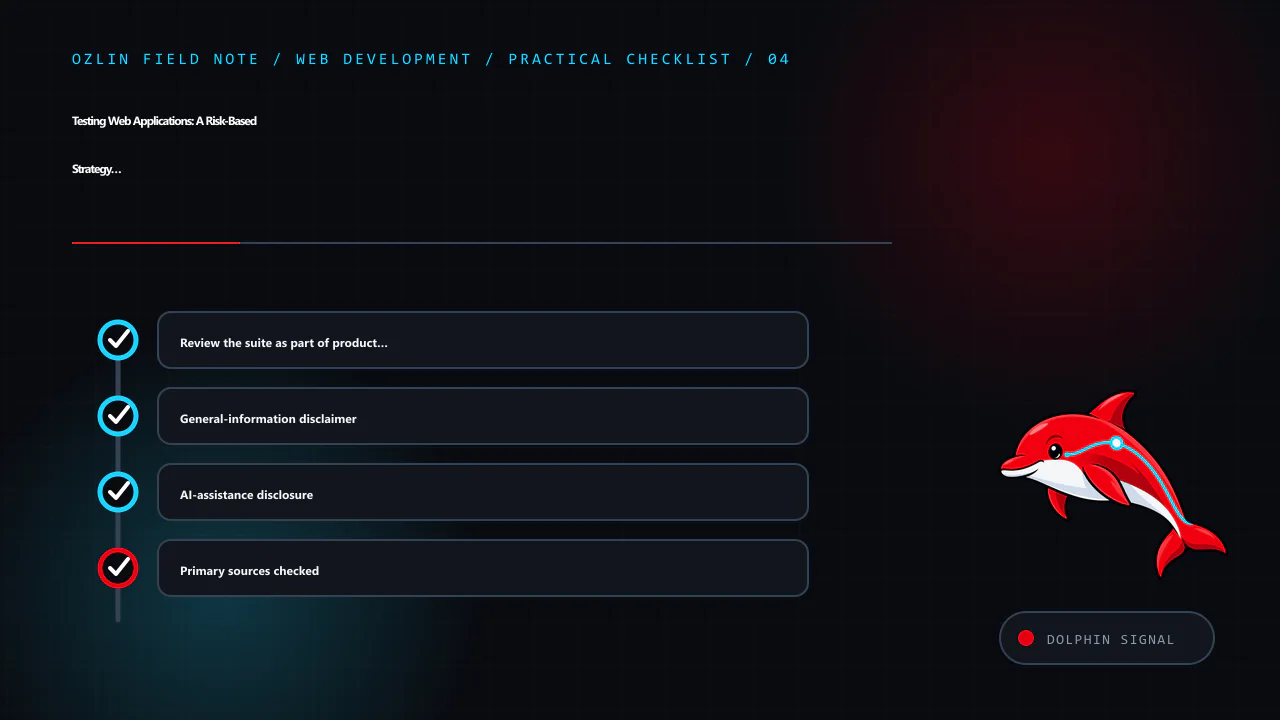
    Practical checklist for Testing Web Applications: A Risk-Based Strategy That Scales, covering Review the suite as part of product maintenance, General-information disclaimer, AI-assistance disclosure and related review…
    Practical checklist: Review the suite as part of product maintenance; General-information disclaimer; AI-assistance disclosure; Primary sources checked.

    Primary sources checked

    Source access date: 29 August 2026.

  • Docker Compose in Production: A Defensible Single-Host Pattern

    Docker Compose in Production: A Defensible Single-Host Pattern

    Reviewed: 13 September 2026 · Next review: 13 December 2026
    Author: Ozlin Info Editorial Team · Human review: Lin (accountable human); Codex assisted

    Reviewed: 29 August 2026 · Next review: 28 February 2027
    Author: Ozlin Info Editorial Team · Human review: Lin

    Docker Compose can be a practical production option for a modest application on one well-managed server. It provides a declarative description of services, networks, volumes and runtime configuration, and Docker documents a production workflow using a base Compose file with a production-specific override (Docker Docs — Use Compose in production).

    That does not make one Compose host highly available. The host, storage and Docker daemon can remain single points of failure. If the service requires automatic rescheduling across machines, multi-node availability or sophisticated traffic management, evaluate an orchestrator or managed platform instead of implying that a restart policy solves infrastructure failure.

    Define the operating target first

    Record the service-level needs before writing YAML:

    • expected traffic and resource profile;
    • tolerable downtime and data loss;
    • backup and restore objectives;
    • public and private network paths;
    • data classification and secrets;
    • patch, release and rollback ownership;
    • monitoring and alert response; and
    • conditions that require migration beyond one host.

    For a small content site, several minutes of controlled recovery may be acceptable. A payment or safety-critical service may need a very different architecture. Compose is a packaging and lifecycle tool, not a substitute for risk assessment.

    Build immutable, reviewable images

    Production application code should normally be inside a versioned image rather than bind-mounted from a mutable source directory. Use a multi-stage Dockerfile so compilers, package managers and build-time credentials stay out of the final runtime image. Choose a small, trusted base image, install only required packages and run as a non-root user where the application permits it.

    Docker notes that tags are mutable. Pinning an image digest improves reproducibility, but it also means the team must deliberately update the digest to receive fixes. Automate notifications or pull requests rather than pinning and forgetting (Docker Docs — Building best practices).

    A defensible release records:

    • source commit and build workflow;
    • image repository, tag and digest;
    • software bill of materials or dependency inventory where appropriate;
    • vulnerability-review result and accepted exceptions;
    • configuration version and database migration; and
    • deployment and rollback evidence.

    Do not bake passwords, API keys or private certificates into an image layer. Removing a secret in a later layer does not reliably erase it from earlier image history.

    Separate development and production configuration

    Keep common service definitions in compose.yaml and apply production differences through a reviewed override such as compose.production.yaml:

    services:
      web:
        image: registry.example.test/acme-web@sha256:REPLACE_WITH_APPROVED_DIGEST
        restart: unless-stopped
        read_only: true
        tmpfs:
          - /tmp
        ports:
          - "127.0.0.1:8080:8080"
        healthcheck:
          test: ["CMD", "wget", "-qO-", "http://127.0.0.1:8080/healthz"]
          interval: 30s
          timeout: 5s
          retries: 3
          start_period: 20s
        security_opt:
          - no-new-privileges:true
        networks:
          - edge
          - app
    
      database:
        image: mysql@sha256:REPLACE_WITH_APPROVED_DIGEST
        restart: unless-stopped
        volumes:
          - db-data:/var/lib/mysql
        networks:
          - app
    
    networks:
      edge: {}
      app:
        internal: true
    
    volumes:
      db-data: {}

    This is an illustration, not a drop-in deployment. The image may not support a read-only filesystem, wget, the shown port or non-root operation. Validate the actual image and application.

    Render the combined configuration before deployment:

    docker compose -f compose.yaml -f compose.production.yaml config

    Review the output for unintended port exposure, missing variables, duplicate mounts and development flags.

    Expose the minimum network surface

    Publish only ports that genuinely need host access. If a reverse proxy on the same host is the only caller, bind the application to loopback rather than every interface. Keep databases and queues on internal networks without published host ports unless an authorised operational requirement says otherwise.

    Network separation reduces accidental reachability but is not an authorisation system. The application must still authenticate callers, authorise actions, validate input and protect transport where traffic crosses an untrusted boundary.

    Avoid privileged containers, host network mode, broad Linux capabilities and Docker socket mounts unless a reviewed use case requires them. Access to the Docker socket is effectively high-impact control of the host.

    Handle secrets according to the deployment model

    Compose can mount declared secrets into a service as files, which is generally preferable to copying them into the image or printing them in environment dumps. On standalone Compose, however, the source secret is still a host file or external resource that the operator must protect. Docker Swarm secrets add encrypted transport and at-rest handling for Swarm services; those guarantees do not automatically apply to every standalone Compose deployment (Docker Docs — Manage sensitive data with Docker secrets).

    Use restrictive host permissions or an appropriate secret manager, grant each service only the secrets it needs, avoid logging values and define rotation. Treat .env as configuration convenience, not an encrypted vault, and keep secret-bearing files out of source control and build context.

    Use health checks without confusing them with monitoring

    A health check should test whether the service can perform a small, representative local function. Compose can wait for a dependency marked service_healthy before creating a dependent service (Docker Docs — Control startup order). This helps startup sequencing, but it does not guarantee that a remote user can reach the application or that every dependency works.

    Combine container health with external availability checks, application metrics, structured logs and host monitoring. Track disk, memory, CPU, file descriptors, container restarts, certificate expiry, backup results and application-specific failures. Put retention and access controls around logs because they may contain personal or security-relevant information.

    Set memory and CPU expectations carefully. A hard limit can contain one service but can also cause abrupt failure under legitimate load. Observe real usage, preserve host capacity and test behaviour when a limit is reached.

    Separate persistent data from disposable containers

    Containers should be replaceable. Store mutable application data in named volumes, bind mounts with explicit ownership or external services. Document exactly what must be backed up: database-consistent data, uploads, configuration, certificates, encryption keys and any queue or object storage required for recovery.

    A copy of a live database directory is not automatically a valid backup. Use the database's supported logical or physical backup method, protect the result and test restoration into an isolated environment. Record recovery time and recovered data point rather than merely checking that a backup file exists.

    Named volumes do not create backups, replication or geographic resilience. They only separate data lifecycle from a particular container.

    Release one controlled change at a time

    A single-host deployment can use this sequence:

    1. build and test the image in CI;
    2. approve the image digest and configuration;
    3. take or verify the required backup;
    4. pull images without replacing running containers;
    5. run backward-compatible database migrations where possible;
    6. recreate the affected service;
    7. verify health, external behaviour, logs and data; and
    8. retain a tested rollback route.

    Docker's production guide shows rebuilding and recreating one service with docker compose build web followed by docker compose up --no-deps -d web. When deploying registry images, use the equivalent controlled pull and up flow for the exact approved reference. Understand that recreating a container can cause brief downtime on one host.

    Rollback must account for data schema. Restoring an earlier application image may fail after an irreversible migration. Prefer expand-and-contract migrations, backups and explicit compatibility windows.

    Patch the complete stack

    Rebuild images regularly with updated base images and application dependencies, then test and deploy them. Also patch the host kernel, Docker Engine, Compose plugin and reverse proxy. Schedule reboot paths and verify containers return as expected.

    Review configuration drift with docker compose config, image digests and host records. Do not use latest as an undocumented release decision, and do not enable unattended replacement of stateful services without tested compatibility and rollback.

    For help designing or reviewing a scoped web hosting deployment, see Ozlin Info's web development services or contact Ozlin Info.

    Related reading: Incident response and disaster recovery: design for evidence and recovery.


    General-information disclaimer

    This article provides general technical information only. It is not a complete architecture, security assessment, availability commitment or backup design. Production controls must reflect the actual application, images, host, data and recovery requirements.

    AI-assistance disclosure

    AI tools assisted with source discovery, outlining and copyediting. A human reviewer must validate every command, image capability, deployment assumption, service claim and publication decision before release. No uptime, security or recovery outcome is guaranteed.

    Primary sources checked

    Source access date: 29 August 2026.
    nn
    Article map for Docker Compose in Production: A Defensible Single-Host Pattern, covering Define the operating target first, Build immutable, reviewable images, Separate development and production configuration and relat…
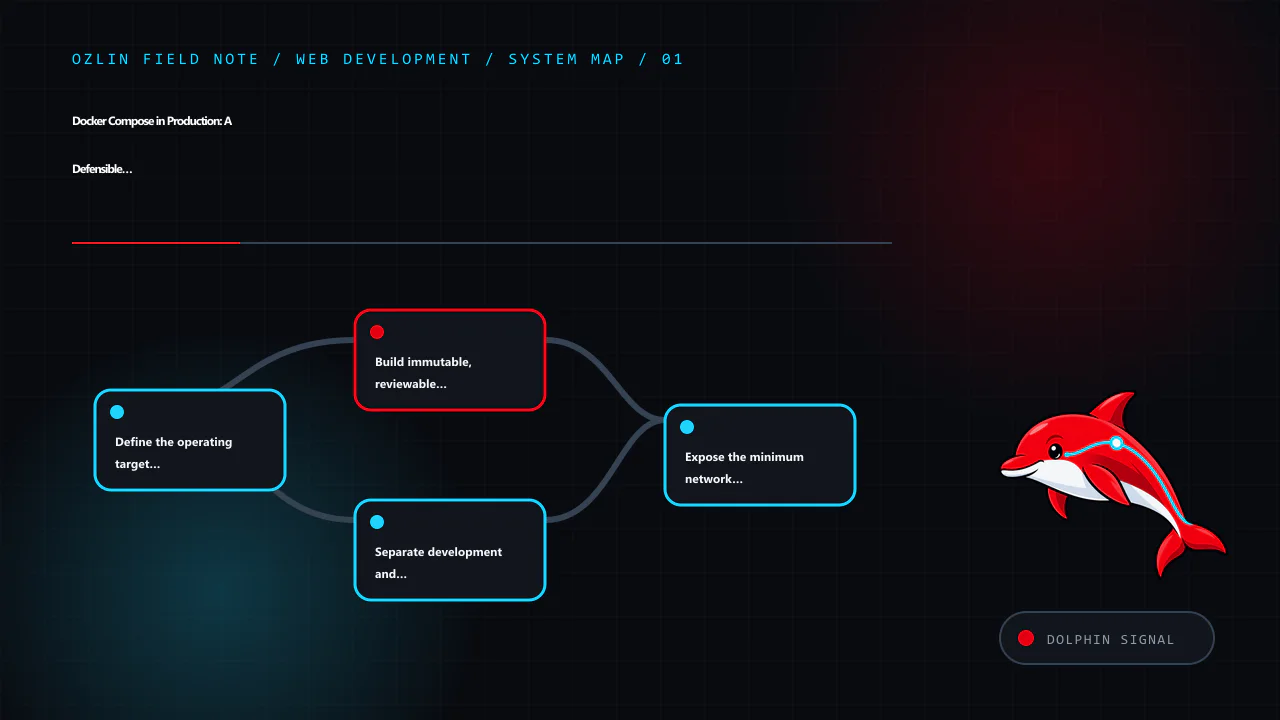
    Article map: Define the operating target first; Build immutable, reviewable images; Separate development and production configuration; Expose the minimum network surface.
    n
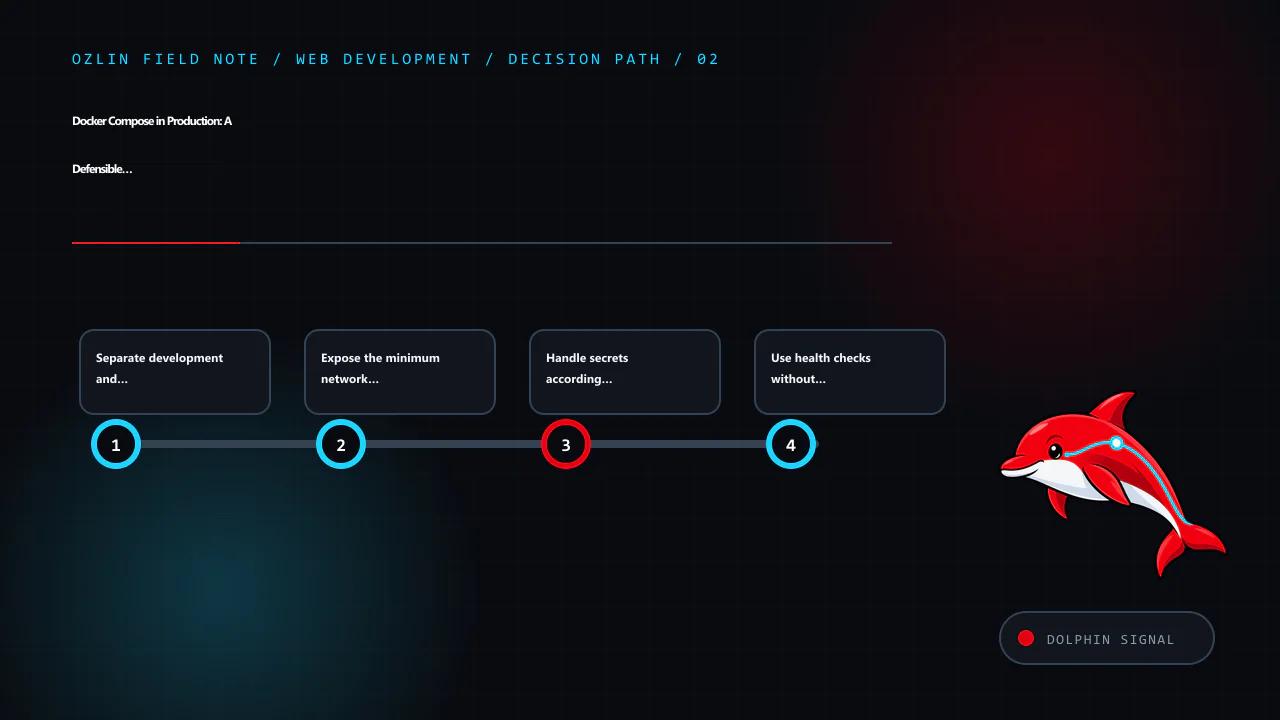
    Decision path for Docker Compose in Production: A Defensible Single-Host Pattern, covering Separate development and production configuration, Expose the minimum network surface, Handle secrets according to the deploymen…
    Decision path: Separate development and production configuration; Expose the minimum network surface; Handle secrets according to the deployment model; Use health checks without confusing them with monitoring.
    n
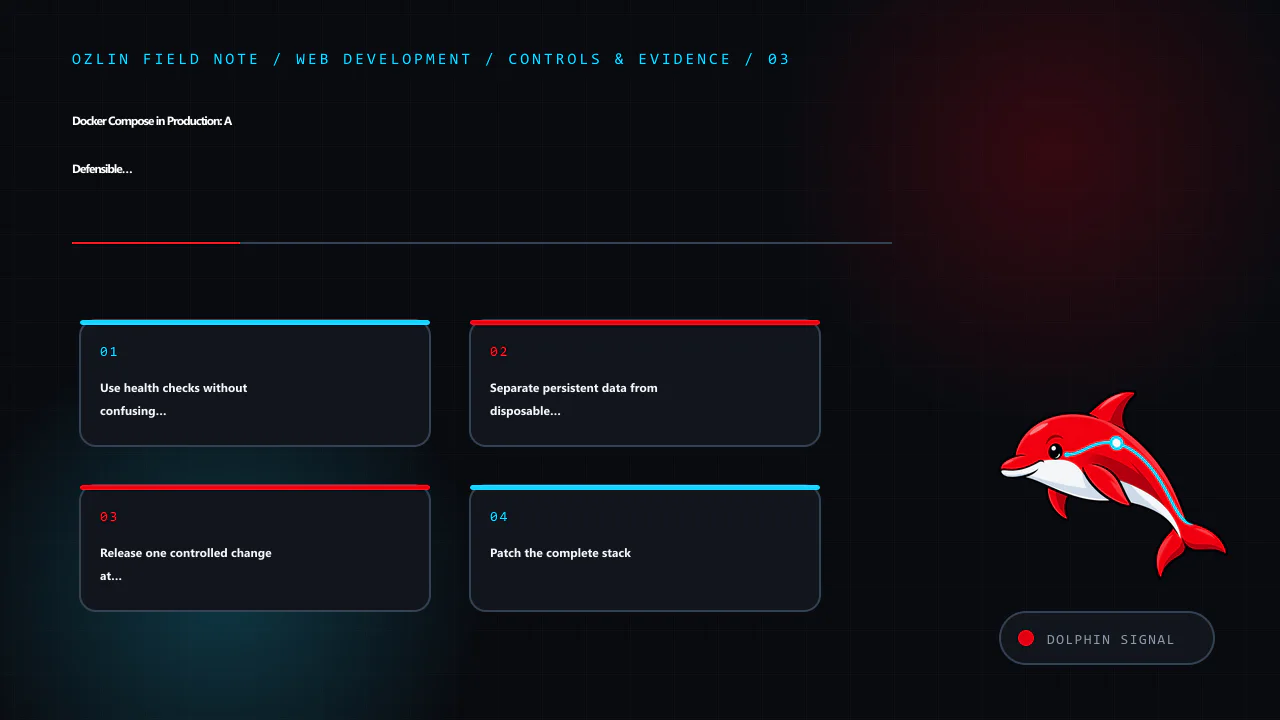
    Control and evidence map for Docker Compose in Production: A Defensible Single-Host Pattern, covering Use health checks without confusing them with monitoring, Separate persistent data from disposable containers, Releas…
    Control and evidence map: Use health checks without confusing them with monitoring; Separate persistent data from disposable containers; Release one controlled change at a time; Patch the complete stack.
    n
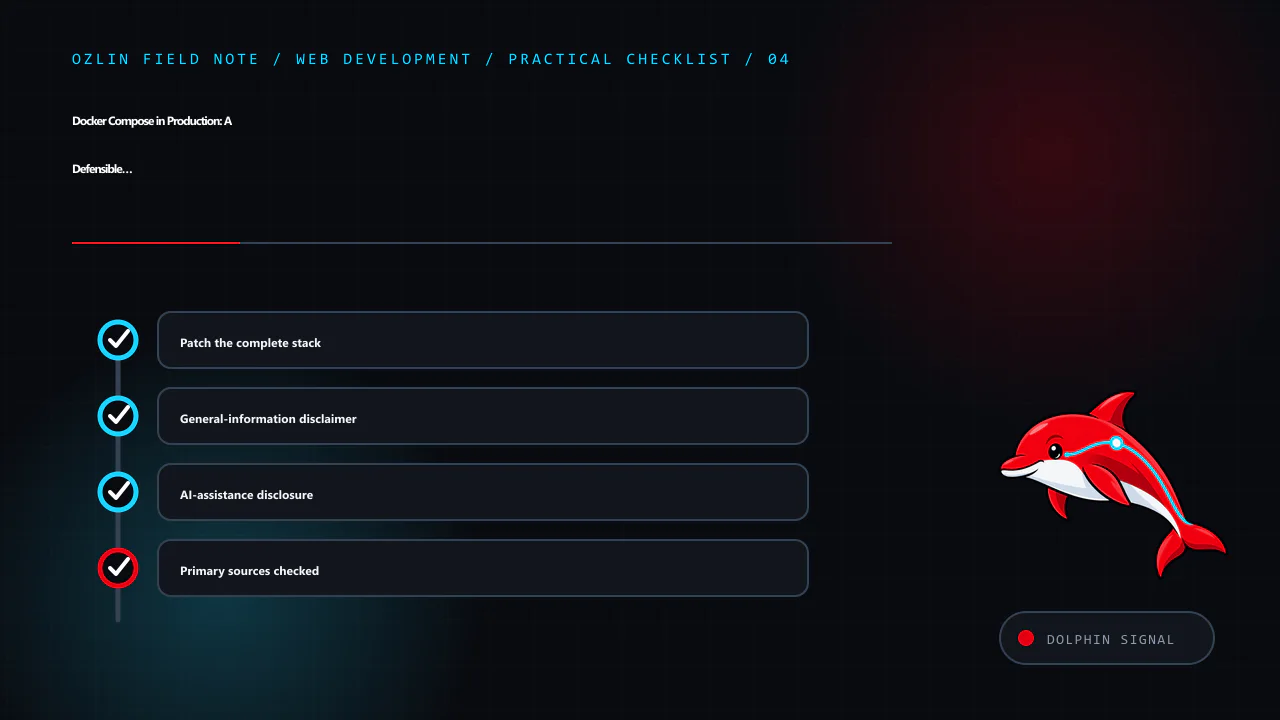
    Practical checklist for Docker Compose in Production: A Defensible Single-Host Pattern, covering Patch the complete stack, General-information disclaimer, AI-assistance disclosure and related review points.
    Practical checklist: Patch the complete stack; General-information disclaimer; AI-assistance disclosure; Primary sources checked.

    Limitations: Compose behaviour depends on the actual images, host, data, migrations and recovery process; this is not an architecture or availability guarantee.

  • MySQL and WordPress Database Performance: Measure Before You Tune

    MySQL and WordPress Database Performance: Measure Before You Tune

    Database tuning begins with a slow user journey and evidence—not a generic cleanup button. A page can wait on PHP, remote APIs, object storage, locks, a cold cache or the browser while the database is behaving normally. Conversely, a fast average can hide one expensive query that affects only administrators or a particular filter.

    For WordPress backed by MySQL, the safest workflow is to reproduce the affected task, measure where time and resources are spent, inspect the responsible query and application call path, make one controlled change, then compare the same evidence.

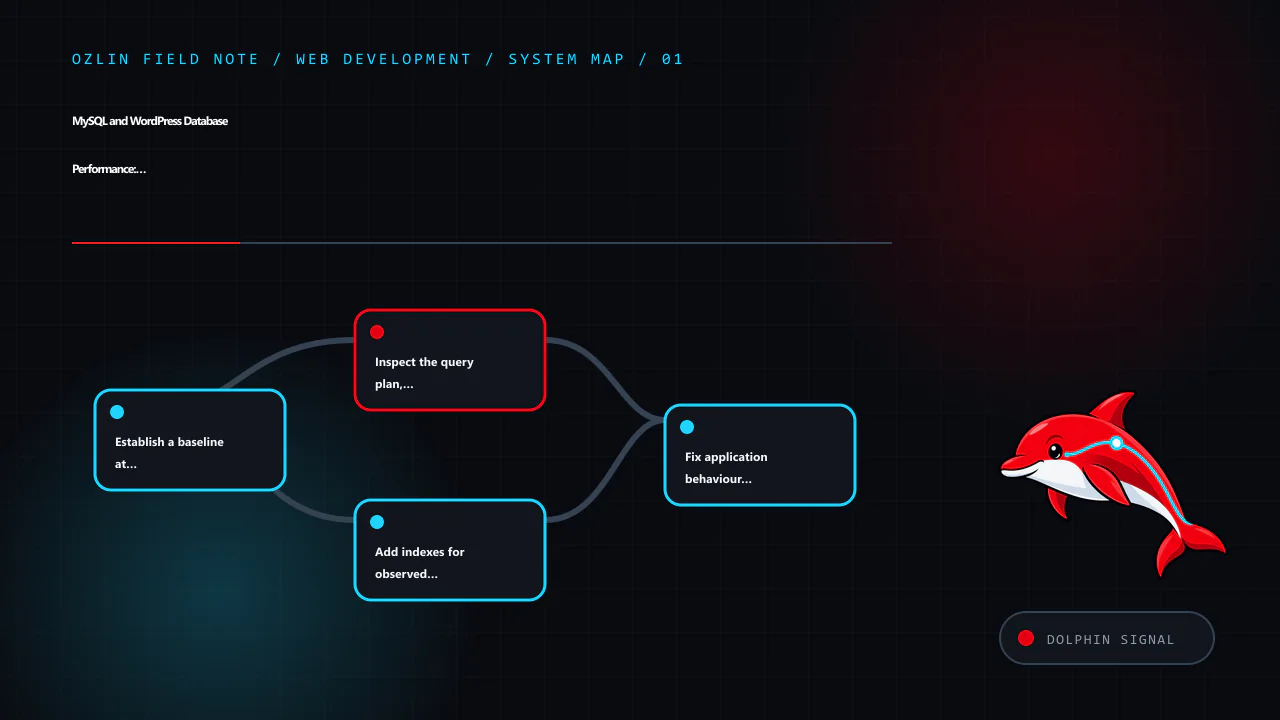
    Article map for MySQL and WordPress Database Performance: Measure Before You Tune, covering Establish a baseline at the user and server layers, Inspect the query plan, not just the SQL text, Add indexes for observed acc…
    Article map: Establish a baseline at the user and server layers; Inspect the query plan, not just the SQL text; Add indexes for observed access patterns; Fix application behaviour before increasing server limits.

    Establish a baseline at the user and server layers

    Record the exact journey, data volume, account role, cache state and time window. Useful observations include:

    • response time at the reverse proxy and application;
    • database query count and cumulative time for the request;
    • slow-query frequency, rows examined and lock time;
    • CPU, memory, disk latency and connection pressure;
    • cache hit and miss behaviour;
    • background jobs or cron activity; and
    • whether the problem occurs on a cold cache, warm cache or both.

    Use production telemetry with appropriate data minimisation, access controls and retention. Reproduce in staging with representative synthetic data when a diagnostic action could add risk or load.

    MySQL's slow query log records statements exceeding long_query_time and can also apply a minimum examined-row threshold. It is a diagnostic source, not something to enable indefinitely without considering volume, sensitive values and storage (MySQL 8.4 — Server Logs). Application performance monitoring can connect a query to a route or request, but inspect how it captures parameters before sending database details to a third party.

    Inspect the query plan, not just the SQL text

    EXPLAIN shows how the optimiser intends to execute a statement, including access type, candidate and selected indexes, join order and estimated rows. EXPLAIN ANALYZE actually runs a supported statement and adds observed iterator timing, row counts and loops. Because it executes the work, use it deliberately—prefer a safe staging environment or a carefully reviewed read query on production (MySQL 8.4 — EXPLAIN).

    Look for evidence such as:

    • far more rows examined than returned;
    • full scans that grow with the table;
    • repeated nested-loop work;
    • sorting or temporary processing on a large result;
    • poor estimates compared with actual rows; and
    • filters or joins that cannot use an appropriate index.

    A full scan is not automatically wrong. It may be optimal for a small table or a query returning much of the table. The question is whether the plan fits the data and workload.

    If estimates appear stale after major data changes, ANALYZE TABLE can refresh statistics. InnoDB determines cardinality estimates using sampled index dives, so estimates are not exact and repeated analysis can produce different values (MySQL 8.4 — ANALYZE TABLE). Do not use ANALYZE TABLE as a ritual without an identified planning problem and change controls.

    Add indexes for observed access patterns

    An index can reduce rows examined for filters, joins and ordered retrieval. It also occupies storage and must be maintained on insert, update and delete. MySQL explicitly cautions that unnecessary indexes waste space and increase write work (MySQL 8.4 — Optimization and Indexes).

    For a candidate composite index, consider:

    • columns used together in equality and range predicates;
    • join columns and data types;
    • sort order and limit;
    • selectivity in the real dataset;
    • the leftmost-prefix behaviour of a B-tree index;
    • existing overlapping indexes; and
    • impact on writes and maintenance.

    Test the plan and workload before and after. A forced index hint can mask stale statistics or an incomplete model and may become harmful as data changes.

    In WordPress, do not alter core table structures casually. A plugin query may need an application-level redesign, a supported plugin index or a purpose-built table rather than another index on wp_postmeta. Meta queries across large, weakly selective values can remain expensive even after a plausible index is added.

    Decision path for MySQL and WordPress Database Performance: Measure Before You Tune, covering Add indexes for observed access patterns, Fix application behaviour before increasing server limits, Treat maintenance comman…
    Decision path: Add indexes for observed access patterns; Fix application behaviour before increasing server limits; Treat maintenance commands as changes; Tune the server after the workload is understood.

    Fix application behaviour before increasing server limits

    Common application problems include:

    • an N+1 pattern that fetches related records one at a time;
    • selecting unused columns or unlimited result sets;
    • running the same query repeatedly during one request;
    • loading large option values on every page;
    • synchronous work that belongs in a bounded background job;
    • remote calls inside a database transaction; and
    • missing pagination or an unbounded administrative report.

    Correcting one query pattern is usually more durable than allocating more memory to execute it faster. Use the WordPress APIs and prepared queries rather than constructing SQL from untrusted input. Performance work must not weaken authorisation or validation.

    Review WordPress autoloaded options

    Autoloaded options are loaded with every WordPress request. A plugin or theme can leave large or obsolete values in wp_options, increasing memory and transfer work across the site. WordPress's current administration guidance says excessive autoloaded options can slow a site and gives a general target of keeping them below 800 KB, but treat that number as an investigation trigger rather than a universal guarantee (WordPress — Optimization).

    Inventory the largest autoloaded values, identify their owner and confirm whether they are required on most requests. Do not directly delete unfamiliar rows. Some values are active configuration or serialised structures; an unsupported change can break the site.

    Cache only where correctness is defined

    WordPress's Transients API stores temporary cached data with an expiration. A transient may disappear before its nominal expiry, so the application must be able to regenerate it (WordPress — Transients API). A persistent object cache can reduce repeated database reads across requests, but it introduces capacity, eviction, invalidation and operational dependencies.

    For each cached value, define:

    • the key and tenant or user scope;
    • maximum acceptable staleness;
    • invalidation triggers;
    • behaviour on a miss or cache outage;
    • size and retention; and
    • whether personal or confidential data is appropriate to store.

    Do not cache an authorisation decision longer than the underlying access can safely remain valid. Avoid cache keys that let one user's result reach another.

    Treat maintenance commands as changes

    OPTIMIZE TABLE is often advertised as routine WordPress cleanup. For InnoDB, MySQL maps it to ALTER TABLE ... FORCE, rebuilding the table to update statistics and reclaim unused space in the clustered index (MySQL 8.4 — OPTIMIZE TABLE). A rebuild can require time, I/O, temporary space and operational coordination. Run it only for an evidenced need with backups, capacity checks and an understood locking/online-DDL path.

    Deleting expired transients, old revisions or logs may reduce storage, but retention must be intentional. Confirm plugin behaviour, legal or business requirements and rollback before removing records. Database “repair” plugins with broad write access add their own supply-chain and operational risk.

    Tune the server after the workload is understood

    MySQL buffer, connection and I/O settings depend on engine, dataset, concurrency, available memory and other services on the host. Copying a large-server configuration into a small container can trigger swapping or out-of-memory termination. Container memory limits do not make oversized MySQL settings safe.

    Measure the working set, peak connections, temporary object use, disk latency and buffer-pool behaviour. Change one group of settings with a hypothesis and compare during a representative period. Preserve capacity for the operating system, web workers, caches and backup jobs.

    Connection pooling or persistent connections can reduce setup overhead but also multiply idle sessions or stale transactions if application workers and limits are not coordinated.

    Control and evidence map for MySQL and WordPress Database Performance: Measure Before You Tune, covering Treat maintenance commands as changes, Tune the server after the workload is understood, Validate performance and…
    Control and evidence map: Treat maintenance commands as changes; Tune the server after the workload is understood; Validate performance and recovery together; General-information disclaimer.

    Validate performance and recovery together

    Before a schema, cleanup or configuration change:

    1. take a database-consistent backup using a supported method;
    2. verify available disk and temporary space;
    3. record the original configuration and plan;
    4. test the change and rollback in a representative environment;
    5. deploy during an appropriate window; and
    6. verify both the target journey and unrelated critical workflows.

    A backup is credible only after a restore test. Monitor for regressions in writes, replication if used, background jobs and cache behaviour—not just the one query that improved.

    For help profiling a WordPress application or planning a scoped performance change, see Ozlin Info's web development services or contact Ozlin Info.

    Related reading: 10 WordPress performance checks before optimisation.


    General-information disclaimer

    This article provides general technical information only. Commands and settings must be assessed against the actual database version, workload, data, hosting design and recovery requirements. Performance changes can cause downtime or data loss if applied without appropriate review and backups.

    AI-assistance disclosure

    AI tools assisted with source discovery, outlining and copyediting. A human reviewer must verify all database statements, operational assumptions, service claims and the publication decision before release. No performance improvement or availability outcome is guaranteed.

    Practical checklist for MySQL and WordPress Database Performance: Measure Before You Tune, covering Validate performance and recovery together, General-information disclaimer, AI-assistance disclosure and related review…
    Practical checklist: Validate performance and recovery together; General-information disclaimer; AI-assistance disclosure; Primary sources checked.

    Primary sources checked

    Source access date: 29 August 2026.
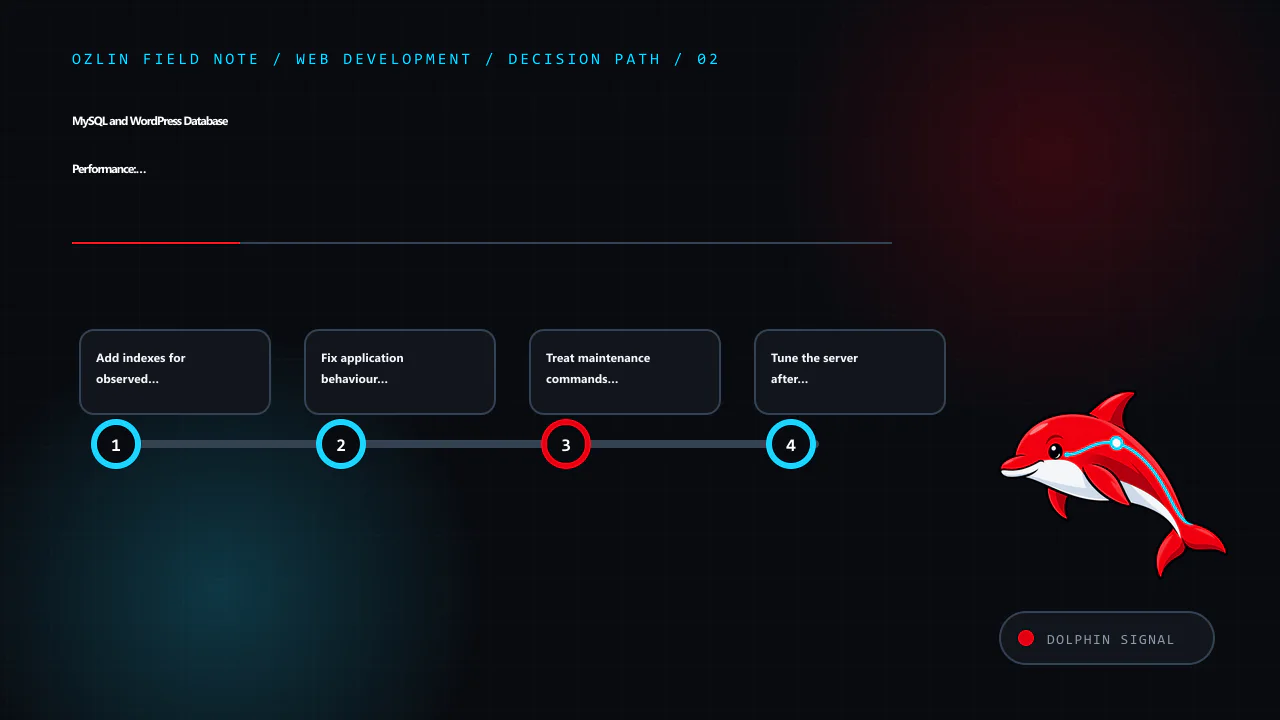
  • Progressive Web Apps: Design the Experience Before the Install Prompt

    Progressive Web Apps: Design the Experience Before the Install Prompt

    A progressive web app (PWA) is still a website. It uses web platform capabilities to offer an experience that can include installation, standalone display, resilience to unreliable networks and selected device integrations. Those capabilities vary by browser and operating system, and none of them rescues a slow, inaccessible or confusing service.

    Begin with a user problem. A field worker may need to reopen assigned jobs with intermittent connectivity. A returning customer may value a home-screen launch and fast account access. A marketing site with occasional visits may gain little from an install prompt or a service worker that adds caching complexity.

    Article map for Progressive Web Apps: Design the Experience Before the Install Prompt, covering Write the capability case before the implementation, Give the application a deliberate manifest, Use a service worker for a…
    Article map: Write the capability case before the implementation; Give the application a deliberate manifest; Use a service worker for a bounded reliability goal; Define the offline experience honestly.

    Write the capability case before the implementation

    For each proposed feature, record:

    • the task and user group it supports;
    • required browser and operating-system coverage;
    • what should work online, offline and during partial failure;
    • data sensitivity and local-storage implications;
    • update and recovery behaviour;
    • accessibility and permission experience; and
    • a fallback when the capability is unavailable.

    Use progressive enhancement: start with usable HTML, navigation and server responses, then add capabilities when the runtime supports them. Do not block a browser-only visitor because installation, push, background sync or another optional API is absent.

    Give the application a deliberate manifest

    A web app manifest is a JSON document that supplies application metadata such as name, icons, start URL, display mode and navigation scope. The W3C specification describes it as a central place for metadata used when launching and presenting an installed web application (W3C — Web Application Manifest).

    A small example is:

    {
      "name": "Acme Field Notes",
      "short_name": "Field Notes",
      "start_url": "/app/",
      "scope": "/app/",
      "display": "standalone",
      "background_color": "#0B0D12",
      "theme_color": "#C51F32",
      "icons": [
        {
          "src": "/assets/icon-192.png",
          "sizes": "192x192",
          "type": "image/png"
        },
        {
          "src": "/assets/icon-512.png",
          "sizes": "512x512",
          "type": "image/png",
          "purpose": "any maskable"
        }
      ]
    }

    The paths, icons and colours must be real and suitable for the application. Declare scope deliberately so navigation outside the application is handled predictably. Test icon masks and contrast on target platforms rather than assuming one square asset will render well everywhere.

    Installability criteria and presentation are browser decisions that change over time. A manifest is important but does not guarantee that every browser will show the same prompt or installed experience. Explain installation as an optional feature, and avoid repeatedly interrupting visitors who dismiss it.

    Use a service worker for a bounded reliability goal

    A service worker can intercept network requests and respond from the network, Cache Storage or constructed responses. It has install and activate lifecycle events and can be terminated when no event needs handling; application design should not treat it as a continuously running server (W3C — Service Workers).

    Service workers normally require a secure context. HTTPS is also necessary to protect application code and data from network modification.

    Choose caching by resource type and freshness requirement:

    • Cache first: appropriate for versioned, immutable interface assets when a cached response is safe.
    • Network first: useful when current data matters but a known cached response can provide a fallback.
    • Stale while revalidate: serves a cached response promptly and refreshes it for a later request.
    • Network only: appropriate for sensitive or mutation requests that must reach the server.

    These are design patterns, not universal rules. web.dev's PWA guidance notes that Cache Storage does not automatically update or delete assets when the server changes; the application owns versioning and cleanup (web.dev — PWA Caching).

    Do not cache every request indiscriminately. Avoid storing authentication responses, personalised pages or sensitive API data unless the threat model, expiry, logout and device-sharing behaviour are understood. Cache names and storage are origin-scoped, which matters when several applications share one origin.

    Decision path for Progressive Web Apps: Design the Experience Before the Install Prompt, covering Use a service worker for a bounded reliability goal, Define the offline experience honestly, Plan service-worker updates…
    Decision path: Use a service worker for a bounded reliability goal; Define the offline experience honestly; Plan service-worker updates as a product flow; Ask for permissions at the moment of value.

    Define the offline experience honestly

    “Offline capable” does not have to mean that every feature works without a network. A useful minimum can be a branded explanation, previously viewed non-sensitive information and a clear list of actions that require reconnection. A transactional application may need a queue, conflict resolution and user-visible sync status.

    For an offline mutation, define:

    1. when the action is considered accepted;
    2. how it is stored and encrypted if necessary;
    3. how duplicate submission is prevented;
    4. retry limits and backoff;
    5. conflict rules when server data changed;
    6. how the user sees pending, failed and completed states; and
    7. how queued data is removed on logout or account change.

    Do not tell a user “saved” if the record only exists in a fragile local queue without explaining the state. Test storage eviction, low disk space, browser data clearing and a device shared between accounts.

    Plan service-worker updates as a product flow

    When a service-worker script changes, the browser can install a new worker while the existing version continues controlling open pages. A new version may wait until old clients close. Forcing immediate activation can leave an old page talking to new cached code or data.

    Choose whether updates apply on the next launch or through a visible “update available” action. Preserve unsaved work, version caches and remove obsolete entries during an appropriate lifecycle phase. web.dev cautions that deleting or renaming the service-worker file does not unregister existing installations, and that new versions do not automatically remove old cached assets (web.dev — PWA Update).

    Test upgrades from at least the currently deployed version, not only a clean installation.

    Ask for permissions at the moment of value

    Push notifications, camera, location and other device capabilities can be useful, but permission prompts without context are easy to deny and can damage trust. Explain the feature and ask only after the user takes an action that needs it. Provide a useful experience if permission is denied or later revoked.

    Push delivery is not guaranteed and must not be the sole channel for safety-critical or contractual communication. Give users meaningful subscription controls and do not infer consent for unrelated marketing.

    Test the web, installed and degraded states

    The test matrix should include:

    • supported browsers and operating systems;
    • normal browser tab and installed display modes;
    • first visit, return visit and upgrade from an older worker;
    • fast, slow, intermittent and offline networks;
    • cache eviction and storage denial;
    • logged-out, logged-in and account-switch states;
    • keyboard, zoom and screen-reader tasks;
    • deep links within and outside manifest scope; and
    • denied, granted and revoked permissions.

    Measure the same user outcomes as any web application: task completion, accessibility, response and interaction performance, reliability and support burden. Installation count alone does not show that people receive value.

    Control and evidence map for Progressive Web Apps: Design the Experience Before the Install Prompt, covering Plan service-worker updates as a product flow, Ask for permissions at the moment of value, Test the web, insta…
    Control and evidence map: Plan service-worker updates as a product flow; Ask for permissions at the moment of value; Test the web, installed and degraded states; Know when a PWA is not enough.

    Know when a PWA is not enough

    A PWA may be unsuitable where the product depends on a platform API that target browsers do not expose, strict background execution, a required store distribution model or specialised hardware integration. A conventional responsive site may also be simpler and better for an occasional public-information journey.

    Compare a PWA, packaged web approach, cross-platform framework and native application against the actual capability matrix, team skills, lifecycle cost and user expectations. “One codebase” does not mean one identical behaviour on every device.

    For help evaluating or building a progressive web experience within a defined browser and feature scope, see Ozlin Info's web development services or contact Ozlin Info.

    Related reading: Web accessibility with WCAG 2.2: a practical delivery guide.


    General-information disclaimer

    This article provides general technical information only. Browser capabilities, installability rules and platform policies change, and a production PWA requires validation against the actual target devices, data and risk profile.

    AI-assistance disclosure

    AI tools assisted with source discovery, outlining and copyediting. A human reviewer must verify the manifest, caching, storage, permission and platform statements before publication. No installation, compatibility, offline or business outcome is guaranteed.

    Practical checklist for Progressive Web Apps: Design the Experience Before the Install Prompt, covering Know when a PWA is not enough, General-information disclaimer, AI-assistance disclosure and related review points.
    Practical checklist: Know when a PWA is not enough; General-information disclaimer; AI-assistance disclosure; Primary sources checked.

    Primary sources checked

    Source access date: 29 August 2026.
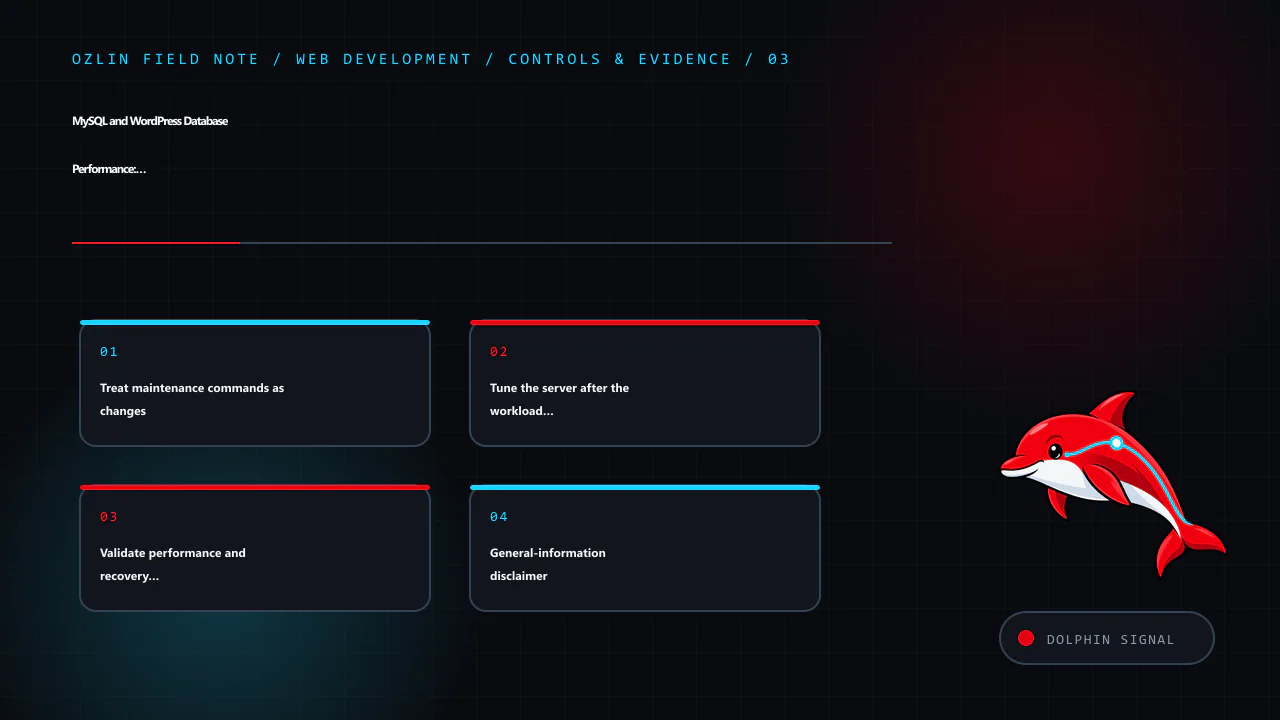
  • Web Performance: Diagnose Real User Experience Before Optimising

    Web Performance: Diagnose Real User Experience Before Optimising

    Web performance is the experience of waiting for useful content, interacting with it and keeping the page visually stable. It is not one synthetic score and not a one-time compression exercise. Device capability, network, geography, cache state, account state and page content all affect what a visitor experiences.

    The most productive workflow is evidence-led: identify a slow user task, measure it in the field, reproduce it in a controlled lab, find the limiting part, make one change and confirm the result for real users.

    Article map for Web Performance: Diagnose Real User Experience Before Optimising, covering Use field and lab data for different questions, Start with the page and task that matters, Break LCP into the request and render…
    Article map: Use field and lab data for different questions; Start with the page and task that matters; Break LCP into the request and rendering path; Improve INP by shortening main-thread work.

    Use field and lab data for different questions

    Field data describes visits on real devices and networks. It can show distributions, route differences and whether a problem affects mobile users, a region or a particular template. Lab tools make the environment repeatable and expose network waterfalls, main-thread work, layout shifts and rendering detail.

    Neither replaces the other. A lab run cannot represent every customer, while a field percentile rarely tells a developer exactly which script or image caused the delay.

    For Core Web Vitals, evaluate the 75th percentile of page visits separately for mobile and desktop where the data permits it. Current “good” thresholds are:

    Metric What it represents Good threshold
    Largest Contentful Paint (LCP) Loading of the largest visible content element 2.5 seconds or less
    Interaction to Next Paint (INP) Overall responsiveness to click, tap and keyboard interactions 200 milliseconds or less
    Cumulative Layout Shift (CLS) Unexpected visual movement 0.1 or less

    These thresholds are guidance for classifying experience, not a guarantee of usability, conversion or search position. A site can meet them and still have an inaccessible form, broken checkout or slow task after the measured page state (web.dev — LCP; web.dev — INP; web.dev — CLS).

    Start with the page and task that matters

    Segment by template and journey before optimising the global average. A home page, article, product listing and logged-in dashboard have different content and dependencies. Record:

    • target URL and navigation path;
    • device and viewport;
    • network and geographic path;
    • cold and warm cache;
    • consent and authentication state;
    • content or experiment variant; and
    • field time range and sample size.

    Define a performance budget for assets and behaviour: maximum initial JavaScript, image bytes, third-party requests, font files, server response and long tasks. A budget makes performance reviewable during delivery rather than a rescue project after launch.

    Break LCP into the request and rendering path

    LCP includes time before the HTML arrives, delay before the LCP resource starts loading, the resource transfer and delay before the browser paints it. Improve the dominant part instead of applying generic minification.

    Reduce server and connection delay

    Trace DNS, TLS, redirects, edge routing, reverse proxy, application, database and remote APIs. Remove avoidable redirects, cache safe public responses, keep the application and database appropriately close, and fix slow queries or synchronous external calls. A content delivery network can shorten delivery for cacheable resources but does not repair slow origin generation or incorrect cache rules.

    Measure time to first byte in context. A fast synthetic response from a nearby location does not represent a personalised request from another region.

    Make the LCP resource discoverable

    If the main image is only inserted after JavaScript runs or hidden in a CSS background, the browser may discover it late. Put important content in the initial HTML where appropriate, use responsive image markup and avoid lazy-loading an above-the-fold LCP image. Apply priority hints only after confirming discovery order; prioritising everything means nothing is prioritised.

    Serve an image with dimensions and an appropriate intrinsic size. Compare AVIF, WebP and conventional fallbacks at acceptable visual quality instead of assuming one format always wins.

    Remove render delay

    Limit render-blocking CSS to what the initial view needs, keep style rules maintainable and defer non-critical work. Font loading, large client-rendered bundles and long main-thread tasks can delay paint even after the resource arrived. Server-rendered or statically generated content may improve time to content when a marketing or article page does not need a client-only application.

    Decision path for Web Performance: Diagnose Real User Experience Before Optimising, covering Break LCP into the request and rendering path, Improve INP by shortening main-thread work, Prevent CLS by reserving space and…
    Decision path: Break LCP into the request and rendering path; Improve INP by shortening main-thread work; Prevent CLS by reserving space; Apply caching with HTTP semantics.

    Improve INP by shortening main-thread work

    INP observes interaction latency across the page visit and usually reports the worst interaction, with an outlier adjustment for pages with many interactions. A slow interaction can include input delay, event-handler work and delay before the next paint.

    Profile the actual slow interaction. Common improvements include:

    • remove unused third-party and application JavaScript;
    • split long tasks and yield so the browser can update;
    • avoid repeated synchronous layout reads and writes;
    • render or virtualise only the visible part of a large list;
    • debounce or schedule non-essential work without delaying critical feedback;
    • move suitable computation to a worker; and
    • show immediate, accessible feedback while longer work continues.

    Do not make an interface appear responsive by acknowledging a destructive action before the server has safely accepted it. Performance must preserve correctness and communicate pending, success and failure states.

    Third-party tags, chat widgets, A/B tests and consent tools execute in the same page. Give each an owner, purpose and performance budget; remove campaigns and integrations that are no longer used.

    Prevent CLS by reserving space

    CLS measures unexpected movement, not animation in general. Common causes include images without dimensions, late ads or embeds, injected banners and font changes.

    Set width and height or an aspect ratio for images and video. Reserve realistic space for embeds, cookie notices and dynamic results. Insert new content below the current focus where possible, or allocate its space before an asynchronous response arrives. Use font metrics and fallbacks that reduce reflow.

    A layout shift immediately following a user action may be excluded from the metric, but it can still be confusing or move a control away from a keyboard or magnification user. Review the experience, not just the number.

    Apply caching with HTTP semantics

    Cache versioned static assets for a long period and change their URL when content changes. For HTML and API responses, define freshness, validators and private/shared behaviour based on the data. Cache-Control: no-store, private, Vary, ETags and conditional requests have distinct semantics; a broad CDN “cache everything” rule can expose personalised content.

    RFC 9111 describes an HTTP cache key as including at least the method and target URI, with additional request fields where selected by Vary (RFC 9111 — HTTP Caching). Test authenticated, consent, language and device variants before enabling shared caching.

    A service worker adds another cache with its own lifecycle. Use it only for a defined reliability goal and plan invalidation; it can serve stale or incompatible code if updates are mishandled.

    Optimise images, fonts and CSS as systems

    For images:

    • choose dimensions for the rendered slot and device density;
    • use srcset and sizes so the browser can select a candidate;
    • compare codecs at representative quality;
    • lazy-load below-the-fold images, not the primary LCP image;
    • preserve width and height; and
    • remove metadata only where it is not required.

    For fonts, use only needed families, weights and character sets, preload sparingly and choose an appropriate font-display strategy. System fonts can be a strong option where brand requirements allow. Ensure fallbacks do not create severe layout shifts.

    For CSS, remove truly unused rules with a build process that understands dynamic class names. Do not trade maintainability or accessibility for a tiny byte reduction without measurable benefit.

    Control and evidence map for Web Performance: Diagnose Real User Experience Before Optimising, covering Prevent CLS by reserving space, Apply caching with HTTP semantics, Optimise images, fonts and CSS as systems and re…
    Control and evidence map: Prevent CLS by reserving space; Apply caching with HTTP semantics; Optimise images, fonts and CSS as systems; Verify the change in production.

    Verify the change in production

    After deployment:

    1. check errors, availability and critical tasks;
    2. compare controlled lab traces under the same conditions;
    3. watch field distributions long enough to account for cache and traffic mix;
    4. check slower devices and regions, not only the median;
    5. verify accessibility, analytics and consent behaviour; and
    6. keep rollback available.

    Core Web Vitals field data may move gradually as new visits enter the reporting window. Use your own real-user monitoring for faster diagnostics, with appropriate privacy and sampling controls.

    For help auditing a WordPress or custom website performance path, see Ozlin Info's web development services or contact Ozlin Info.

    Related reading: MySQL and WordPress database performance: measure before you tune.


    General-information disclaimer

    This article provides general technical information only. Performance results depend on the actual site, users, devices, networks and measurement design. Core Web Vitals targets do not guarantee accessibility, revenue, search position or business outcomes.

    AI-assistance disclosure

    AI tools assisted with source discovery, outlining and copyediting. A human reviewer must verify the current metric definitions, technical recommendations, service claims and publication decision before release. No performance or ranking outcome is guaranteed.

    Practical checklist for Web Performance: Diagnose Real User Experience Before Optimising, covering Verify the change in production, General-information disclaimer, AI-assistance disclosure and related review points.
    Practical checklist: Verify the change in production; General-information disclaimer; AI-assistance disclosure; Primary sources checked.

    Primary sources checked

    Source access date: 29 August 2026.
  • HTTP API Design: Stable Semantics, Useful Errors and Safe Change

    HTTP API Design: Stable Semantics, Useful Errors and Safe Change

    A maintainable HTTP API is a contract between independent systems. Good design lets a client understand what a request means, which outcomes are safe to retry, how to recover from an error and how the contract will evolve. URL style matters, but predictable semantics and operational behaviour matter more.
    HTTP already defines methods, status codes, conditional requests, content negotiation and caching. Reusing those semantics reduces private conventions and helps clients, gateways and observability tools behave correctly. RFC 9110 defines HTTP as a stateless request/response protocol with a uniform interface to resources (RFC 9110 — HTTP Semantics).

    Not every JSON-over-HTTP interface is strictly REST, and a service does not become RESTful merely by using plural nouns. This guide focuses on practical resource-oriented HTTP APIs without claiming conformance to every architectural constraint associated with REST.

    Article map for HTTP API Design: Stable Semantics, Useful Errors and Safe Change, covering Model resources and business transitions, Respect HTTP method semantics, Use status codes to describe the HTTP outcome and relat…
    Article map: Model resources and business transitions; Respect HTTP method semantics; Use status codes to describe the HTTP outcome; Give errors one predictable shape.

    Model resources and business transitions

    Start with business concepts, identities and state changes. A resource is something a client can identify and exchange a representation of, such as:

    • /customers/{customerId};
    • /orders/{orderId};
    • /orders/{orderId}/items; or
    • /orders/{orderId}/cancellations.

    Use stable identifiers that do not expose a storage layout or sensitive sequence without a reason. Keep paths understandable, but do not force every complex action into a verb-free fiction. A cancellation can be represented as a subordinate resource when it has its own status, reason, timestamp and permissions.

    Separate the API representation from database rows. The representation should express the contract, not leak internal column names, join tables or fields that may later change. Decide whether absence, null, an empty collection and a default value mean different things, then document them.

    Respect HTTP method semantics

    RFC 9110 defines GET, HEAD, OPTIONS and TRACE as safe methods: the client is not requesting a state change. Safe does not mean that the server performs no logging or accounting; it means the requested semantics are read-only. GET must not trigger a destructive business action through a query parameter.

    Idempotent methods can be repeated with the same intended effect. PUT and DELETE are idempotent by definition, while POST is not generally idempotent. Idempotency does not require byte-identical responses or prohibit audit timestamps; it constrains the requested effect.

    A practical mapping is:

    Intent Common method Notes
    Retrieve a representation GET Safe; define cache and authorisation behaviour
    Create under a server-selected URI POST to a collection Return the resulting status and location where appropriate
    Replace the state of a known resource PUT Define complete-replacement semantics explicitly
    Apply a partial modification PATCH Document the patch media type and conflict rules
    Remove a resource or make it unavailable DELETE Repeated requests should preserve the intended removed state

    If clients may retry a POST after a network failure, design an idempotency mechanism. A client-generated key can bind repeated attempts to one operation, but the server must define scope, expiry, payload comparison, storage and concurrent-arrival behaviour. Do not label a request idempotent without implementing the guarantee.

    Use status codes to describe the HTTP outcome

    Choose the most specific standard status that matches the result. Common examples include:

    • 200 OK for a successful response with a representation;
    • 201 Created when a new resource is created;
    • 202 Accepted when processing is accepted but not complete;
    • 204 No Content when success has no response content;
    • 400 Bad Request for malformed or invalid request content;
    • 401 Unauthorized when authentication is required or invalid;
    • 403 Forbidden when the authenticated principal is not allowed;
    • 404 Not Found where the target is unavailable, including deliberate concealment where appropriate;
    • 409 Conflict for a conflict with current resource state;
    • 412 Precondition Failed for a failed conditional request;
    • 422 Unprocessable Content for syntactically valid content that cannot be processed as supplied;
    • 429 Too Many Requests for rate limiting; and
    • 500-class statuses for server-side failure.

    Do not return 200 with { "success": false } for every failure. HTTP-aware clients and monitoring should be able to classify the response without first decoding a private envelope.

    Give errors one predictable shape

    RFC 9457 defines Problem Details for HTTP APIs using the application/problem+json media type. Its members can include type, status, title, detail and an occurrence-specific instance; an API can add extension fields for structured validation information (RFC 9457 — Problem Details for HTTP APIs).

    For example:

    {
      "type": "https://api.example.test/problems/invalid-request",
      "title": "The request contains invalid fields",
      "status": 422,
      "detail": "Correct the listed fields and submit again.",
      "instance": "/problems/01J8EXAMPLE",
      "errors": [
        { "pointer": "/email", "code": "invalid_format" }
      ]
    }

    Keep human text safe for display, but give clients stable machine-readable types or codes. Do not expose stack traces, SQL, filesystem paths, secrets or internal hostnames. Put a correlation identifier in the response and logs so support can investigate without revealing internals.

    Decision path for HTTP API Design: Stable Semantics, Useful Errors and Safe Change, covering Use status codes to describe the HTTP outcome, Give errors one predictable shape, Design collections, filters and pagination e…
    Decision path: Use status codes to describe the HTTP outcome; Give errors one predictable shape; Design collections, filters and pagination explicitly; Protect concurrent updates.

    Design collections, filters and pagination explicitly

    Collections grow. Define pagination before a client depends on an unbounded response. Offset pagination is easy to understand but can duplicate or skip records as data changes and can become expensive at large offsets. Cursor pagination can provide stable traversal when the cursor encodes a deterministic order, but cursors should be opaque to clients and protected from tampering.

    Document:

    • default and maximum page size;
    • stable sort keys and tie-breakers;
    • filter syntax and allowed combinations;
    • whether total counts are exact, estimated or omitted;
    • links or tokens for next and previous pages; and
    • behaviour when records change between requests.

    Reject unsupported filters rather than silently ignoring them. Bound expensive search and aggregation paths to protect the service.

    Protect concurrent updates

    Two clients can read the same resource and overwrite each other's change. HTTP conditional requests provide a standard control. The server can return an ETag; a client sends If-Match with an update, and the server returns 412 Precondition Failed if the representation changed. RFC 9110 specifies the evaluation order for request preconditions.

    Do not invent a last-write-wins policy accidentally. Choose whether conflicts should be rejected, merged or represented as a business workflow. Test simultaneous requests, retries and partial failures.

    Define caching rather than inheriting surprises

    GET responses can be cacheable, including by browsers and intermediaries. Use Cache-Control, validators and Vary according to whether content is public, private, personalised or dependent on request headers. RFC 9111 describes when caches may store and reuse a response (RFC 9111 — HTTP Caching).

    Authenticated does not automatically mean uncacheable, but shared caching of personalised content requires careful, explicit controls. Test that one user's response cannot be served to another. Mutation responses should invalidate or update relevant cached representations through a defined strategy.

    Treat authentication and authorisation as separate decisions

    Authenticate the caller using a mechanism appropriate to the client type and threat model. Authorise every operation and object at the server; possession of a valid token does not grant access to every resource. Scope credentials narrowly, rotate secrets, validate token audience and issuer, and require protected transport.

    Apply input limits, schema validation and safe parsing. Rate limits can protect capacity but are not a complete denial-of-service strategy. Log security-relevant decisions without storing access tokens or unnecessary personal data.

    For browser clients, assess cross-origin policy and request-forgery risks based on where credentials are stored and automatically sent. CORS is a browser read-control mechanism, not authentication.

    Control and evidence map for HTTP API Design: Stable Semantics, Useful Errors and Safe Change, covering Protect concurrent updates, Define caching rather than inheriting surprises, Treat authentication and authorisation…
    Control and evidence map: Protect concurrent updates; Define caching rather than inheriting surprises; Treat authentication and authorisation as separate decisions; Document and test the contract.

    Document and test the contract

    An OpenAPI description can make operations, parameters, schemas and responses reviewable and can support generated documentation or tests. Keep it in the same change workflow as implementation, and verify that deployed behaviour matches the description. Generated clients do not resolve ambiguous business semantics.

    Test:

    • valid and invalid representations;
    • authentication and object-level authorisation;
    • each documented status and problem type;
    • pagination boundaries and concurrent data changes;
    • timeouts, retries and duplicate requests;
    • conditional updates;
    • cache behaviour; and
    • backward compatibility with supported clients.

    Evolve deliberately

    Prefer additive changes: new optional fields, new resources and new operations. Clients should usually ignore unknown response fields, while servers should reject unknown or invalid request fields according to the documented policy. Changing a field's type or meaning is breaking even if its name remains.

    When a breaking change is unavoidable, define the supported versions, migration guide, telemetry, deprecation notice and removal date. A version number in the path does not replace lifecycle management. Keep old versions secure during their support window and remove them only after checking actual client use.

    For help designing or reviewing a web API contract and implementation plan, see Ozlin Info's web development services or contact Ozlin Info.

    Related reading: Testing web applications: a risk-based strategy that scales.


    General-information disclaimer

    This article provides general technical information only. A production API design must reflect its clients, data, threat model, performance, compatibility and contractual requirements. Standard HTTP semantics do not by themselves make an API secure or reliable.

    AI-assistance disclosure

    AI tools assisted with source discovery, outlining and copyediting. A human reviewer must verify the protocol statements, examples, security guidance, service claims and publication decision before release. No compatibility, security or availability outcome is guaranteed.

    Practical checklist for HTTP API Design: Stable Semantics, Useful Errors and Safe Change, covering Evolve deliberately, General-information disclaimer, AI-assistance disclosure and related review points.
    Practical checklist: Evolve deliberately; General-information disclaimer; AI-assistance disclosure; Primary sources checked.

    Primary sources checked

    Source access date: 29 August 2026.