
2026 editor’s note: this article keeps its original 2025 URL so existing links do not break, but the advice has been replaced. Local search is not a checklist that guarantees a position, and a mail-receiving address does not turn an online business into an eligible local storefront.
Local SEO helps people find a business that genuinely serves them in a place. It combines accurate business information, an eligible local presence, useful pages, crawlable technology, reputation and evidence from search data. The first step is therefore not “add keywords”; it is to confirm what the business actually does and whether a local profile is permitted.

Pass the eligibility test before creating a profile
Google states that a Business Profile is for businesses making in-person contact with customers during stated hours. Online-only brands are not eligible. A business can qualify through a staffed location that customers visit or as a service-area business that travels or delivers to customers, subject to the detailed rules (Google Business Profile policy overview).
That distinction matters for remote-first consultants and digital studios. Video calls, email delivery and a local phone number do not by themselves establish face-to-face service. A virtual office used only for mail or registration is not eligible, and a co-working address cannot be listed as a storefront unless the business meets Google’s signage, staffing and customer-reception requirements. Google’s business representation guidelines state these limits directly.
Use this decision sequence:
- Do staff meet customers in person during the stated hours?
- If customers visit, is the location genuinely operated, signed and staffed by the business?
- If staff travel to customers, is it a real service-area operation rather than online-only delivery?
- Does every public address, service area, category, hour and phone number describe the real operation?
An eligible home-based service-area business should hide the residential address if customers are not served there and list accurate cities or postcodes it actually visits. Google currently allows up to 20 service areas and advises that the overall boundary generally should not extend much beyond about two hours’ driving time (service-area guidance). Do not invent an address or service footprint to obtain a map listing.
If the business is online-only, skip the Business Profile. Invest in the website, Search Console, relevant industry profiles, referrals, partnerships and—where commercially justified—advertising. Eligibility is not a growth verdict; it only determines access to a particular local product.
Make every public fact consistent and specific
For an eligible profile, use the real-world business name rather than a keyword-stuffed variation. Select the most accurate primary category, add relevant services, publish actual hours and use a phone number and website controlled by the business. Keep material details consistent across the site, profile, invoices and reputable directories.
Complete information can help Google understand relevance, but nobody can request or pay Google for a better organic local position. Google says local results are mainly based on relevance, distance and prominence (local-ranking guidance). Distance cannot be optimised away, and prominence is broader than one activity or posting schedule.
Ask genuine customers for honest reviews at a natural point in the service. Do not buy reviews, create them through staff accounts, filter unhappy customers into a private path or promise a benefit for a positive rating. Respond without disclosing private project details. Review volume and sentiment can support trust, but neither a weekly post nor a fixed number of photos creates a published ranking guarantee.
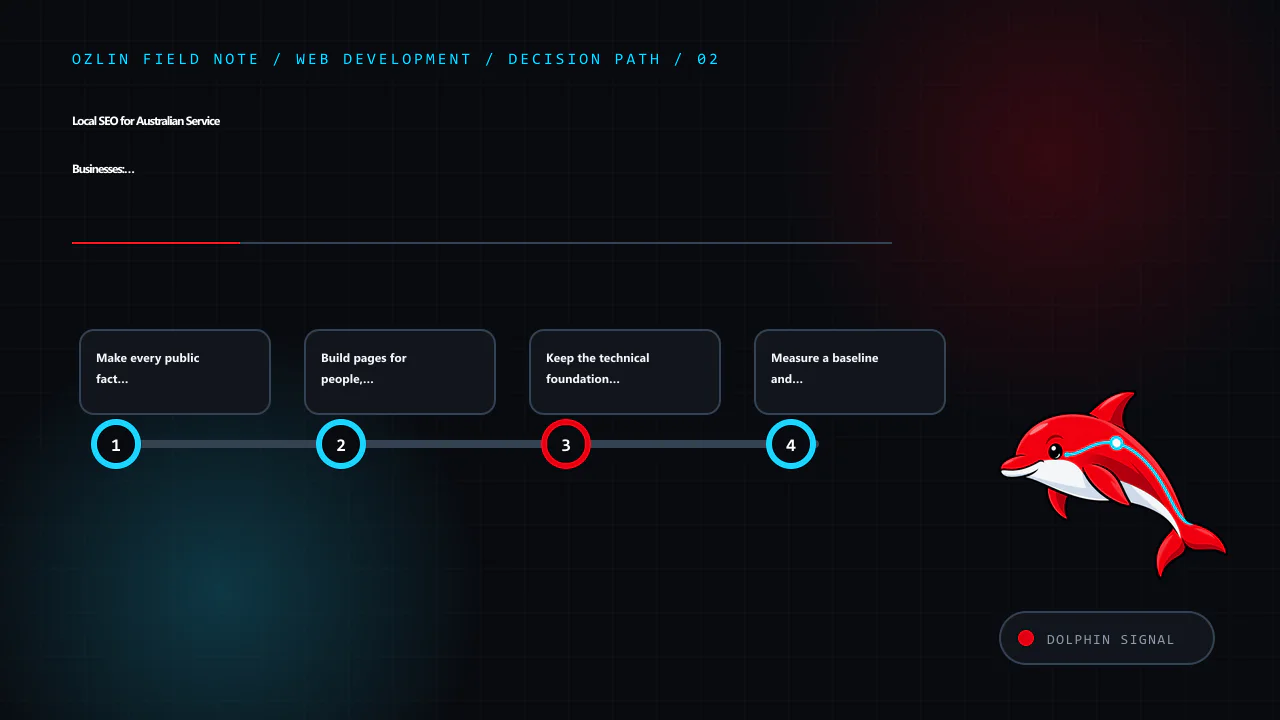
Build pages for people, not suburb permutations
A useful service page should answer:
- what outcome the service supports;
- who it is for and where it is genuinely available;
- what is included, excluded or dependent on discovery;
- how delivery, pricing or quotation works;
- what evidence, limitations and next step a buyer needs; and
- who is accountable for the content.
Create a location page when the operation, team, case evidence, availability or customer questions are materially specific to that place. Do not produce near-identical pages with only the suburb name changed. Google recommends helpful, reliable, people-first content rather than content made primarily to manipulate rankings (Search Central guidance).
Use Australian spelling and terminology because they fit the audience, not as keyword decoration. Verify claims, name the author or reviewer, show a review date where facts can change, and link to primary sources. A concise page grounded in actual delivery is stronger than a long page padded with every phrase a search tool suggests.
Keep the technical foundation observable
Ensure important pages return a successful response, are linked through normal navigation, have a canonical URL, descriptive title and one clear page heading. Submit an XML sitemap, review indexing in Search Console and fix accidental noindex, redirect loops, duplicate variants and broken internal links.
Test the page on real mobile devices and slower connections. Current Core Web Vitals assess Largest Contentful Paint, Interaction to Next Paint and Cumulative Layout Shift, with “good” guidance of LCP within 2.5 seconds, INP at or below 200 milliseconds and CLS at or below 0.1 at the 75th percentile (web.dev — Web Vitals). These are diagnostic targets, not a promise that passing them causes a rank increase.
Structured data should match visible, truthful content and a supported Google feature. It can make information easier to interpret but does not guarantee a rich result or a ranking change. FAQ rich results are generally restricted to well-known authoritative government and health sites, so an ordinary service business should not sell an FAQ plugin as a search-result shortcut (Google’s FAQ/HowTo change).
Measure a baseline and test changes
Record at least 28 days of baseline data before a substantial rewrite where traffic permits. In Search Console, track impressions, clicks, click-through rate, queries and landing pages. Position is contextual and should not be the only outcome. Google describes Search Console as the source of truth for Search performance and Analytics as the source of truth for behaviour inside the site (Search Central measurement guidance).
Connect search data to qualified enquiries, booked calls or completed purchases without collecting unnecessary personal information. Annotate profile, content and technical changes, then compare sensible periods while accounting for seasonality. Avoid crediting every movement to the most recent edit.
A defensible 90-day plan is simple: confirm eligibility and facts; repair crawl and mobile problems; improve the few pages that represent real services; request genuine reviews; then measure queries, landing pages and conversions. Repeat what evidence supports, not what a ranking myth prescribes.
For a technical and content review, see Ozlin Info’s web-development services or contact Ozlin Info.
Related reading: web performance optimisation and WordPress privacy for Australian SMEs.

General-information disclaimer
This article provides general marketing and technical information, not a ranking guarantee, Google policy determination, legal advice or representation that any particular business is eligible for a Business Profile. Check current platform rules and the actual operating model before acting.
AI-assistance disclosure
AI tools assisted with source discovery, outlining and copyediting. A human reviewer must verify eligibility, business facts, links, measurements and platform requirements before publication or implementation.
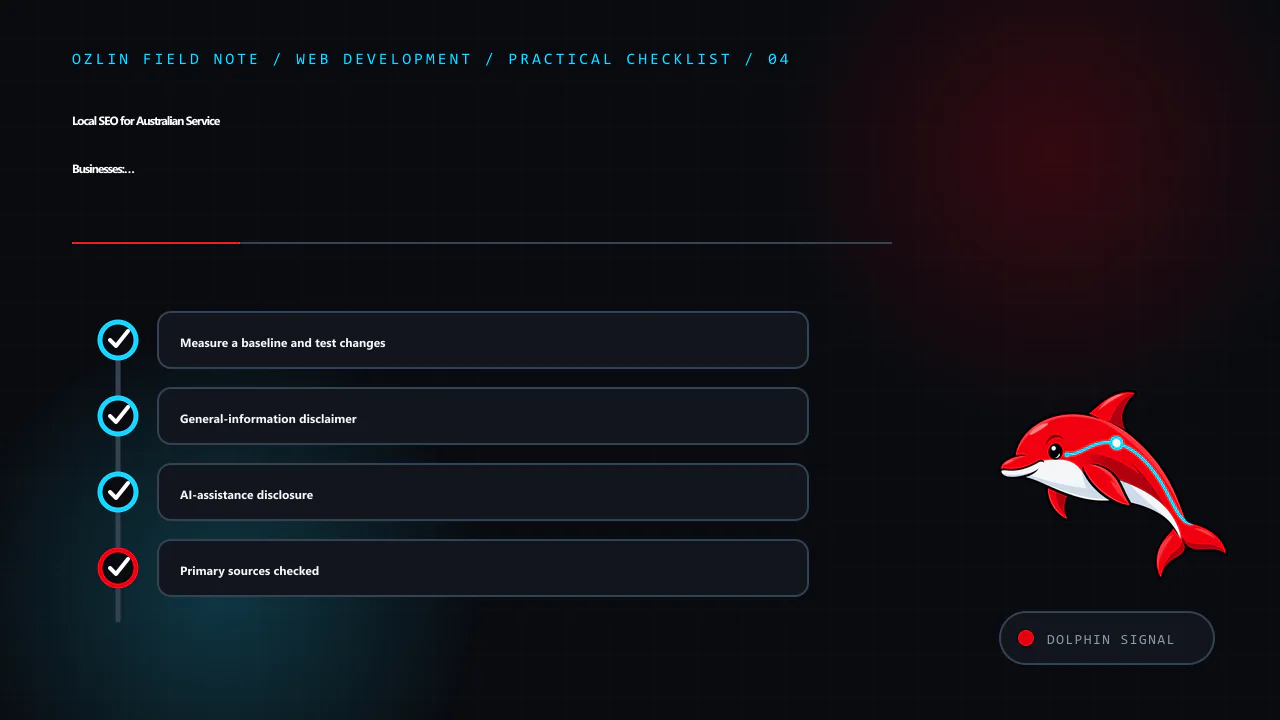
Primary sources checked
- Google Business Profile Help — Policy overview and eligibility
- Google Business Profile Help — Guidelines for representing a business
- Google Business Profile Help — Service areas
- Google Business Profile Help — Local ranking
- Google Search Central — Helpful, reliable, people-first content
- web.dev — Web Vitals
- Google Search Central — FAQ and HowTo rich-result changes
- Google Search Central — Search Console and Analytics measurement
Source access date: 29 August 2026.